


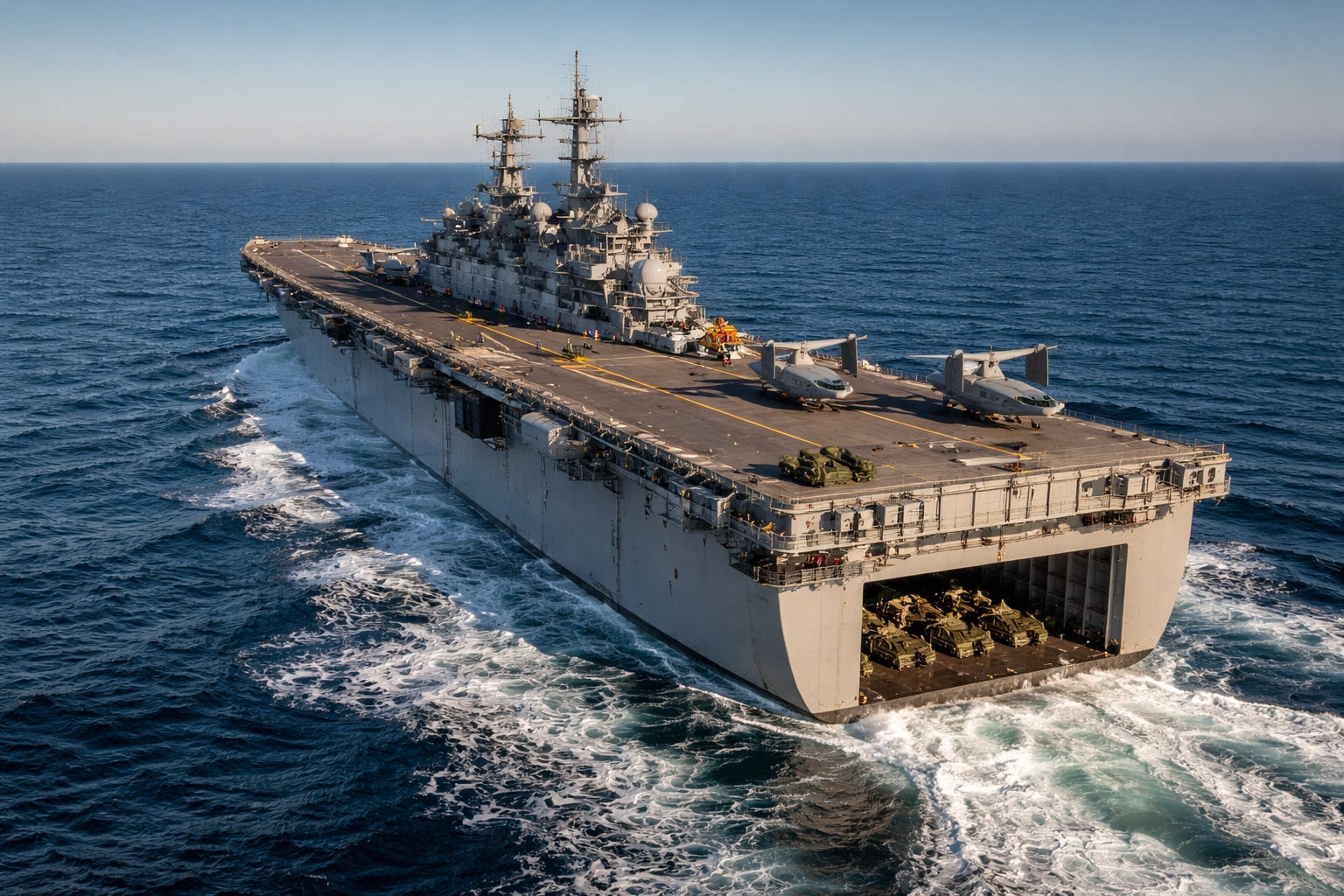
The Pentagon just doubled its ground forces heading to the Persian Gulf.
The USS Boxer amphibious ready group departed San Diego carrying 2,500 Marines of the 11th Marine Expeditionary Unit.
A second group, the USS Tripoli with the 31st MEU, is already transiting the Indian Ocean from Japan.
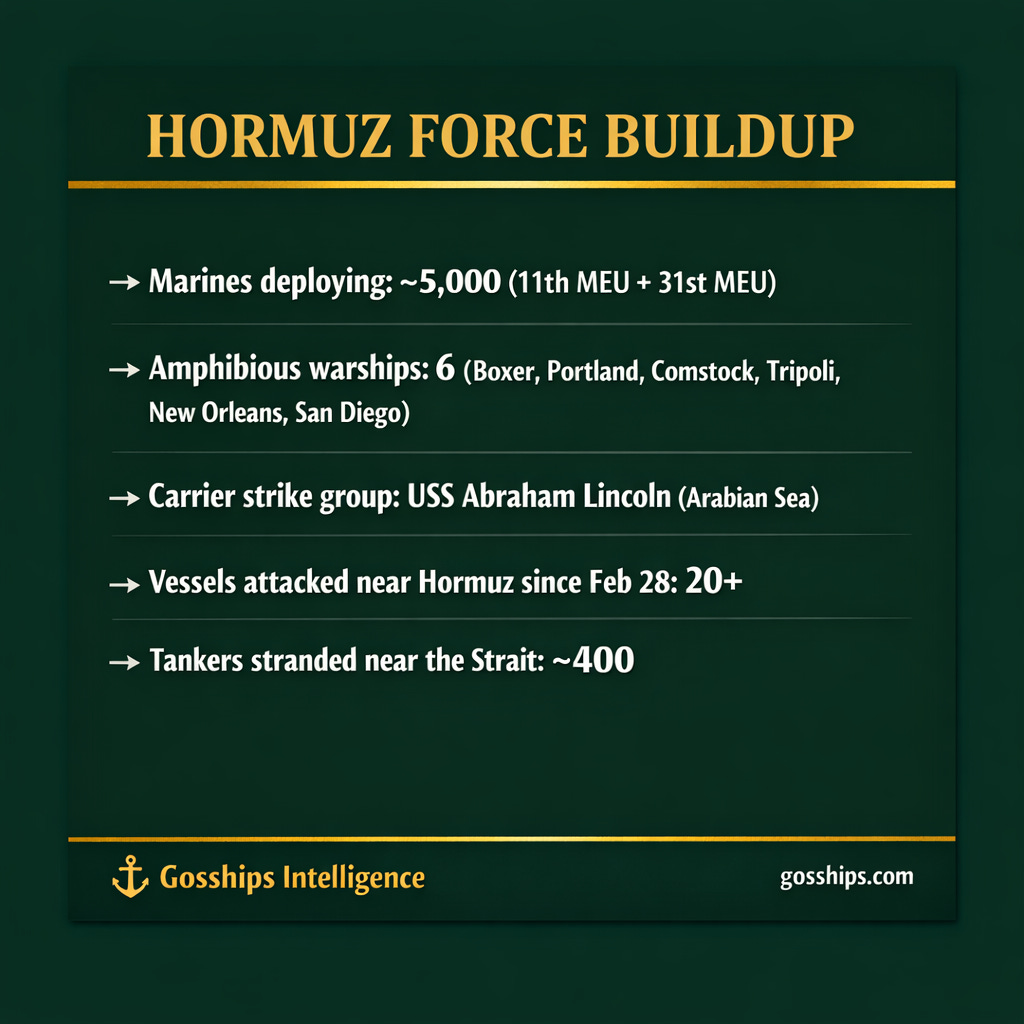
That’s 5,000 Marines, six amphibious warships, and a carrier strike group converging on the Gulf.
Experts say reopening Hormuz may require seizing Iranian coastline. The administration is reportedly weighing a takeover of Kharg Island, Iran’s primary oil export terminal.
And the tanker captains waiting outside the Strait? They haven’t heard a word from the military about when, how, or whether they’ll be escorted through.
📋 In this issue:
🛢️ The Story
📊 By the Numbers
🔍 Why It Matters
👀 What to Watch
⚓ Gosships Signal
📊 GOSSHIPS DATA CARD
🛢️ The Story
The USS Boxer (LHD-4) and two accompanying warships, the USS Portland (LPD-27) and USS Comstock (LSD-45), departed San Diego this week carrying roughly 2,500 Marines of the 11th Marine Expeditionary Unit. The 11th MEU is a Camp Pendleton-based air-and-ground attack force that specializes in rapid response and amphibious assault. The Boxer carries F-35B stealth fighter jets, V-22 Osprey tiltrotors, helicopters, and hovercraft in its well deck.
This is the second major amphibious deployment in a week. The Japan-based USS Tripoli (LHA-7), USS New Orleans (LPD-18), and elements of the 31st Marine Expeditionary Unit were ordered to the Middle East last week and transited the Strait of Malacca earlier this week, according to USNI News. USS San Diego (LPD-22) was also operating with the group before splitting off.
Combined, the two deployments put approximately 5,000 Marines and thousands of additional sailors on a trajectory toward the Persian Gulf, joining a U.S. force posture that already exceeds 50,000 troops in the theater, according to Army Recognition. The USS Abraham Lincoln carrier strike group is operating in the Arabian Sea.
Two additional signals emerged today. The U.S. Naval Institute reported that two San Diego-based littoral combat ships, the USS Tulsa and USS Santa Barbara, have docked in Singapore, potentially headed for the Middle East for mine countermeasure duty in the Strait of Hormuz. And Axios reported that the Trump administration is actively considering a blockade or seizure of Kharg Island, Iran’s main oil export terminal through which roughly 90% of Iranian crude exports flow. A U.S. Navy MQ-4C Triton surveillance drone was tracked completing a reconnaissance orbit over Kharg Island today, according to OSINT analysts.
📊 By the Numbers
→ Marines deploying to the Gulf: ~5,000 across two MEUs → Amphibious warships en route: 6 → U.S. forces already in theater: 50,000+ → Vessels attacked near Hormuz since Feb 28: 20+ → Tankers stranded near the Strait: ~400 → Brent crude (March 20): ~$108.84/bbl → National gas average (March 20): $3.92/gal, up $1/gal from Feb 20
🔍 Why It Matters
For tanker owners and charterers with vessels stranded near Hormuz, the Marine deployment answers one question and raises a bigger one.
