


⚓About | 🛢️Deep Water Reports | 📋SwiftAction Training |🏅Gold Anchor Membership (*53 Slots Left)
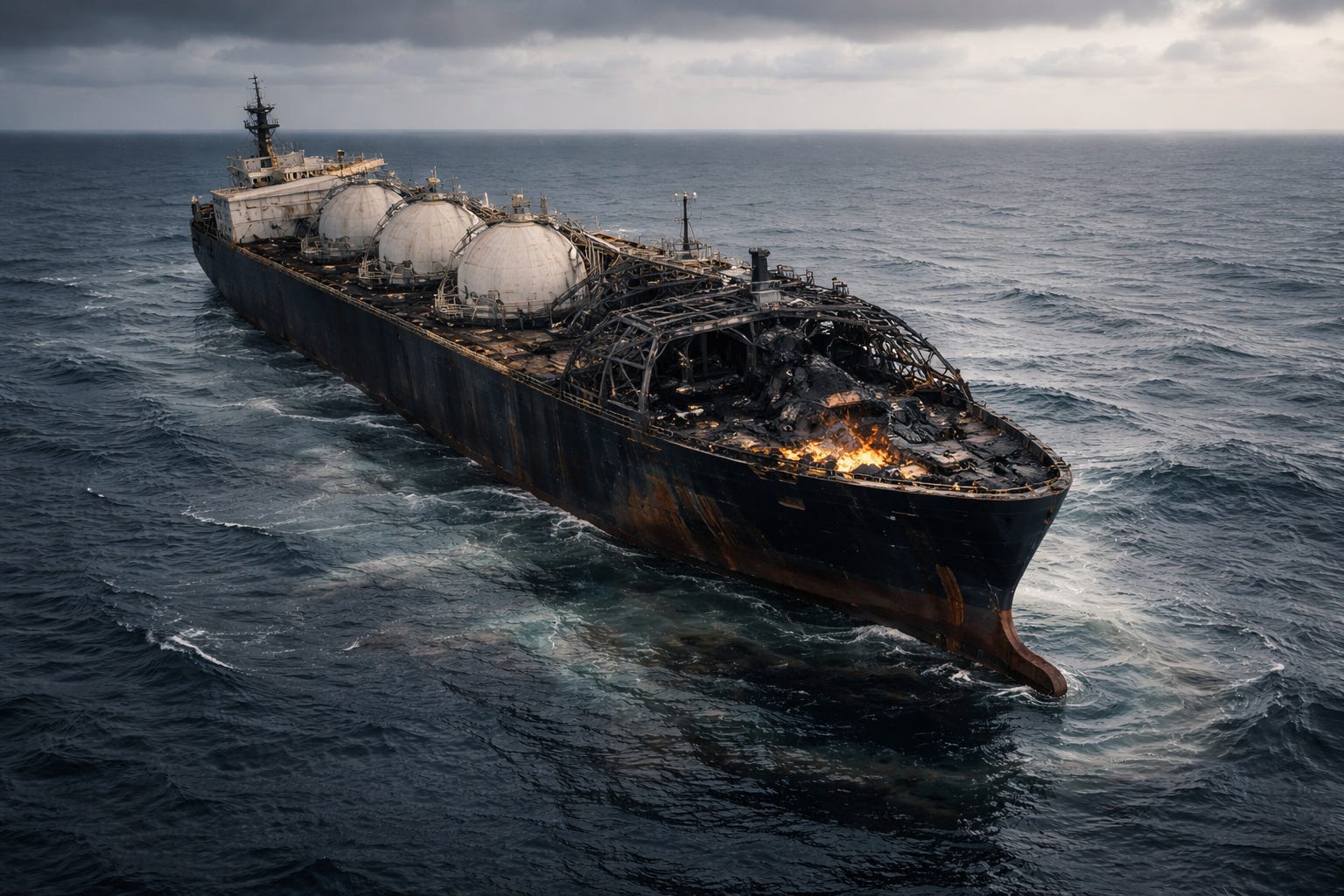
A sanctioned Russian LNG carrier is drifting uncontrolled through the central Mediterranean Sea.
It has no crew. No power. No steering. No AIS signal.
It is carrying up to 62,000 metric tons of liquefied natural gas and 700 tons of fuel oil.
Italy’s deputy prime minister called it “an environmental time bomb that risks causing serious damage throughout the surrounding area of the Mediterranean Sea.”
Italian PM Giorgia Meloni convened an emergency cabinet session. Nine EU member states wrote to the European Commission warning of “an imminent and serious risk of a major ecological disaster in the heart of the Union’s maritime space.”
And as of Friday, March 21, the Arctic Metagaz is approximately 53 nautical miles north of Tripoli, drifting toward Libya’s coast. Italian officials estimate it could reach Libyan shores within four to six days.
Nobody has boarded it. Nobody has claimed it. Nobody has a plan.
📋 In this issue:
🛢️ The Story
📊 By the Numbers
🔍 Why It Matters
👀 What to Watch
⚓ Gosships Signal
📊 GOSSHIPS DATA CARD
🛢️ The Story
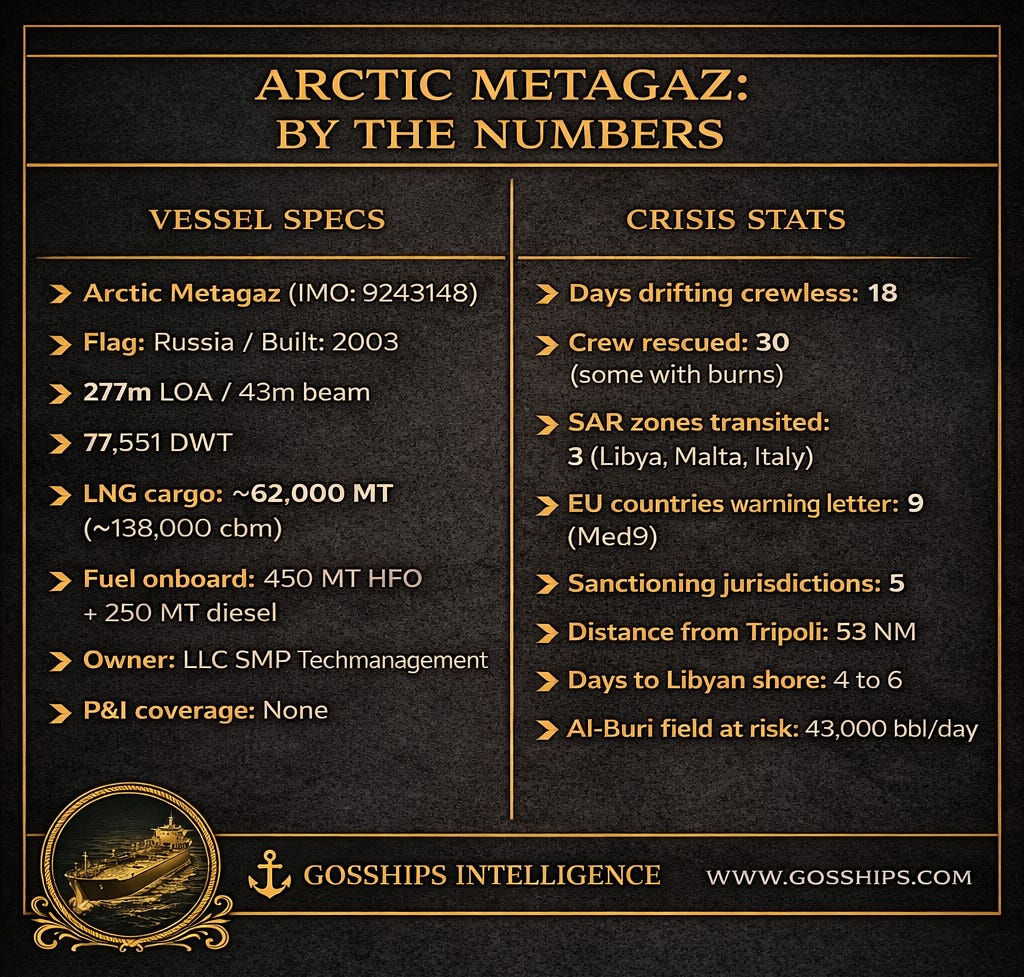
The Arctic Metagaz (IMO: 9243148) is a 277-meter, Russian-flagged LNG carrier built in 2003. She has a deadweight tonnage of 77,551 and a cargo capacity of approximately 138,000 cubic meters of liquefied natural gas. The vessel is registered to LLC SMP Techmanagement, a Russian company linked to Novatek, the state-connected gas giant behind the Arctic LNG-2 project. Her commercial manager is listed as Ocean Speedstar Solutions, an Indian-registered company. According to SynMax Maritime Intelligence, the vessel has operated under six different names since 2003, cycling through Norwegian, Singaporean, Liberian, Palauan, and Russian flags as sanctions pressure intensified. She has been under the Russian flag since April 2025.
The vessel is sanctioned by the United States (since August 2024), the European Union (since February 2025), the United Kingdom, Canada, and New Zealand. The U.S. Treasury’s Office of Foreign Assets Control designated her as one of seven vessels linked to the Arctic LNG-2 project that were conducting illegal ship-to-ship transfers. She operates without Protection and Indemnity Club coverage, according to SynMax. During previous voyages, she used AIS spoofing to transmit false position data in violation of international maritime regulations, according to The Insider and Ukrainian intelligence assessments.
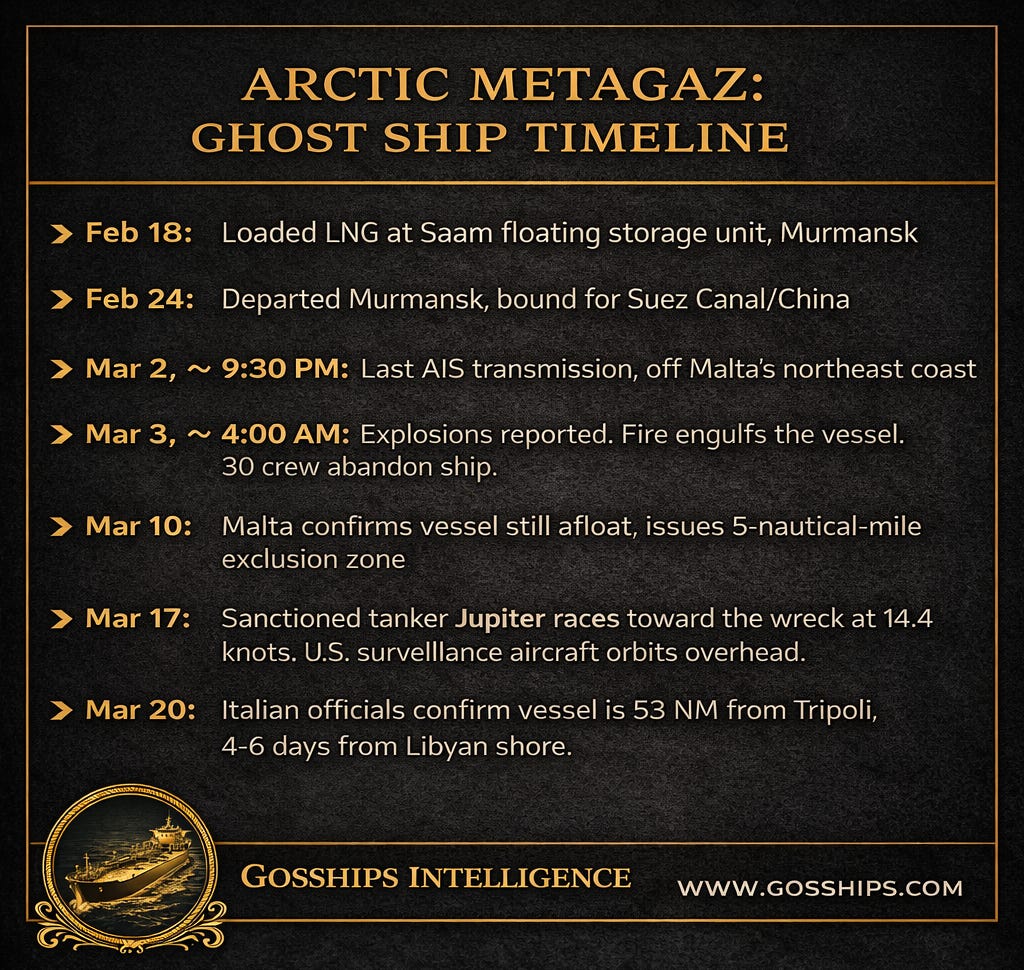
On February 18, the Arctic Metagaz loaded LNG at the Saam floating storage unit in Ura Guba Bay, near Murmansk. The Saam FSU is a sanctioned floating terminal operated by Novatek’s subsidiary Arctic Transshipment LLC. The vessel departed Murmansk on February 24, routed around the United Kingdom and Spain, and entered the Mediterranean. Her declared destination was Port Said, Egypt, almost certainly transiting Suez en route to buyers at the Beihai terminal in China. She was likely carrying approximately 62,000 metric tons of LNG.
On the evening of March 2, the Arctic Metagaz stopped transmitting AIS data approximately 30 nautical miles off Malta’s northeastern coast, according to Starboard Maritime Intelligence. At roughly 4:00 AM local time on March 3, a series of explosions tore through the vessel’s hull, followed by a massive fire that engulfed the forward section.
Thirty crew members, all Russian nationals, abandoned ship. Some sustained burn injuries. They boarded a lifeboat with no satellite communications, only rocket pyrotechnics and a short-range VHF radio. Captain Andrei Zelensky told reporters that the crew drifted for 15 hours before being picked up by a tanker with a Russian crew, coordinated by Russian, Maltese, and Libyan services. The crew was taken to Benghazi by the Libyan Coast Guard, and the two most seriously injured were airlifted to Moscow.
Russia’s Transport Ministry accused Ukraine of launching unmanned naval drones from the Libyan coast. President Vladimir Putin called it “a terrorist attack” on state television. Foreign Ministry spokeswoman Maria Zakharova called it “a flagrant violation of international law.” Russia’s presidential advisor Nikolai Patrushev, chairman of the Russian Maritime Council, described the incident as “international terrorism and maritime piracy.” Ukraine has neither confirmed nor denied involvement. However, the attack is consistent with an escalating Ukrainian campaign against shadow fleet vessels. In December 2025, Ukrainian forces struck the crude oil tanker Qendil in the Mediterranean between Crete and Malta, the first confirmed Ukrainian attack on a vessel that far south of the combat zone.
Libya’s port authority initially reported that the vessel had sunk. That report was wrong. On March 10, Malta’s Ports and Yachting Directorate confirmed the vessel was still afloat, drifting at approximately 35 degrees 24 minutes North, 14 degrees 27 minutes East, roughly 37 nautical miles south of Malta. Transport Malta issued a notice to all mariners: maintain a minimum distance of five nautical miles. Navigation near the vessel was strictly prohibited.
What followed was an 18-day drift across three nations’ search and rescue zones. The Arctic Metagaz wandered from Libya’s SAR zone into Malta’s zone, approached within 20 nautical miles of the Sicilian island of Linosa, then drifted south again through Malta’s zone and back into Libyan waters. Surveillance footage from Italian military aircraft showed the blackened vessel listing approximately 30 degrees to starboard, with collapsed decks, destroyed piping, gutted command quarters, massive gashes on both the port and starboard sides, and a filmy substance in the surrounding water. One of the vessel’s LNG tanks (Tank No. 2) was confirmed destroyed. Two other tanks were believed to remain structurally intact. Explosions were observed as late as March 13.
On March 15, severe weather hit. Cyclone Jolina swept the area with 4-meter waves and wind gusts exceeding 55 knots. Experts warned that the already weakened hull could snap under the stress, and boarding or towing operations became physically impossible.
On March 17, the crisis escalated further. VesselFinder data showed the sanctioned Russian tanker Jupiter (IMO: 9397535), a Sovcomflot-linked vessel, suddenly break from a slow patrol pattern southwest of Malta and race toward the Arctic Metagaz at 14.4 knots on a course of 197 degrees. A U.S. intelligence-linked Super King Air surveillance aircraft (registration N241VW) was tracked orbiting at 3,500 feet over the Jupiter’s projected intercept point, according to FlightRadar24 data. The Jupiter has been maneuvering along the drift route of the Arctic Metagaz for a week. Reports suggest the Jupiter could theoretically be used to pump remaining fuel from the wreck during a rescue operation.
As of Friday, March 20, the Arctic Metagaz has entered Libya’s search and rescue zone. Italy’s Civil Protection Agency confirmed it is approximately 53 nautical miles north of Tripoli. Italian spokesman Demilito told Reuters that based on prevailing southbound winds and currents, the vessel could reach Libyan shores in four to six days. The vessel is estimated to still carry 450 metric tons of heavy fuel oil and 250 tons of diesel, plus an uncertain quantity of LNG that may have partially regasified and dispersed. It has a large gash on its side but does not appear to be at imminent risk of sinking. The primary concerns are that it could run aground on the Libyan coast or collide with offshore oil platforms.
The Al-Buri oil field, Libya’s largest offshore production complex, is directly in the drift path. Al-Buri produces approximately 43,000 barrels of oil per day and significant volumes of natural gas. The field is operated by Libyan companies in partnership with French energy giant TotalEnergies. As of March 20, the Arctic Metagaz was estimated to be 35 to 40 miles from Al-Buri’s platforms. Six supply vessels and two tugboats were operating in the area.
Nobody has boarded the vessel. Malta engaged an international salvage company to prepare a contingency plan, and Transport Malta placed tugboats on standby. Italy dispatched chemical response vessels and containment teams to standby positions. The EUNavfor Med IRINI mission conducted an overflight. Libya’s Ministry of Environment convened an emergency meeting in Tripoli. The Libyan Ports and Maritime Transport Authority raised its maritime alert level and ordered all vessels in the area to report any changes in the vessel’s condition, including smoke, leaks, or structural deterioration.
But as Maltese Prime Minister Robert Abela acknowledged publicly, attempts to find a solution with Russia and the vessel’s owner have not yielded results. Russia’s position, expressed by Zakharova, is that international law places the responsibility on coastal states to resolve the situation. Malta’s position is that the vessel is in international waters outside any country’s territorial jurisdiction, and since the crew has been rescued, search-and-rescue obligations no longer apply. Italy says it will help if asked. Libya has raised its alert level but lacks the salvage capability. The EU faces a sanctions dilemma: any technical assistance to the vessel, including towing it to port, could undermine the integrity of the sanctions regime against Russia.
📊 By the Numbers
📰 Related Coverage:
Shadow Fleet Under Fire: Arctic Metagaz Blaze Signals New Phase in Maritime Sanctions Warfare (March 3, 2026)
Russian LNG Tanker Arctic Metagaz Sinks in Mediterranean After Explosions (March 7, 2026)
Maritime Sanctions 2026: Shadow Fleet Surge (March 7, 2026)
Found this useful? Share Gosships Intelligence with a colleague.
What the sanctions dilemma means for your compliance framework, what a BLEVE explosion would actually look like, and why this ghost ship rewrites the risk model for every P&I club in the market is below.
🔍 Why It Matters
The Arctic Metagaz is the most dangerous single vessel incident in Mediterranean history since the Haven disaster of 1991, and it may end up being worse.
