


⚓ The Gosships Team
Gosships Intelligence Is Published At Gosships.com
For Sponsorship And Partnership Inquiries Contact intelligence@gosships.com
|⚓ About Us | 🛢️ Exclusive Report | 📋 SwiftAction Training |
🏅Black Gold Membership (*53 Slots Left)
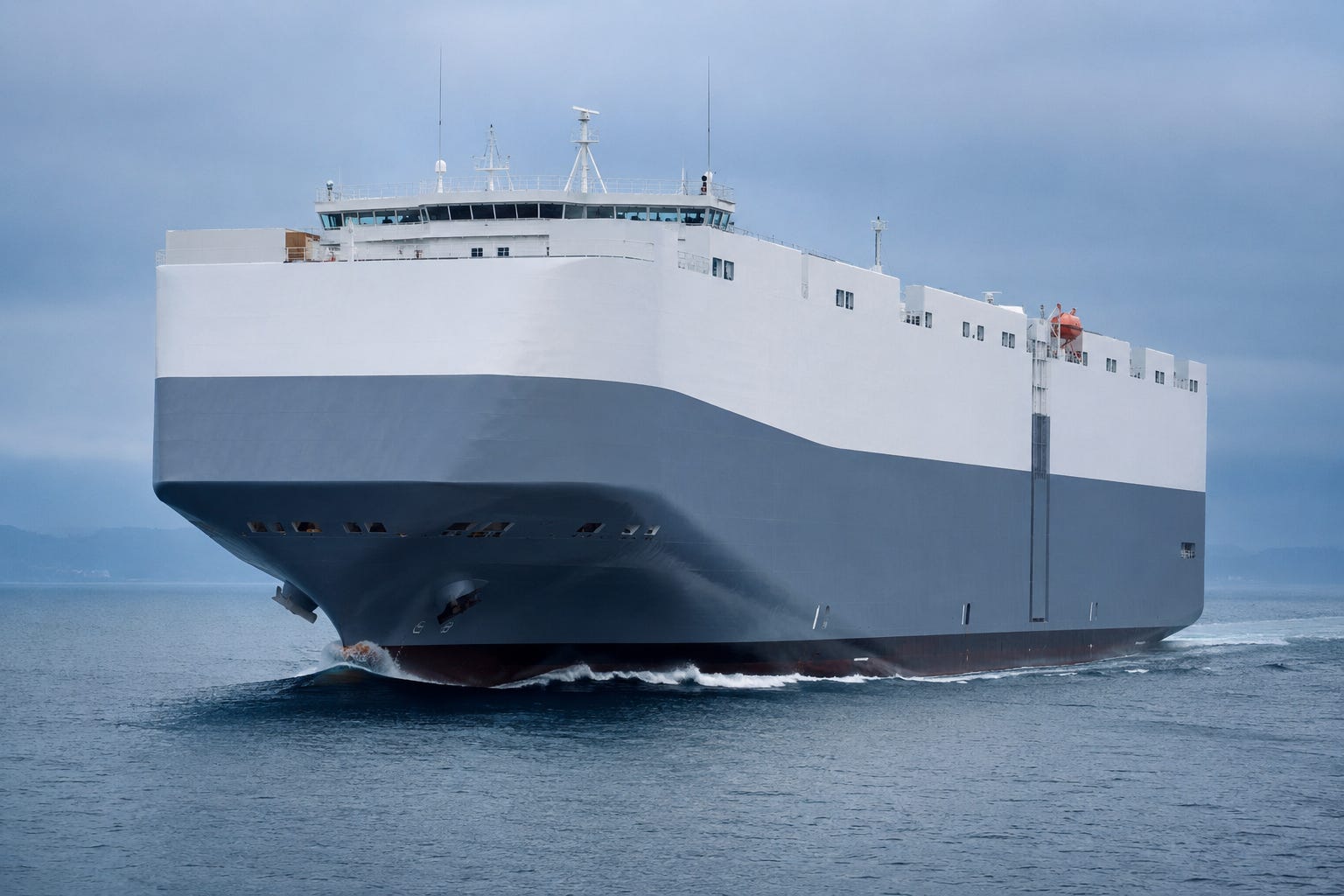
For decades, the idea of a merchant ship powered by a nuclear reactor lived in the realm of the thought experiment, technically possible, politically impossible, and commercially nowhere. This week in Athens, it took a concrete step toward reality.
On June 2, at the Posidonia exhibition in Athens, Lloyd’s Register granted an Approval in Principle for a nuclear-powered pure car and truck carrier, the tall, boxy vessels that move finished vehicles across oceans. The ceremony was one of several the society staged at the show, but it was the one that broke new ground. The design was developed with a consortium of Korean partners, and it studies how a molten salt reactor, a type of advanced small modular reactor, could be built into a working merchant ship. An Approval in Principle does not authorize anyone to start cutting steel. It is a classification society’s judgment that a concept is technically credible enough to be taken seriously. For nuclear propulsion, that judgment is the news.
Why this matters to an oil-shipping publication is straightforward. The same owners ordering crude and product tankers for delivery in 2028 and beyond are wrestling with the hardest question in shipping: what will power their ships across a thirty-year life, as the industry is pushed to decarbonize. Nuclear has long been the answer almost no one would say out loud. At Posidonia this week, a lot of serious people started saying it.
📋 In this issue:
🛢️ The Story
📊 By The Numbers
🔍 Why It Matters
👀 What to Watch
🚨 Gosships Signal
📊 Order Our Exclusive Report
→ Global Tanker Market Outlook
Q3 2026 Edition
📋 Competency-Based Maritime Training
→ SwiftAction
📌 Gosships Data Card
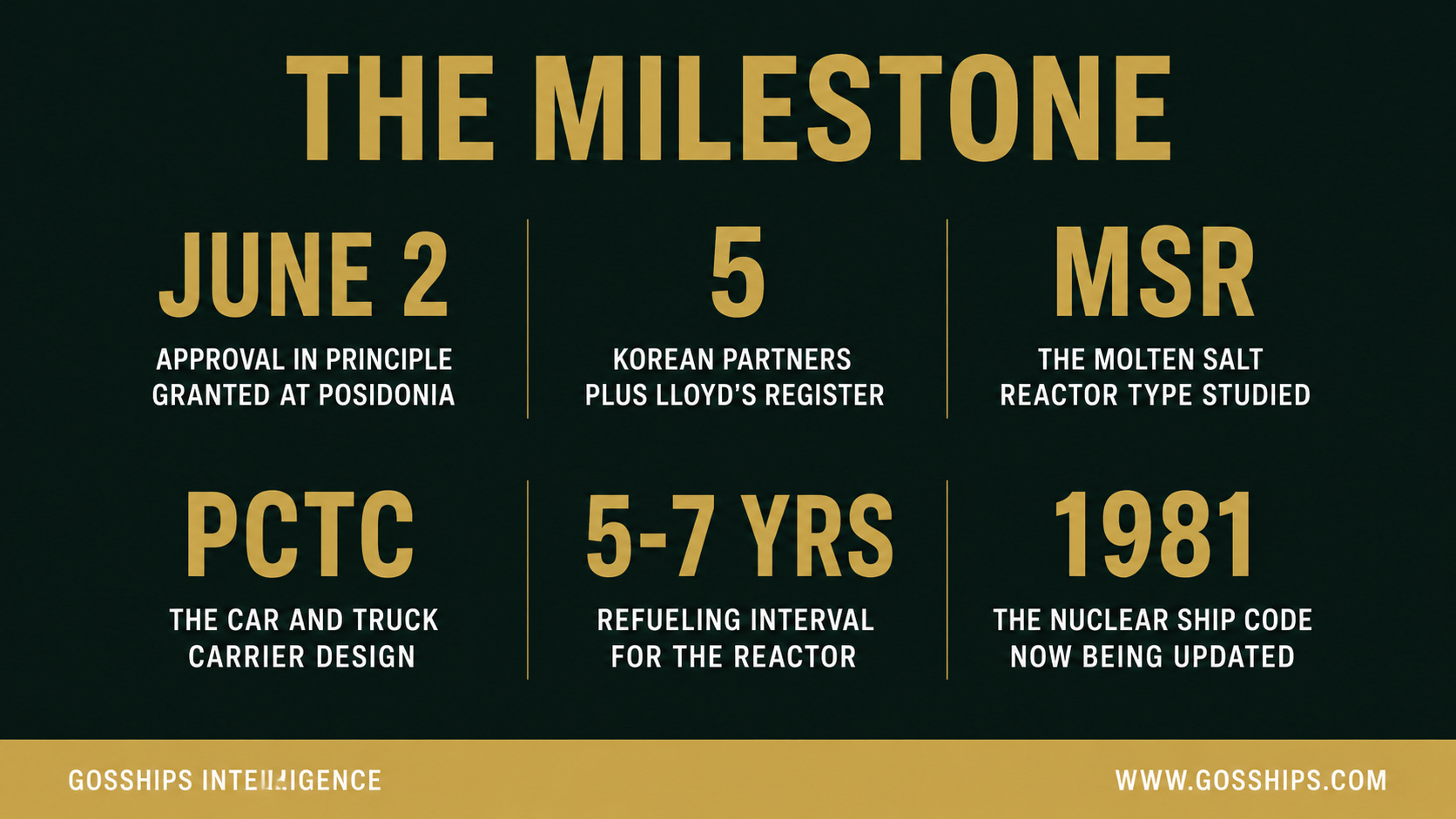
→ The Milestone: Lloyd’s Register Granted Approval in Principle for a Nuclear-Powered Car Carrier at Posidonia on June 2 Per Lloyd’s Register
→ The Partners: The Project Joins Hyundai Heavy Industries, KSOE, Hyundai Glovis, G-Marine Service and KAERI With Lloyd’s Register Per Lloyd’s Register
→ The Reactor: The Study Examined a Molten Salt Reactor Based Small Modular Reactor Per Ship and Bunker
→ The Vessel: The Design Is a Pure Car and Truck Carrier, or PCTC Per Lloyd’s Register
→ The Refueling: Advanced Nuclear Designs Offer Refueling Intervals of About 5 to 7 Years Per Posidonia Seminar Materials
→ The Roundtable: A Closed-Door Nuclear Roundtable Was Held in Athens on June 1 With the IAEA Attending Per Lloyd’s Register
🛢️ The Story
This is a story about an idea crossing the line from impossible to merely difficult.
The approval. The centerpiece was the Approval in Principle granted by Lloyd’s Register on June 2 at its Posidonia stand. The project is a joint development with five Korean partners: Hyundai Heavy Industries, Korea Shipbuilding and Offshore Engineering, the logistics group Hyundai Glovis, the technical firm G-Marine Service, and the Korea Atomic Energy Research Institute. Together they studied how a molten salt reactor, a fourth-generation design that uses fuel dissolved in molten salt rather than solid rods, could be integrated into a pure car and truck carrier. The presence of Hyundai Glovis matters here: it operates one of the world’s largest fleets of these vehicle carriers, so the study was shaped by an operator that actually runs the ship type, not only by designers and a reactor lab. The engineering work was not superficial. According to Lloyd’s Register, it examined the internal arrangement and segregation of the reactor, the shielding required to protect crew and cargo, the effect of the reactor’s weight on the vessel’s stability and trim, the layout of the car decks and how many vehicles would still fit, and the configuration of the propulsion system. Lloyd’s Register led the hazard identification and a preliminary risk assessment focused on containment and onboard safety.
What an AiP is, and is not. It is important to be precise about what happened, because the temptation is to overstate it. An Approval in Principle is not a construction permit, not an order, and not a promise that the ship will ever be built. It is a classification society confirming that a design concept does not contain an obvious technical showstopper and is sound enough to develop further. Many concepts that receive an AiP never reach the water, and to be clear, no public order for a nuclear-powered merchant ship has been placed anywhere in the world. What makes this one notable is the subject: a nuclear reactor on a commercial cargo ship, assessed and judged credible by one of the world’s leading classification societies. The Lloyd’s Register executive who leads its North East Asia region framed it carefully, noting that nuclear propulsion remains at an early stage but that establishing feasibility at the concept stage is a valuable step forward, particularly on questions like cargo optimization, vessel stability and integrated safety design. That measured language, neither dismissive nor breathless, is itself a marker of how far the conversation has moved.
The roundtable. The approval did not happen in isolation. The day before, on June 1, Lloyd’s Register convened a closed-door Nuclear Roundtable at the Athens Olympic Museum, gathering around 20 senior representatives from shipowners, regulators, reactor developers and industry bodies. The session was opened by a senior Lloyd’s Register strategy executive and featured an address from a deputy director general of the International Atomic Energy Agency, with a video welcome from the agency’s director general. The presence of the IAEA, the world’s nuclear watchdog, at a commercial shipping roundtable is itself a signal of how the subject is being treated. Lloyd’s Register noted that the roundtable drew mounting interest from governments, including the Government of Greece, and from operators searching for scalable, zero-emission propulsion. The blunt conclusion from the room, as reported, was that the technology is now advancing faster than the regulatory and legal framework around it, and that the rules will have to be built in parallel with the reactors rather than waiting for them to mature.
The case for. Advocates make an energetic argument. A nuclear reactor produces zero carbon dioxide while it operates, which in a decarbonizing industry is the headline attraction. Advanced designs promise refueling intervals measured in years, between five and seven by some estimates, rather than the constant bunkering a conventional ship requires. A reactor eliminates the fuel tanks and much of the engine room, freeing space and removing exposure to volatile fuel prices. One Greek owner at the wider Posidonia discussion, the deputy chairman of Contships Management, went as far as to call nuclear the only true green solution, dismissing many of the alternative fuels currently being promoted as impractical at the scale global shipping requires.
The case against. The skeptics are not arguing about the physics. They are arguing about everything around it. As the Group Head of Market Development at CORE POWER, the nuclear developer that hosted a separate Posidonia briefing, framed it, the decisive challenges are regulatory alignment, liability frameworks, port acceptance and insurance structures. The sharpest version of the problem came from a Bureau Veritas technical director and chair of the Greek section of the naval architects’ society, who described the sector as pre-commercial but no longer hypothetical, and warned that a vessel may be technically sound but commercially dead if it cannot enter major ports. That single line captures the whole challenge: a ship that no port will accept, no insurer will cover, and no liability regime will underwrite is a ship that cannot trade, however elegant its reactor.
The precedents. None of this is unprecedented, which is part of why it is being taken seriously now. Nuclear-powered ships are not new. The American-built NS Savannah and the Soviet icebreaker Lenin both demonstrated nuclear propulsion at sea as far back as the late 1950s. What has changed is the technology and the pressure. Advanced small modular reactors and molten salt designs are smaller, and the designs are being paired with a decarbonization mandate that did not exist in the Savannah’s day. In 2025, the sector logged an Approval in Principle for a nuclear-powered LNG carrier concept and the formation of a dedicated Nuclear Energy Maritime Organization, and the International Maritime Organization began a formal process to modernize its 1981 code of safety for nuclear merchant ships. The June car carrier approval sits on top of that building momentum.
For shipowners staring at thirty-year investment decisions in a decarbonizing world, the question is no longer whether nuclear is technically conceivable. It is whether the rules will arrive in time to matter. The full read is below.
📊 By The Numbers
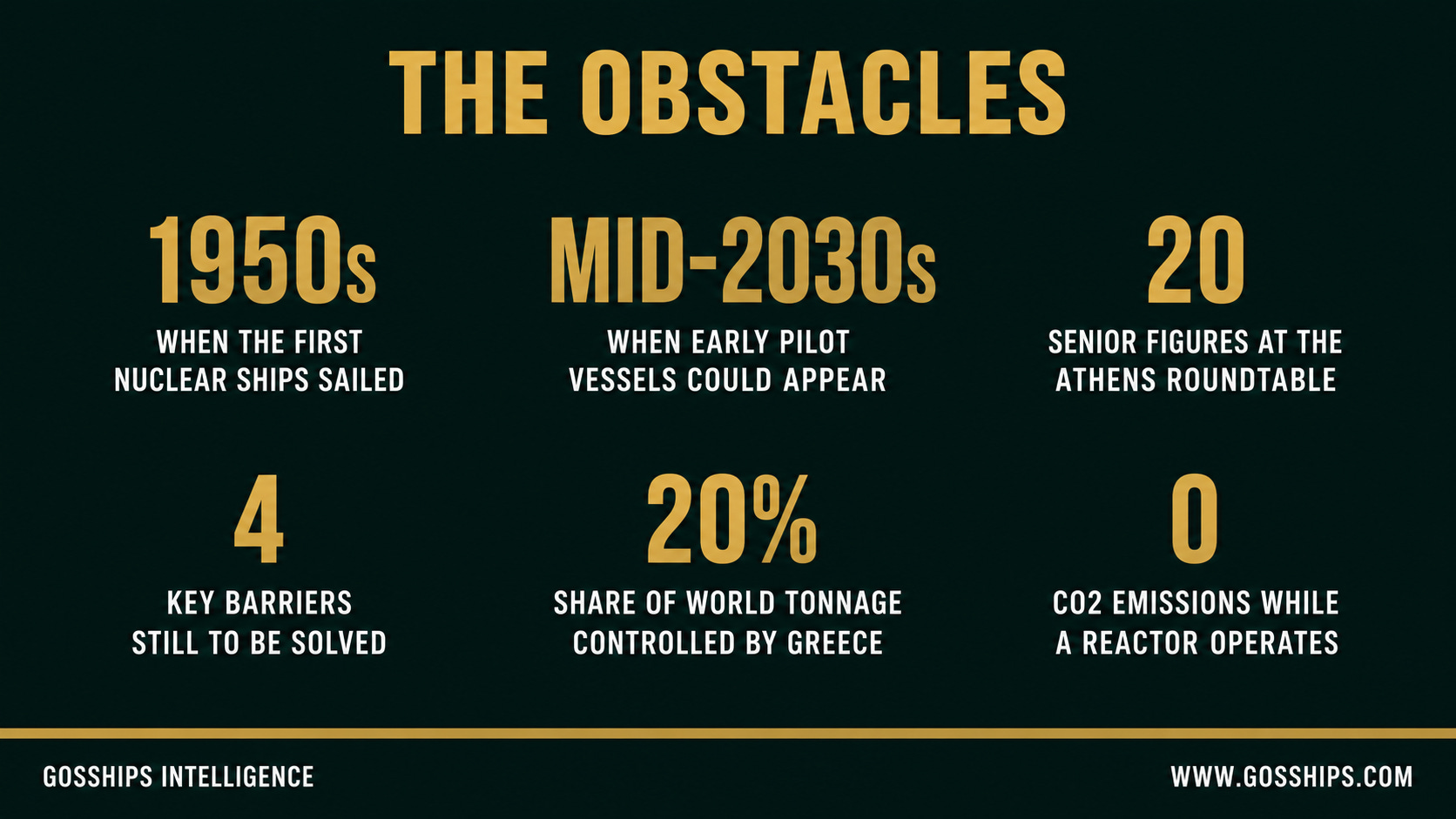
→ The History: The First Nuclear Merchant Ship and Icebreaker Sailed in the Late 1950s Per Posidonia Seminar Materials
→ The Timeline: Early Pilot Vessels Could Appear in the Mid-2030s Per John Kokarakis of Bureau Veritas
→ The Roundtable Size: About 20 Senior Representatives Attended the Athens Session Per Lloyd’s Register
→ The Barriers: Regulation, Liability, Port Acceptance and Insurance Remain the Decisive Challenges Per Charlotte Vere of CORE POWER
→ The Greek Weight: Greece Controls Roughly 20% of Global Merchant Tonnage Per Ship Management International
→ The Appeal: Nuclear Propulsion Produces Zero CO2 Emissions While Operating Per Posidonia Seminar Materials
Found this useful? Share Gosships Intelligence with a colleague.
Why an Approval in Principle is a bigger deal than it sounds, and a smaller one than the headlines suggest. What the IAEA showing up actually signals. The single barrier that could keep these ships tied to the dock for a decade. Below.
🔍 Why It Matters
Strip away the novelty and the significance is simple: the barrier to nuclear shipping is no longer mainly technical, which means the fight has moved to ground where it can actually be won or lost.
