


⚓ The Gosships Team
Gosships Intelligence Is Published At Gosships.com
For Sponsorship And Partnership Inquiries Contact intelligence@gosships.com
|⚓ About Us | 🛢️ Exclusive Report | 📋 SwiftAction Training |
🏅Black Gold Membership (*53 Slots Left)
Most shipowners use the Posidonia stage to talk their book in careful, uncontroversial terms. Evangelos Marinakis used it to call for Europe to blockade every barrel of Russian oil bound for the rest of the world.
Speaking in a fireside session at the TradeWinds Shipowners Forum, which opened the main conference week at Posidonia, the founder and chairman of Capital Maritime and Trading Corp took on the two forces bending the tanker market right now, sanctions and the closed Strait of Hormuz, and he did it without the usual hedging. His argument on Russia was that half-measures are worse than none. His argument on Hormuz was that a toll, however unwelcome, would have been better than a shutdown. Both positions are debatable, and both put a major owner clearly on the record at the industry’s biggest event.
This is a market intelligence story rather than an endorsement. Marinakis speaks from a particular vantage point, as the head of one of Greece’s largest shipping groups, and his views are not universally shared in the industry. But when an owner of his scale says these things from that stage, the positions themselves are worth laying out plainly.
📋 In this issue:
🛢️ The Story
📊 By The Numbers
🔍 Why It Matters
👀 What to Watch
🚨 Gosships Signal
🔔 Not yet subscribed? Gosships Intelligence Delivers Oil Shipping Intelligence. Subscribe For Free!
📊 Order Our Exclusive Report
→ Global Tanker Market Outlook
Q3 2026 Edition
📋 Competency-Based Maritime Training
→ SwiftAction
📌 Gosships Data Card
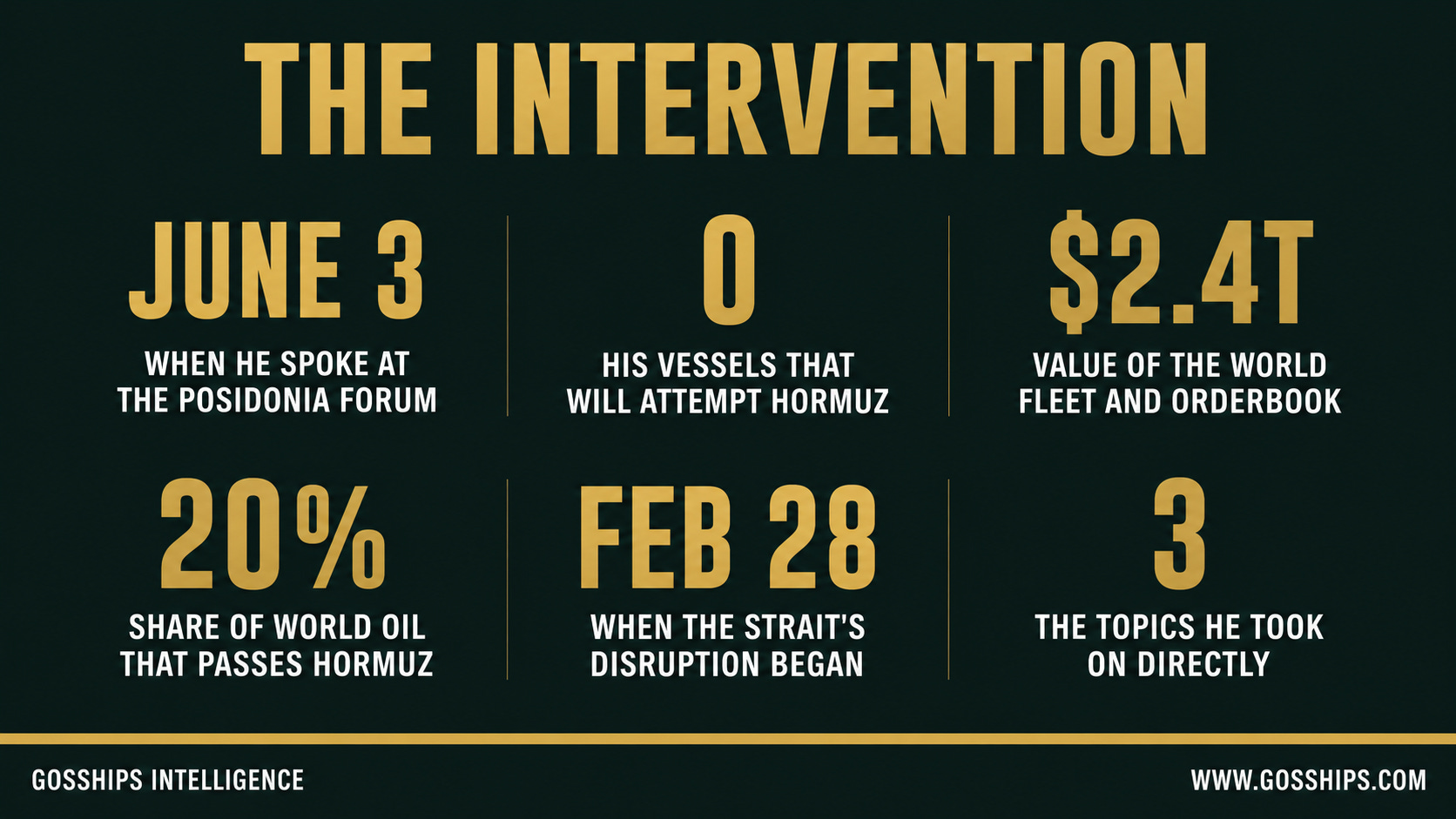
→ The Speaker: Evangelos Marinakis, Founder and Chairman of Capital Maritime and Trading Corp, Spoke at the TradeWinds Shipowners Forum Per Cyprus Mail
→ The Sanctions Line: He Argued Partial Sanctions on Russian Oil Are Counterproductive and Should Be Total Per Maritime Gateway
→ The Hormuz Line: He Said None of His Vessels Would Attempt Crossing the Strait, Citing Crew Safety Per Cyprus Shipping News
→ The Toll: He Said Paying a Passage Fee Would Be Far Better Than Having the Strait Closed Per Cyprus Mail
→ The Fleet Backdrop: Clarksons Put the World Fleet and Orderbook at a Combined $2.4 Trillion Per Maritime Gateway
→ The Recycling Point: He Argued Sanctioned Tankers Should Be Pushed Toward Recycling Yards Per Splash247
🛢️ The Story
This is a story about a major owner saying out loud what many in the industry only discuss privately.
The setting. The TradeWinds Shipowners Forum opened the main conference week of Posidonia 2026 under the theme “Resilience in the Face of Disruption.” The show itself is the largest in its history, with 2,227 exhibitors from 83 countries, and the mood, as keynote speaker Steve Gordon of Clarksons Research framed it, was of an industry of extraordinary scale, with a world fleet and orderbook worth a combined $2.4 trillion, operating under deepening geopolitical stress. Into that setting, in a fireside exchange, Marinakis offered some of the bluntest positions of the week. The conversation, conducted one-on-one with TradeWinds editor-in-chief Julian Bray, ranged across the day-after in the markets, the dark fleet and the strength of Greek shipping, but it was his interventions on sanctions and the strait that cut through.
On Russia. His central claim was that partial sanctions on Russian oil are not just ineffective but actively harmful to the countries imposing them. “Indians and Chinese are buying drastically discounted Russian oil and we Europeans are paying sky-high prices,” he said. In his view, sanctions only work if they are total, and the logical conclusion is a comprehensive blockade. “They should blockade any shipment from Russia to the rest of the world, because if sanctions apply only partially, that’s bad for Europe and the rest of the world that does not trade Russian oil,” he said. It is a maximalist position, and an unusual one to state so directly, because the policy it implies, a total interdiction of Russian seaborne oil, goes far beyond what the European Union, the United States or any coalition has been willing to attempt.
On Hormuz. Marinakis was equally direct about the closed strait, and here his position split in two. On the practical question of his own fleet, he was unequivocal that safety comes first: none of his vessels would attempt the crossing, with crew safety the overriding concern. But on the policy question of how the disruption was handled, he argued the shutdown was the worst available outcome. “Even if we had to pay a passage fee, it would be far better than having the Strait closed,” he said. A structured payment to keep the corridor open, in his telling, would have been preferable to the costs the industry has already absorbed through war risk premiums and market disruption. The comparison is not abstract. Since the strait seized up, owners and charterers have swallowed war risk premiums that surged many times over, rerouting costs, idled tonnage and the broader disruption of one of the world’s principal energy corridors going dark. Set against that bill, a defined fee to keep cargoes moving starts to look, in pure cost terms, like the cheaper option, which is precisely the calculation Marinakis was inviting his audience to make. It is a striking thing for a Greek owner to say, because it accepts, in principle, the idea of paying for transit through a chokepoint, the very arrangement that has been so contentious since the strait seized up.
On the dark fleet. He also waded into the question of the shadow fleet, the aging, often anonymously owned tankers that move sanctioned crude outside mainstream oversight. His argument was that sanctioned tankers should be given incentives to head directly to recycling yards, removing them from the trade. Anticipating the objection that this effectively rewards the owners of such vessels, he rejected it flatly. “We are not helping them, we are helping ourselves,” he said. The point was that clearing sanctioned tonnage out of the market serves the interests of compliant owners and the integrity of the trade, regardless of who benefits at the margin.
The range of views around him. Marinakis was not the only voice, and the forum showed the spread of opinion in the room. BIMCO president Paul Pathy, chief executive of Fednav, struck a more detached note, arguing that shipowners are adaptable by nature and that the industry need not take sides in disputes between states, because “money talks and shipping doesn’t need to take sides.” Star Bulk’s chief strategy officer spoke to how thoroughly geopolitics has redefined the dry bulk market. The common thread was an industry adapting to fragmentation, but the prescriptions varied widely, and Marinakis sat at the more interventionist end of that range. That spread is itself worth noting. A few years ago, a major owner publicly calling for a blockade of another country’s oil exports would have been remarkable; that it now sits within the normal range of forum debate is a measure of how far sanctions and geopolitics have moved into the center of commercial shipping conversation.
What to make of these positions, and what they reveal about how the largest owners are thinking, is below.
📊 By The Numbers
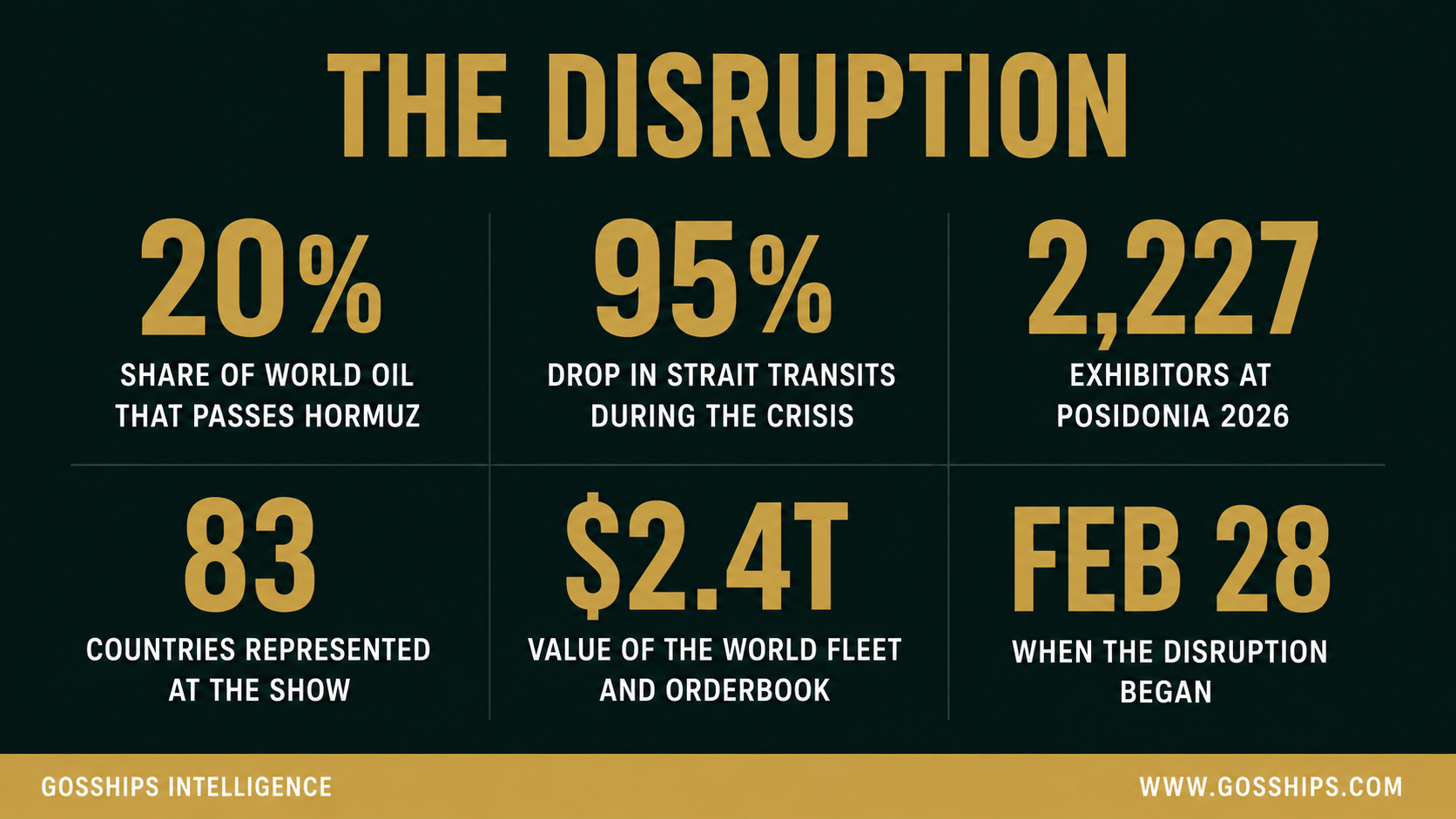
→ The Chokepoint: Roughly 20% of the World’s Oil Normally Passes Through the Strait of Hormuz Per the Lloyd’s Market Association
→ The Collapse: Transits Through the Strait Have Fallen About 95% During the Crisis Per Clarksons Research
→ The Show: Posidonia 2026 Drew 2,227 Exhibitors, the Largest Edition in Its History Per GTP Headlines
→ The Reach: Exhibitors Came From 83 Countries and Territories Per GTP Headlines
→ The Scale: Clarksons Valued the World Fleet and Orderbook at a Combined $2.4 Trillion Per Maritime Gateway
→ The Trigger: The Strait’s Disruption Began With the Strikes on Iran on February 28 Per Insurance Business
Found this useful? Share Gosships Intelligence with a colleague.
Why a call for a total Russian oil blockade is more than just talk. What his Hormuz toll comment quietly concedes. Where he sits relative to the rest of the industry, and why it matters. Below.
🔍 Why It Matters
Marinakis’s remarks matter less as policy proposals, which are unlikely to be adopted as stated, than as a window into how some of the largest owners are now reasoning about a fractured market.
