


⚓ Gosships Intelligence
Gosships Intelligence Is Published At Gosships.com
For Sponsorship And Partnership Inquiries Contact intelligence@gosships.com
|⚓ About Us | 🛢️ Exclusive Report | 📋 SwiftAction Training |
🏅Black Gold Membership (*53 Slots Left)
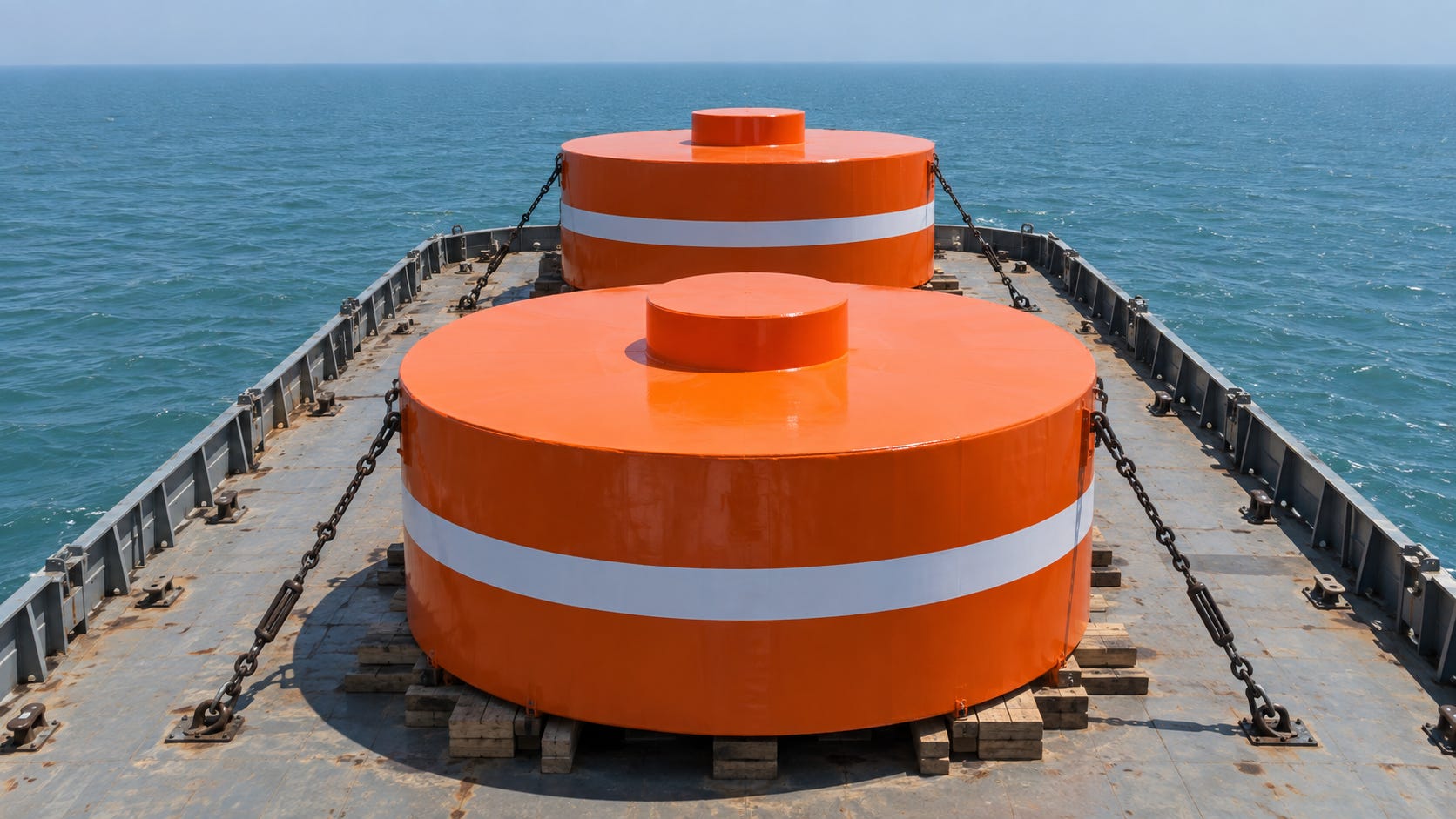
Argentina is building its first deepwater crude loading point at Punta Colorada, in the Golfo San Matías, and the two mooring buoys that make it work were fabricated in the United Arab Emirates. They left Jebel Ali aboard a heavy-lift vessel around August 11 and Horacio Marín, president and chief executive of YPF, announced on August 20 that they had crossed the Strait of Hormuz. He had already tied the export schedule to that voyage, telling the Argentine press in July that so long as the buoys sailed by September 19 there would be no delay. They made the window. They arrive at the end of October.
Which is the easy part.
Punta Colorada has no channel, no quay and no turning basin, because a catenary anchor leg mooring needs none of them. Two of them will sit about seven kilometres offshore on a bottom of roughly 40 metres. A laden very large crude carrier draws somewhere near 22 metres. The vessel picks up the buoy, swings freely to wind and sea, and loads through floating hoses.
That is a genuine VLCC loading point and Argentina has never had one. Most of its crude leaves today through Puerto Rosales, inside the Bahía Blanca estuary, on a navigation channel of 13.71 metres. When the port took its first Suezmax in July 2025 the vessel loaded about 717,000 barrels, roughly two thirds of what she could carry.
But run the terminal’s own published thresholds and something falls out that nobody has reported. On the gate the operator has stated, the first cargo out of Punta Colorada comes up short of a full VLCC parcel on every published input, and the piece of the project that decides how short is the one running late.
📋 In This Issue:
⚖️ The Story:
What two mooring buoys had to cross, what the strait looked like the week they crossed it and what happened in it at the end of August, the capacity figure lodged with the Argentine state that nobody has reported as the base it is, why the September 3 expansion news is the pipeline catching up to the moorings, why 40 metres of water settles the vessel question, the arithmetic that sizes the first cargo on three different published inputs and comes up short on all three, the tank programme running behind its own published pace, how Argentine crude actually leaves the country today, the Asian refiners who started buying before the terminal exists, what is genuinely left to do offshore, the first cargo date that keeps moving, and the substitution nobody has counted.
📊 By The Numbers:
The 437 kilometres, the 377,400, what 44.5 hours actually measures, the $2 billion facility, the 1.2 million barrel gate, the 215,000 barrels a day Argentina already exports.
🔍 Why It Matters:
What changes for the VLCC owner, the charterer, the trader and the marine underwriter.
👀 What To Watch:
The five markers between now and first cargo, including the roof count that is already running late and the three findings that would prove this reading wrong.
🚨 Gosships Signal:
What a deepwater loading point does to a country that has never had one.
🔔 Not A Member? Unlock The Full Analysis, Data Cards, Archive, & More!
📊 Order Our Exclusive Report
→ Global Tanker Market Outlook Q3 2026 Edition
📋 Competency-Based Maritime Training
→ SwiftAction
📌 Gosships Data Card
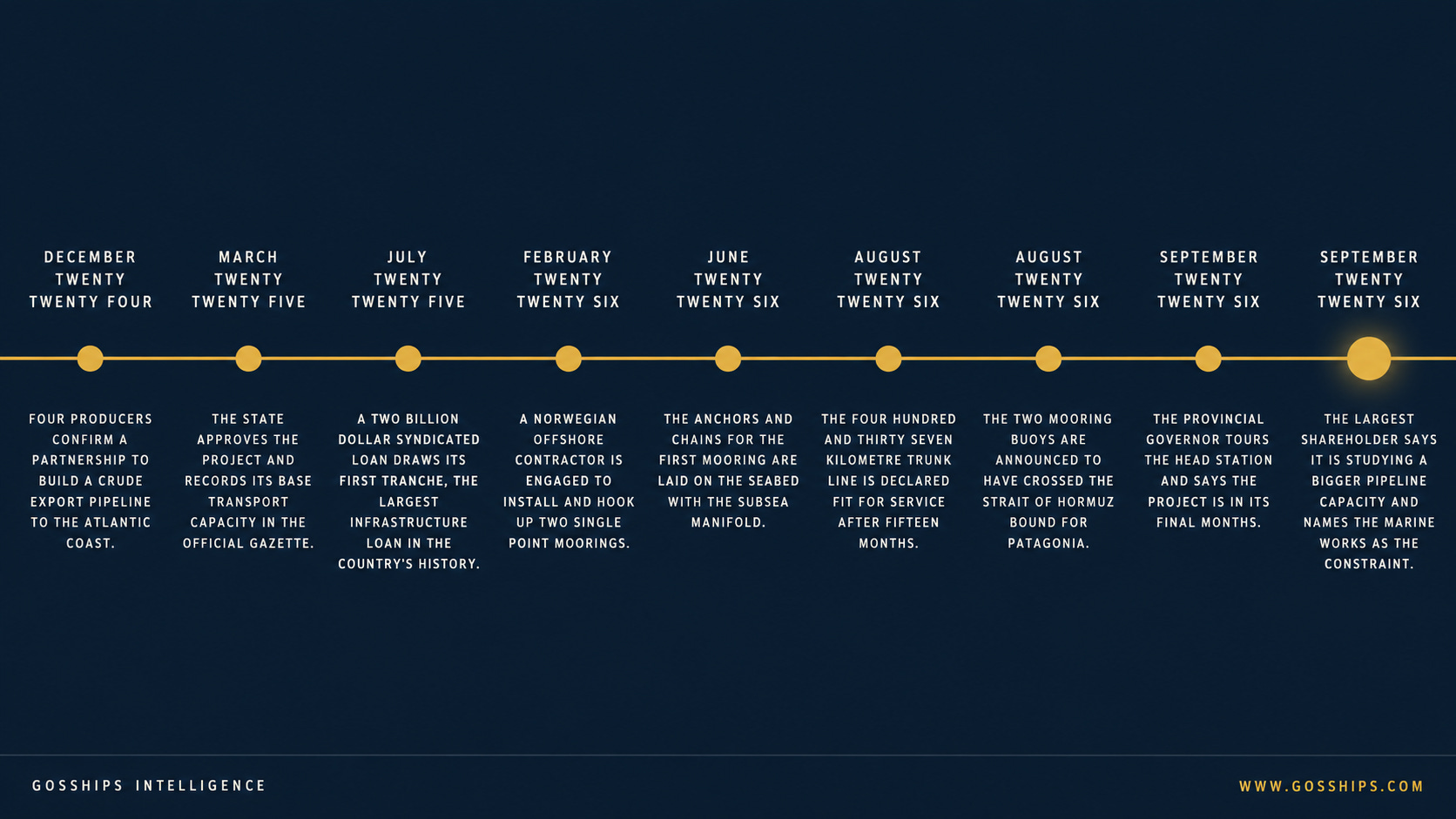
December 16, 2024: Pampa Energía confirms its participation in a crude export pipeline from Allen in Río Negro to the Atlantic coast at Punta Colorada, naming four shareholders at that stage: Pampa, YPF, Vista Energy Argentina and Pan American Sur. Pampa reports an initial 18 percent holding and states that “Pampa’s equity stake ensures a take-or-pay transportation contract for 50,000 bpd, along with storage and dispatch capacity”, adding that “This shareholding could decrease as new shareholders join.” Its Form 20-F filings then record 11.11 percent in April 2025 and 10.2 percent in April 2026.
March 21, 2025: The Argentine state approves the project under the RIGI large-investment regime and publishes Resolución 302/2025 in the Boletín Oficial. The filing records a 437-kilometre export pipeline from Allen to Punta Colorada, a terminal of six storage tanks, a maritime terminal of two monobuoys sited six kilometres offshore, a declared base transport capacity of 377,400 barrels a day with possible future expansion to 550,000, storage of 3,774,000 barrels expandable to 6,290,000, monobuoy loading potential of 700,000 barrels a day, total cost between $2.9 billion and $3.2 billion, and a minimum-investment deadline of December 31, 2028.
July 14, 2025: A $2 billion syndicated secured term loan draws its first tranche of $240 million. Counsel to the borrower describes it as “the largest commercial loan for an infrastructure project in Argentine history and one of the top five oil and gas financings in Latin America”, and as the first financing executed under RIGI. The structure is 70 percent debt and 30 percent shareholder equity.
July 22, 2025: Puerto Rosales receives the first Suezmax in its history, the Seaways Pecos, 274 metres long and 48 metres in the beam, loading about 717,000 barrels for the United States. That is roughly two thirds of what a Suezmax can carry, and it is the largest parcel Argentina has loaded.
February 16, 2026: DOF Group ASA discloses a contract award in Argentina for “Mooring pre-lay, pipeline end manifold installation / construction management, tie-in spools installation, hook-up and pre-commissioning of two CALM buoys, and diving services”, using the vessels Skandi Hera and Skandi Patagonia. Value is classified as substantial, between $25 million and $50 million. DOF puts the two campaigns, one in the second quarter and one in the second half, at more than 250 days combined. The disclosure names neither the client nor the project. Argentine reporting on the June campaign identifies DOF and both vessels as working for VMOS.
June 16, 2026: Shale24 reports that the first stage of the subsea works is complete and the first monobuoy’s mooring is fixed: six high-holding-power anchors of about 42 tonnes on six chains of 400 metres, laid together with the subsea manifold. GlobalPorts, the same day, describes the anchors and chains as fixing both monobuoys.
August 19, 2026: The 437-kilometre trunk line is declared fit for service [”Apto para Funcionar”] by the Techint and SACDE consortium after 15 months of construction, at a reported expected final cost of $2.976 billion against a budget of $3 billion. The project manager says reaching the milestone on the scheduled date is the result of the team’s commitment.
August 20, 2026: YPF’s chief executive announces that the two mooring buoys, fabricated in the United Arab Emirates and loaded at Jebel Ali aboard the heavy-lift vessel Topaz Ishim, have crossed the Strait of Hormuz. They departed Jebel Ali around August 11. Expected arrival at Punta Colorada is the end of October.
September 1, 2026: The governor of Río Negro tours the Allen head station and says the project is in its final months. The same reporting records that at Punta Colorada, 437 kilometres away, the third storage tank roof is now in place and the fourth is under construction. Provincial reporting the same day puts the start of operations in February 2027.
September 3, 2026: Speaking in Houston, YPF’s chief executive says the company is studying an expansion of VMOS beyond its 550,000 barrel a day design to about 700,000, with a stated ceiling of 700,000 to 770,000, again by adding pumping stations rather than building a second line. He puts the project at more than 80 percent complete and names the Punta Colorada marine works as the constraint. No decision is announced.
Sources: Boletín Oficial, Resolución 302/2025, March 21, 2025; Pampa Energía press release, December 16, 2024, and Forms 20-F filed April 2025 and April 9, 2026; Sullivan & Cromwell LLP, July 15, 2025; Diario Río Negro, July 22, 2025 and September 1, 2026; DOF Group ASA company disclosure, February 16, 2026; Shale24, May 11, June 16, July 13 and July 30, 2026; Más Energía, June 1 and September 3, 2026; EconoJournal, June 1, 2026; iProfesional, August 19, 2026; GlobalPorts, June 16 and August 20, 22 and 23, 2026; Pescare, August 23, 2026; Latin Energy Group, September 1, 2026; Energía Online and BNamericas, August 21, 2026; ArgenPorts, July 28 and September 3, 2026; Lloyd's List Intelligence Strait of Hormuz briefs, August 19 and 27, 2026; USNI News, August 28, 2026; US Central Command release, September 1, 2026; Axios, September 2, 2026; Saudi Press Agency, September 2, 2026; Windward, September 3, 2026; Kpler via Reuters, September 3, 2026.
⚖️ The Story
The Risk Everybody Could See
Horacio Marín, president and chief executive of YPF, which holds 25 percent of the consortium, set the gate in July. So long as the buoys left the Middle East by September 19, he said, there would be no delay [”Tenemos la ventana para salir hasta el 19 de septiembre. Saliendo hasta el 19 de septiembre no va ningún atraso”].
He was talking about two mooring buoys built by Bluewater Energy Services in the United Arab Emirates, each 272 tonnes and 15.3 metres across. They loaded at Jebel Ali aboard the heavy-lift vessel Topaz Ishim and departed around August 11. On August 20 Marín announced they had crossed the Strait of Hormuz. Nobody has published the date of the crossing itself.
Now look at what that passage was in August, because it explains why a pipeline company in Patagonia was watching a strait in the Persian Gulf.
Lloyd’s List Intelligence counted 73 transits of the strait in the week of August 10 to 16, against 91 the week before. Take that pairing carefully, because it is not like for like. Lloyd’s List revises these counts upward as dark transits are confirmed, and its own later brief back-solves the same week to roughly 85. The honest reading is a passage that Lloyd’s List describes as a shadow of its pre-war self, thinned out over months, not one that collapsed in seven days.
The rest of it is not in dispute. Iran had stood up a Persian Gulf Strait Authority in May and was vetting who went through. By August 17, the Monday after the buoys’ transit week, United States Central Command had redirected 64 commercial vessels, disabled three and boarded two, and the Baltic Exchange put the Middle East Gulf to China benchmark at nearly $510,000 a day, the highest since late June.
And it did not lift once the buoys were clear. Iran published a blacklist of 45 named hulls on August 23, carrying a threat of fines, detention and confiscation. The benchmark hit a record $647,000 a day on August 27. Central Command announced on August 28 that it had cleared Iranian sea mines from the international shipping lanes. And on that same day, in a report on a week when transits had actually risen 27 percent, Richard Meade, who edits Lloyd’s List, put it this way: “The industry is still operating under crisis conditions rather than anything approaching a return to normality.”
He was right, and the proof arrived three days later. On the night of August 31 two VLCCs were hit within minutes of each other about 16 miles off Khasab. One was the Sidr (IMO 9854715), Saudi-flagged and owned by Bahri, where two of the 16 Filipino seafarers aboard were killed. The other was Sinokor’s Senegal Prosperity, struck by three projectiles in the port side, engine room and ballast tank, disabled and listing, her crew taken off. Bahri called it a security incident. On September 2 the Saudi foreign ministry went further than the owner and named Iran directly, condemning “the Islamic Republic of Iran’s targeting of the Saudi tanker SIDR while it was transiting the Strait of Hormuz, which resulted in fatalities among the tanker’s crew.”
The day before that, Central Command struck what it listed as “air defense sites, radar systems, maritime assets and facilities, mine laying capabilities, and communications sites” in Iran, and said the strikes followed attempted IRGC attacks on commercial shipping in the strait. Axios reported the following day, citing an unnamed United States official, that about 100 targets were hit and that two Iranian government tankers were among them, disabled by missiles into their engine rooms under a new “tanker for tanker” policy. Central Command’s own release names no tankers and gives no count, and its spokesman declined to confirm the tanker strikes. The IRGC says two vessels hit naval mines and has threatened additional punitive measures.
Then look at the traffic. Windward counted eight transits in the 24 hours of September 2, four inbound and four outbound, five of them running without AIS. Kpler, reported by Reuters, put commodity vessels through the strait that Wednesday at six, against a ten-day average near 13. There is no ceasefire and no peace agreement. The Baltic Exchange record of $647,000 a day set on August 27 is still the most recent published print.
That is the water Argentina’s export schedule was routed through. Nobody planned it that way. It is simply where the hardware was made.
And the connection runs a second time, in the opposite direction. Bloomberg reported on August 31 that Eneos and Taiyo Oil in Japan, Hyundai Oilbank in South Korea, and PetroChina and Shaanxi Yanchang in China have all taken Argentine cargoes loading between August and October, and it attributes the buying to disruption of Iranian supply. One strait made the demand. The same strait sat on the equipment.
And it cleared. The buoys sailed on August 11, five and a half weeks inside Marín’s own September 19 gate, and they will be on station at the end of October. The visible risk on this project, the one with a war attached to it, is the one that came in early. Hold that thought, because the rest of this brief is about a risk with no war attached to it at all.
