


⚓About Us |🛢️Deep Water Reports |📋SwiftAction Training |
🏅Gold Anchor Membership (*53 Slots Left)
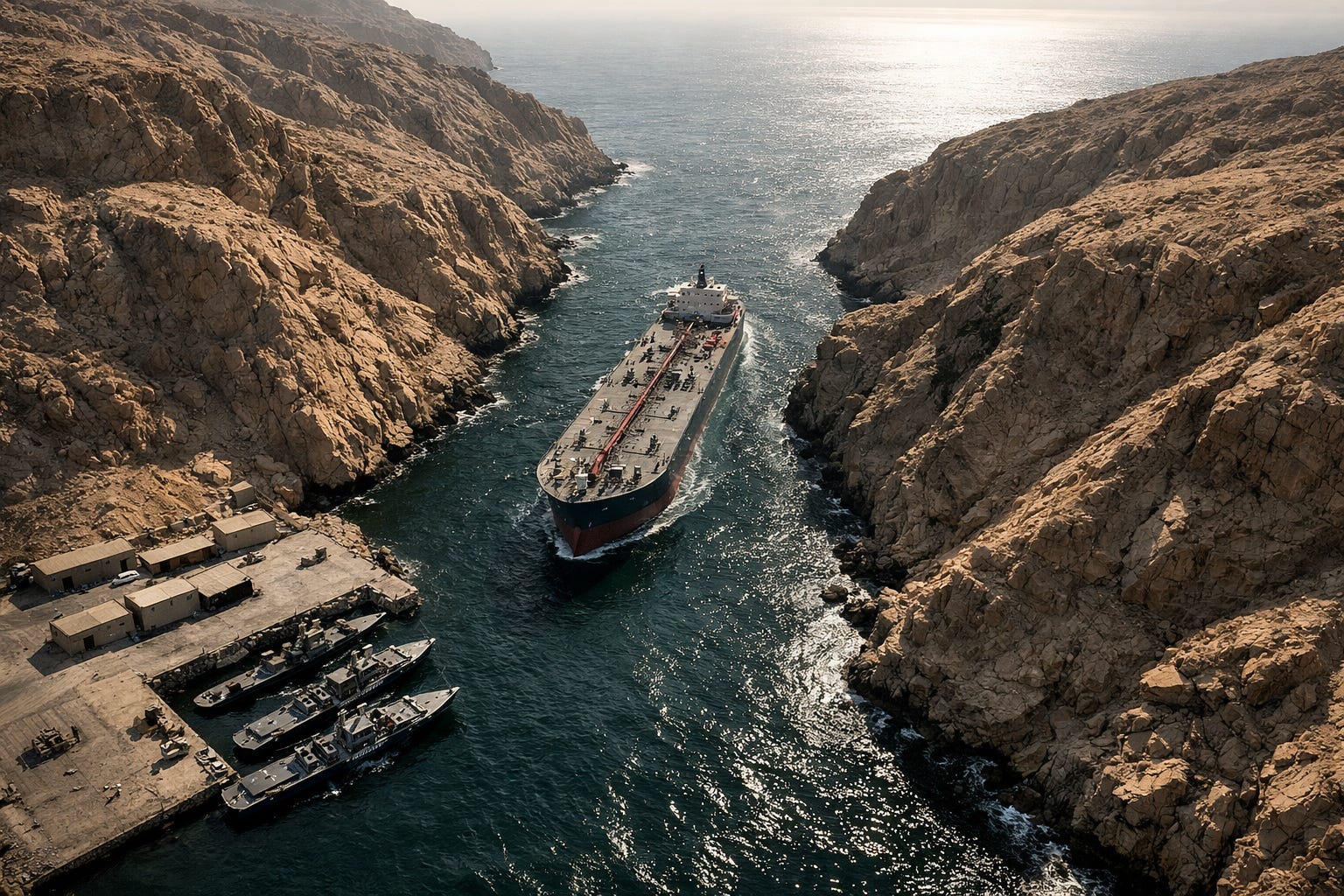
Iran has turned the Strait of Hormuz into a checkpoint.
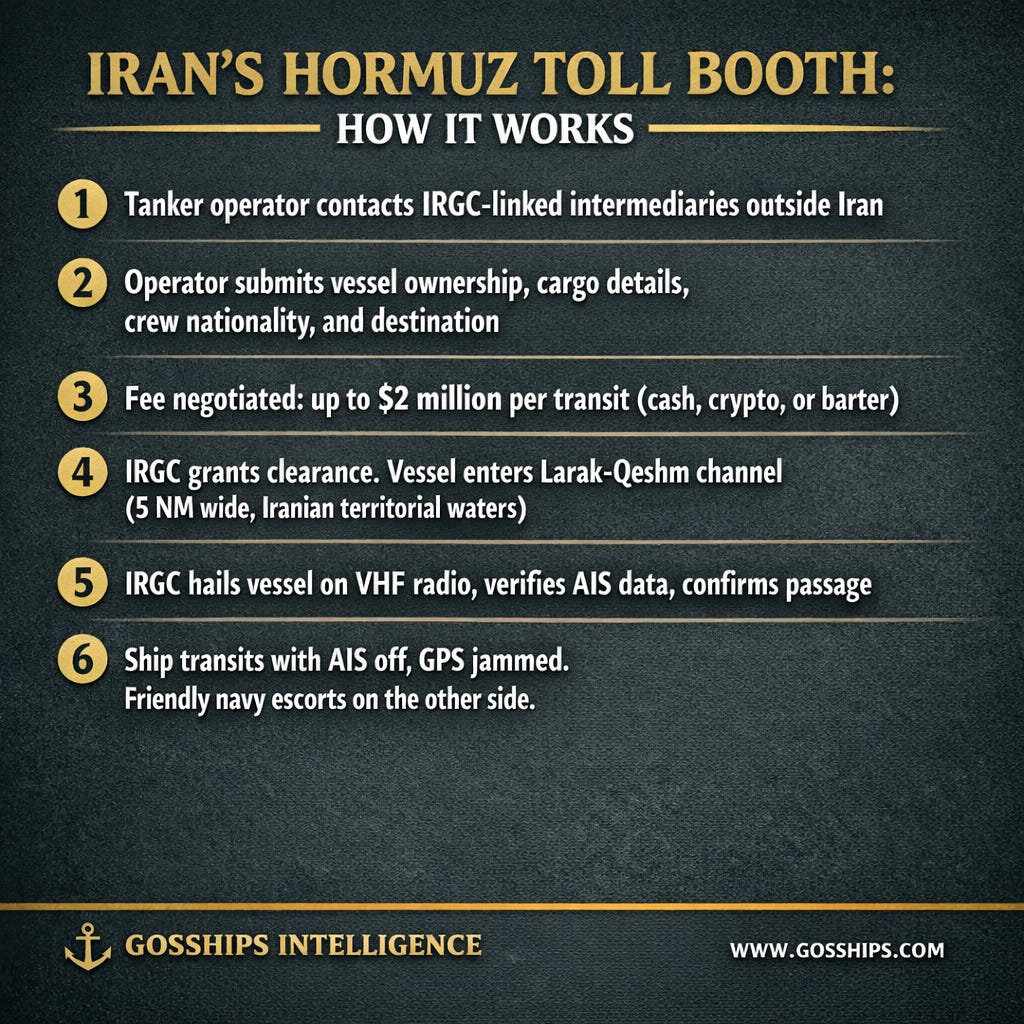
The Islamic Revolutionary Guard Corps has established a controlled shipping corridor through Iranian territorial waters, funneling approved vessels through a narrow 5-mile channel between the islands of Larak and Qeshm.
Ships that want to pass submit ownership details, cargo manifests, crew nationalities, and destination ports to the IRGC in advance, through a network of Iran-affiliated intermediaries operating outside Iran.
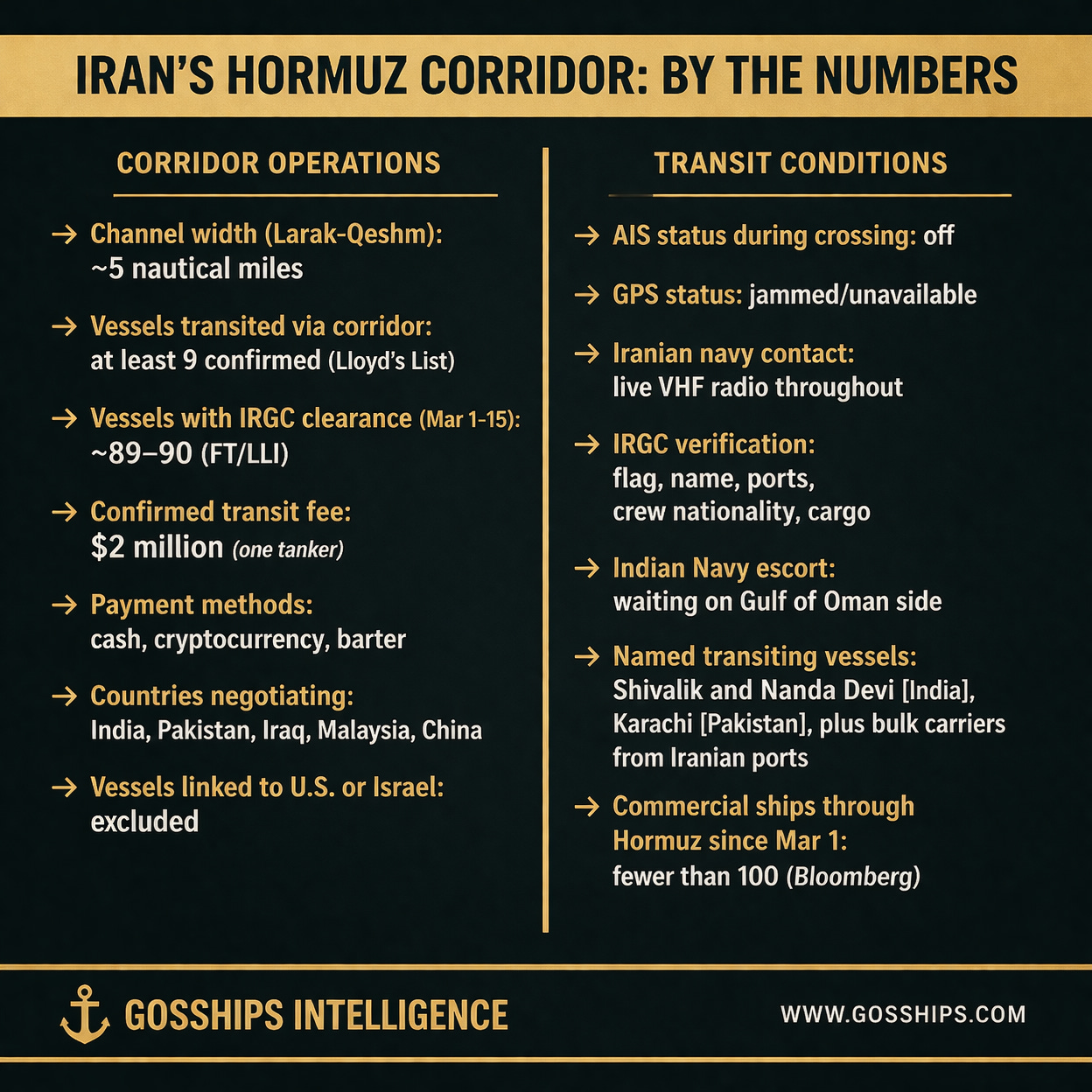
At least one tanker operator paid approximately $2 million for the right to transit, according to Lloyd’s List.
Payments are accepted in cash, cryptocurrency, or through barter, according to the Financial Times.
Vessels linked to the United States or Israel are excluded.
The IRGC is building a formal vetting and registration system to replace the current case-by-case approvals. India, Pakistan, Iraq, Malaysia, and China are in direct talks with Tehran to secure transit slots for their vessels.
This is not a blockade anymore. It is a toll road. And the IRGC is the operator.
📋 In this issue:
🛢️ The Story
📊 By the Numbers
🔍 Why It Matters
👀 What to Watch
⚓ Gosships Signal
📊 GOSSHIPS DATA CARD
🛢️ The Story
The first concrete evidence of Iran’s controlled transit system emerged between March 13 and 17. AIS vessel tracking data analyzed by EOS Risk Group, gCaptain, and Bloomberg showed multiple outbound vessels taking an unusual route between the Iranian islands of Larak and Qeshm, well outside the established traffic separation scheme and deep within Iranian territorial waters. Under normal conditions, vessels exiting the Persian Gulf remain closer to the southern side of the strait near Oman, minimizing exposure to Iranian waters. These ships were doing the opposite.
Martin Kelly, head of advisory at EOS Risk Group, was the first to publicly identify the pattern. After tracking four vessels taking the same route, Kelly confirmed the trend on March 16: vessels were getting approval to exit the Gulf via the Larak-Qeshm channel, likely for verification of ownership, destination, and cargo. The Pakistan-flagged Aframax tanker Karachi (IMO: 9903413), carrying crude from Abu Dhabi, was the first confirmed non-Iranian cargo vessel to make the transit while broadcasting its location, according to Kpler’s MarineTraffic.
Lloyd’s List secured the most detailed confirmation of the system’s operation. The IRGC has built what amounts to an ad hoc ship registration process, according to Lloyd’s List reporting this week. Before a vessel is cleared for transit, its operator must provide granular information about ownership structure, cargo contents, and intended destination. That information passes through a chain of intermediaries with ties to Iran who are based outside the country. Lloyd’s List confirmed that at least nine vessels have used the corridor so far. In one confirmed case, a tanker operator paid roughly $2 million for passage. How that transaction was executed under the existing sanctions architecture remains unclear. Lloyd’s List reported that the IRGC plans to replace the current informal approvals with a structured registration system in the coming days.
The Blockonomi analysis, citing Financial Times and Lloyd’s List Intelligence, provided additional granularity. Between March 1 and March 15, approximately 89 to 90 vessels transited under some form of IRGC clearance. Not all paid the toll. Iranian and allied ships, along with some Indian tankers, received passage through separate government-to-government arrangements. Payments for those that did pay were accepted in cash, cryptocurrency, or through barter. The $2 million figure, confirmed by at least one transaction, has set a benchmark that the broader market now faces.
The most detailed first-person account came from Bloomberg on March 21. A senior officer aboard an Indian LPG tanker described the transit to Bloomberg on condition of anonymity. His vessel was one of two Indian ships that made the crossing. The crew had been sitting at anchor in the Gulf for roughly 10 days when word came on the morning of March 13 that they had clearance to move that night. The sailors prepared life rafts before entering the strait. Once underway, the ship maintained continuous VHF radio contact with Iranian naval forces. Iranian personnel requested the vessel’s flag state, name, ports of origin and destination, and the nationalities of all crew onboard. Every sailor was Indian. After verification, the Iranians directed the ship along a designated route.
The ship’s AIS transponder was switched off for the entire crossing. Bloomberg’s review of tracking data confirmed the vessel went dark upon entering the strait and only reappeared electronically after reaching the Gulf of Oman. The officer reported that GPS was nonfunctional throughout the transit due to persistent signal interference across the region since the war began. Without satellite navigation, the passage took significantly longer than a normal Hormuz crossing. When the vessel emerged on the eastern side, Indian Navy warships were positioned and waiting. The officer noted that the ships were flying India’s flag at a height he had not seen before.
The geography of the corridor gives Iran total control. The channel between Larak and Qeshm is approximately five nautical miles wide at its narrowest point. Qeshm’s southern shore is home to an IRGC naval base that was filled with fast attack boats before the start of hostilities. The route passes directly in front of this base before threading through the gap between the two islands. At that distance, ships would have minutes at most to respond to an incoming Iranian boarding attempt or attack. The Maritime Executive noted that this route fully avoids the official traffic separation scheme, leaving the central waterway unused. Security analysts have warned that Iran could mine the main shipping lanes southeast of Larak while maintaining its own controlled corridor to the north.
Multiple governments are now negotiating directly with Tehran for access. According to Lloyd’s List and Al Jazeera, India, Pakistan, Iraq, Malaysia, and China are all in discussions with Iranian officials. Dimitris Maniatis, CEO of shipping security provider Marisks, confirmed that efforts are underway involving government and industry to establish a formal procedure under which vessels with no affiliation to Israel or the United States would receive confirmation of safe passage. The process is currently handled case by case, with individual governments communicating with Iranian authorities to seek approval for specific vessels.
Control Risks, the security consultancy, warned in a client briefing that the U.S. is unlikely to tolerate this system for long. Shipowners and operators with Western ties are almost certainly not going to route their vessels voluntarily into Iranian territorial waters. Others, particularly those from non-aligned countries, may be more willing to take the risk. Control Risks assessed that U.S. forces would likely move in coming days to strike individuals, facilities, or IRGC Navy assets directly involved in running the corridor. Security analysts also cautioned that IRGC approval does not guarantee physical safety. The transit remains dangerous.
📊 By the Numbers
📰 Related Coverage:
Strait of Hormuz Hits Zero: No Oil Tanker Transits in 24 Hours (March 2026)
Hormuz Shut Down: Three Tankers Hit, P&I Clubs Pull War Risk Cover as Iran War Escalates (March 2026)
Found this useful? Share Gosships Intelligence with a colleague.
What this means for international maritime law, why the U.S. will likely strike the corridor, and why every P&I club in the world just got a new exclusion clause to write is below.
🔍 Why It Matters
Iran has done something that no country has successfully done in modern history: turned an international shipping lane into a sovereign toll road.
