
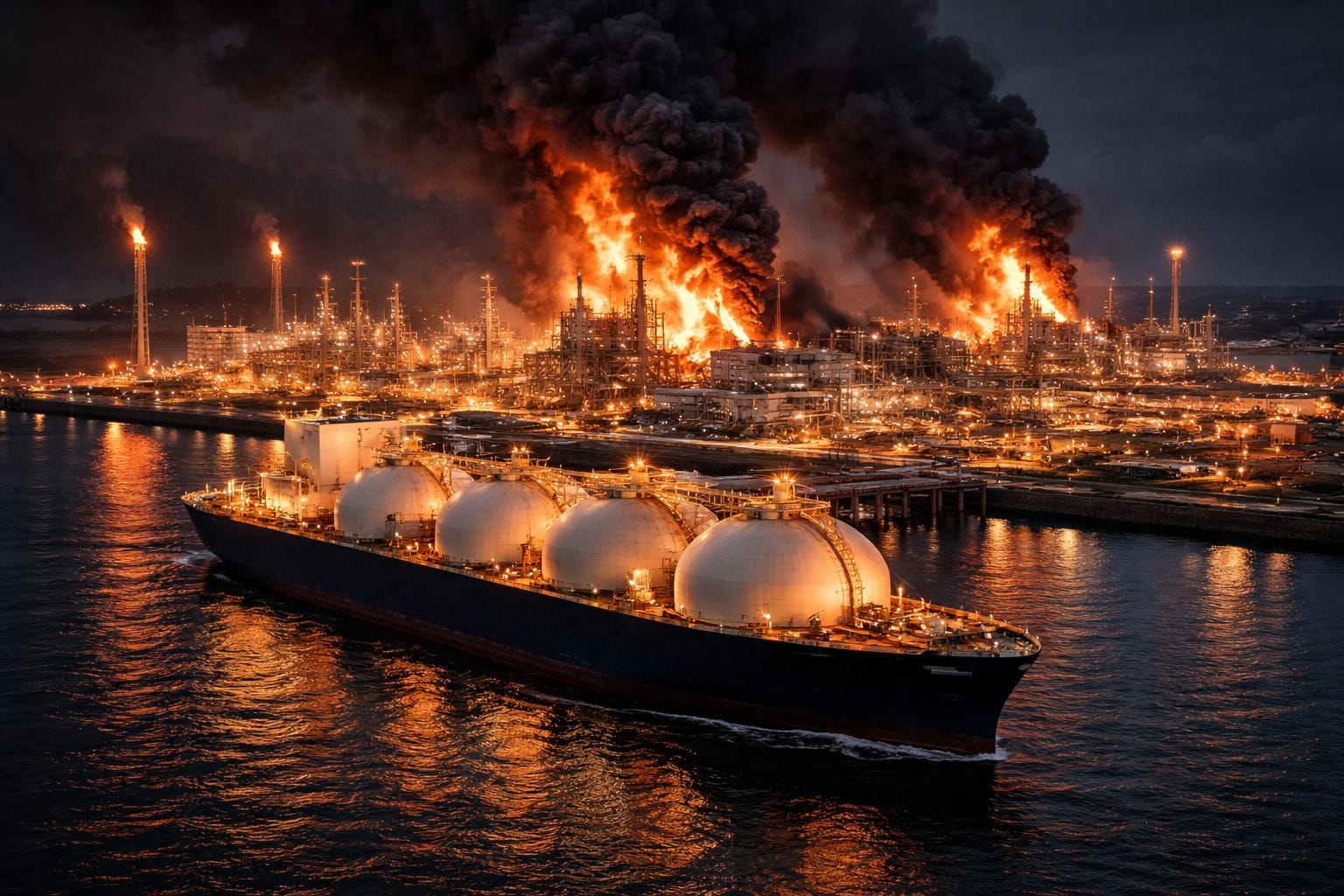
Iran Just Knocked Out 17% of Qatar's LNG Export Capacity. Repairs Will Take Up to Five Years.
Two LNG trains at Ras Laffan are down. 12.8 million tons per year offline. Force majeure declared on long-term contracts to Italy, Belgium, South Korea, and China. The damage alone cost $26 billion to
The Story
QatarEnergy CEO Saad al-Kaabi confirmed Thursday that Iranian missile strikes on the Ras Laffan Industrial City damaged two of Qatar’s 14 LNG liquefaction trains and one of its two gas-to-liquids facilities. The repairs will sideline 12.8 million tons per year of LNG production for three to five years, according to al-Kaabi’s interview with Reuters. That represents approximately 17% of Qatar’s total LNG export capacity.
The damaged units are Train S4 and Train S6. U.S. oil major ExxonMobil holds a 34% stake in Train S4 and a 30% stake in Train S6. The facilities cost approximately $26 billion to build. QatarEnergy has declared force majeure on its entire LNG output following the attacks and will extend force majeure on long-term supply contracts to Italy, Belgium, South Korea, and China for up to five years due to the two damaged trains specifically.
The fallout extends well beyond LNG. Al-Kaabi said Qatar’s condensate exports will drop by approximately 24%, LPG by 13%, helium by 14%, and naphtha and sulfur by 6% each. The helium reduction alone represents roughly 5% of global supply, according to Phil Kornbluth of Kornbluth Helium Consulting, a figure he described as “certainly significant.”
The strikes came as part of a broader Iranian retaliation against Gulf energy infrastructure on Wednesday and Thursday, after Israel struck Iran’s South Pars gas field. South Pars provides 80% of Iran’s domestic natural gas. In response, Iran’s Islamic Revolutionary Guard Corps launched attacks across the Gulf, hitting energy facilities in Qatar, Saudi Arabia, Kuwait, and the UAE. Al-Kaabi did not conceal his shock: “I never in my wildest dreams would have thought that Qatar would be in such an attack, especially from a brotherly Muslim country in the month of Ramadan.”
Why It Matters
Qatar accounts for nearly 20% of global LNG exports. Losing 17% of that capacity for three to five years is not a temporary disruption. It is a structural removal of supply from the global LNG market at a moment when every alternative source is already stretched.
European buyers are the most exposed. The EU spent the past three years weaning itself off Russian pipeline gas by signing long-term LNG contracts with Qatar, the U.S., and Australia. Two of those three pillars are now compromised: Qatar’s Ras Laffan is partially offline, and U.S. LNG cargoes face longer voyage times as Red Sea and Hormuz disruptions force rerouting. European natural gas futures had already jumped 50% in the first days of the war. This damage locks in elevated LNG pricing for years, not months.
For the tanker market, the implications cut across segments. LNG carrier demand will shift as buyers scramble for replacement cargoes from the U.S. Gulf, Australia, and emerging African exporters (Mozambique, Nigeria). Voyage distances increase. Tonne-mile demand rises. The LNG carrier orderbook, already at record levels, suddenly looks undersized against a market that just lost 12.8 million tons per year of baseload supply.
On the crude side, the Qatar strikes landed the same day Iran hit Saudi Arabia’s SAMREF refinery at Yanbu and targeted refineries in Kuwait and Abu Dhabi. The IRGC issued evacuation warnings to multiple Gulf energy sites before striking. The message from Tehran is explicit: if Israel hits Iranian energy infrastructure, Iran will systematically degrade Gulf energy infrastructure in response. For VLCC and Suezmax owners, this raises the risk premium on every loading berth in the region, not just those inside the Strait of Hormuz.
The force majeure declarations will ripple through commodity trading desks and energy procurement teams for weeks. Long-term LNG contracts are the backbone of how utilities in Europe and Asia plan their supply. When Qatar declares force majeure for up to five years on contracts with national buyers in Italy, Belgium, South Korea, and China, those buyers must either find replacement supply at spot prices (which are surging) or face physical shortages. There is no quick fix. LNG liquefaction trains take four to seven years to build from scratch. Repair timelines of three to five years assume no further attacks on Ras Laffan.
What to Watch
Al-Kaabi was unambiguous about one condition: “For production to restart, first we need hostilities to cease.” That means Qatar’s undamaged trains (12 of 14) remain vulnerable to further strikes for as long as the war continues. A second round of Iranian attacks on Ras Laffan could push force majeure from partial to total, and from years to potentially a decade.
Track LNG spot pricing in Asia and Europe over the next 10 days. The TTF (Dutch Title Transfer Facility) benchmark and the JKM (Japan Korea Marker) will reflect how quickly the market prices in three to five years of lost Qatari supply. Any spike above the levels seen in the 2022 European gas crisis would signal that traders believe this damage is not recoverable on the timeline al-Kaabi described.
Watch the diplomatic fallout. Qatar expelled Iran’s military and security attaches from its embassy following the Ras Laffan attacks. Saudi Arabia’s foreign minister said trust with Tehran “has been completely shattered.” A formal Gulf state military response, including potential participation in Hormuz escort operations, is now more likely than it was 48 hours ago.

