
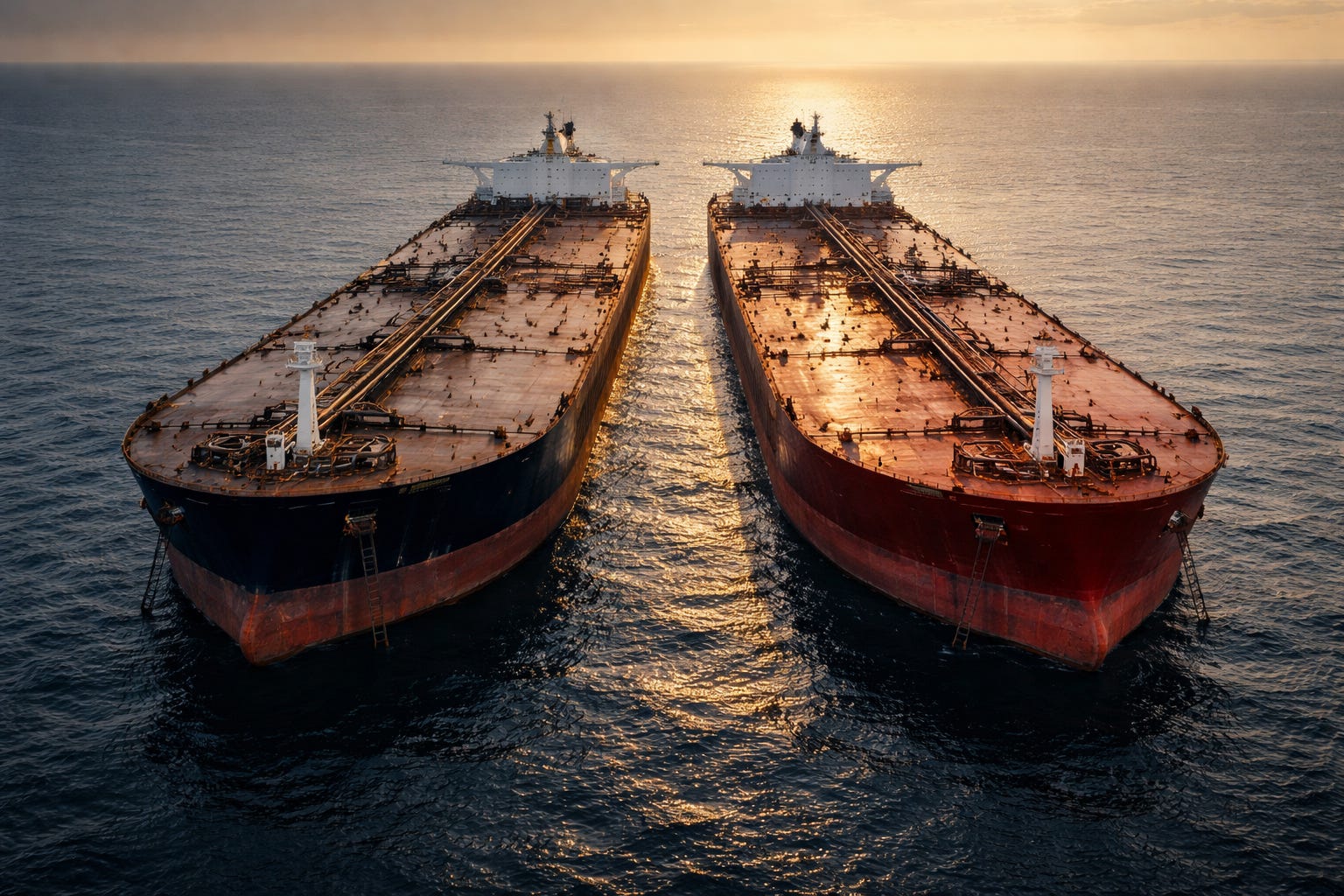
MSC Just Bought Half of Sinokor. The World's Biggest Container Line Now Controls a Quarter of the Compliant VLCC Fleet.
The Aponte family's tanker play is no longer speculation. Regulatory filings confirm MSC is behind Sinokor's $2.5 billion VLCC buying spree — and the crude market will never look the same.
The Story
Months of market speculation ended this morning. Regulatory filings published by the Greek and Cypriot Competition Commissions confirm that Mediterranean Shipping Company — the world’s largest container line, controlled by the secretive Italian billionaire Gianluigi Aponte — is acquiring a 50% stake in South Korean shipowner Sinokor Maritime. The deal is being executed through MSC’s Luxembourg-registered subsidiary, SAS Shipping Agencies Services. Sinokor’s founder, Ga-Hyun Chung, retains the other half. Joint control. The investment framework agreement was signed on February 2, 2026.
This is the formal confirmation of a relationship the market has been piecing together since late December, when Sinokor embarked on the most aggressive VLCC acquisition campaign the industry has ever seen. Starting in mid-December and accelerating through January, Sinokor absorbed 35 out of 45 VLCC sale-and-purchase transactions concluded in early 2026 — 78% of total deal volume — spending over $2.5 billion on secondhand tonnage alone, according to Veson Nautical. The vessels acquired were built between 2007 and 2016, averaging about 12 years of age, sourced from blue-chip owners including Frontline (eight VLCCs for $832 million), CMB.TECH/Euronav (six VLCCs for approximately $520-530 million), Capital Group, Delta Tankers, and Dynacom. By late January, Lloyd’s List was reporting the spree had surpassed 40 vessels, with Aponte rumored to have earmarked up to $5 billion for the play — including potential VLCC newbuild orders at Chinese yard Hengli Heavy Industry.
The result is a level of fleet concentration the VLCC market has never experienced. According to Norwegian broker Fearnleys, Sinokor now controls approximately 25% of the compliant VLCC spot fleet. Signal Ocean Platform data puts the figure at 24% of the spot-trading fleet and roughly 12% of the total global VLCC fleet. BRS, in a recent report, called Chung a “super operator” and noted that no single entity has ever held comparable dominance over the active VLCC fleet. For context, as recently as 2023, the largest operator — Tankers International — controlled about 15% of the spot fleet.
Why It Matters
This isn’t just an ownership story. It’s a structural shift in how the crude tanker market will price and allocate VLCC capacity — and it’s landing at the worst possible moment for charterers.
The Hormuz crisis has already removed roughly 80 VLCCs from circulation inside the Persian Gulf (about 9% of the active fleet, per BRS). On top of that, an estimated 230 VLCCs operate in the shadow fleet servicing sanctioned trades, according to TankerTrackers.com. Strip those out, and the pool of compliant, commercially available VLCCs was already thin before Sinokor consolidated a quarter of what remained under a single commercial platform. Charterers now face a spot market where one entity controls an outsized share of available tonnage during the most severe supply disruption in oil market history.
The pricing power implications are direct. VLCC asset values for 10-year-old tonnage have surged 24% year-on-year to their highest levels in a decade, according to Signal Ocean data. One-year time charter rates have blown past $90,000/day, with DHT Holdings locking in at that level in February. Three-year period deals are being done above $60,000/day. Sinokor’s acquisitions alone drove 10-year-old VLCC values up roughly 17% month-on-month during the buying campaign, pushing 320,000-dwt vessels from around $87 million to over $101 million. Sellers who cashed out — Fredriksen, the Saverys family, Marinakis — walked away at prices well above broker estimates. Multiple sellers are already circling Asian yards with newbuild inquiries, recycling the proceeds back into the VLCC orderbook.
The Aponte angle adds a layer of strategic depth that pure tanker owners don’t have. MSC operates 971 container vessels with 120 more on order, per Alphaliner. The group has diversified aggressively into terminals, air cargo, cruise (MSC Cruises), and inland logistics. Entering crude tanker shipping — and entering it by effectively cornering the VLCC spot market — signals something bigger than a speculative freight play. It’s a bet on energy logistics as a permanent pillar of the MSC empire. The container-tanker asset swap dimension is also in play: Splash247 reported that Sinokor may divest part or all of its container fleet (roughly 80 vessels including units under construction) to MSC, with negotiations around a 20-ship en bloc deal already underway.
What to Watch
Regulatory approvals are not yet complete. Greece and Cyprus have received the notification, but further jurisdictions may need to clear the transaction. Any antitrust scrutiny of a single operator controlling 24-25% of the VLCC spot fleet in the middle of a global supply crisis would be unprecedented — but so is the deal itself.
Watch for Sinokor fixture activity over the next two weeks. With the MEG-China TD3C index still hovering near record territory and Atlantic basin rates softening under the weight of repositioning VLCCs, how Sinokor deploys its fleet — whether it holds tonnage for premium MEG cargoes, pivots to Atlantic basin lifts, or locks in more period charters — will set the tone for VLCC rates into Q2. The entity now has enough fleet mass to move the market in whichever direction it leans.
The newbuild pipeline matters too. Lloyd’s List linked MSC to a potential order of eight VLCC newbuilds at Hengli Heavy Industry. Clarksons data shows total VLCC investment in Q1 2026 is on track to exceed $10 billion — a quarterly record for any single vessel segment. If Sinokor-MSC locks in long-lead newbuilds on top of its secondhand fleet, the message to the rest of the market is clear: this isn’t a trade. It’s a permanent reordering of who controls global crude shipping.

