


⚓ The Gosships Team
Gosships Intelligence Is Published At Gosships.com
For Sponsorship And Partnership Inquiries Contact intelligence@gosships.com
|⚓ About Us | 🛢️ Exclusive Report | 📋 SwiftAction Training |
🏅Black Gold Membership (*53 Slots Left)
On Sunday, OPEC+ raised its oil output target for the second month running, and the UAE has left the group entirely so it can pump without quota limits. On paper, more crude is coming. The problem is the sea. The barrels those decisions authorize still have to cross the Strait of Hormuz, and almost nothing is crossing it. For the tanker market, the gap between the oil that has been approved and the oil that can physically reach a ship is the whole story, and it is why freight has crashed into a glut even as the quotas climb.
📋 In This Issue:
🛢️ The Story
📊 By The Numbers
🔍 Why It Matters
👀 What To Watch
🚨 Gosships Signal
🔔 Not Yet Subscribed? Gosships Intelligence Delivers Oil Shipping Intelligence. Subscribe Here!
📊 Order Our Exclusive Report
→ Global Tanker Market Outlook Q3 2026 Edition
📋 Competency-Based Maritime Training
→ SwiftAction
📌 Gosships Data Card
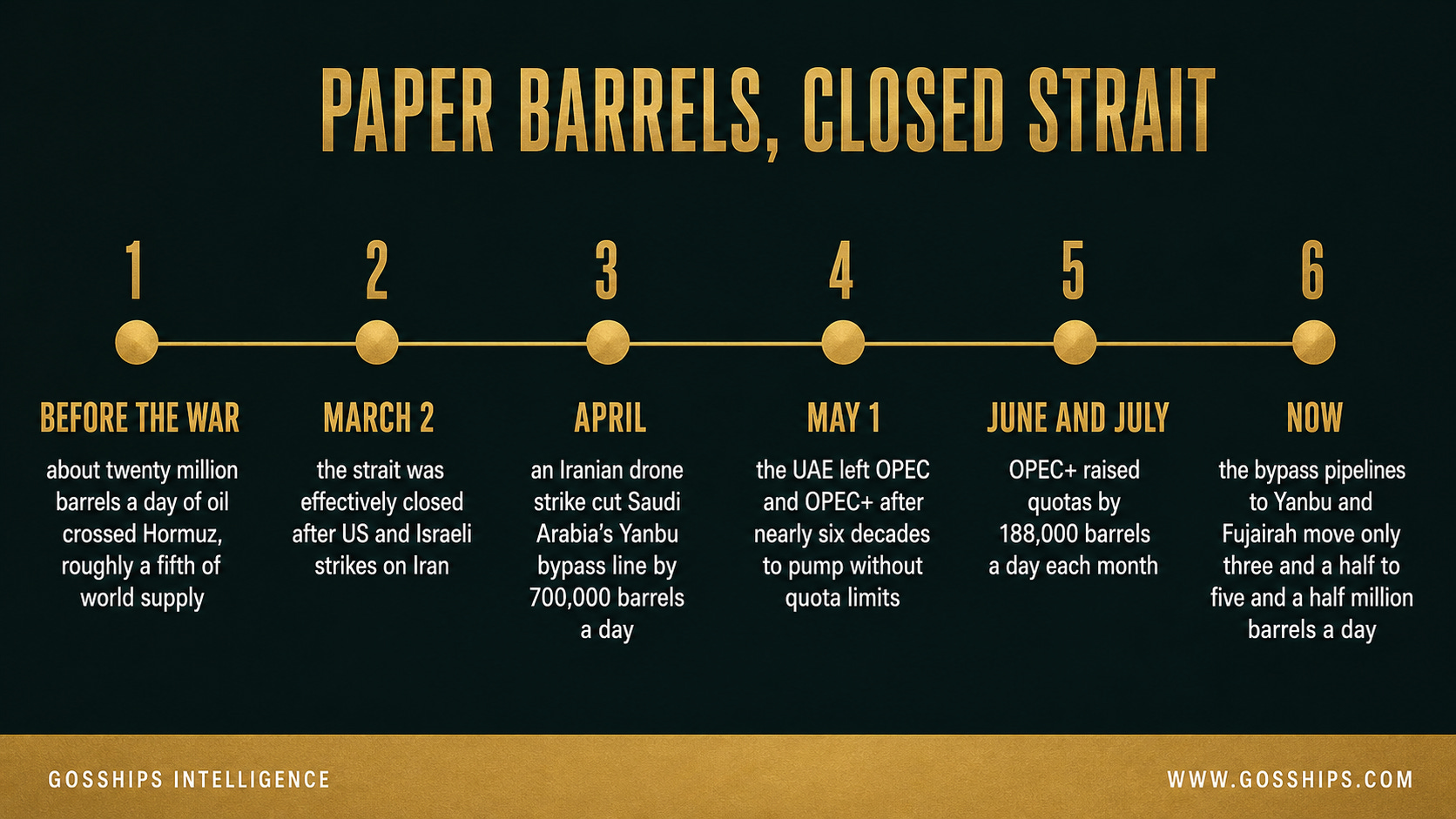
→ Before The War: About 20 Million Barrels A Day Of Oil Crossed Hormuz, Roughly A Fifth Of World Supply
→ March 2: The Strait Was Effectively Closed After US And Israeli Strikes On Iran
→ April: An Iranian Drone Strike Cut Saudi Arabia’s Yanbu Bypass Line By 700,000 Barrels A Day
→ May 1: The UAE Left OPEC And OPEC+ After Nearly Six Decades To Pump Without Quota Limits
→ June And July: OPEC+ Raised Quotas By 188,000 Barrels A Day Each Month, The Second Straight Increase
→ Now: The Bypass Pipelines To Yanbu And Fujairah Move Only 3.5 To 5.5 Million Barrels A Day, Against 20 Million Normally
🛢️ The Story
There is a number that crossed the wires on Sunday and looked, on the surface, like a straightforward easing of supply. The seven core members of OPEC+, the alliance led by Saudi Arabia and Russia, met by video conference on June 7 and agreed to lift their combined output target by 188,000 barrels a day in July. It was the second month in a row they have added that exact amount, after approving the same increase for June, and it keeps the group on a path to restore the voluntary cuts it first announced in April 2023. According to the production table released with the statement, Saudi Arabia and Russia will each add 62,000 barrels a day, with Iraq, Kuwait, Kazakhstan, Algeria, and Oman splitting the rest. The next meeting is set for July 5.
The market did not treat it as straightforward at all. Bloomberg headlined the decision a symbolic quota increase, a move it said continues the process of restarting halted production only on paper. Rystad Energy was blunter, telling clients the increases would have little real impact on the market, and its head of geopolitical analysis, Jorge Leon, put his finger on exactly why. With Hormuz closed, Leon wrote, the real question is not the size of OPEC’s paper quota but “whether additional barrels can actually reach the market.” He added that the group remains on track to unwind the first tranche of its voluntary cuts by September, if not earlier.
That single sentence is the entire tanker story. A production quota is a permission slip. It is not a cargo. And the distance between the two has rarely been wider than it is right now.
Start with the chokepoint. The Strait of Hormuz, the narrow channel at the mouth of the Persian Gulf, normally carries about 20 million barrels a day of oil and petroleum liquids, which the US Energy Information Administration puts at roughly a fifth of global consumption. Before the war, Lloyd’s List Intelligence counted around 3,000 vessels a month moving through it, and Kpler estimated about 15 million barrels a day of crude and products, close to a fifth of the world’s oil trade. The Center for Strategic and International Studies dates the effective closure of the strait to March 2, after the US and Israeli strikes on Iran in late February. Iran’s foreign minister declared the waterway open on April 17, and the Islamic Revolutionary Guard Corps reversed him the next day. The result, by Kpler’s count, was that just 191 vessels crossed Hormuz in the entire month of April. Kpler’s maritime risk and compliance manager Dimitris Ampatzidis called the disruption “both rapid and unprecedented.” As of early June, a conditional ceasefire is in place but the waterway remains effectively closed, with almost no commercial shipping using it, according to the UK House of Commons Library.
So when OPEC authorizes more barrels for its Gulf members, it is authorizing barrels that have to leave through a door almost nothing is leaving through. The only crude that can reliably reach a buyer is the crude that can avoid Hormuz altogether, and that comes down to two overland pipelines, both running at or near their limits.
The larger one is Saudi Arabia’s East-West Pipeline, the Petroline, a roughly 750-mile dual-line system that carries crude from the Abqaiq processing hub on the Gulf coast across the kingdom to the Red Sea port of Yanbu. Its design capacity is 5 million barrels a day, and Aramco chief executive Amin Nasser confirmed in the spring that the line had been ramped to its full 7 million. But pipeline capacity is not the same as export capacity. The Engineering News-Record notes that Aramco ships around 2 million barrels a day to its own Red Sea refineries before any export crude can leave Yanbu, and the port’s loading terminals were never expanded to match the pipe. Industry estimates put Yanbu’s effective export loading closer to 4 million barrels a day, with the consultancy Vortexa estimating roughly 3 million under wartime conditions. The smaller bypass is the UAE’s Abu Dhabi Crude Oil Pipeline, the Habshan-Fujairah line, which runs about 400 kilometers to the port of Fujairah on the Gulf of Oman, the only major route that exits the Gulf directly into the Indian Ocean. The International Energy Agency puts its capacity near 1.8 million barrels a day, of which the UAE already uses about 1.1 million, leaving only around 700,000 barrels a day of headroom.
Add the two together and the IEA estimates the bypass routes can move between 3.5 and 5.5 million barrels a day. Against the roughly 20 million that normally cross Hormuz, that is between a fifth and a quarter of the strait’s usual flow. The arithmetic does not improve when you map it onto who got the July increase. Russia and Kazakhstan do not export through Hormuz at all, so their added barrels can move through the Baltic, the Black Sea, and Pacific terminals as normal. Saudi Arabia can route extra crude to Yanbu, except Yanbu is already loading near its ceiling. Iraq, which is taking 26,000 barrels a day of the July rise, sends almost all of its crude out through Basra and the Gulf, with only the northern Kirkuk-to-Ceyhan line as an alternative, according to analysis published in The Conversation. Kuwait, taking another 16,000, has no bypass pipeline at all. A meaningful share of what OPEC just approved is crude that has no clear way onto a ship.
Gosships Read: This is what makes the increase a paper number for the tanker market. The barrels that can actually move are the ones from producers who never depended on Hormuz, plus whatever Saudi Arabia can move through a port already near capacity. The rest is supply that exists in a communique and nowhere on the water.
The bypass routes are not even a safe haven. The Conversation reports that an Iranian drone strike on a Petroline pumping station in April knocked roughly 700,000 barrels a day offline, and while Aramco had the line back to full capacity within three days, the strike happened at all. Fujairah’s crude terminal was hit by Iranian drones on March 3, 14, and 16, setting storage tanks on fire and suspending loadings. As the Engineering News-Record put it, the bypass infrastructure was a hedge sized for a disruption lasting days or weeks. This one has lasted three months.
Now the supply story collides with a demand story that is just as soft. China, the single largest buyer of Gulf crude, has pulled back its imports and leaned on domestic inventory rather than overseas supply since the conflict began, according to data cited by Trading Economics on June 8. So even the barrels that can reach the sea are sailing toward a buyer who, for now, is drawing down tanks instead of ordering more cargoes.
This is the part that matters most for anyone with a position in freight, and it is why the war did not deliver the rate boom that the headlines kept predicting. The initial shock in late February did spike rates. The Baltic Exchange’s VLCC composite hit around $169,000 a day on February 26, with Persian Gulf to China assessed near $209,000. But a spike built on a risk premium is not the same as a market with enough cargoes to go around, and by late April the picture had inverted. Sentosa Shipbrokers reported that very large crude carriers were running at roughly 55 percent ballast, sailing empty in search of cargoes, with Suezmaxes and Aframaxes both near 51 percent. All three crude segments crossing the 50 percent ballast threshold at once is, in the brokers’ description, highly unusual, and it reflects the same thing the OPEC quotas cannot fix: there are not enough cargoes. The forward market agrees. As of early March, the Baltic’s freight derivatives priced VLCC rates for the fourth quarter of 2026 at around $23.40 a tonne, roughly half the late-February peak, and Discovery Alert notes that fleet growth of about 6 percent is due to arrive in 2026 regardless of how the war ends.
Then there is the producer that left the group. On April 28 the UAE announced it was leaving OPEC and the wider OPEC+ framework, effective May 1, ending nearly six decades inside the organization it joined through Abu Dhabi in 1967. Energy Minister Suhail al-Mazrouei said the decision was a policy choice to gain flexibility, the freedom “to be outside any constraint.” The UAE was OPEC’s third-largest producer, with capacity Rystad puts near 4.8 million barrels a day and a stated plan to reach 5 million by 2027. Rystad called the exit a significant blow, saying the loss of a producer pumping near 4.8 million barrels a day, with the ambition to pump more, strips the group of one of its real levers for steadying the market. Axios, citing the same firm, framed the longer-term problem: a structurally weaker OPEC, with less spare capacity concentrated inside it, will find it harder to calibrate supply and steady prices. Daniel Sternoff of Columbia’s Center on Global Energy Policy called the move “a politically big deal” that, for the moment, has limited effect precisely because Hormuz is throttled and Gulf producers cannot ramp anyway.
So the group is adding supply a major producer short, into a market where the barrels it authorizes for its remaining Gulf members largely cannot move, toward a buyer that is not buying, while the one member free to pump without quota limits is the one that just left. Oil itself tells the story in price. Brent was trading around $98 a barrel on June 8, off sharply from the roughly $108 it commanded in early May and volatile on a fresh exchange of strikes, yet still more than 40 percent above where it sat a year ago. The market is not pricing OPEC’s quota. It is pricing the strait. Where that leaves rates, the bypass terminals, and the books of everyone trading this market is below.
📊 By The Numbers
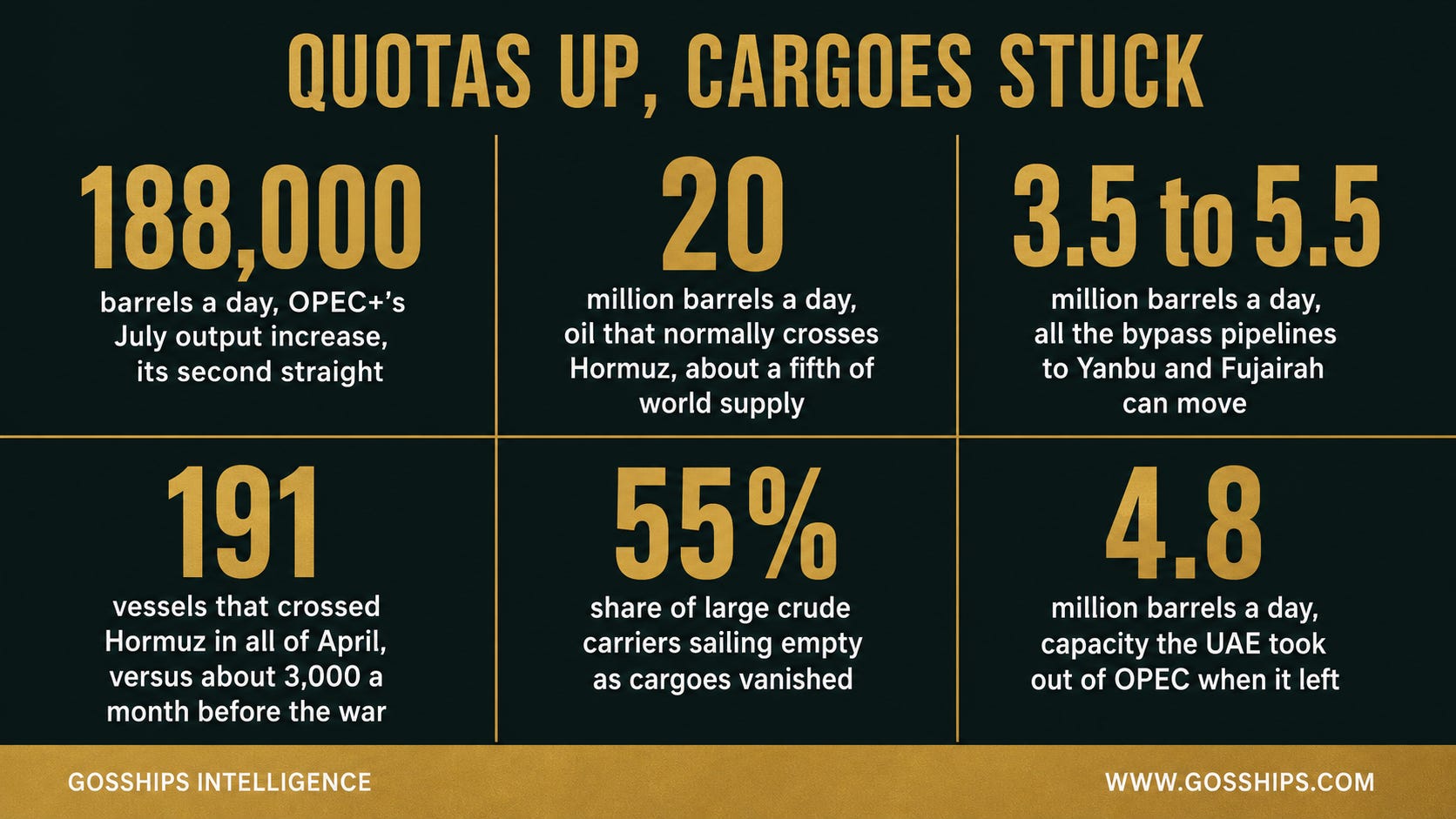
→ 188,000 Barrels A Day: OPEC+’s July Output Increase, Its Second Straight (OPEC)
→ 20 Million Barrels A Day: Oil That Normally Crosses Hormuz, About A Fifth Of World Supply (EIA)
→ 3.5 To 5.5 Million Barrels A Day: All The Bypass Pipelines To Yanbu And Fujairah Can Move (IEA)
→ 191: Vessels That Crossed Hormuz In All Of April, Versus About 3,000 A Month Before The War (Kpler, Lloyd’s List Intelligence)
→ 55 Percent: Share Of VLCCs Sailing Empty As Cargoes Vanished (Sentosa Shipbrokers)
→ 4.8 Million Barrels A Day: Capacity The UAE Took Out Of OPEC When It Left (Rystad Energy)
The number OPEC published on Sunday and the number of barrels that can actually reach a tanker are two different figures, and the distance between them is where the freight market, the bypass terminals, and the next leg of the rate cycle will be decided. There is also a reading of this data that says the war premium is closer to its end than its peak, and that the barrels finally moving are doing so on routes that quietly reshape ton-mile demand. That analysis, and the signals we are watching to call the turn, is below.
🔍 Why It Matters
The 188,000-barrel number is not a supply story for the tanker market. It is a sentiment story dressed as a supply story, and every desk that touches a Gulf cargo is exposed to the gap differently.
