


⚓ The Gosships Team
Gosships Intelligence Is Published At Gosships.com
For Sponsorship And Partnership Inquiries Contact intelligence@gosships.com
|⚓ About Us | 🛢️ Deep Water Reports | 📋 SwiftAction Training |
🏅 Founding Black Gold Membership (*52 Slots Left)
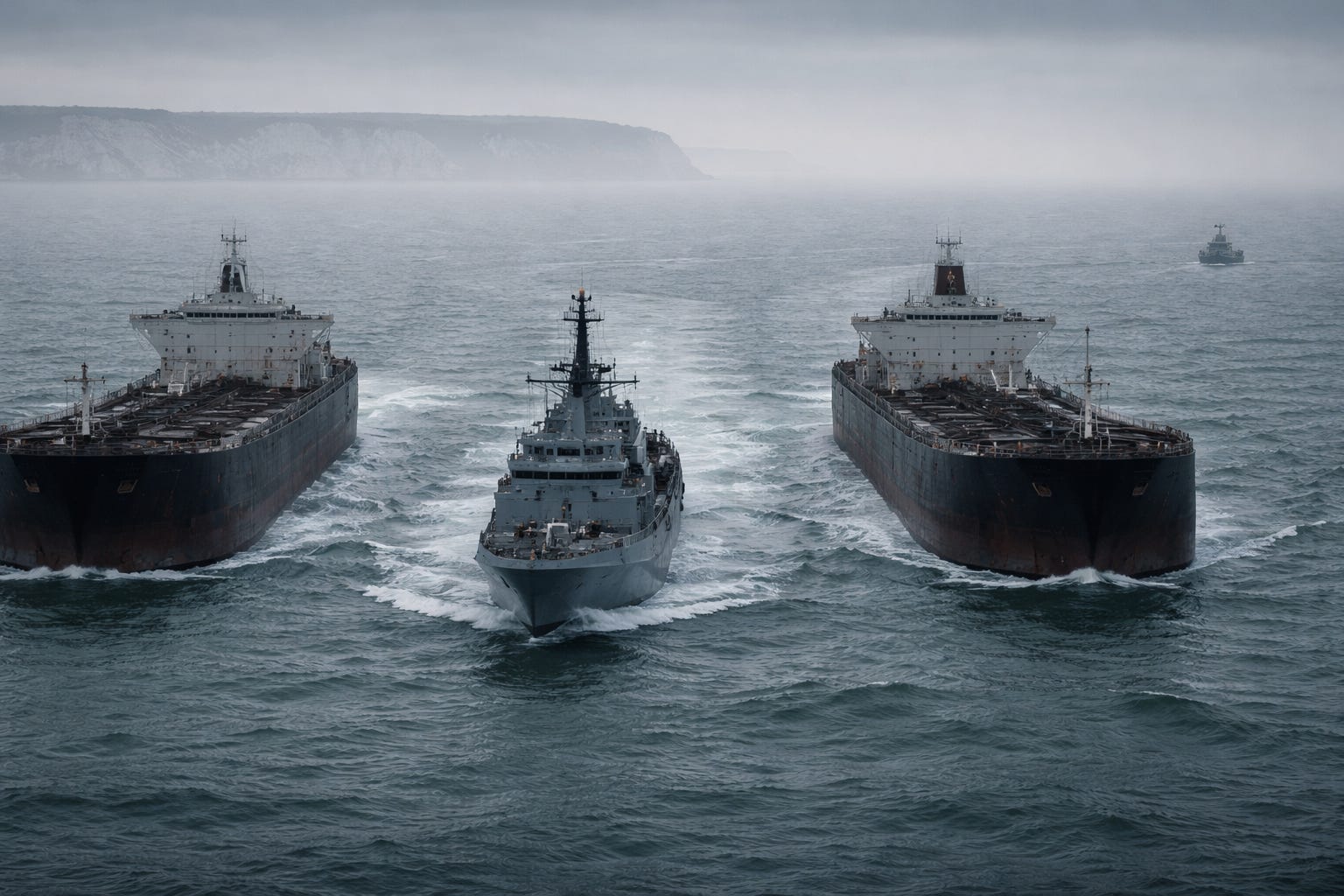
Russia sent a missile frigate armed with Kalibr cruise missiles to escort two sanctioned oil tankers through the English Channel on April 8. The Royal Navy monitored the transit. Britain did not board, detain, or intercept a single vessel. The defense press covered the confrontation. Nobody has analyzed what it means for your insurance, your charter, or your sanctions exposure. Two weeks earlier, on March 25, Prime Minister Keir Starmer had authorized British armed forces to board and seize sanctioned shadow fleet ships in UK waters. The tanker diesel that sailed past the south coast of England that morning is now on its way to Turkey. The UK Government says the shadow fleet’s revenues fund Russia’s war in Ukraine. UK diesel averaged 192p per litre the week of April 13, up from 143p before the war began on February 28, according to UK Government data via PetrolPrices. The diesel on those tankers enters the same global market that sets the price at your pump.
📋 In this issue:
🛢️ The Story
📊 By The Numbers
🔍 Why It Matters
👀 What to Watch
🚨 Gosships Signal
📊 Get The Deep Water Report
→ Global Tanker Market Outlook Q2 2026
📋 Competency-Based Maritime Training
→ SwiftAction
📌 Gosships Data Card
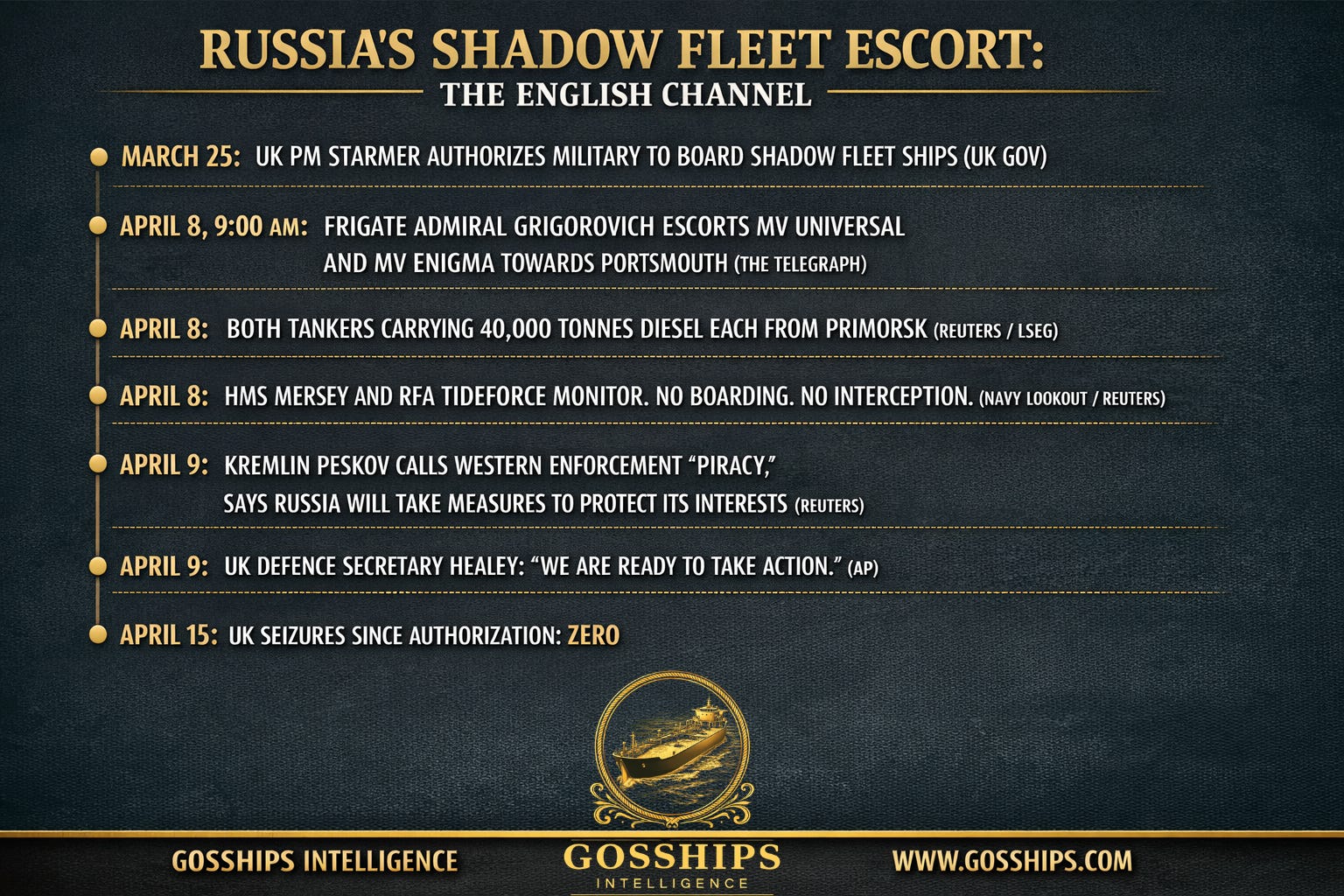
→ March 25: UK PM Starmer Authorizes Military To Board Shadow Fleet Ships (UK Gov)
→ April 8, 9:00 AM: Frigate Admiral Grigorovich Escorts MV Universal And MV Enigma Towards Portsmouth (The Telegraph)
→ April 8: Both Tankers Carrying 40,000 Tonnes Diesel Each From Primorsk (Reuters/LSEG)
→ April 8: HMS Mersey And RFA Tideforce Monitor. No Boarding. No Interception. (Navy Lookout, Reuters)
→ April 9: Kremlin Peskov Calls Western Enforcement "Piracy," Says Russia Will Take Measures To Protect Its Interests (Reuters)
→ April 9: UK Defence Secretary Healey: “We Are Ready To Take Action.” (AP)
→ April 15: UK Seizures Since Authorization: Zero
🛢️ The Story
On the morning of April 8, a Russian Black Sea Fleet frigate sailed between two sanctioned oil tankers off the south coast of England. The frigate was the Admiral Grigorovich, a 3,620-tonne warship armed with Kalibr cruise missiles and anti-ship weapons, according to The Telegraph, which had a reporter on the water approximately 10 miles off Dover. The two tankers were the MV Universal, sailing under the Russian flag, and the MV Enigma, sailing under the Cameroon flag. Both are on the UK sanctions list, according to Reuters.
The three vessels transited westward through the English Channel with the frigate positioned between the two tankers, according to The Telegraph. They sailed towards Portsmouth shortly after 9:00 AM. The Royal Navy did not board, intercept, or detain either vessel.
Both tankers were carrying approximately 40,000 tonnes of diesel each, loaded at the Russian Baltic port of Primorsk in Russia’s Leningrad region at the end of March, according to LSEG data cited by Reuters. The Enigma is heading to Mersin, Turkey. The destination of the Universal was not clear, Reuters reported on April 9.
The Royal Navy deployed HMS Mersey, a River-class offshore patrol vessel, alongside the RFA Tideforce, a fleet tanker, and a Wildcat helicopter from 815 Naval Air Squadron to monitor the transit, according to Navy Lookout. Belgian, French, and Dutch aircraft and ships were also involved in the monitoring operation, according to Reuters. No boarding or interception was attempted.
The English Channel is an international strait where transit passage rights apply under the United Nations Convention on the Law of the Sea (UNCLOS Part III, Articles 37-44). The legal authority Starmer granted on March 25 applies to sanctioned vessels in UK waters, but the practical application in an international strait where transit passage is protected is more complex than the authorization alone suggests. Defence Matters, a European defense analysis publication, noted that “the threshold between monitoring and intervention remains finely balanced” when a state navy enters the picture in a congested, politically sensitive route.
This happened 14 days after Prime Minister Keir Starmer authorized British armed forces to board and seize sanctioned shadow fleet vessels in UK waters. The authorization was announced on March 25 ahead of the Joint Expeditionary Force Summit in Helsinki, according to the UK Government. Starmer addressed the summit on March 26. He said at the time: “Putin is rubbing his hands at the war in the Middle East because he thinks higher oil prices will let him line his pockets. That’s why we’re going after his shadow fleet even harder, not just keeping Britain safe but starving Putin’s war machine of the dirty profits that fund his barbaric campaign in Ukraine,” according to the UK Government press release.
Since that authorization, no boarding has been conducted. No vessel has been seized. More than 300 shadow fleet movements have been recorded in and around UK waters in the first three months of 2026, according to the UK Government. The UK has imposed sanctions on 544 Russian shadow fleet vessels, according to the UK Government.
On April 9, one day after the escort, the Kremlin responded. Kremlin spokesman Dmitry Peskov said: “We have witnessed cases of piracy in international waters. These cases harmed the economic interests of the Russian Federation, so Russia considers itself in the right, and will take measures to protect its interests,” according to Reuters.
On the same day, UK Defence Secretary John Healey held a press conference at 9 Downing Street. Asked about the shadow fleet escort, Healey said: “We have the military options, and we’re ready to take action. Not just in support of, but action with, allies to interdict shadow fleet vessels,” according to the Associated Press. Healey also stated: “If Russia is rerouting its shadow ships or escorting them with its own warships, the stance, the military posture, the determined work that we’ve done, particularly with allied nations, is having an impact and making it harder for Putin to pursue his illegal oil revenues,” according to the April 9 press conference, as reported by AP.
The escort was not an isolated incident. Between March 29 and April 7, HMS Mersey tracked multiple Russian naval units transiting the Channel, including the Admiral Grigorovich, the landing ship Aleksandr Shabalin, and a Kilo-class submarine, the Krasnodar, which transited on the surface, according to Navy Lookout.
Russia’s shadow fleet consists of approximately 700 vessels, carrying around 40% of all Russian oil exports including refined products, according to The Telegraph. Around 75% of Russia’s crude oil specifically is transported by these vessels, according to the UK Government. The higher percentage reflects crude oil only; the lower reflects all oil exports including diesel, fuel oil, and other products.
The legal framework exists. On March 25, the UK Government confirmed that military and law enforcement specialists had trained for scenarios including boarding vessels that resist, are armed, or use surveillance to evade capture, according to the UK Government. Each target ship is individually assessed by law enforcement, military, and energy market specialists before a recommendation is made to ministers, the UK Government stated.
France has already acted. A French Maritime Gendarmerie team boarded the Mozambique-flagged tanker Deyna, described by France as part of Russia’s shadow fleet, in the Mediterranean on March 20, according to AP. The United States and UK cooperated in the seizure of the Bella 1 in January 2026, according to Downing Street.
Britain authorized. France boarded. The United States seized. Russia responded with a missile frigate. And on April 8, in the English Channel, the sanctioned diesel sailed past without incident.
What this means for P&I underwriters repricing war risk on shadow fleet interdiction, for compliance officers navigating a sanctions regime now challenged by military force, and for every shipowner transiting waters where armed escorts protect sanctioned trade, is below.
Related Coverage:
Shadow Fleet Under Fire: Sanctions Warfare
Maritime Sanctions 2026: Shadow Fleet Surge
The Shadow Beneath the Waves: The Rise of the Dark Fleet
📊 By The Numbers
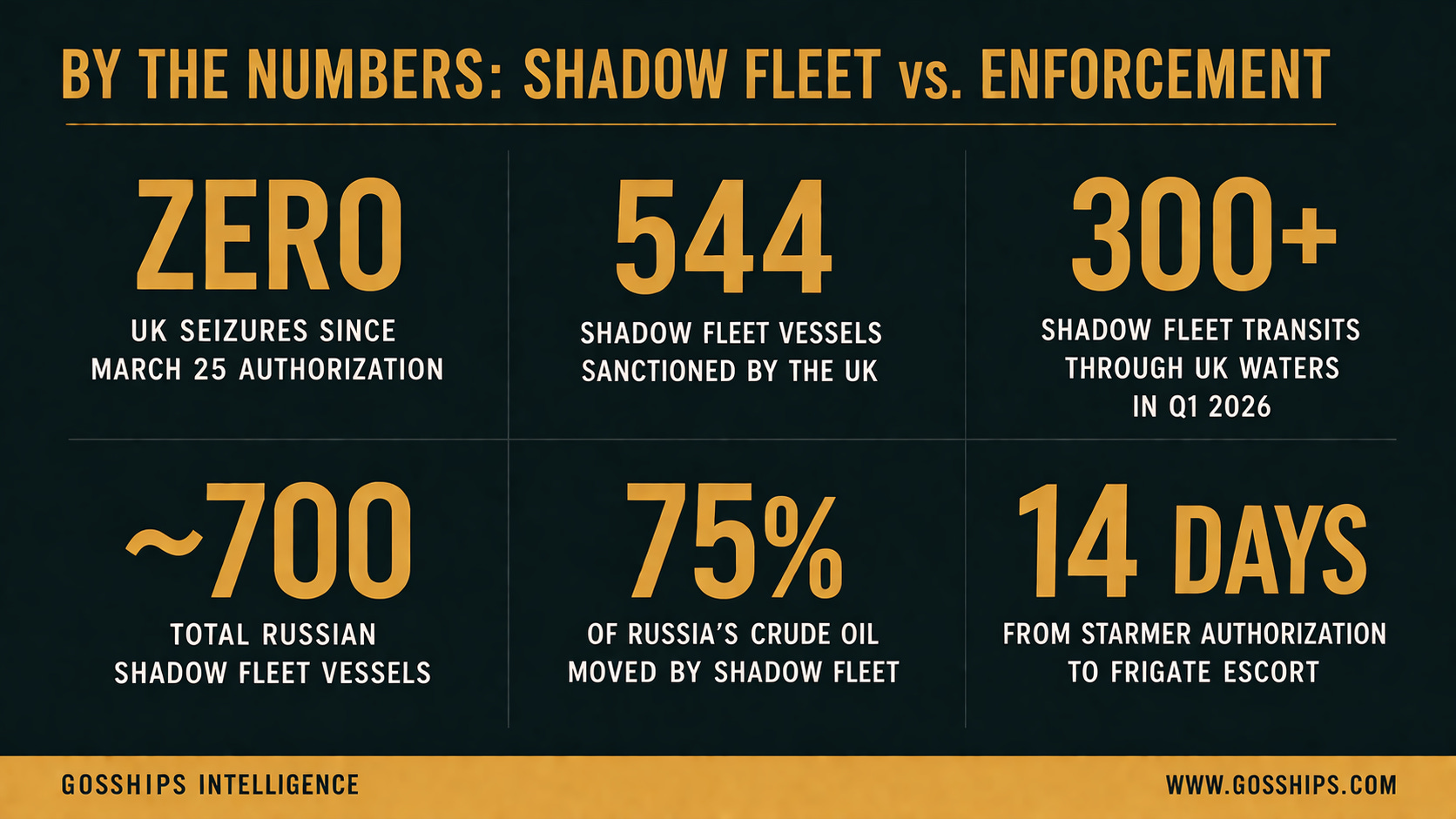
→ Zero: UK Seizures Since March 25 Authorization
→ 544: Shadow Fleet Vessels Sanctioned By The UK (UK Gov)
→ 300+: Shadow Fleet Transits Through UK Waters In Q1 2026 (UK Gov)
→ ~700: Total Russian Shadow Fleet Vessels (The Telegraph)
→ 75%: Of Russia’s Crude Oil Moved By Shadow Fleet (UK Gov)
→ 14 Days: From Starmer Authorization To Frigate Escort
→ 40,000 Tonnes: Diesel Cargo Per Tanker, Loaded At Primorsk (Reuters/LSEG)
→ 3,620 Tonnes: Admiral Grigorovich Displacement, Armed With Kalibr Missiles
→ April 8: The Day The Escort Transited. No Boarding.
→ April 9: Kremlin Called Western Enforcement “Piracy” (Reuters)
→ April 9: Healey Said UK Is “Ready To Take Action” (AP)
🔍 Why It Matters
For P&I underwriters, the risk model for shadow fleet interdiction changed on April 8.
