


|⚓ About Us | 🛢️ Deep Water Reports | 📋 SwiftAction Training |
🏅 Founding Black Gold Membership (*52 Slots Left)
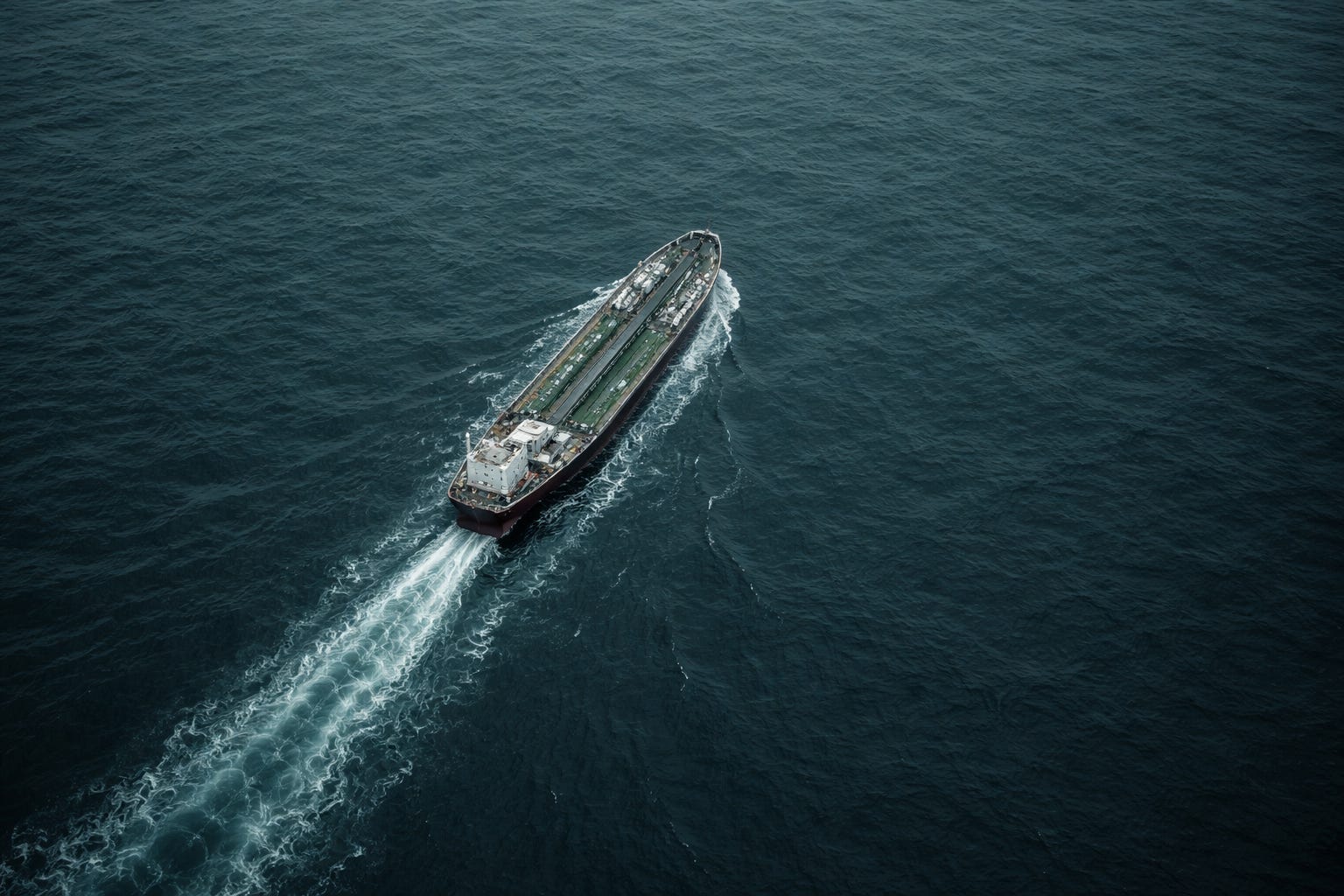
The Russian-flagged tanker Anatoly Kolodkin, owned by sanctioned state company Sovcomflot, departed Russia’s Primorsk port on March 8 carrying approximately 730,000 barrels of crude oil, according to Bloomberg and CiberCuba. A Russian Steregushchiy-class frigate, the RFN Soobrazitelny, escorted the tanker through the English Channel, according to the Maritime Executive. The British Royal Navy dispatched HMS Mersey and a Wildcat helicopter for 48 hours of monitoring, according to the Maritime Executive. Multiple US Navy and Coast Guard assets tracked the tanker across the Atlantic but did not interfere, according to SOUTHCOM Commander Gen. Francis Donovan’s Senate testimony on March 20. On March 29, Trump told reporters aboard Air Force One: “If a country wants to send some oil into Cuba right now, I have no problem with that, whether it’s Russia or not,” according to the Washington Post and NPR. On March 30, Kremlin spokesman Dmitry Peskov confirmed: “This issue was indeed raised in advance during contacts with our American counterparts,” according to the Moscow Times. The tanker arrived in Cuban territorial waters on March 30, according to Russia’s Transport Ministry, Bloomberg, and CiberCuba.
📋 In this issue:
🛢️ The Story
📊 By The Numbers
🔍 Why It Matters
👀 What to Watch
🚨 Gosships Signal
📊 Get The Deep Water Report
→ Global Tanker Market Outlook Q2 2026
📋 Competency-Based Maritime Training
→ SwiftAction
📌 Gosships Data Card
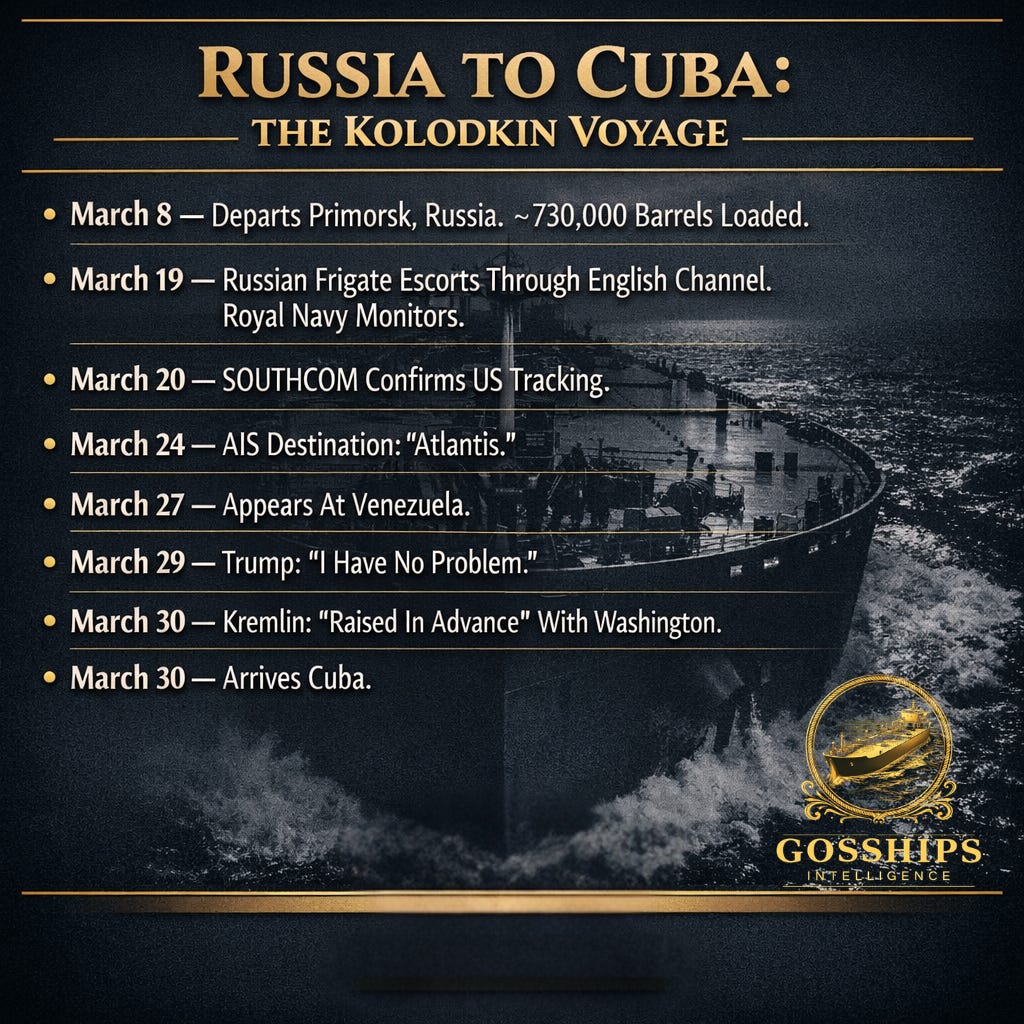
→ March 8: Anatoly Kolodkin Departs Primorsk With ~730,000 Barrels Of Russian Crude (Bloomberg, CiberCuba)
→ March 19: Russian Frigate RFN Soobrazitelny Escorts Tanker Through English Channel. Royal Navy Dispatches HMS Mersey (Maritime Executive)
→ March 20: SOUTHCOM Commander Gen. Donovan Confirms US Is Tracking The Tanker (Senate Testimony)
→ March 24: Tanker’s AIS Destination Changed From “Atlantis” To “Atlantic For Order” (Maritime Executive, UPI)
→ March 27: Tanker Skips Cuba, Appears At Venezuela’s Puerto Cabello (UPI)
→ March 29: AIS Destination Changes To “Matanzas, Cuba, Arriving March 31” (MarineTraffic)
→ March 29: Trump Says “I Have No Problem” With Russian Oil Going To Cuba (Washington Post, NPR)
→ March 30: Kremlin Confirms “This Issue Was Raised In Advance” With Washington (Moscow Times)
→ March 30: Russia’s Transport Ministry Confirms Anatoly Kolodkin Arrives In Cuban Waters (Bloomberg, CiberCuba)
🛢️ The Story
The Anatoly Kolodkin (IMO 9610808, 118,316 DWT) is owned by Sovcomflot, Russia’s state shipping company, which has been under US, EU, and UK sanctions since 2022, according to the Maritime Executive. The vessel loaded approximately 730,000 barrels, roughly 100,000 metric tons, of crude oil at Russia’s Primorsk port on March 8, according to Bloomberg and CiberCuba.
The tanker’s journey across the Atlantic was shadowed at every stage. The Russian navy dispatched a Steregushchiy-class frigate, the RFN Soobrazitelny, to escort the tanker through the English Channel, according to the Maritime Executive. The British Royal Navy sent Portsmouth-based HMS Mersey and a Wildcat helicopter for 48 hours of surveillance on March 19, according to the Maritime Executive. The Russian frigate turned back after clearing the Channel.
The vessel’s AIS destination was changed multiple times during the crossing, according to UPI and the Maritime Executive. It was initially set to “Atlantis,” then “USA,” then “Atlantic for order,” and on March 29 to “Matanzas, Cuba, arriving March 31.” On March 27, the tanker appeared at Venezuela’s Puerto Cabello anchorage before resuming course for Cuba, according to UPI. A second tanker, the Hong Kong-flagged Sea Horse, carrying approximately 200,000 barrels of Russian-origin diesel, also arrived near Venezuela on March 25 but had not yet discharged cargo as of March 28, according to the Washington Post and LSEG data.
The US military tracked the Anatoly Kolodkin throughout. SOUTHCOM Commander Gen. Francis Donovan confirmed tracking during Senate testimony on March 20, calling it a “replenishment ship” that would have “no significant impact” on Cuba’s shortages, according to Senate testimony reported by gCaptain. US Navy destroyer USS Nitze was positioned near the Bahamas. USCG cutters Tahoma and Richard Etheridge patrolled near Florida and Cuba, according to the Maritime Executive.
On March 29, Trump told reporters aboard Air Force One: “If a country wants to send some oil into Cuba right now, I have no problem with that, whether it’s Russia or not,” according to the Washington Post, NPR, and CNN. He added: “I’d prefer letting it in, whether it’s Russia or anybody else, because the people need heat and cooling.” He said of Cuba: “Cuba’s finished, they have a bad regime, they have very bad and corrupt leadership, and whether or not they get a boat of oil it’s not going to matter,” according to the Washington Post. On Putin: “It doesn’t help him. He loses one boatload of oil, that’s all it is.”
Trump’s statement appears to conflict with Treasury OFAC General License 134A, issued March 20, which explicitly barred Cuba from receiving Russian oil, according to CBS News.
On March 30, Kremlin spokesman Dmitry Peskov confirmed the arrival and said: “We are pleased that this shipment of petroleum products has already arrived on the island.” He added: “This issue was indeed raised in advance during contacts with our American counterparts,” according to the Moscow Times. Russian Energy Minister Sergei Tsivilev characterized it as “humanitarian support.”
Cuba has not received an oil tanker since January 9, 2026, according to President Diaz-Canel. The island has suffered three nationwide blackouts in March alone, according to NPR. Eight of Cuba’s 16 thermoelectric plants are offline. Rolling power outages last up to 20 hours daily, according to Al Jazeera and IEEE Spectrum.
The 730,000 barrels will provide roughly one week to one month of relief depending on how it is processed, according to estimates from Bloomberg, Kpler, and SOUTHCOM.
Jorge Pinon of the University of Texas Energy Institute estimated that processing time is 15 to 20 days to refine plus 5 to 10 days to deliver, producing approximately 250,000 barrels of diesel, enough for roughly 12.5 days of Cuba’s demand, according to Bloomberg. SOUTHCOM estimated the cargo would last at most two weeks. Kpler calculated roughly one month’s supply of crude.
Geopolitical analyst Basil Germond of Lancaster University told the BBC: “This seems to confirm that this vessel acts as a tripwire signal: interfering with it would escalate from sanctions enforcement to direct confrontation with a Russian asset.” Alex Gray, former NSC chief of staff, told France 24: “At the cost of one oil tanker, they can try and create a disproportionate impact on our focus and resources.”
What this means for sanctions enforcement credibility, for the shadow fleet operators who calculate whether the West is serious about interdiction, and for the broader question of whether Russia can ship oil anywhere it wants while the US fights Iran over Hormuz, is below.
📊 By The Numbers
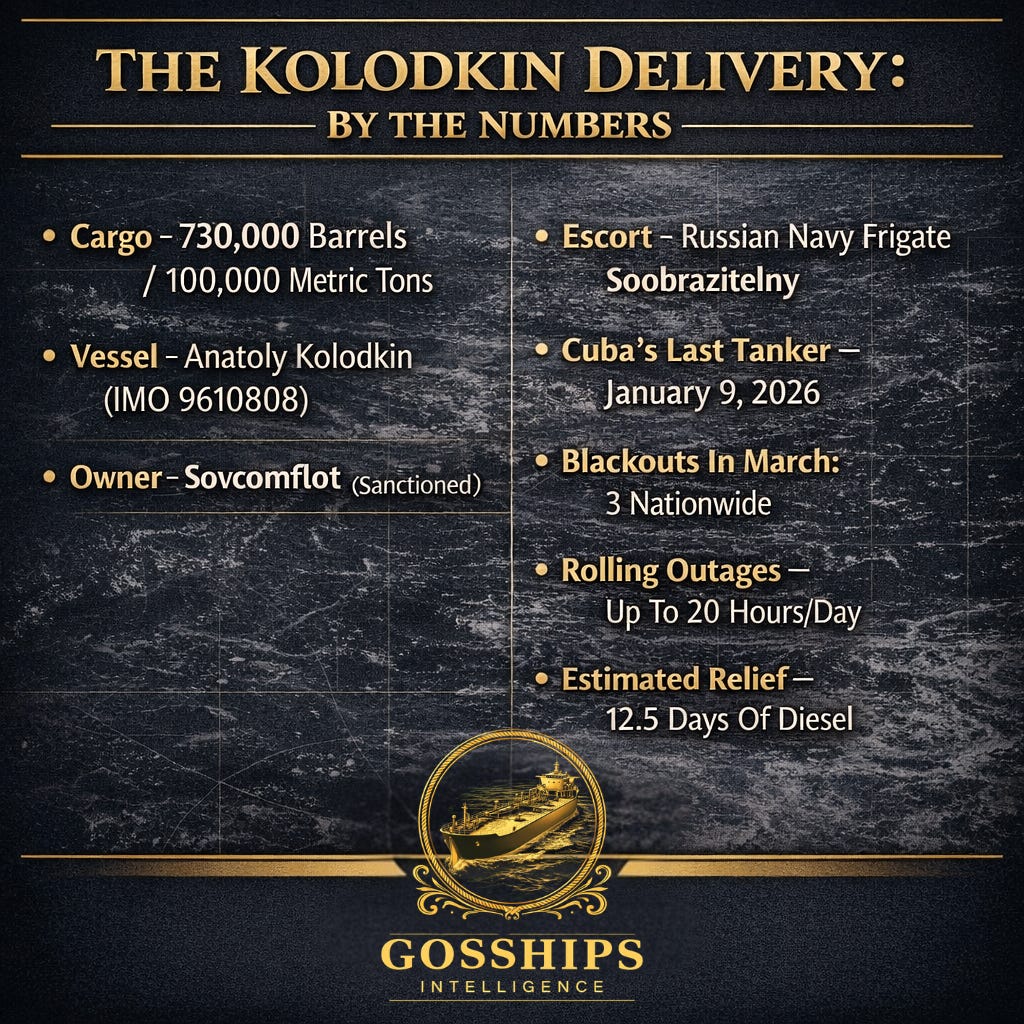
→ 730,000 Barrels: Crude Oil Loaded On Anatoly Kolodkin (Bloomberg, CiberCuba)
→ 100,000 Metric Tons: Cargo Weight (Russia Transport Ministry, Bloomberg)
→ IMO 9610808: Anatoly Kolodkin Vessel Identifier (Maritime Executive)
→ 118,316 DWT: Vessel Deadweight Tonnage (Maritime Executive)
→ 200,000 Barrels: Approximate Cargo On Second Tanker Sea Horse (Washington Post)
→ 3: Nationwide Blackouts In Cuba In March 2026 (NPR, Al Jazeera)
→ 20 Hours/Day: Rolling Power Outages In Cuba (Al Jazeera)
→ 8 of 16: Cuban Thermoelectric Plants Offline (IEEE Spectrum)
→ January 9: Last Time Cuba Received An Oil Tanker Before Kolodkin (President Diaz-Canel)
→ 12.5 Days: Estimated Diesel Supply From 730,000 Barrels Once Refined (Bloomberg, Univ. of Texas)
→ 544: Vessels Sanctioned By The UK (Washington Times)
→ ~600: Vessels Blacklisted By The EU (Euromaidan Press)
🔍 Why It Matters
The Kolodkin is not about 730,000 barrels. It is about what happens when a
