


|⚓About Us |🛢️Deep Water Reports |📋SwiftAction Training |
🏅Founding Black Gold Membership (*53 Slots Left)
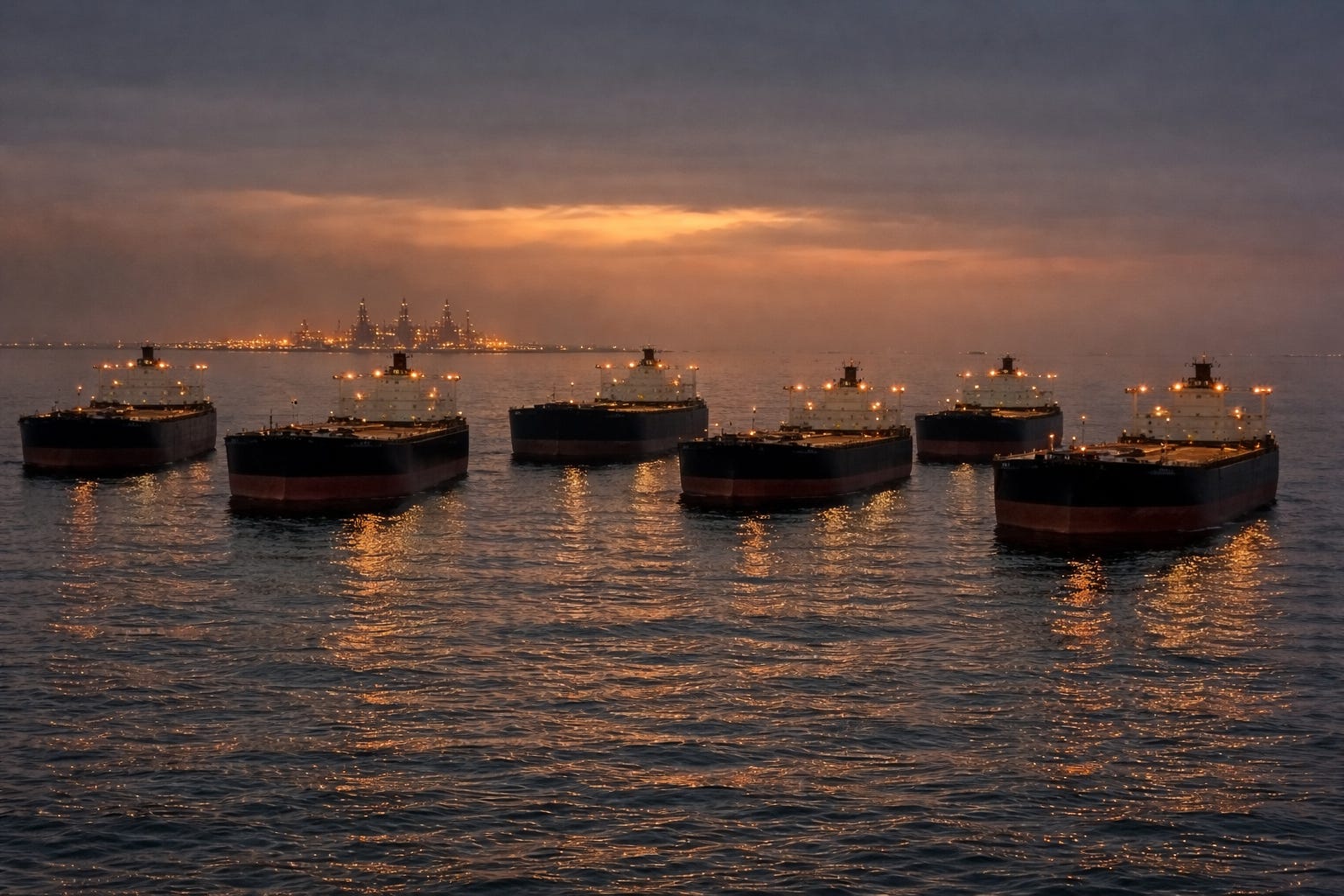
On January 29, 2026, a Sinokor-operated supertanker called the Singapore Loyalty crossed the Strait of Hormuz and sat empty inside the Persian Gulf.
Over the next four weeks, at least five more empty VLCCs followed, congregating in a cluster near Dubai with no cargo and no apparent commercial purpose, Bloomberg reported on March 14.
Exactly 30 days later, on February 28, the United States and Israel launched airstrikes on Iran. The Strait of Hormuz effectively shut down. Traffic collapsed by approximately 97%, according to Windward.
Those six empty ships became some of the most valuable commercial vessels on the planet. Brokers cited by Bloomberg say they are now earning an estimated $500,000 a day each as floating storage for oil producers who suddenly had nowhere to put their crude.
Bloomberg says it’s unclear whether Sinokor moved the ships into the Gulf in anticipation of the war, or if they were simply heading to a major oil-producing region in search of cargoes. The debate is the story.
📋 In this issue:
🛢️ The Story
📊 By the Numbers
🔍 Why It Matters
👀 What to Watch
⚓ Gosships Signal
📊 GOSSHIPS DATA CARD
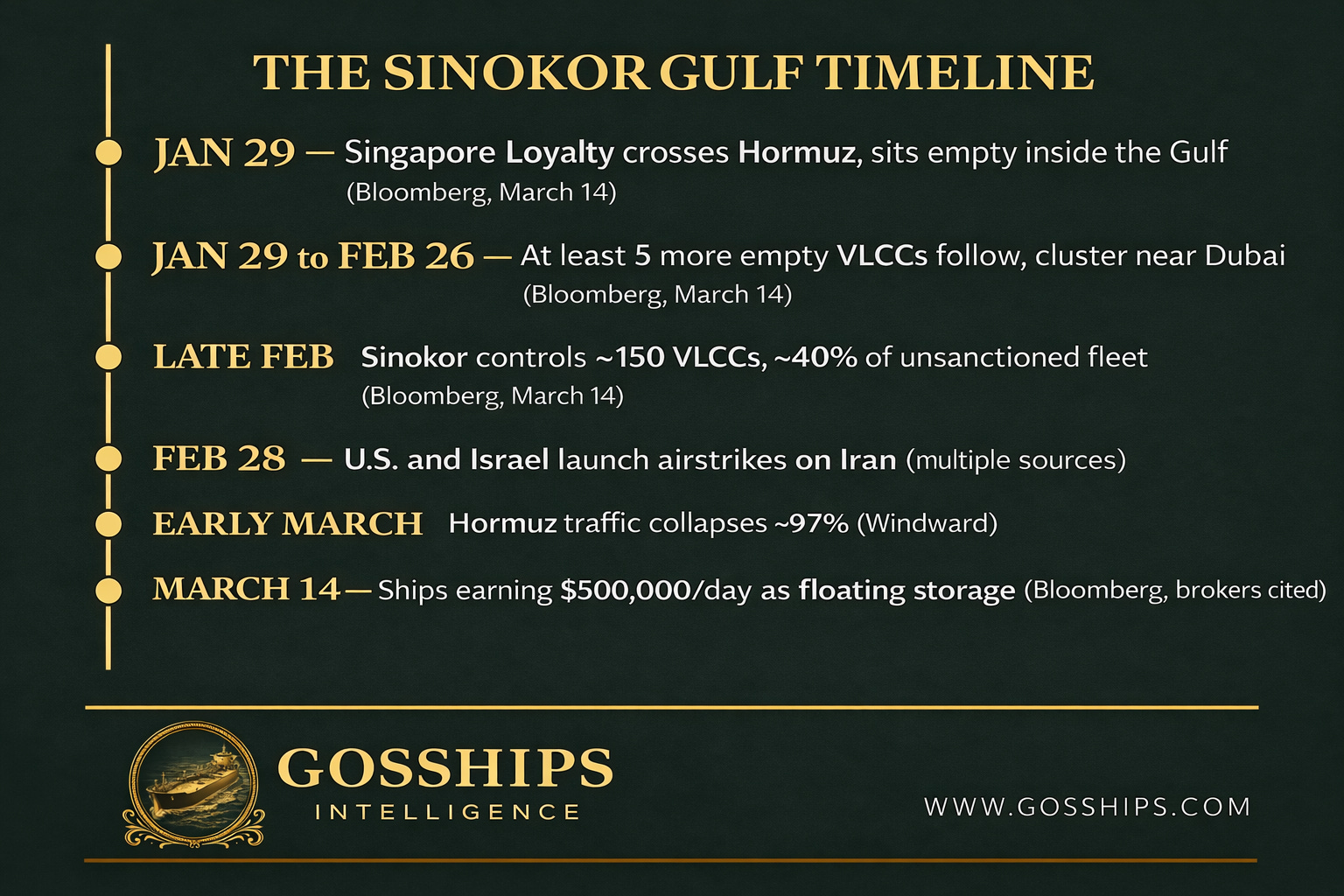
→ Jan 29: Singapore Loyalty crosses Hormuz, sits empty inside the Gulf (Bloomberg, March 14)
→ Jan 29 to Feb 26: At least 5 more empty VLCCs follow, cluster near Dubai (Bloomberg, March 14)
→ Late Feb: Sinokor controls ~150 VLCCs, ~40% of unsanctioned fleet (Bloomberg, March 14)
→ Feb 28: U.S. and Israel launch airstrikes on Iran (multiple sources)
→ Early March: Hormuz traffic collapses ~97% (Windward)
→ March 14: Ships earning $500,000/day as floating storage (Bloomberg, brokers cited)
🛢️ The Story
The question consuming the tanker market for the past three weeks is simple. Did Sinokor know the war was coming?
Bloomberg reported on March 14 that at least six Sinokor-operated VLCCs were moved into the Persian Gulf in the weeks before the U.S.-Iran conflict began on February 28. The first vessel, the Singapore Loyalty, crossed the Strait of Hormuz on January 29, Bloomberg reported. It sat empty inside the Gulf with no cargo. Over the following four weeks, at least five more vessels followed, gathering in a cluster near Dubai, according to Bloomberg’s March 14 report.
Bloomberg noted that “it’s not clear whether Sinokor moved the ships into the Gulf in anticipation of US military action, or if they were simply heading to a major oil-producing region in search of cargoes to pick up.”
That one line has become the most debated sentence in the shipping industry this month.
What happened next is not debatable. On February 28, the United States and Israel launched coordinated airstrikes on Iran. Within days, Iran’s Revolutionary Guards effectively shut down the Strait of Hormuz. Traffic through the waterway, which handles roughly 20% of the world’s oil and gas, collapsed by approximately 97%, according to Windward, the maritime intelligence platform. In the most recent seven-day window, Windward recorded just 16 AIS-visible crossings, consisting of 11 outbound and 5 inbound transits, according to Windward’s March 22 daily intelligence report.
With the Strait closed, onshore storage across the Gulf began filling rapidly. Oil producers in Iraq and Kuwait slowed production due to storage shortages, UPI reported on March 16 citing the Wall Street Journal. Those six Sinokor ships sitting empty near Dubai were suddenly among the few vessels available for hire by oil companies desperate for additional storage capacity.
Bloomberg reported on March 14 that the ships are now on charter as floating storage, earning Sinokor an estimated $500,000 a day each, according to brokers cited by Bloomberg. That rate is roughly ten times the average daily VLCC earnings from last year, Bloomberg noted. Sources told UPI that Sinokor is leasing several vessels to ADNOC, the United Arab Emirates’ state oil company, to be used as floating storage facilities, citing the Wall Street Journal.
The Gulf pre-positioning was the sharpest edge of a much larger play. Starting in late 2025, Sinokor began acquiring VLCCs at an extraordinary pace. By late February 2026, rivals estimated that Sinokor controlled approximately 150 supertankers, a number Bloomberg reported on March 14 equated to almost 40% of the ships at the time that were not either sanctioned or already tied up in long-term commitments.
A rival described the buying spree as “seismic,” according to Bloomberg’s February 26 report. The cost of hiring a VLCC for one year surged past $100,000 a day on average during the spree, a record in data going back to 1988, Bloomberg reported on March 14.
“They’ve controlled a big part of the fleet,” said Halvor Ellefsen, a London-based director at Fearnleys Shipbrokers UK Ltd, quoted by Bloomberg on March 14. He added that Sinokor had “sharpened competition, and ultimately sometimes have been able to name their price.”
“It is a fundamental shift in the ownership base,” said Lois Zabrocky, CEO of supertanker owner International Seaways Inc., on an earnings call reported by Bloomberg on February 26. “It’s got staying power.”
Carl Larry, an oil analyst at Enverus, offered a measured take when quoted by Bloomberg on March 14. “A good position is a little strategy and a little luck,” Larry said. He described Sinokor’s bet as “quite unusually advantageous.”
The full economics of the $500,000-a-day floating storage play, the Forbes investigation that traced 31 tankers through Panama corporate records to MSC’s Cyprus address, the $88 million payback math, and what all of it means for every broker, trader, and underwriter in the tanker market is below.
