


⚓ The Gosships Team
Gosships Intelligence Is Published At Gosships.com
For Sponsorship And Partnership Inquiries Contact intelligence@gosships.com
|⚓ About Us | 🛢️ Exclusive Report | 📋 SwiftAction Training |
🏅Black Gold Membership (*53 Slots Left)
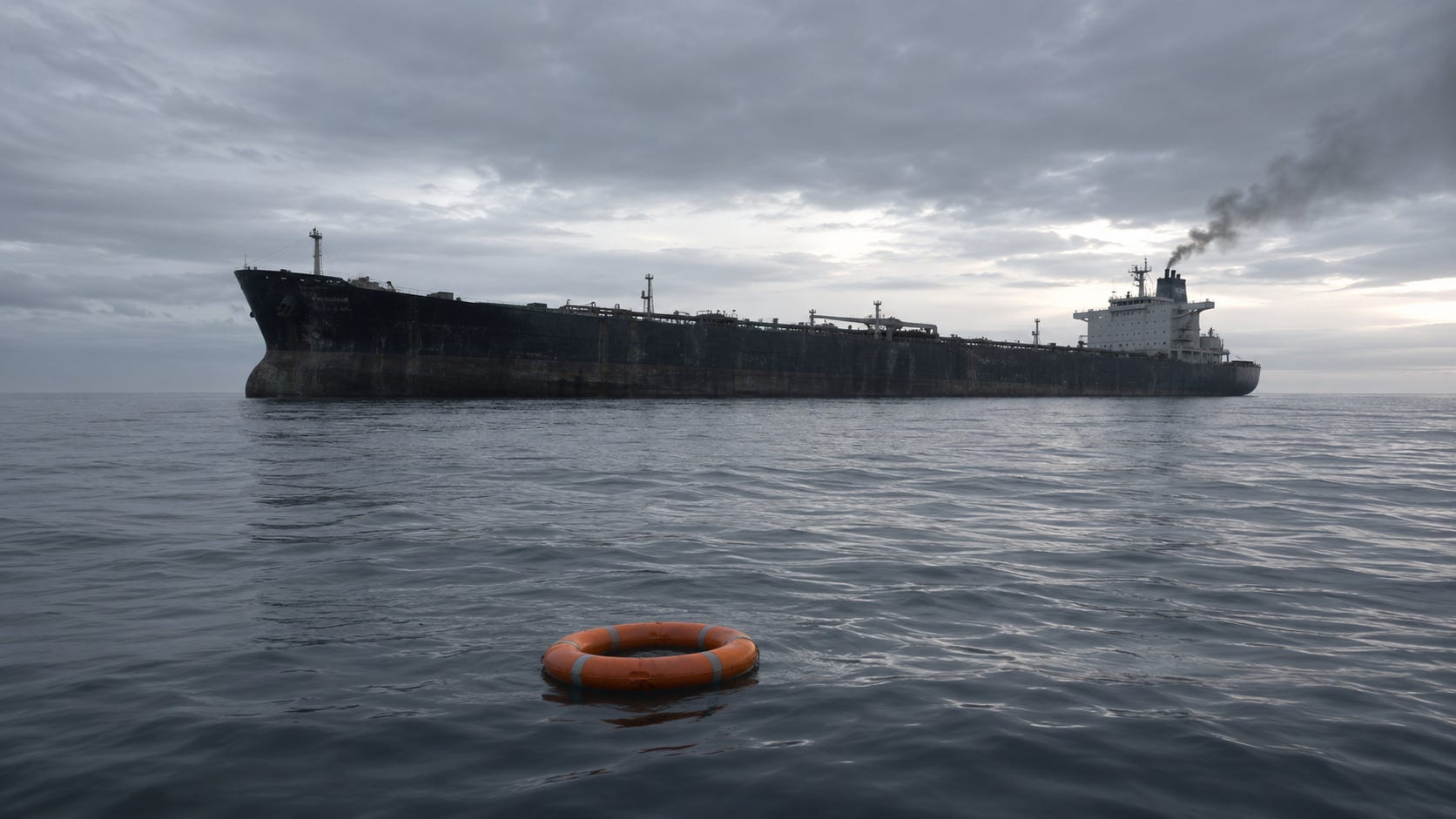
The blockade’s eighth tanker came with a cost the first seven did not. US Central Command confirmed Wednesday that its forces disabled the Palau-flagged products tanker Settebello in the Gulf of Oman, the second interdiction in two days, firing precision munitions into the engine room after the crew repeatedly ignored warnings while, by Washington’s account, carrying oil from Iran. Of the 24 Indian crew aboard, 21 were rescued, and by Thursday the Forward Seamen's Union of India was reporting that two of the three missing sailors had died, with the ship's Chief Engineer still unaccounted for. New Delhi formally condemned the attack and summoned the senior US diplomat in the country, the first such rupture between Washington and a major partner to surface in eight weeks of an enforcement campaign that, until this week, had reported no casualties at all.
📋 In This Issue:
🛢️ The Story
📊 By The Numbers
🔍 Why It Matters
👀 What To Watch
🚨 Gosships Signal
🔔 Not Yet Subscribed? Gosships Intelligence Delivers Oil Shipping Intelligence. Subscribe Here!
📊 Order Our Exclusive Report
→ Global Tanker Market Outlook Q3 2026 Edition
📋 Competency-Based Maritime Training
→ SwiftAction
📌 Gosships Data Card
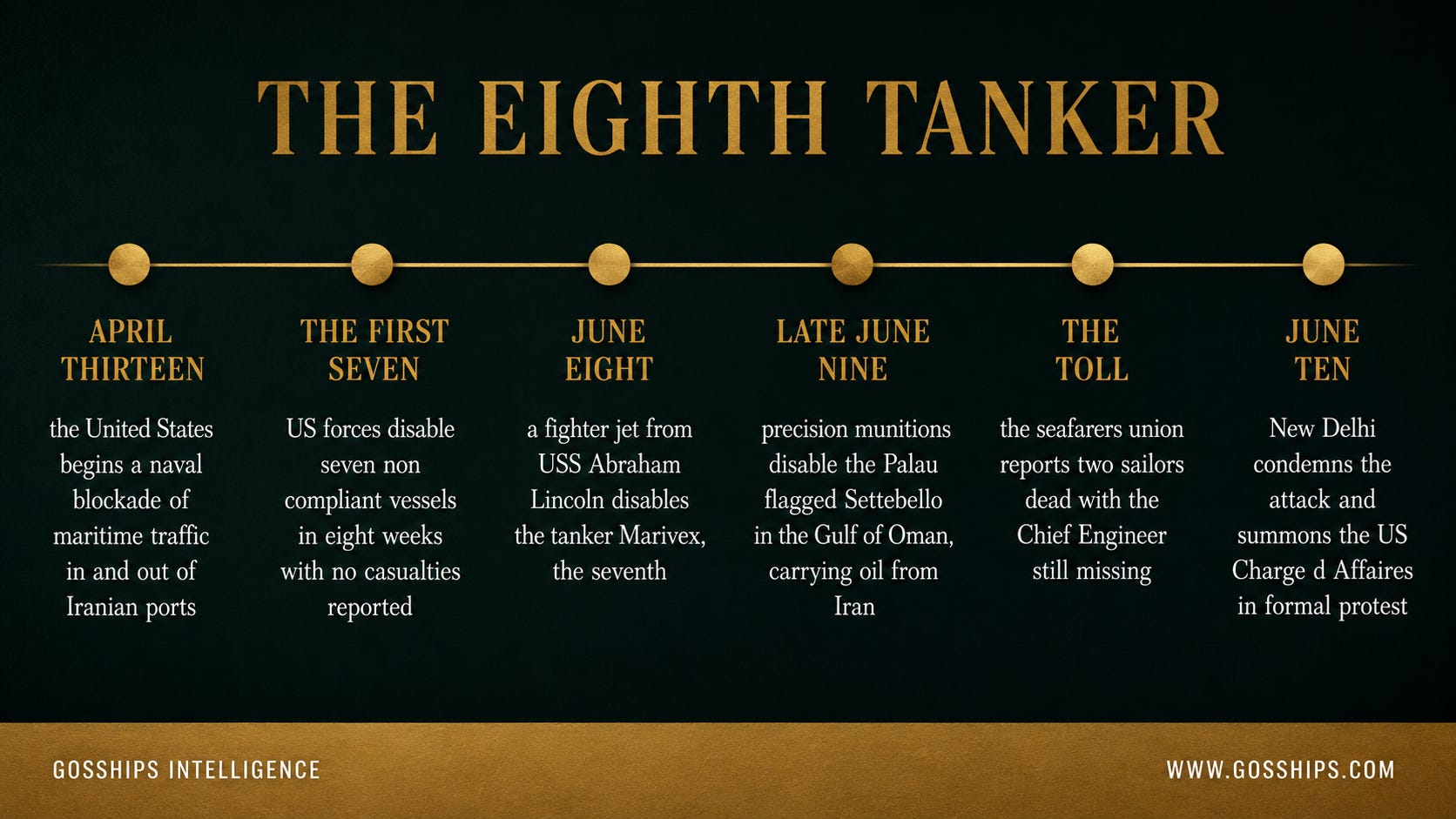
→ April 13: The United States Begins A Naval Blockade Of Maritime Traffic In And Out Of Iranian Ports
→ The First Seven: US Forces Disable Seven Non-Compliant Vessels In Eight Weeks With No Casualties Reported
→ June 8: A Fighter Jet From USS Abraham Lincoln Disables The Tanker Marivex, The Seventh
→ Late June 9: Precision Munitions Disable The Palau-Flagged Settebello In The Gulf Of Oman, Carrying Oil From Iran
→ The Toll: The Seafarers' Union Reports Two Sailors Dead With The Chief Engineer Still Missing
→ June 10: New Delhi Condemns The Attack And Summons The US Chargé d’Affaires In Formal Protest
🛢️ The Story
For eight weeks, the American blockade of Iran’s ports ran on a remarkable statistic: zero reported casualties. Seven tankers disabled, 134 ships warned off, 42 humanitarian vessels waved through, and not one report of a sailor hurt. That run ended this week. On Wednesday, US Central Command confirmed it had disabled the M/T Settebello, a Palau-flagged chemical and oil products tanker, as it transited the Gulf of Oman, saying the ship had “violated the ongoing blockade by attempting to transport oil from Iran.” A US aircraft fired precision munitions into the engine room, CENTCOM said, after the crew repeatedly failed to comply with American forces’ directions. The UK Maritime Trade Operations center had earlier relayed a report that the vessel experienced “a fire in their engine room,” placing the incident 20 nautical miles northeast of Sohar, Oman, and the Omani Navy answered the ship’s distress call, per maritime risk firm Vanguard. Ship-tracking data shows the tanker was partially laden and last broadcast a position off Oman on June 1, per MarineTraffic, and its India-based listed operator could not be reached by Reuters.
Then came the human toll, and it grew by the day. There were 24 Indian crew members aboard, India's Ministry of External Affairs said Wednesday: 21 rescued, three missing, with India's embassy in Oman coordinating the search and rescue with Omani authorities. UKMTO separately said the crew had reported one casualty, without details. By Thursday, the Forward Seamen's Union of India delivered the grimmer update: "two have died, while the Chief Engineer is still reported as missing," union general secretary Manoj Yadav told ANI, adding that the union had been unable to establish a connection with the ship. The union is also asking the question New Delhi has so far implied rather than stated: the US, in its telling, knew who was on board. CENTCOM, which has now specified it targeted the ship at 11:14 PM on June 9, US time, has not addressed the crew at all. It described the action as the second such operation in two days, following the disabling of the Marivex on June 8, and updated the campaign’s scoreboard: eight vessels disabled as violators since the blockade began April 13, 134 ships diverted, and 42 humanitarian vessels allowed through, while reiterating its call for de-escalation and a negotiated end.
New Delhi’s response went beyond protest into outright condemnation. “We condemn the attack on the commercial vessel Settebello,” the Ministry of External Affairs said in its official statement, adding that the targeting of commercial shipping and civilian infrastructure must end, per ABC News. Additional Secretary Nagaraj Naidu summoned Jason Meeks, the US Chargé d’Affaires in New Delhi, standing in for Ambassador Sergio Gor who was traveling, and Indian officials delivered what Reuters described as a strong protest over the strike. Read that again: a major US partner, the world’s most populous democracy and one of the largest employers of merchant seafarers on earth, formally condemning an American military strike on a civilian ship, with two of its citizens reported dead by their union.
The Settebello strike also marks a quiet shift in what the blockade is shooting at. The seventh tanker, the Marivex, was disabled on June 8 while sailing empty toward an Iranian port; the sixth, the Lexie, was also unladen, headed for Kharg Island. Those strikes targeted Iran’s inbound logistics, the empty ships that would become its exports or floating storage. The Settebello, partially laden by ship-tracking data and carrying Iranian oil by Washington’s account, was running the other direction, moving barrels away from the blockade. Hitting a ship with cargo aboard is a different proposition entirely: crew in the engine spaces the munitions are aimed at, a fire reported in exactly those spaces, and a hull that becomes an environmental question the moment it is disabled in open water.
And the timing could hardly be more combustible. The strike on the Settebello landed in the middle of the sharpest escalation of the war so far: the downing of a US Apache helicopter near Hormuz earlier this week, American strikes on Iranian air-defense and radar sites in response, Iranian missiles launched at US-linked targets in Jordan and across the Persian Gulf, most of them intercepted according to US officials cited by RFE/RL, and a second night of US strikes beginning Wednesday evening. President Trump told reporters at the White House on June 10 that the United States would keep hitting Iran hard without a finalized peace deal, even as a Qatari delegation traveled to Tehran the same day, after consulting Washington, to try to close the remaining gaps in negotiations, per AFP reporting cited by RFE/RL.
Gosships Read: The blockade’s political armor has always been its precision. Eight weeks, seven hulls, no blood: that record let Washington describe the campaign as surgical pressure rather than war on shipping, and let allied governments look away. Two dead Indian seafarers, by their union's account, ends that. The world’s merchant crews come overwhelmingly from a handful of labor markets, India and the Philippines chief among them, and every manning agency, every seafarers’ union, and every government with citizens at sea just learned that a blockade-running tanker’s engine room can contain their nationals when the munition arrives. The military arithmetic of the blockade has not changed. The human and diplomatic arithmetic changed at 11:14 PM on June 9.
Who crews the shadow fleet and how 24 Indian sailors ended up aboard a sanctioned blockade runner, what a loaded and disabled tanker means for the waters off Oman, how New Delhi's protest could reshape the enforcement rules, and what every owner, charterer, and underwriter with crews in the region should do about it, is below.
📊 By The Numbers
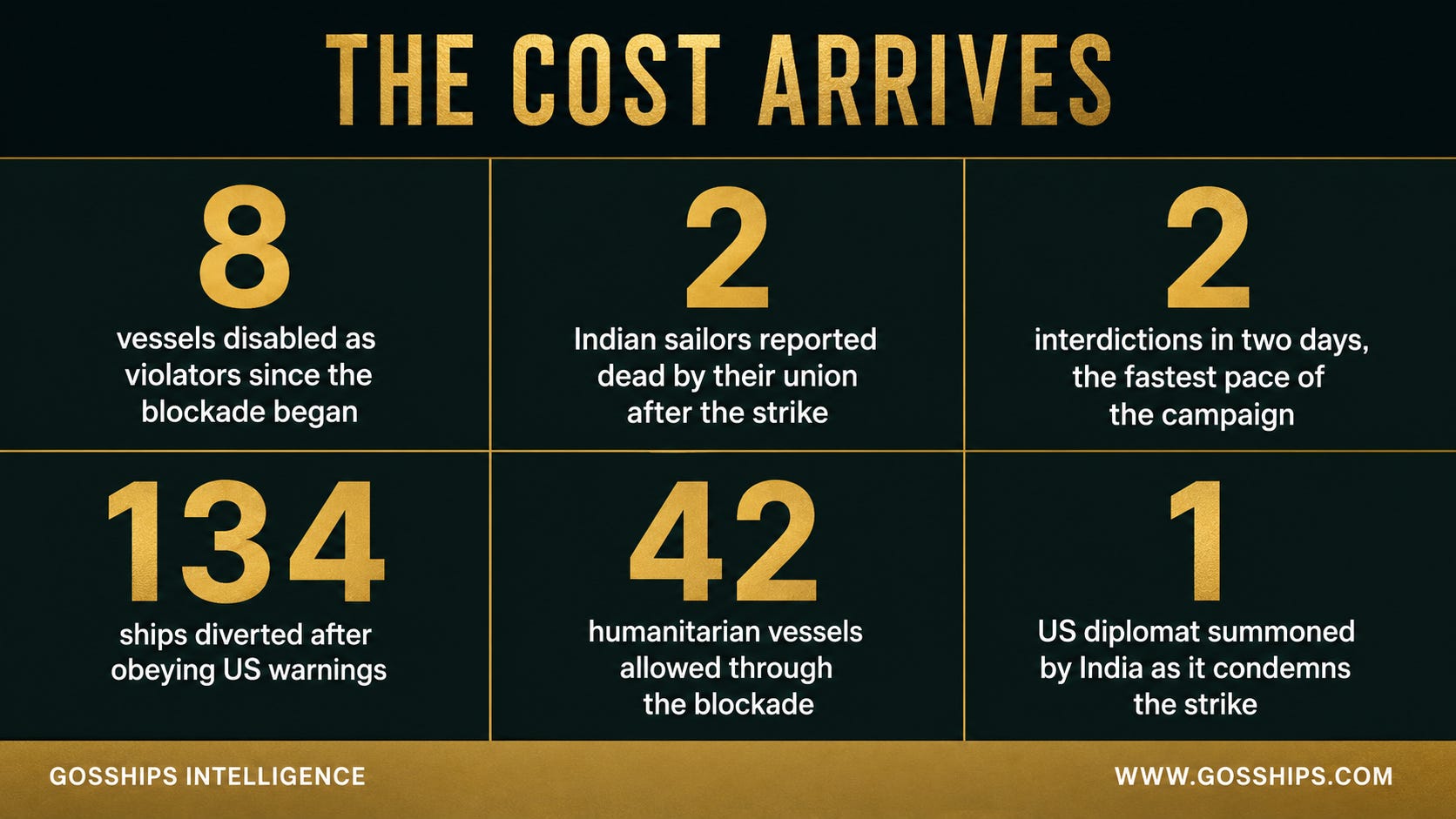
→ 8: Vessels Disabled As Violators Since The Blockade Began (CENTCOM)
→ 2: Indian Sailors Reported Dead By Their Union After The Strike (FSUI, Via ANI)
→ 2: Interdictions In Two Days, The Fastest Pace Of The Campaign (CENTCOM)
→ 134: Ships Diverted After Obeying US Warnings (CENTCOM)
→ 42: Humanitarian Vessels Allowed Through The Blockade (CENTCOM)
→ 1: US Diplomat Summoned By India As It Condemns The Strike (Reuters / Indian MEA)
Related Coverage
A US Fighter Jet Just Disabled the Seventh Tanker to Defy the Iran Blockade. 134 Ships Turned Back When Warned. The Shadow Fleet Keeps Coming. Why?
Gulf State Oil Companies Are Running Tankers Dark Through Hormuz
Who put 24 Indian sailors on a sanctioned blockade runner, what a loaded, disabled tanker drifting off Oman means for everyone underwriting these waters, and whether New Delhi's protest forces Washington to change its rules of engagement, is below.
