


⚓ The Gosships Team
Gosships Intelligence Is Published At Gosships.com
For Sponsorship And Partnership Inquiries Contact intelligence@gosships.com
|⚓ About Us | 🛢️ Deep Water Reports | 📋 SwiftAction Training |
🏅 Founding Black Gold Membership (*53 Slots Left)
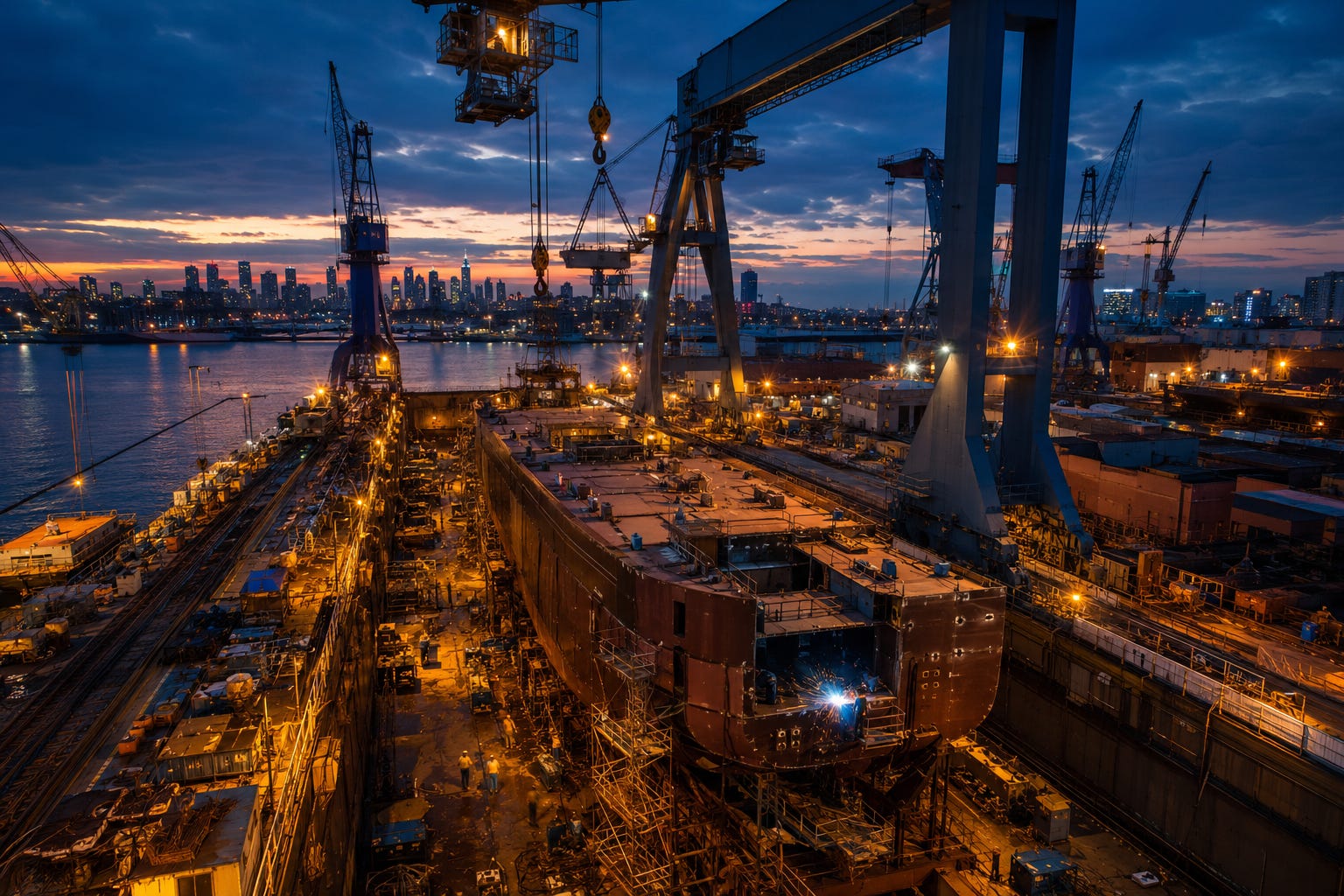
The three South Korean companies that dominate global shipbuilding, trailing only China, are together committing tens of billions of dollars to building ships on American soil. Hanwha, HD Hyundai, and Samsung Heavy Industries are pouring money and expertise into US shipyards under a Korea-US pact with a name borrowed straight from the politics of the moment: MASGA, Make American Shipbuilding Great Again. In May 2026, Korea’s trade minister and the US Commerce Secretary signed the memorandum that formally set it in motion.
The numbers are staggering. The two governments have agreed on a $350 billion investment framework, of which $150 billion is earmarked for shipbuilding cooperation. Hanwha alone is spending $5 billion to transform a Philadelphia yard that builds about one ocean-going ship a year into one that builds twenty. HD Hyundai is serving as Korea’s anchor investor. Samsung Heavy has tied up with a US shipbuilder. For perspective, these are companies whose Korean yards build a ship roughly every week, while the US produces a fraction of a percent of the world’s commercial ships.
And the entire effort turns on a single American law written in 1920. Here is the full picture, sourced entirely from Hanwha, the US Maritime Administration, the Cato Institute, the Korea Herald, Lloyd’s List, the Philadelphia Inquirer, and named reporting.
📋 In this issue:
🛢️ The Story
📊 By The Numbers
🔍 Why It Matters
👀 What to Watch
🚨 Gosships Signal
📊 Get The Deep Water Report
→ Global Tanker Market Outlook Q2 2026
📋 Competency-Based Maritime Training
→ SwiftAction
📌 Gosships Data Card
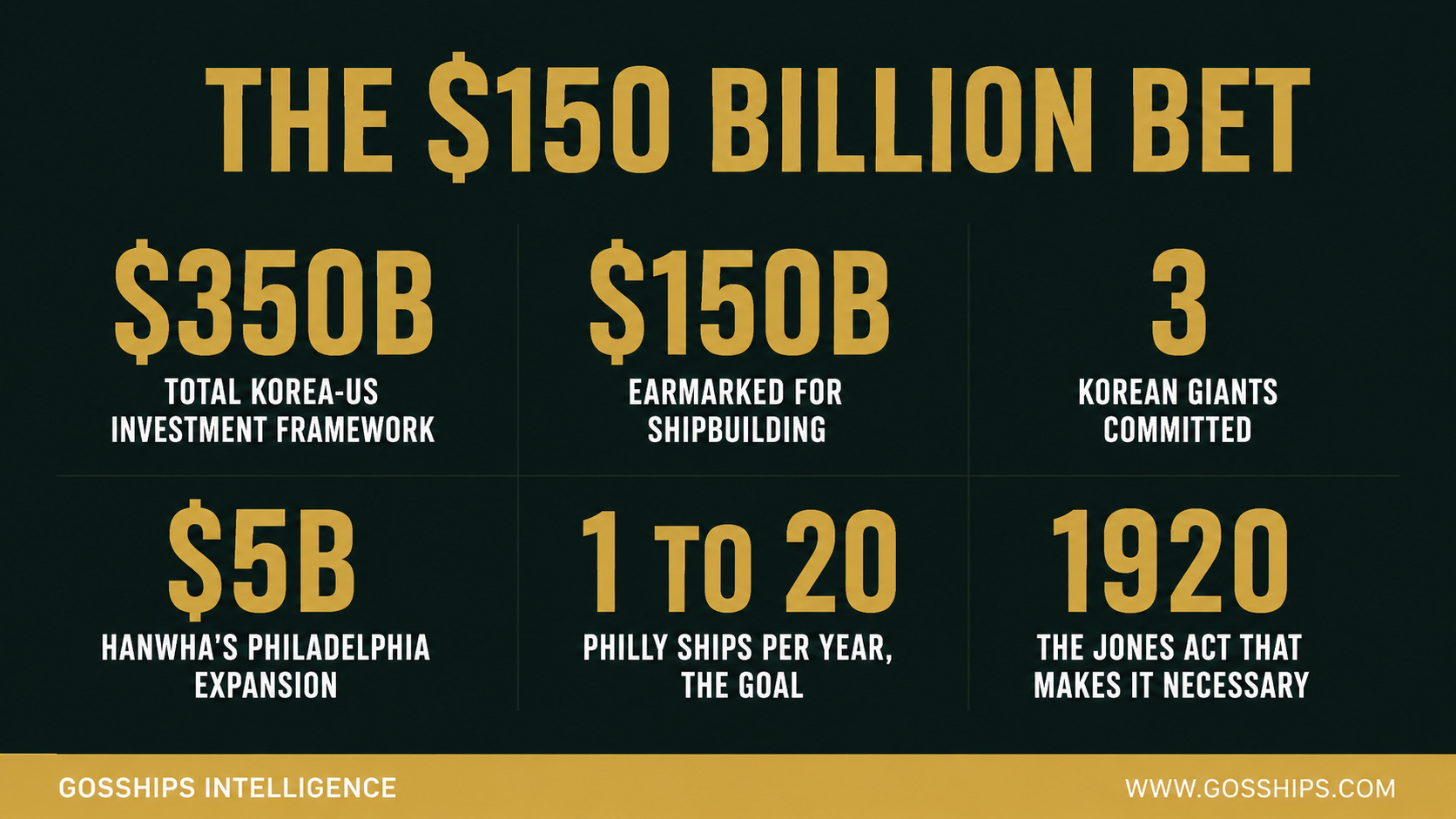
→ Total Framework: A $350 Billion Korea-US Investment Framework, With $150 Billion Earmarked For Shipbuilding Cooperation Per South Korean Government Via Lloyd’s List And Korea Herald
→ The Initiative: MASGA, Make American Shipbuilding Great Again, Led By Korean Companies Per South Korean Government
→ The Three Giants: Hanwha, HD Hyundai, And Samsung Heavy Industries Have All Committed To US Shipbuilding Per Lloyd’s List
→ Hanwha’s Investment: A $5 Billion Plan To Expand Its Philadelphia Yard From Roughly One Vessel Per Year To Up To 20 Per Hanwha
→ The Cost Gap: US-Built Ships Cost Approximately Five Times Their South Korean Equivalents Per Cato Institute
→ The Linchpin: The Jones Act Of 1920 Requires Domestic-Trade Ships To Be Built In The US, Which Is Why Korea Must Invest Onshore Per Merchant Marine Act
🛢️ The Story
The Law That Makes It Necessary.
The Jones Act, formally the Merchant Marine Act of 1920, requires that any vessel carrying cargo between two US ports be built in America, owned by Americans, and crewed by Americans. This is the hinge the entire MASGA project turns on. Because the Jones Act forbids putting foreign-built ships into domestic US trade, the Korean giants cannot simply build vessels at home and sail them over. To participate in the American market, they have to build on American soil, with American workers. The century-old law is precisely why $150 billion of Korean money is flowing into US yards rather than into more orders at Geoje or Ulsan. The Jones Act is not an obstacle to MASGA. It is the reason MASGA exists.
The Three Giants.
The scale of the Korean move is what sets it apart. Under the MASGA umbrella, all three of Korea’s shipbuilding champions have committed to the US at the same time. Hanwha is the furthest along, with its $5 billion Philadelphia expansion. HD Hyundai, Korea’s largest shipbuilder, is serving as the anchor investor, having signed a multi-billion-dollar maritime investment deal with the US private equity firm Cerberus Capital and the Korea Development Bank. Samsung Heavy Industries has formed a US shipbuilding partnership with General Dynamics’ NASSCO and opened its first US research center. Together, three competing national champions committing to the same foreign market at once is a degree of concentration with few precedents in the sector. In May 2026, South Korea’s industry minister and US Commerce Secretary Howard Lutnick signed a memorandum of understanding formally launching the partnership, the step that moved MASGA from framework to action.
Hanwha’s Philadelphia Bet.
Hanwha is the clearest window into how this works in practice. In December 2024, the sprawling South Korean conglomerate, with arms in energy, defense, and shipbuilding, bought the historic Philly Shipyard for $100 million. The yard carries enormous symbolic and strategic weight. According to Hanwha, it has delivered roughly half of all large oceangoing Jones Act commercial ships built in the United States since 2000. In August 2025, Hanwha announced a $5 billion plan to transform the yard with new dry docks, expanded quays, and advanced production facilities, with the stated goal of lifting annual output from roughly one vessel to as many as twenty within a decade.
The plan rides a wave of political momentum. The Trump administration has made reviving American shipbuilding a national priority, and the expansion followed summit talks between US President Donald Trump and South Korean President Lee Jae Myung, which included a pledged South Korean shipbuilding investment fund. Hanwha’s own shipping arm has put money where the policy is, ordering ten medium-range oil and chemical tankers from its own Philadelphia affiliate, with the first expected by early 2029.
The Scale Of The Climb.
The distance between today and twenty ships a year is vast. Hanwha’s flagship yard on Geoje Island in South Korea builds at a rate of nearly one ship per week, according to the Philadelphia Inquirer and CBS News. The Philadelphia yard builds about one a year. Closing that gap means not just new docks but thousands of newly trained workers, automation, and robotics that do not yet exist on the site. Hanwha has sent dozens of Korean trainers to Philadelphia and is running multi-year training programs for American welders and pipefitters.
The Number That Decides It.
This is where the economics come into focus. According to an analysis by the Cato Institute, a think tank that has long criticized the Jones Act, US-built ships cost approximately five times their South Korean equivalents. The yard is currently building three container ships at a cost of about $335 million each. Comparable and far larger ships, capable of carrying many times the cargo, are built in leading Asian yards for under $270 million. Cato characterized the Philadelphia-built vessels as among the most expensive container ships ever constructed, and noted that the United States accounts for roughly 0.04% of global commercial shipbuilding output.
That gap is the crux of the whole story. In open global markets there is little appetite for vessels priced several times higher than the alternative, so the orders that fill a twenty-ship-a-year yard have to come from somewhere specific: the protected Jones Act trade, government programs, and strategic buyers for whom American-built matters more than price. Understanding where that demand comes from, and whether it is deep enough, is the key to understanding whether the bet pays off. The same Jones Act protection that makes the ships viable at all is also what concentrates the market, and that is the dynamic worth watching.
📊 By The Numbers
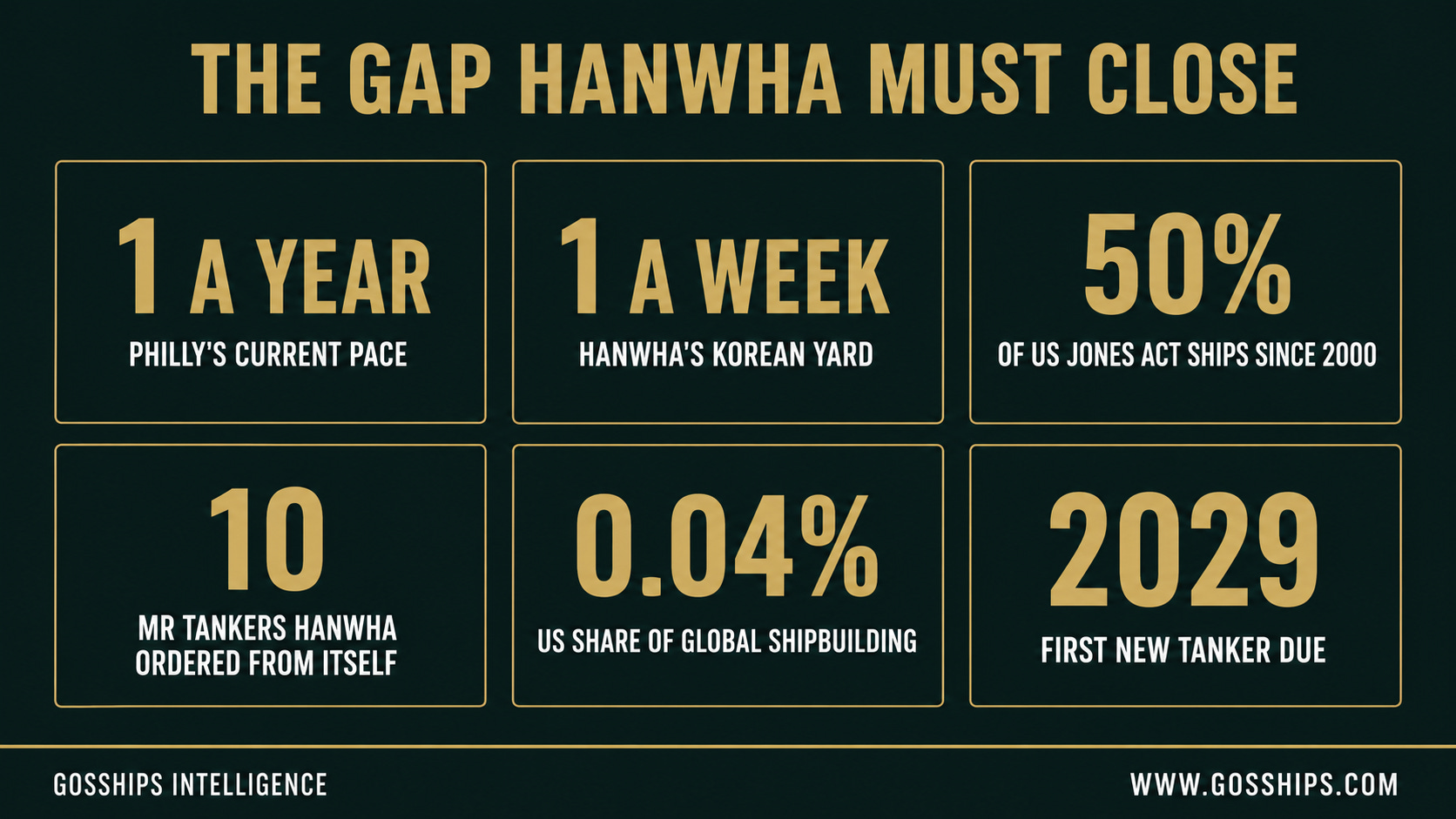
→ Current Pace: Philly Shipyard Has Delivered Roughly One Vessel Per Year Per CBS News And Hanwha
→ Korean Benchmark: Hanwha’s Geoje Island Yard In South Korea Builds At A Rate Of Nearly One Ship Per Week Per Philadelphia Inquirer And CBS News
→ Track Record: The Yard Has Built Roughly 50% Of All Large Oceangoing Jones Act Commercial Ships Since 2000 Per Hanwha
→ Self-Order: Hanwha Shipping Ordered 10 MR Oil And Chemical Tankers From Its Own Affiliate, Hanwha Philly Shipyard Per Hanwha
→ US Global Share: The US Accounts For About 0.04% Of Global Commercial Shipbuilding Output Per Cato Institute
→ First Delivery: The First Of The 10 New Tankers Is Expected By Early 2029 Per Hanwha
📰 Related Coverage
Greek Shipowners Just Ordered Nearly Half Of Every New Ship On Earth In 2026. One Man Ordered 12 Supertankers.
In 3 Days, 40,000 People Land In Athens For The Most Important Week In Shipping.
Found this useful? Share Gosships Intelligence with a colleague.
Why the cost gap is the whole story. What the tiny Jones Act fleet means for the order book. Why national security may matter more than price. And the one thing that would make the entire bet pay off. Below.
🔍 Why It Matters
The Hanwha bet is a direct test of whether the United States can rebuild a commercial shipbuilding industry that has spent roughly fifty years in decline. How it resolves matters far beyond one yard in Philadelphia.
