


⚓ The Gosships Team
Gosships Intelligence Is Published At Gosships.com
For Sponsorship And Partnership Inquiries Contact intelligence@gosships.com
|⚓ About Us | 🛢️ Exclusive Report | 📋 SwiftAction Training |
🏅Black Gold Membership (*53 Slots Left)
Put yourself in the position of a tanker owner this spring with a ship that needs to pass through the Strait of Hormuz. You have, in theory, three ways to get cleared. You can pay Iran for passage. You can wait for the United States to escort you under its government-backed insurance plan. Or you can buy private war cover on the open market and run it. The trouble is that all three are now blocked, broken, or beside the point, and understanding why is the clearest way to understand why the world’s most important oil chokepoint is still effectively shut.
This is not a question of options. The options exist. It is a question of whether any of them actually gets a ship safely and legally through the water, and at the moment, none of them does. One route exposes you to US sanctions. One has not moved a single vessel under its protection. And one does not touch the risk that is actually keeping owners away. Walk through the three doors in turn and the same wall sits behind each of them.
📋 In this issue:
🛢️ The Story
📊 By The Numbers
🔍 Why It Matters
👀 What to Watch
🚨 Gosships Signal
🔔 Not yet subscribed? Gosships Intelligence Delivers Oil Shipping Intelligence. Subscribe For Free!
📊 Order Our Exclusive Report
→ Global Tanker Market Outlook
Q3 2026 Edition
📋 Competency-Based Maritime Training
→ SwiftAction
📌 Gosships Data Card
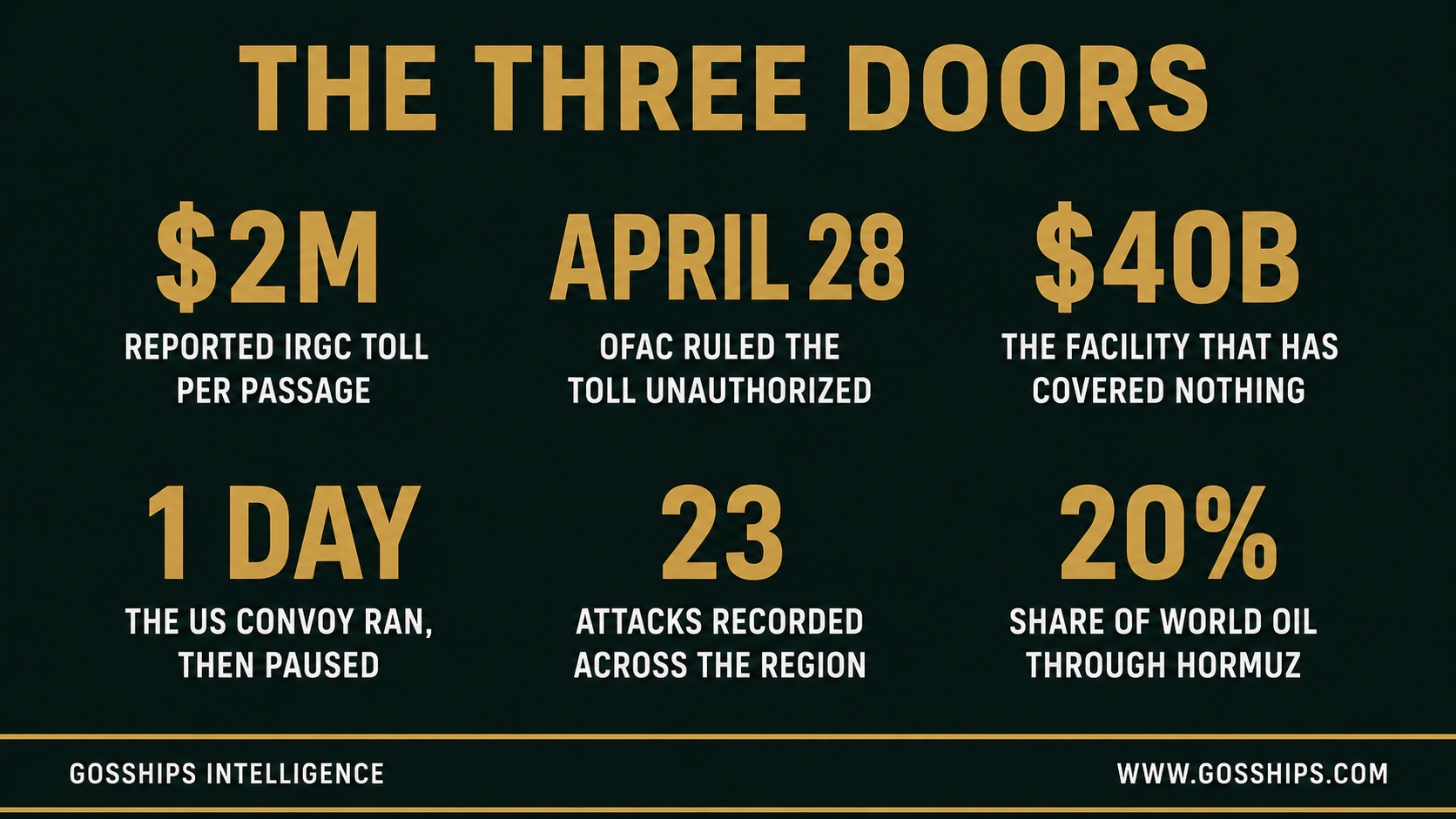
→ The Toll Route: Iran’s IRGC Has Reportedly Charged Up to $2 Million Per Passage Per the Financial Times
→ The Sanctions Wall: OFAC Ruled on April 28 That Paying for Safe Passage Is Not Authorized Per OFAC FAQ 1249
→ The Insurance Route: The US-Backed $40 Billion Facility Has Written Zero Business Per Insurance Business
→ The Convoy: The US Escort Operation Was Paused One Day After It Began Per Wikipedia and CNN
→ The Danger: The Joint Maritime Information Center Listed 23 Attacks Across the Region Per the Lloyd’s Market Association
→ The Stakes: Roughly 20% of the World’s Oil Normally Passes Through the Strait of Hormuz Per the Lloyd’s Market Association
🛢️ The Story
This is a story about three exits from the same trap, and how each one turns out to be sealed.
Door one: pay Iran. Once Iran moved to control the strait, an informal market in passage appeared. According to reporting by the Financial Times, Iran’s Islamic Revolutionary Guard Corps has been charging tanker operators a fee, reported at up to $2 million per passage, with clearance confirmed over VHF radio, and Lloyd’s List Intelligence reported that roughly 89 to 90 vessels transited under some form of IRGC clearance in the first two weeks of March. For an owner with a ship at anchor and a cargo to move, paying to get through can look like the pragmatic choice. It is also, for many, a trap. On April 28, the US Treasury’s Office of Foreign Assets Control issued formal guidance, FAQ 1249, stating that payments to the Government of Iran or the IRGC for safe passage through the strait are not authorized for US persons, and that they create significant sanctions exposure for non-US persons as well, including foreign financial institutions that risk losing access to the US banking system. Washington has since gone further and sanctioned the Iranian body administering the toll, the so-called Persian Gulf Strait Authority, warning that anyone cooperating with it may be supporting the IRGC. The door is open, but stepping through it can cost an owner their access to dollars, their banking relationships, and, as their insurers have warned, potentially their cover.
Door two: transit under the US-backed plan. The United States built what was meant to be the legitimate alternative. Through its Development Finance Corporation, Washington created a maritime reinsurance facility, with Chubb as lead underwriter and six more American insurers behind it, scaled to $40 billion in coverage and announced by President Trump as the mechanism to get energy moving through the strait again. But the facility carries a defining condition: coverage applies to vessels transiting under US naval escort. And the escort is the part that has not held. The US launched its convoy operation, Project Freedom, on May 4, and paused it roughly a day later, with the President citing progress toward a possible agreement with Iran. The facility, for its part, has written zero business. Not one dollar of coverage has been placed under it, and not one vessel has transited under its protection. The legitimate door was built to open only when American warships are escorting ships through, and that escort has so far been the briefest of demonstrations rather than a standing service.
Door three: buy private cover and run it. The third option is the oldest one: purchase war risk insurance on the commercial market and simply make the transit. Here the news is better than the headlines suggest, and it complicates the story in an important way. The Lloyd’s Market Association, which represents the London marine market, has stated plainly that war insurance remains available in the Lloyd’s and London market for vessels wishing to transit Hormuz, that liability cover through the P&I clubs is non-cancellable and still reinsured, and that only a small number of fixed-premium charterer covers were cancelled or repriced. A survey of the market found that the overwhelming majority of participants retained their appetite to write the risk. In other words, the paper is available. The reason ships are not moving, the association argues, is not insurance at all. It is safety. With attacks recorded on a wide range of vessels across the region, owners are declining to send their crews into the line of fire, coverage or no coverage.
The wall behind all three. Line the doors up and the pattern is unmistakable. The Iranian route is blocked by sanctions. The US route is blocked by the absence of the convoy it depends on. And the private route is not blocked at all, which is precisely what proves the point: even with coverage freely available, owners still will not go, because the thing stopping them was never a missing policy or a closed insurance market. It was, and remains, a war in the water. The full implications for owners, insurers and the oil market are below.
📊 By The Numbers
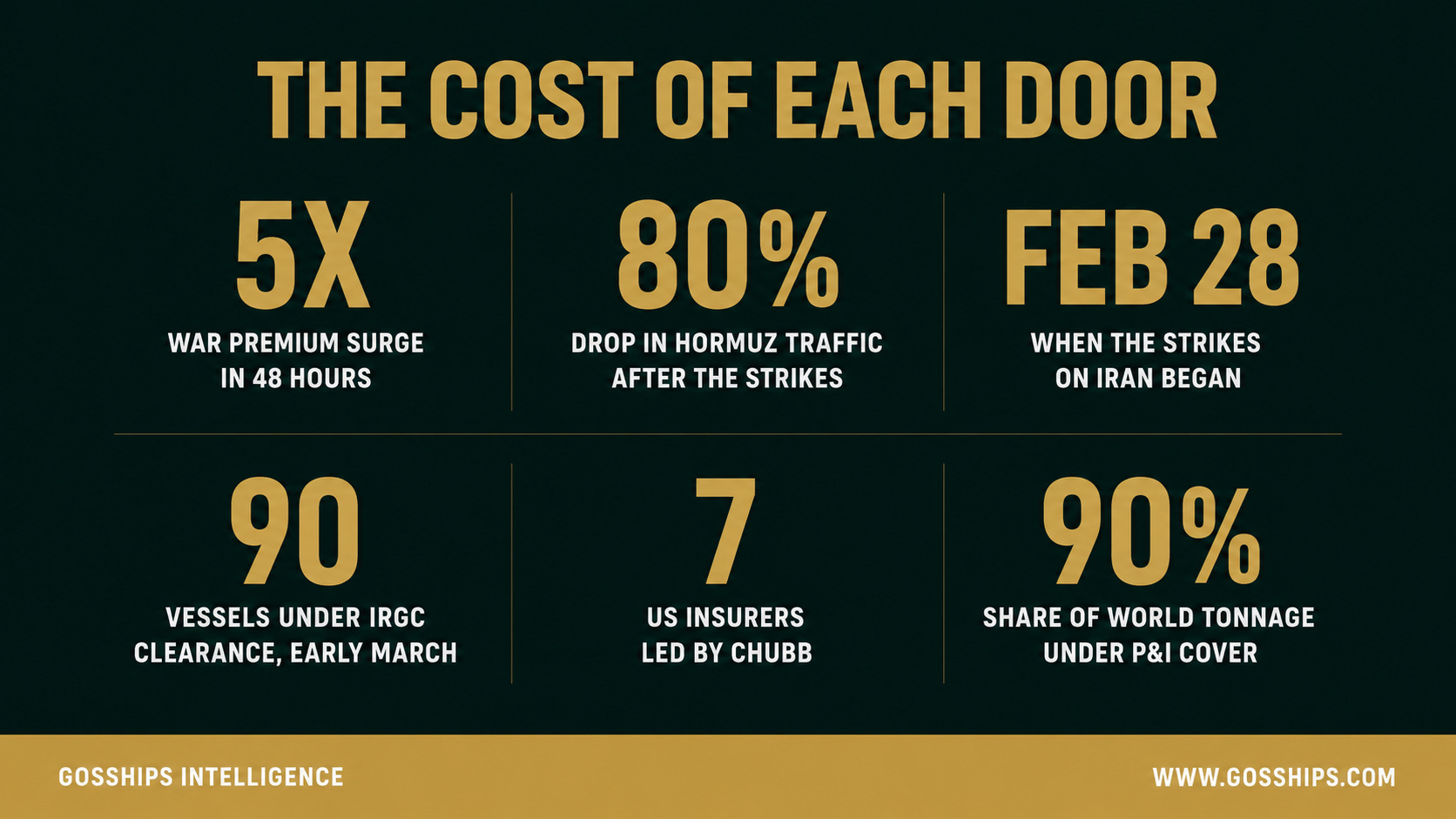
→ The Spike: War Risk Premiums Surged Roughly Fivefold Within 48 Hours of the Strikes Per Insurance Business
→ The Collapse: Hormuz Traffic Fell More Than 80% Before Iran’s Physical Blockade Was Declared Per Windward
→ The Trigger: US and Israeli Strikes on Iran Began on February 28 Per Insurance Business
→ The Toll Traffic: Roughly 89 to 90 Vessels Transited Under IRGC Clearance Between March 1 and 15 Per Lloyd’s List Intelligence
→ The Backers: Chubb Leads Six Further US Insurers in the Facility Per the DFC
→ The Reach: The International Group of P&I Clubs Covers About 90% of the World’s Oceangoing Tonnage Per S&P Global
Found this useful? Share Gosships Intelligence with a colleague.
Why the sanctions trap on the Iranian toll is tighter than it looks. What the paused convoy reveals about the US plan. Why the insurers insist the problem was never theirs. Below.
🔍 Why It Matters
The three-doors framing is not just a way to organize the chaos. It isolates exactly where the binding constraint sits, and it is not where the policy response assumed it was.
