
|⚓ About Us | 🛢️ Deep Water Reports | 📋 SwiftAction Training |
🏅 Founding Black Gold Membership (*52 Slots Left)
The global oil market is now exposed to simultaneous pressure across three critical export nodes for the first time in modern history, according to Windward’s March 30 maritime intelligence analysis. The Strait of Hormuz remains effectively closed under IRGC control, with transit volumes down 90 to 95% since the war began on February 28, according to Kpler and CBS News. Russia’s Ust-Luga port on the Baltic Sea has sustained its fifth Ukrainian drone attack in seven days, according to Bloomberg and gCaptain. Reuters reported on March 25 that at least 40% of Russia’s oil export capacity, approximately 2 million barrels per day, is at a halt, calling it “the most severe oil supply disruption in the modern history of Russia.” And on March 28, Yemen’s Houthis launched their first missile strikes on Israel since the war began, according to PBS and CNN, threatening to extend their campaign to the Bab al-Mandab Strait, the chokepoint that controls access to the Suez Canal and through which Saudi Arabia’s entire Yanbu bypass must flow. Combined disruption potential across all three chokepoints: approximately 27 million barrels per day. The IEA’s March 12 Oil Market Report characterized the Hormuz closure alone as the largest supply disruption in the global oil market’s history. Since then, two additional chokepoints have come under pressure.
📋 In this issue:
🛢️ The Story
📊 By The Numbers
🔍 Why It Matters
👀 What to Watch
🚨 Gosships Signal
📊 Get The Deep Water Report
→ Global Tanker Market Outlook Q2 2026
📋 Competency-Based Maritime Training
→ SwiftAction
📌 Gosships Data Card
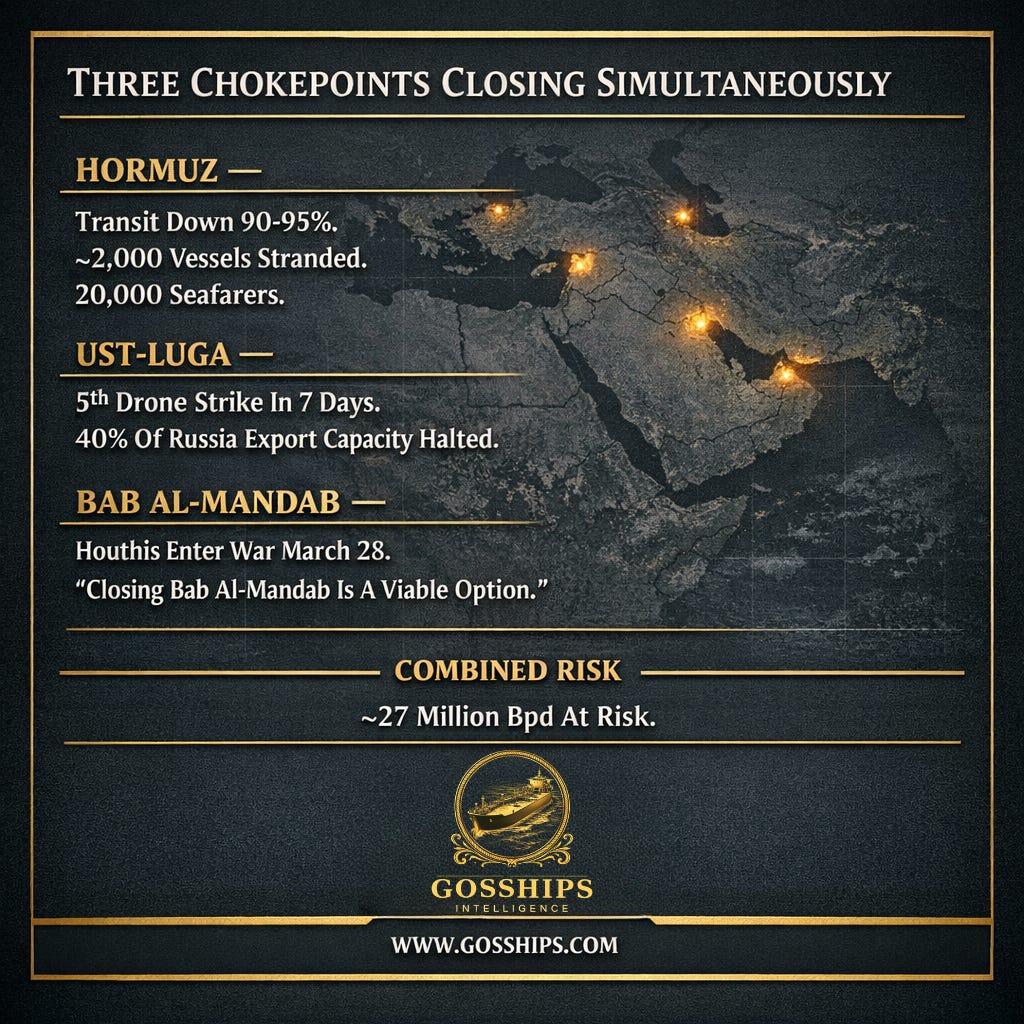
→ Hormuz: Transit Down 90-95% Since February 28. ~2,000 Vessels Stranded. 20,000 Seafarers Stuck. (Kpler, CBS News, IMO)
→ Ust-Luga: 5th Ukrainian Drone Strike In 7 Days. Fire At Novatek Oil Storage Tanks. (Bloomberg, gCaptain, Kyiv Independent)
→ KINEF Refinery (Kirishi): Complete Halt After Drone Strike. 350,000 Bpd Offline. (Ukrainska Pravda, US News)
→ Russia Export Capacity: 40% Halted, ~2 Million Bpd. “Most Severe Disruption In Modern Russian History.” (Reuters Via NBC News)
→ Houthis: First Missile Strikes On Israel March 28. “Closing Bab Al-Mandab Is A Viable Option.” (PBS, CNN, gCaptain)
→ Saudi Yanbu Bypass: Drone Fell On Samref Refinery. Ballistic Missile Intercepted Near Port. (BNEF)
→ Combined Risk: ~27 Million Bpd Across Three Chokepoints (Windward Analysis, March 30)
🛢️ The Story
Chokepoint 1: Hormuz
The Strait of Hormuz, through which approximately 20% of the world’s daily oil supply normally transits, has been effectively closed since February 28, according to CBS News. Daily transits have fallen from a pre-war average of 138 vessels to near zero for most commercial traffic, according to Kpler. The IRGC declared on March 27 that “the Strait of Hormuz is closed,” banning all traffic “to and from” ports of US and Israeli allies, according to Newsweek. Approximately 2,000 vessels and 20,000 seafarers remain stranded, according to the IMO. The IRGC’s toll system has processed 26 approved transits since March 15, with at least two vessels paying approximately $2 million in Chinese yuan, according to Lloyd’s List.
Chokepoint 2: Russia’s Baltic ports
Ukraine has systematically targeted Russia’s two main Baltic oil export terminals over the past week. Ust-Luga sustained its fifth drone attack in seven days on March 29, with fire reported at the port, according to Bloomberg and gCaptain. The March 24-25 overnight attack was Ukraine’s largest drone wave of 2026, setting Novatek’s oil-product storage tanks ablaze and halting crude loadings, according to the Moscow Times. On March 25-26, drones struck the Kirishinefteorgsintez (KINEF) refinery in Kirishi, Leningrad Oblast, causing a complete halt of all operations, according to Ukrainska Pravda. KINEF processes 350,000 barrels per day, representing 6.6% of Russia’s total refining capacity, according to US News and World Report.
Reuters reported on March 25 that at least 40% of Russia’s oil export capacity, approximately 2 million barrels per day, is now at a halt, according to NBC News and Kyiv Independent. Combined Baltic ports (Primorsk and Ust-Luga) handled about 45% of Russia’s seaborne crude exports at 1.72 million barrels per day, according to Reuters. Euromaidan Press reported that “the pace suggests Kyiv is trying to destroy Russia’s Baltic oil export ports beyond repair.” Deputy PM Alexander Novak announced on March 27 that Russia will ban gasoline exports from April 1 to meet domestic demand.
Chokepoint 3: Bab al-Mandab
On March 28, Yemen’s Houthis launched their first missile strikes on Israel since the war began, firing ballistic missiles at targets in southern Israel near Beersheba and the Dimona nuclear research center, according to PBS and CNN. Houthi military spokesman Brig. Gen. Yahya Saree announced: “Strikes will continue until the aggression against all fronts of the resistance ceases,” according to CNN. Houthi Deputy Information Minister Mohammed Mansour stated: “Closing the Bab al-Mandab Strait is a viable option, and the consequences will be borne by the American and Israeli aggressors,” according to gCaptain.
This is the threat that connects all three chokepoints. Saudi Arabia activated its East-West Pipeline (Petroline) to bypass Hormuz, pumping 4.6 million barrels per day through the Red Sea port of Yanbu, more than triple the 2025 average, according to Vortexa. But Yanbu’s output must transit the Red Sea and Bab al-Mandab to reach Asian markets. If the Houthis close Bab al-Mandab, Saudi Arabia’s entire bypass strategy collapses.
The threat is not hypothetical. A drone fell on Yanbu’s Samref refinery and a ballistic missile was intercepted near the port, according to BloombergNEF. CNN Business headlined on March 30: “The Saudis found an escape hatch for some of the world’s oil. The Houthis could slam it shut.” Horn Review analysis found that 70 to 75% of Yanbu exports are potentially exposed to Houthi interference because approximately 90% load onto VLCCs that must transit Bab al-Mandab.
As of March 30, the Houthis had not resumed attacks on commercial shipping, according to gCaptain. But their missile strikes on Israel and their explicit statements about Bab al-Mandab signal that the third chokepoint is now active.
The combined picture
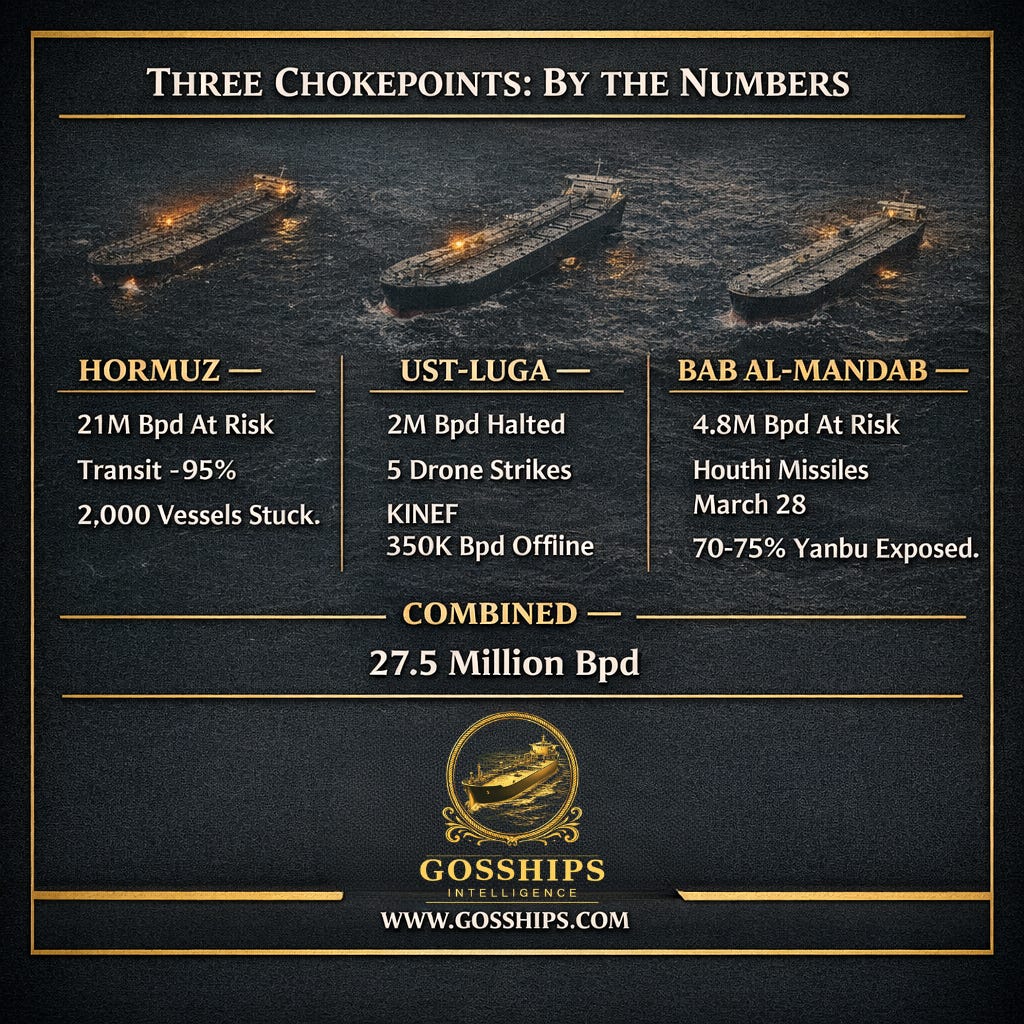
Add up the three chokepoints and the math is staggering. Hormuz handles approximately 21 million barrels per day. Bab al-Mandab handles approximately 4.8 million barrels per day. Russia’s Baltic ports handle approximately 1.72 million barrels per day. Combined: approximately 27.5 million barrels per day at risk, according to Windward’s March 30 analysis. That is more oil than the United States and Russia produce combined.
The IEA’s March 12 Oil Market Report estimated that nearly 20 million barrels per day of crude and product exports were already disrupted, with crude production curtailed by at least 8 million barrels per day. That assessment was published before Ust-Luga sustained five drone strikes and before the Houthis entered the war. The situation has worsened since the IEA’s last count.
Goldman Sachs head of Oil Research Daan Struyven projects an adverse scenario Brent peak of $140 and a severely adverse peak of $160, according to Goldman Sachs research. JPMorgan’s Natasha Kaneva warns of $120 if disruption is prolonged. But those models were built around a single chokepoint. No published forecast accounts for what happens when all three close at once. Brent is trading at $112 to $115 per barrel, according to CNBC. The national gas average is at $3.99, according to AAA. Both numbers are still climbing.
Bloomberg reported on March 30 that there has never been a more lucrative time to own an oil tanker. The Baltic Exchange TD3C benchmark hit $423,736 per day on March 3, according to LSEG data. The VLCC Kalamos set an all-time fixture record at $770,000 per day loading at Yanbu for India, according to Veson Nautical. Frontline, Nordic American Tankers, and DHT Holdings have each gained more than 59% year to date, according to market data. Frontline locked in 7 VLCCs on one-year time charters at $76,900 per day each.
The jet fuel supply chain is collapsing alongside crude. Windward and Vortexa data confirmed that the number of LR1 and LR2 tankers carrying jet fuel dropped from 78 on March 20 to just 22 by March 28. That is a 72% collapse in 8 days. Europe is most exposed. Kuwait, the world’s second-largest jet fuel exporter, shipped 61% of its exports from refineries that were struck on March 19, according to Windward. France, the UK, the Netherlands, and Belgium are the top destinations. Euronews reported on March 30 that airlines are cutting flights and raising fares. Air France-KLM announced long-haul fare increases of approximately 50 euros per round trip. SAS confirmed cancellation of hundreds of flights.
📊 By The Numbers