


|⚓About Us | 🛢️Deep Water Reports | 📋SwiftAction Training |
🏅Founding Gold Anchor Membership (*53 Slots Left)
The President of the United States just started a countdown clock on the most important shipping lane on earth.
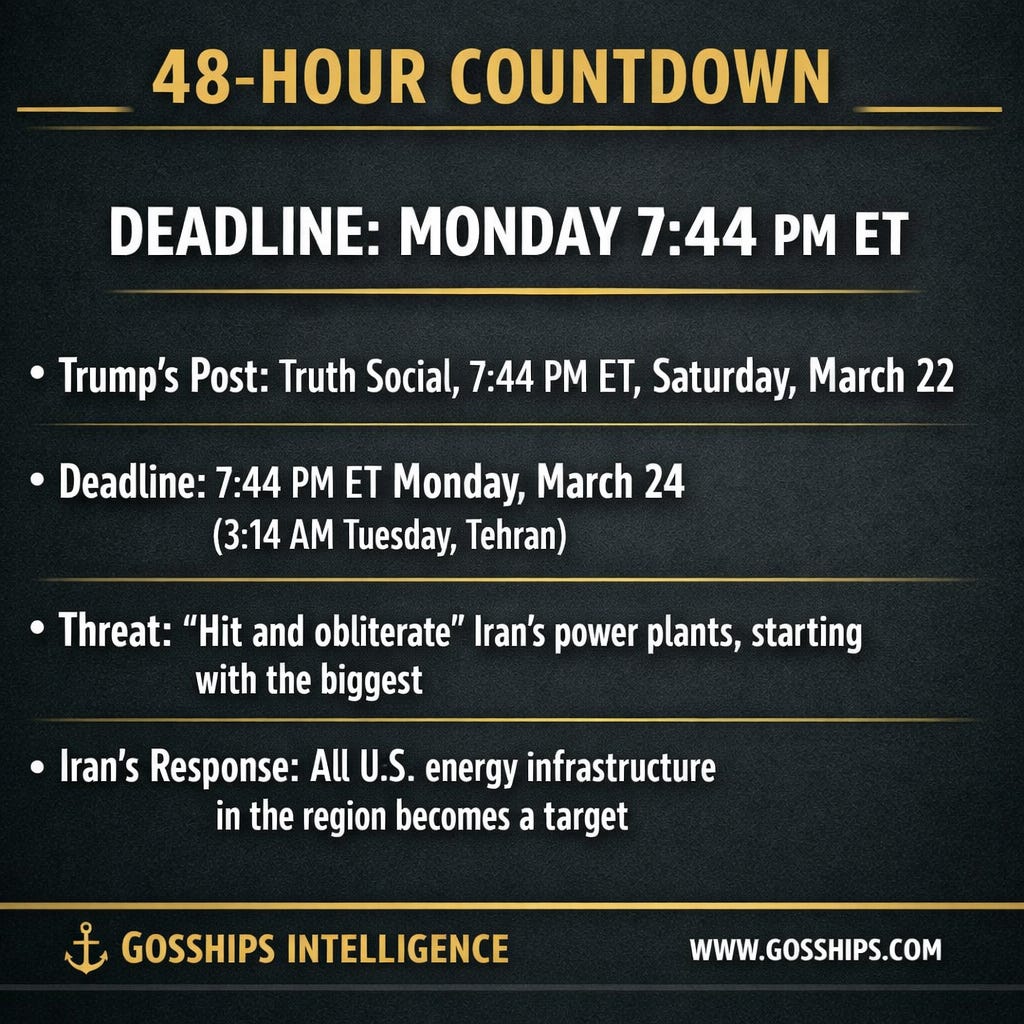
At 7:44 PM Eastern Time on Saturday, March 22, Donald Trump posted on Truth Social: “If Iran doesn’t FULLY OPEN, WITHOUT THREAT, the Strait of Hormuz, within 48 HOURS from this exact point in time, the United States of America will hit and obliterate their various POWER PLANTS, STARTING WITH THE BIGGEST ONE FIRST!”
The deadline expires at 7:44 PM ET on Monday, March 24. That is 3:14 AM Tuesday in Tehran.
Iran’s response came within hours. The Iranian armed forces headquarters declared that if Iran’s fuel and energy infrastructure is attacked, all energy, information technology, and desalination infrastructure belonging to the United States in the region will be targeted.
Iranian President Masoud Pezeshkian posted on X: “The Strait of Hormuz is open to all except those who violate our soil. We firmly confront delirious threats on the battlefield.”
Iran’s parliamentary speaker Mohammad Bagher Ghalibaf went further: vital infrastructure and energy and oil infrastructure across the region would become “legitimate targets” the moment Iran’s own energy facilities are hit.
The tanker market is now operating under a 48-hour countdown to either the reopening of Hormuz or an escalation that makes every scenario discussed in the last three weeks look mild.
📋 In this issue:
🛢️ The Story
📊 By the Numbers
🔍 Why It Matters
👀 What to Watch
⚓ Gosships Signal
📊 GOSSHIPS DATA CARD
🛢️ The Story
Trump’s ultimatum came at the end of a day in which the war escalated on multiple fronts. Iranian missiles struck the southern Israeli cities of Dimona and Arad on Saturday night, wounding more than 100 people. Dimona is located near Israel’s main nuclear research center. Israel branded the strikes a “war crime” and said its attacks on Iran would “increase significantly” this week. Missiles were also fired at the U.S.-U.K. joint military base on Diego Garcia in the Indian Ocean, prompting Britain to denounce what it called “Iran’s reckless attacks.”
The ultimatum represents a reversal from Trump’s position just 24 hours earlier. On Friday, the president said the U.S. was “getting very close to meeting our objectives” and was considering “winding down” military efforts in the Middle East. He told reporters that reopening the strait was a “simple military maneuver” but that NATO allies had lacked the “courage” to assist. He previously said he had deliberately avoided targeting power plants because it would cause years of damage and “trauma” to Iran’s civilian population. The Saturday post abandoned that restraint.
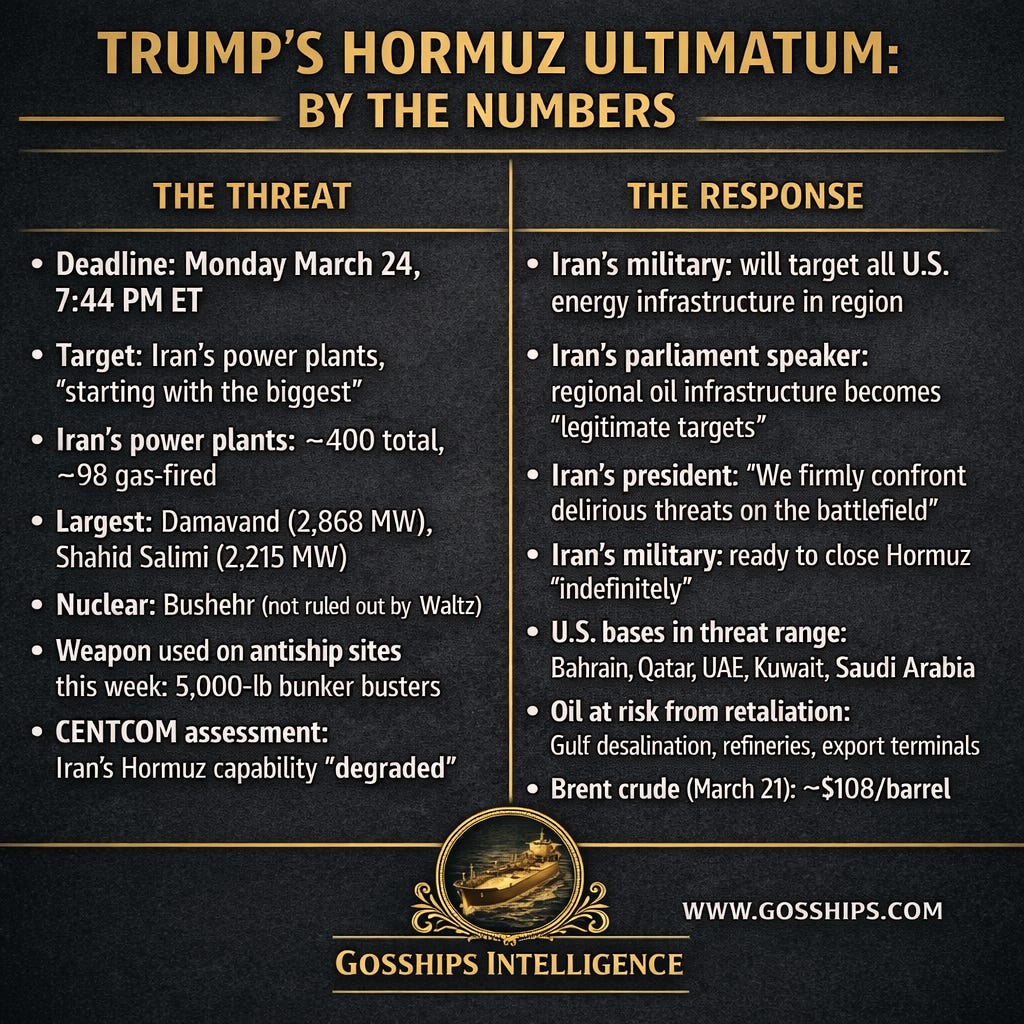
National Security Advisor Mike Waltz confirmed the threat on Sunday morning television. Asked what the president would do if the strait is not reopened by Monday night, Waltz said on Fox News: “He will start by attacking and destroying one of Iran’s largest power plants. There are gas-fired thermal power plants and other type of plants.” Asked whether targeting energy infrastructure could constitute a war crime, Waltz pointed to Iran’s own actions and said “all options should be on the table.”
Iran has approximately 400 power plants. Bloomberg data identifies 98 operational natural gas plants. The largest facilities include the Damavand Combined Cycle Power Plant (2,868 MW, located 70 km southeast of Tehran), the Shahid Salimi plant (2,215 MW, in Mazandaran province near the Caspian Sea), and the Shahid Rajai facility (2,043 MW, approximately 110 km northeast of Tehran). Iran also operates the Bushehr Nuclear Power Plant on its southern coast, 750 km south of Tehran. Trump did not specify which plant he considers “the biggest.” Waltz did not rule out the possibility that the target could include the nuclear facility.
Admiral Brad Cooper, head of U.S. Central Command, said on Saturday that Iran’s ability to threaten vessels in the strait had been “degraded.” U.S. fighter jets dropped 5,000-pound bunker-buster bombs on an underground Iranian coastal facility storing antiship cruise missiles and mobile launchers earlier this week. The strike also destroyed intelligence support sites and missile radar relays used to monitor ship movements, Cooper said. However, Iran’s ability to deploy naval mines, fast attack boats, and coastal defense systems along the strait remains intact.
The Iranian armed forces’ response was immediate and specific. Their statement, carried by Fars News Agency, said: “Following previous warnings, if Iran’s fuel and energy infrastructure is violated by the enemy, all energy, information technology and desalination infrastructure belonging to the US and the regime in the region will be targeted.” That language covers U.S. military bases in Bahrain, Qatar, the UAE, Kuwait, and Saudi Arabia, as well as civilian infrastructure including desalination plants that provide drinking water to Gulf populations.
Iran’s armed forces headquarters also declared that it is ready to close the Strait of Hormuz indefinitely if Trump carries out his threat. That is the first explicit statement from Iran’s military that the partial closure could become permanent. Until now, Iran had maintained that the strait was “open to all except those who violate our soil,” while selectively allowing friendly nations to transit through the IRGC-controlled corridor between Larak and Qeshm islands. A full, permanent closure would remove the last trickle of oil flowing through the world’s most critical chokepoint.
The 48-hour timeline creates a binary for the shipping market. Either Iran reopens the strait by Monday night and commercial traffic begins to resume, or the U.S. strikes Iranian power infrastructure and Iran retaliates against U.S. and allied energy assets across the Gulf. There is no middle outcome that the market can hedge against. The tanker market, the insurance market, and the commodity market will all reprice violently in one direction or the other by Tuesday morning.
📊 By the Numbers
📰 Related Coverage:
Iran Built a Toll Booth on the Strait of Hormuz. The IRGC Is Charging $2 Million Per Ship. (March 2026)
Hormuz Shut Down: Three Tankers Hit, P&I Clubs Pull War Risk Cover as Iran War Escalates (March 2026)
Strait of Hormuz Hits Zero: No Oil Tanker Transits in 24 Hours (March 2026)
What this means for every vessel stranded at Hormuz, what happens to oil prices on Tuesday morning, and why the next 48 hours determine whether the tanker market recovers or enters a crisis that makes the last three weeks look like the preview is below.
🔍 Why It Matters
For the shipping industry, the 48-hour countdown creates two scenarios. Both are extreme.
