


|⚓ About Us | 🛢️ Deep Water Reports | 📋 SwiftAction Training |
🏅 Founding Black Gold Membership (*52 Slots Left)
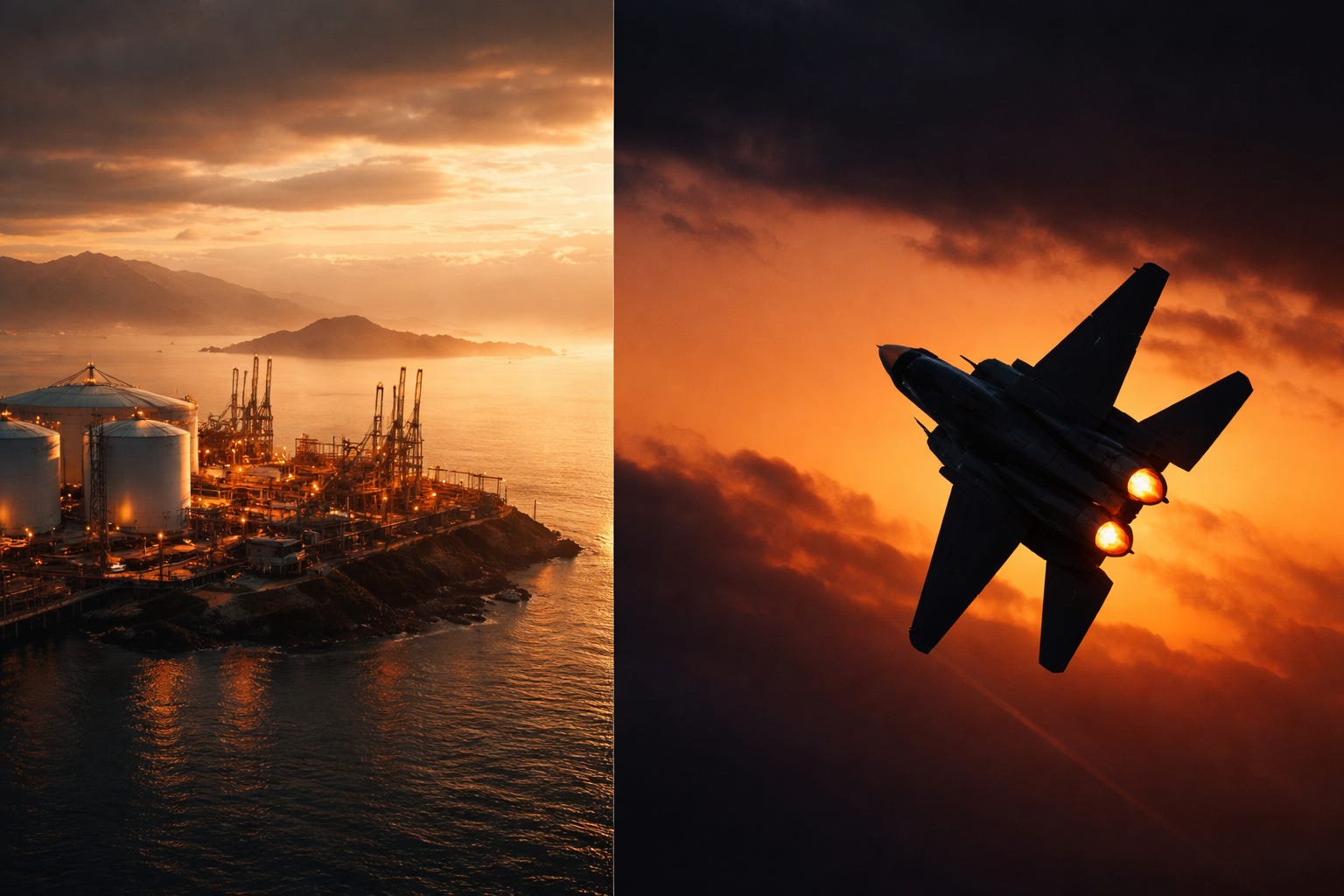
Trump posted on Truth Social on March 30 that without a deal, the United States will conclude its “lovely stay” in Iran by “blowing up and completely obliterating all of their Electric Generating Plants, Oil Wells and Kharg Island (and possibly all desalinization plants!),” according to CNBC. Kharg Island handles approximately 90% of Iran’s crude exports with capacity of roughly 7 million barrels per day, according to CNN. The deadline is April 6, 2026, at 8:00 PM Eastern Time, according to CBS News. Seven days separate the global oil market from the most consequential energy infrastructure strike since the Gulf War.
📋 In this issue:
🛢️ The Story
📊 By The Numbers
🔍 Why It Matters
👀 What to Watch
🚨 Gosships Signal
📊 Get The Deep Water Report
→ Global Tanker Market Outlook Q2 2026
📋 Competency-Based Maritime Training
→ SwiftAction
📌 Gosships Data Card
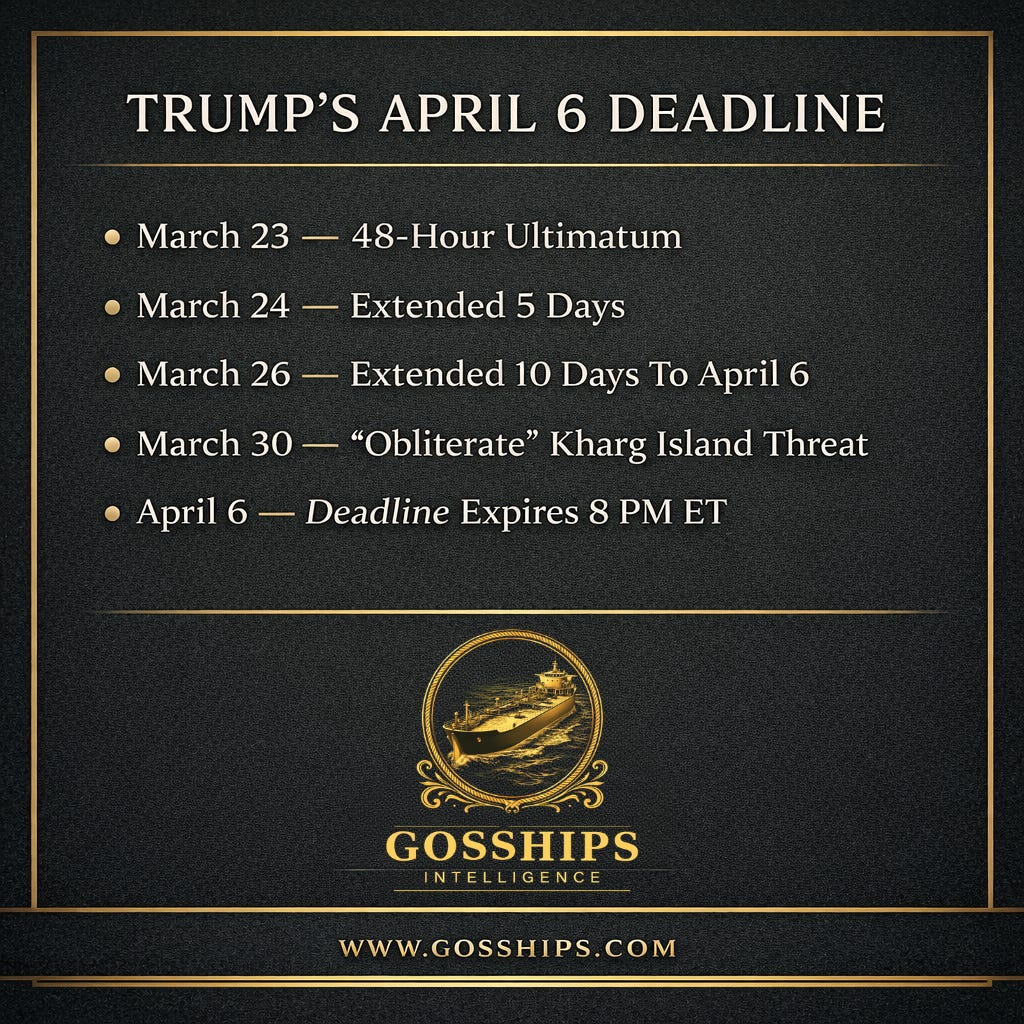
→ March 23: Trump Issues 48-Hour Ultimatum To Iran To Reopen Hormuz (CBS News)
→ March 24: Trump Extends Deadline By 5 Days (CBS News)
→ March 26: Trump Extends Deadline By 10 More Days To April 6 At 8 PM ET (CBS News, Truth Social)
→ March 27: Rubio Tells G7 War Will Continue “2-4 More Weeks” (Axios, 3 Sources)
→ March 30: Trump Threatens To “Obliterate” Kharg Island, Oil Wells, Power Plants (CNBC, Truth Social)
→ March 30: Rubio Tells Al Jazeera Hormuz Will Reopen “One Way Or Another” (Al Jazeera)
→ April 6: Deadline Expires, 8:00 PM Eastern Time
🛢️ The Story
On March 30, President Trump posted on Truth Social the most explicit threat to destroy a nation’s oil infrastructure in modern history. “If for any reason a deal is not shortly reached,” Trump wrote, “we will conclude our lovely ‘stay’ in Iran by blowing up and completely obliterating all of their Electric Generating Plants, Oil Wells and Kharg Island (and possibly all desalinization plants!),” according to CNBC.
In a separate interview with the Financial Times on the same day, Trump said: “Maybe we take Kharg Island, maybe we don’t. We have a lot of options,” according to CNBC.
Kharg Island is not just any target. It handles approximately 90% of Iran’s crude oil exports, with a capacity of roughly 7 million barrels per day, according to CNN. It is the single most important oil export facility in the Middle East. A strike on Kharg Island would remove Iran’s primary source of revenue in the middle of a war that has already closed the Strait of Hormuz for 30 days.
The deadline has been extended three times. Trump first issued a 48-hour ultimatum to Iran on March 23, according to CBS News. He extended it by 5 days on March 24. He extended it again by 10 more days on March 26, pushing the deadline to April 6, 2026 at 8:00 PM Eastern Time, according to CBS News.
Trump wrote on Truth Social when announcing the extension: “As per Iranian Government request, please let this statement serve to represent that I am pausing the period of Energy Plant destruction by 10 Days to Monday, April 6, 2026, at 8 P.M., Eastern Time,” according to CBS News. He added: “They asked for seven, and I said, ‘I’m going to give you 10,’ because they gave me ships,” referring to oil tankers Iran had permitted through Hormuz.
On the same day, Secretary of State Marco Rubio told Al Jazeera: “The Strait of Hormuz will be open when this operation is over, one way or another,” according to Al Jazeera. Rubio told G7 foreign ministers in France on March 27 that he expected the war to continue for “2-4 more weeks,” according to Axios, citing three sources familiar with the conversations. He told reporters: “We are on or ahead of schedule in that operation, and expect to conclude it in a matter of weeks, not months,” according to RFE/RL.
Iran has rejected the American proposal. Iran’s FM spokesperson Esmail Baghaei called the US 15-point plan “largely excessive, unrealistic, and unreasonable demands,” according to CNN. Iran’s five conditions for peace include “recognition of Iran’s sovereignty over the Strait of Hormuz,” according to the Tasnim News Agency. Iran’s Parliament Speaker Ghalibaf accused the US of “secretly planning a ground invasion” while negotiating, according to Euronews.
Pakistan is mediating. A four-nation foreign ministers meeting convened in Islamabad on March 29, with Pakistan, Turkey, Saudi Arabia, and Egypt attending, according to Euronews. Pakistan FM Ishaq Dar confirmed on March 30: “Both Iran and the US have expressed their confidence in Pakistan to facilitate their talks,” according to Al Jazeera. Trump said on March 30 that he was “pretty sure” a deal would be reached, according to Al Jazeera.
If Kharg Island is struck, total global oil production losses could reach 16 million barrels per day, according to JPMorgan’s Natasha Kaneva, head of Global Commodities Strategy. Goldman Sachs head of Oil Research Daan Struyven projects Brent at $115 per barrel in April, with an adverse scenario peak of $140 and a severely adverse peak of $160, according to Goldman Sachs research. Three deadline extensions have trained the market to expect a fourth. But every extension has come with an escalation in language. The first was a warning. The second was a threat. The third named the target.
The USS Gerald R. Ford, which had been the primary carrier for operations against Iran, suffered a laundry-room fire on March 12 that lasted over 30 hours and treated more than 200 personnel for smoke inhalation, according to Army Recognition and The Hill. The carrier withdrew to Souda Bay, Crete for repairs. The USS George H.W. Bush (CVN-77) is preparing to deploy as replacement. The amphibious assault ship USS Tripoli (LHA-7) arrived in the Middle East on March 28 carrying 3,500 Marines and sailors, according to Army Recognition. An additional 2,200 Marines and 2,000 soldiers from the 82nd Airborne are deploying to the region.
Insurance rates have become a secondary blockade. CBS News reported that war risk premiums now range from 3.5% to 10% of hull value per transit. For a typical VLCC valued at $250 million, that translates to approximately $8.75 million per transit at the lower end. according to CBS News. Before the war, premiums were 0.125% to 0.25% of hull value. All 12 members of the International Group of P&I Clubs issued 72-hour cancellation notices effective March 5, voiding war risk extensions across approximately 1,000 vessels with combined hull value exceeding $25 billion, according to Lloyd’s List.
The IMO Extraordinary Council Session convened March 18 to 19 with 120 member states participating, according to the IMO. Secretary-General Arsenio Dominguez declared readiness to negotiate a humanitarian corridor for the 2,000 stranded vessels and 20,000 seafarers.
What a Kharg Island strike would mean for VLCC rates, for the 2,000 vessels stranded near Hormuz, for the 20,000 seafarers stuck on those vessels, and for the gas price that is already at $3.99, is below.
📊 By The Numbers
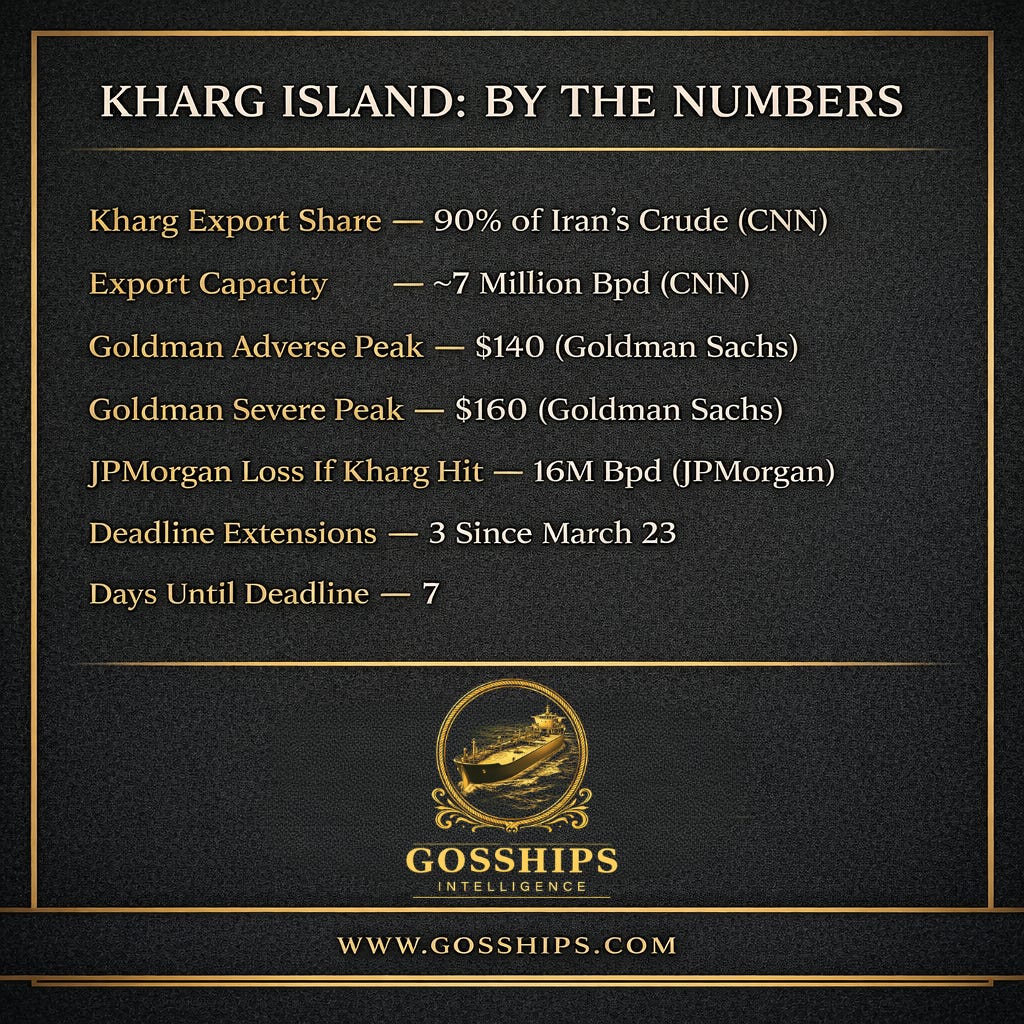
→ 90%: Share Of Iran’s Crude Exports That Flow Through Kharg Island (CNN)
→ ~7 Million Bpd: Kharg Island’s Export Capacity (CNN)
→ 16 Million Bpd: JPMorgan Projected Production Losses If Kharg Is Hit (JPMorgan, Natasha Kaneva)
→ $140/$160: Goldman Sachs Adverse/Severely Adverse Brent Peak (Goldman Sachs, Daan Struyven)
→ 2,000: Vessels Stranded Near Hormuz (IMO)
→ 20,000: Seafarers Stuck On Stranded Vessels (IMO)
→ 3.5%-10%: War Risk Insurance Premium Per Transit, Up From 0.125% Pre-War (CBS News)
→ 3: Deadline Extensions Since March 23
→ 7 Days: Time Remaining Until April 6 Deadline
🔍 Why It Matters
The pattern matters more than the words. Three extensions. Each one paired
