


|⚓About Us |🛢️Deep Water Reports |📋SwiftAction Training |
🏅 Founding Black Gold Membership (*53 Slots Left)
Iran is no longer hiding it. They are bragging about it on television.
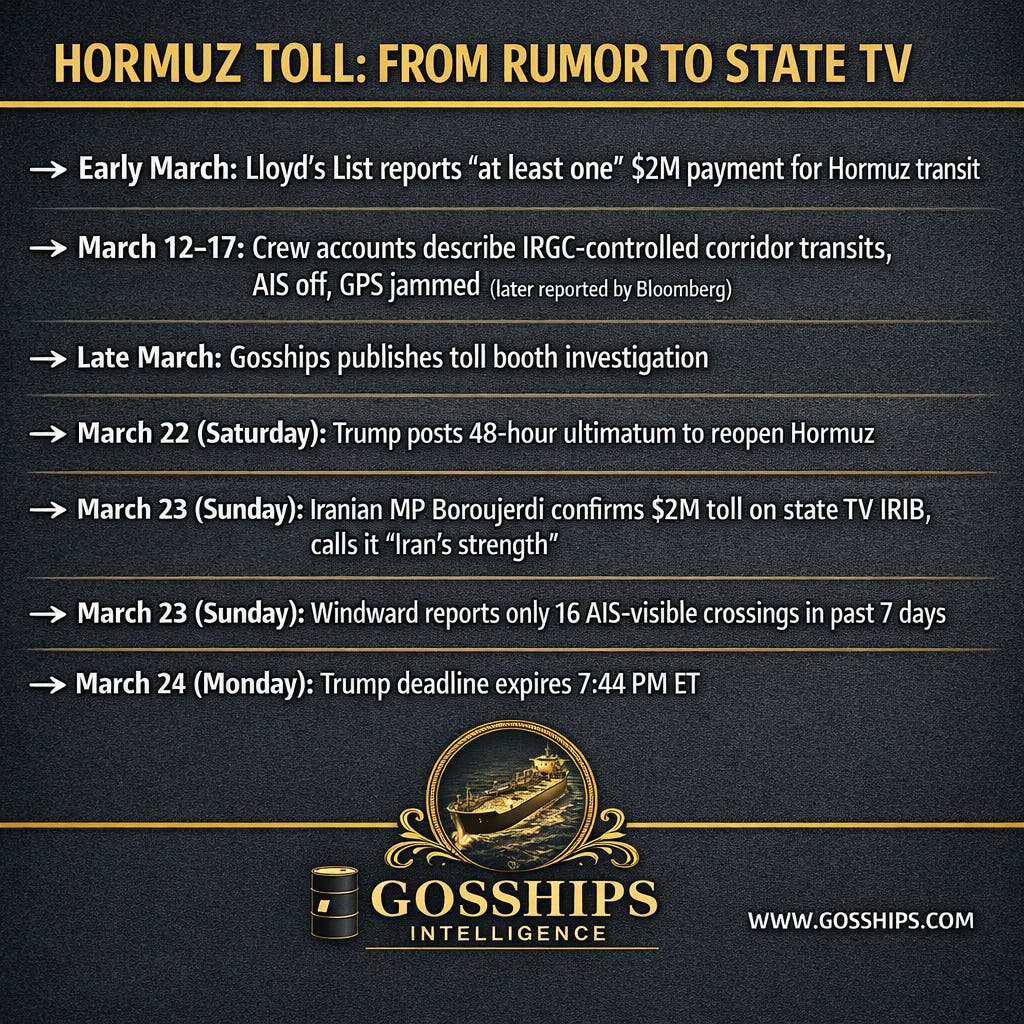
Iranian lawmaker Alaeddin Boroujerdi, a member of parliament’s National Security and Foreign Policy Committee, told state broadcaster IRIB on Sunday that Iran has begun charging certain vessels $2 million to transit the Strait of Hormuz.
“Collecting $2 million as transit fees from some vessels crossing the strait reflects Iran’s strength,” Boroujerdi said.
He described the fee as part of what he called a “new concept of sovereignty” over the strait, one that Iran has now established “after 47 years.” He said the measure has already been implemented. He said war has costs, and Iran must collect transit fees from ships passing through.
This is the first time an Iranian government official has publicly confirmed the toll on the record, by name, on state television.
Until now, the $2 million figure came from Lloyd’s List, Bloomberg crew accounts, and unnamed intermediaries. Gosships reported it earlier this week. Now an Iranian MP on the national security committee is confirming it on IRIB and calling it a demonstration of power.
📋 In this issue:
🛢️ The Story
📊 By the Numbers
🔍 Why It Matters
👀 What to Watch
⚓ Gosships Signal
📊 GOSSHIPS DATA CARD
🛢️ The Story
Boroujerdi’s statement aired on IRIB on Sunday, March 23, the day after Trump’s 48-hour ultimatum. Iran International, the London-based Persian-language news network, first reported the comments. Fox News, TRT World, Anadolu Agency, IANS, and BusinessToday all confirmed the remarks independently.
Boroujerdi is not a fringe figure. He sits on parliament’s National Security and Foreign Policy Committee, the body that oversees Iran’s security policy and foreign relations. His statement was not a leak. It was a public declaration on state television, designed to be heard.
His exact framing is important. He did not describe the toll as a wartime expedient or a temporary measure. He called it a “new concept of sovereignty” over the strait “after 47 years,” an apparent reference to the 1979 Islamic Revolution. He framed it as a structural shift in how the strait is governed, not a crisis response. “Now, because war has costs, naturally we must do this and take transit fees from ships passing through the Strait of Hormuz,” he said.
Iran’s permanent representative to the International Maritime Organization, Ali Mousavi, reinforced the message on the same day. Speaking to the Mehr News Agency, Mousavi said the strait is “open to everyone” except Iran’s adversaries. Iranian President Masoud Pezeshkian posted on X: “The Strait of Hormuz is open to all except those who violate our soil.”
The combined messaging from parliament, the IMO delegation, and the president creates a unified position: the strait is open, on Iran’s terms, for a price.
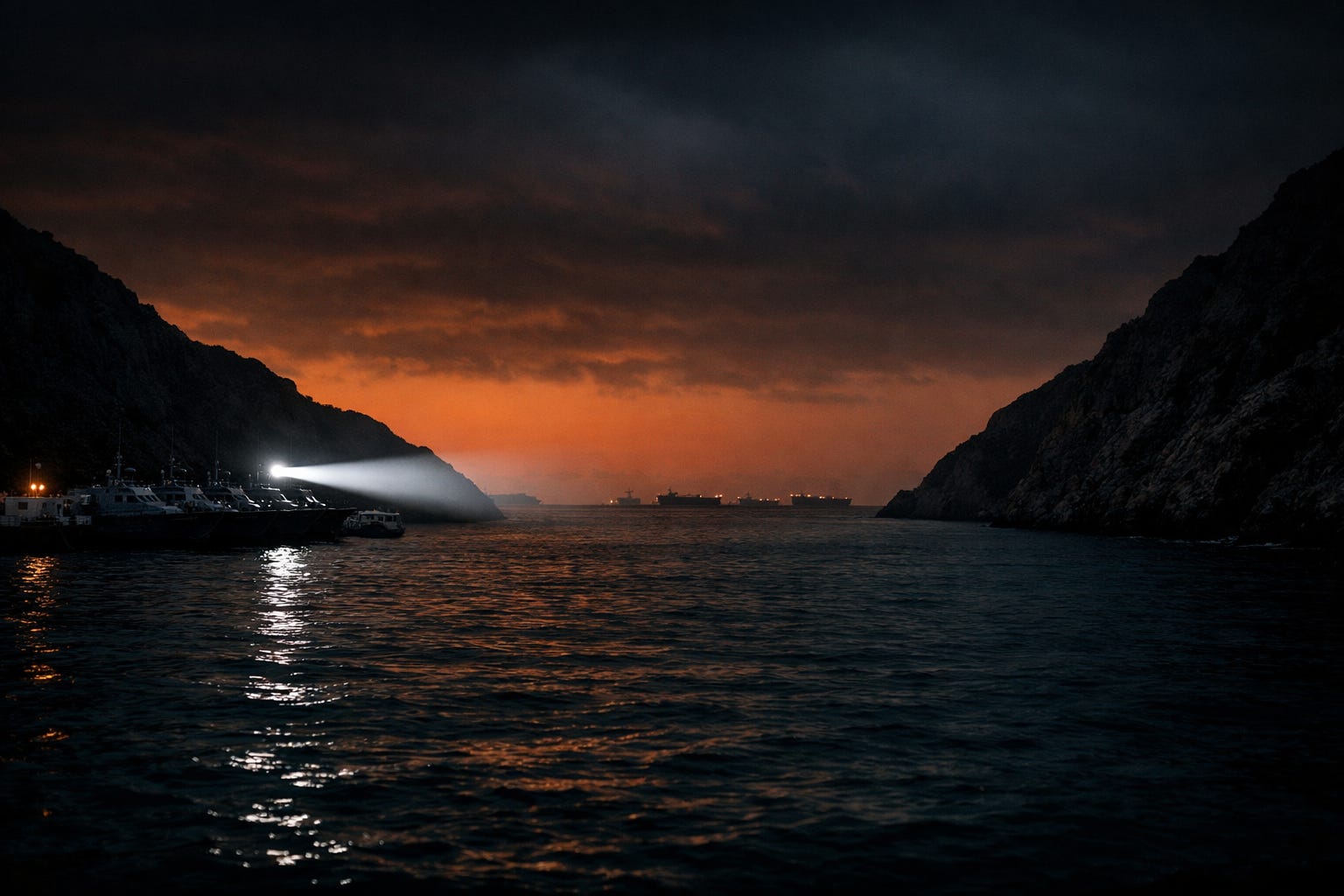
Meanwhile, the strait itself is nearly empty. Maritime intelligence firm Windward AI reported on Sunday that Hormuz traffic was “near collapse,” with only 16 AIS-visible crossings recorded over the past seven days. That is 11 outbound and 5 inbound transits in a full week. Before the war began on February 28, the strait handled roughly 100 to 135 vessel passages per day. Traffic is down approximately 97% from pre-war levels, according to Windward.
Windward’s satellite imagery confirmed that the few vessels still transiting are routing through Iranian territorial waters, passing between the islands of Larak and Qeshm under what appears to be a controlled, permission-based system. Bulk carriers and LPG vessels are the primary traffic. In most observed cases, these vessels had previously called at Imam Khomeini port in Iran, reinforcing the IRGC’s role as gatekeeper.
But the confirmation is only part of the story. Five governments are already in talks with Tehran for passage rights. A second senior Iranian official, an adviser to the Supreme Leader, confirmed the same day that Iran intends to formalize the system permanently. Iran’s state media published a map of every power plant in the Gulf, and the economics of the toll, if applied at scale, could generate over $1 billion annually for the IRGC. What this means for the tanker market, the insurance market, and the commodity market, and why tomorrow night’s deadline may determine whether this toll becomes a permanent feature of global shipping, is below.
