
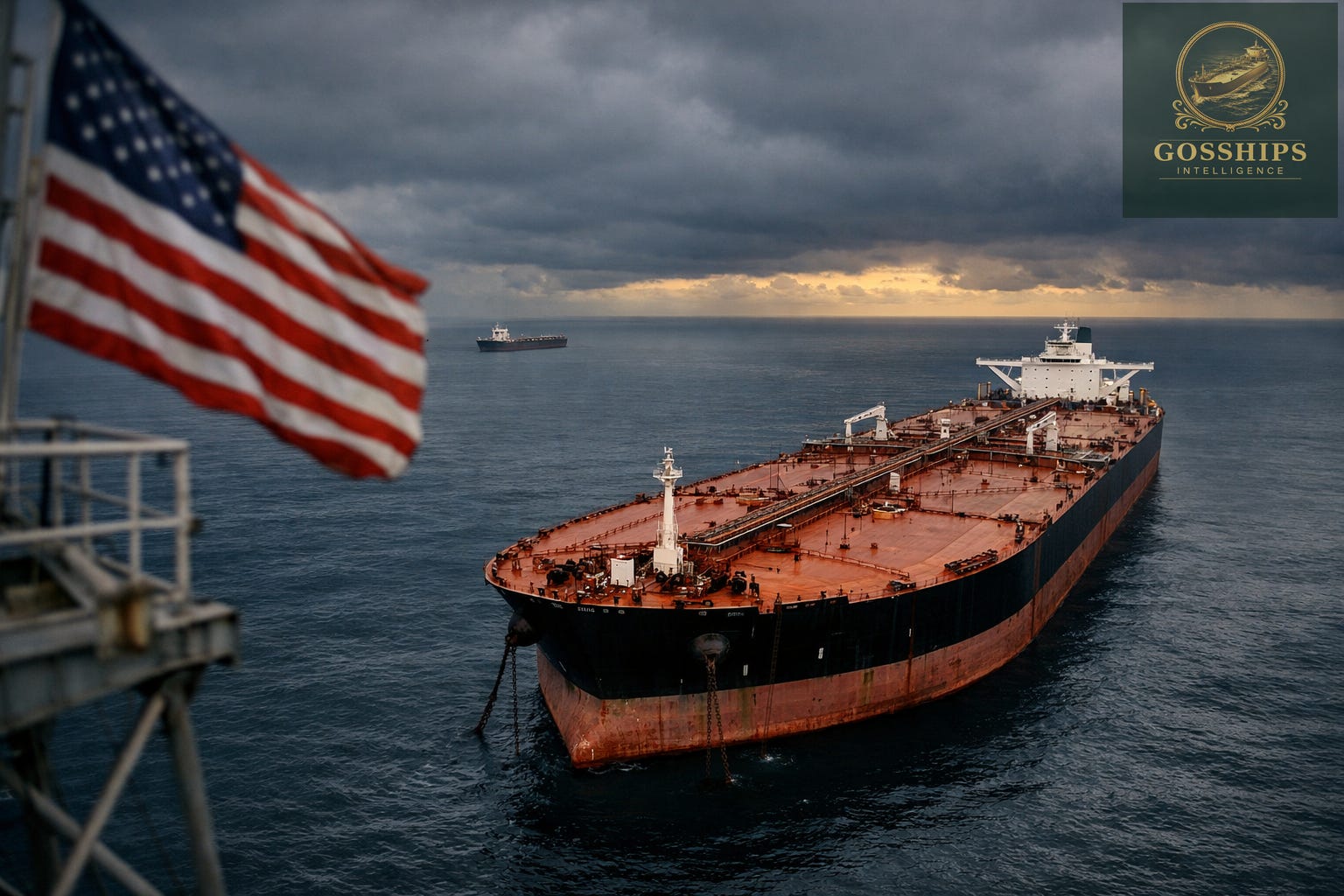
Trump Waives the Jones Act for 60 Days. Foreign Tankers Can Now Move Oil Between U.S. Ports — But It Won't Fix What's Actually Broken.
Foreign-flagged tankers can now move oil between U.S. ports. The real problem — a Strait of Hormuz running at 3% of normal — remains untouched.
The Story
On Wednesday, the White House issued a 60-day waiver of the Jones Act — the 1920 Merchant Marine Act that requires all goods transported between U.S. ports to be carried on U.S.-built, U.S.-flagged, U.S.-owned, and primarily U.S.-crewed vessels. For the next two months, foreign-flagged tankers can carry crude oil, refined products, natural gas, fertilizer, and coal between American ports without restriction.
The waiver is the latest in a series of emergency supply-side moves by the Trump administration since the U.S.-Israel war against Iran began on February 28. In the same 24-hour period, the Treasury Department opened the door for Venezuela’s state oil company PDVSA to resume direct crude sales to American buyers and into global markets, reopening trade with the world’s largest proven reserve holder after years of restrictions. The U.S. has also committed to releasing 172 million barrels from the Strategic Petroleum Reserve over 120 days as part of the IEA’s record 400-million-barrel coordinated stockpile release.
The Jones Act fleet is small — fewer than 100 compliant oceangoing vessels in total. Waiving the requirement theoretically opens U.S. inter-port routes to the thousands of international tankers that are otherwise locked out. But the practical impact is narrow. Oceangoing tankers account for roughly 6.5% of U.S. gasoline distribution, according to Navigistics Consulting. The majority of domestic fuel moves by pipeline, barge, and truck. The American Maritime Partnership called the waiver’s maximum pump-price impact “less than one penny per gallon.” Independent analysts estimated somewhere between 3 and 10 cents — and that’s not a reduction, just an offset against prices that are still climbing.
Why It Matters
For tanker operators and brokers, the Jones Act waiver is a sideshow to the real story: the structural dislocation of the global tanker market caused by the effective closure of the Strait of Hormuz.
S&P Global Commodities at Sea data tells the story in one line: crude loadings out of the Persian Gulf averaged just 4 million barrels per day during the week of March 9. That’s against 19 million b/d in February and 17.5 million b/d across 2025. On March 16, only four vessels transited the Strait of Hormuz — a corridor that averaged 135 transits per day through February. Roughly 400 vessels remain stranded near the chokepoint. The IEA has called it the largest oil supply disruption in history, with global supplies expected to fall by 8 million barrels per day this month.
The VLCC market has entered uncharted territory and is now bifurcating. The Baltic Exchange’s MEG-China TD3C index hit a record $423,736/day on March 3, with Poten & Partners pegging Arabian Gulf-to-Far East hires at $445,200/day — against a 2025 average of $133,000/day. The Pantanassa — a 317,000-dwt Minerva Marine VLCC (IMO 9424261) — picked up a confirmed fixture to South Korean refiner S-Oil at $554,771/day for an Oman-to-Korea voyage, one of the highest spot hires ever recorded for any tanker. But that’s the MEG story. In the Atlantic basin, it’s reversing. The West Africa-China VLCC index fell to $168,220/day by mid-week — down 39% from its wartime peak — as VLCCs flood out of the Gulf and chase limited Atlantic cargoes. BRS reported approximately 80 VLCCs still trapped inside the Gulf (9% of the active fleet), with brokers Gibson and BRS both warning of imminent oversupply in non-MEG loading zones.
The divergence is the market’s way of pricing the new geography of crude supply. Atlantic basin barrels — U.S. Gulf, Brazil, Guyana, West Africa — are now carrying the burden of replacing stranded MEG volumes, but they can’t do it at scale. Meanwhile, the Jones Act waiver is a domestic logistics tweak layered on top of a global supply catastrophe. It helps the SPR drawdown work more efficiently by reducing the cost of moving Gulf Coast barrels to the Northeast. That’s about it.
The Venezuela sanctions easing is more consequential for tanker markets — but on a longer timeline. Venezuela holds the world’s largest proven oil reserves, and the Treasury license reopens PDVSA sales to U.S. companies and global markets — the broadest access since Washington first sanctioned the company in 2019. Payments must flow through a U.S.-controlled account, and deals with Russia, Iran, North Korea, and certain Chinese entities are excluded. The catch: Venezuelan output cratered to under 400,000 b/d by 2020 after decades of mismanagement and sanctions eroded what was once a 3.5-million-b/d producer. Atlantic Council analyst Geoff Ramsey estimated 12 to 18 months before any meaningful production increase. For tanker demand, that means potential incremental tonne-miles out of the Caribbean eventually — but not this quarter.
What to Watch
The next 72 hours will test whether the waiver actually draws foreign-flagged tonnage into U.S. cabotage routes. The practical barriers are real: unfamiliarity with U.S. port procedures, liability considerations, and the 60-day sunset clause that discourages long-term positioning. Watch for fixture reports on USGC-to-PADD 1 (Northeast) and USGC-to-PADD 5 (West Coast) routes involving foreign-flag vessels — that’s where the waiver has the most potential impact.
In the broader tanker market, the Atlantic VLCC glut is the story to track. If Hormuz stays closed — and there’s no indication it won’t — the MEG-Atlantic rate divergence will accelerate. Suezmax and Aframax owners positioned in West Africa, the U.S. Gulf, and Brazil may start seeing rate pressure as repositioning VLCCs absorb cargoes they’d normally carry. Gibson put it plainly in their weekly note: “The longer the current crisis keeps flows locked in, the more bearish the outlook becomes.”
Brent closed Wednesday at $107.38/bbl, up 3.83% on the day. U.S. crude at $96.32. National gasoline average at $3.84/gal — up roughly 92 cents from a month ago. The Jones Act waiver won’t bend those curves. The Strait of Hormuz will.
Sources: Bloomberg, CNBC, S&P Global Commodities at Sea, Lloyd’s List, Kpler, BRS, Gibson Shipbrokers, Tankers International, Baltic Exchange, CNN, NPR, Associated Press, RBN Energy, WorkBoat, Al Jazeera, Navigistics Consulting, AA

