


⚓ The Gosships Team
Gosships Intelligence Is Published At Gosships.com
For Sponsorship And Partnership Inquiries Contact intelligence@gosships.com
|⚓ About Us | 🛢️ Exclusive Report | 📋 SwiftAction Training |
🏅Black Gold Membership (*53 Slots Left)
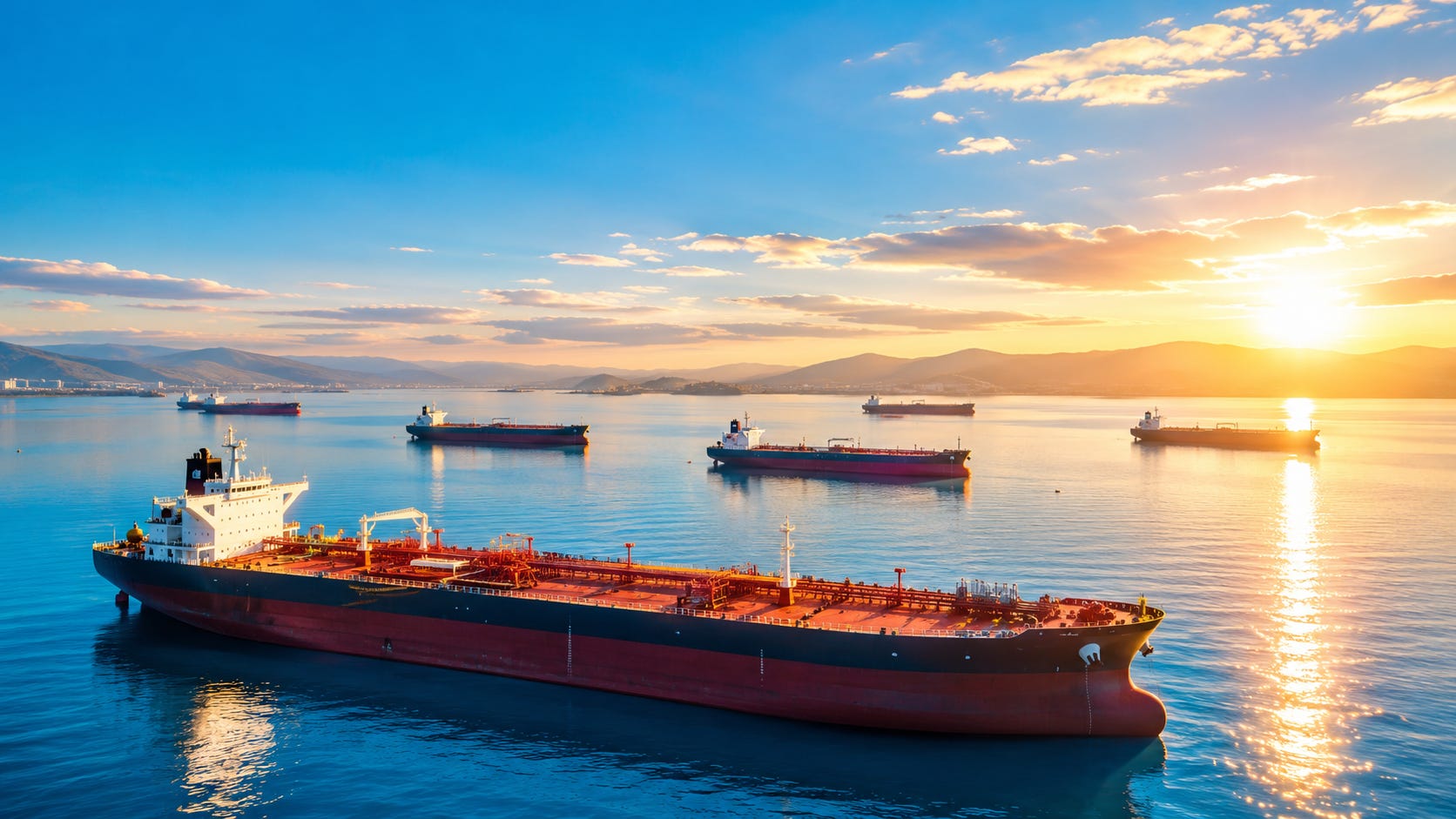
The Flag painted on a tanker’s stern has quietly become the single most revealing thing about it, and often the one detail its owner would least like you to examine.
Fresh UNCTAD figures for the start of 2026 show that three Open Registries now flag 40 percent of the world’s oil-tanker capacity, while a cluster of little-known Flags that barely existed two years ago have muscled past Japan, India and the United States. Where a tanker is registered is no longer paperwork. It is a signal, and once you cross the fleet data with the safety watchdogs’ own scorecards, that signal tells you plenty an owner might prefer to keep quiet.
📋 In This Issue:
🛢️ The Story
📊 By The Numbers
🔍 Why It Matters
👀 What To Watch
🚨 Gosships Signal
🔔 Not Subscribed? Gosships Intelligence Delivers Oil Shipping Intelligence. Subscribe Here!
📊 Order Our Exclusive Report
→ Global Tanker Market Outlook Q3 2026 Edition
📋 Competency-Based Maritime Training
→ SwiftAction
📌 Gosships Data Card
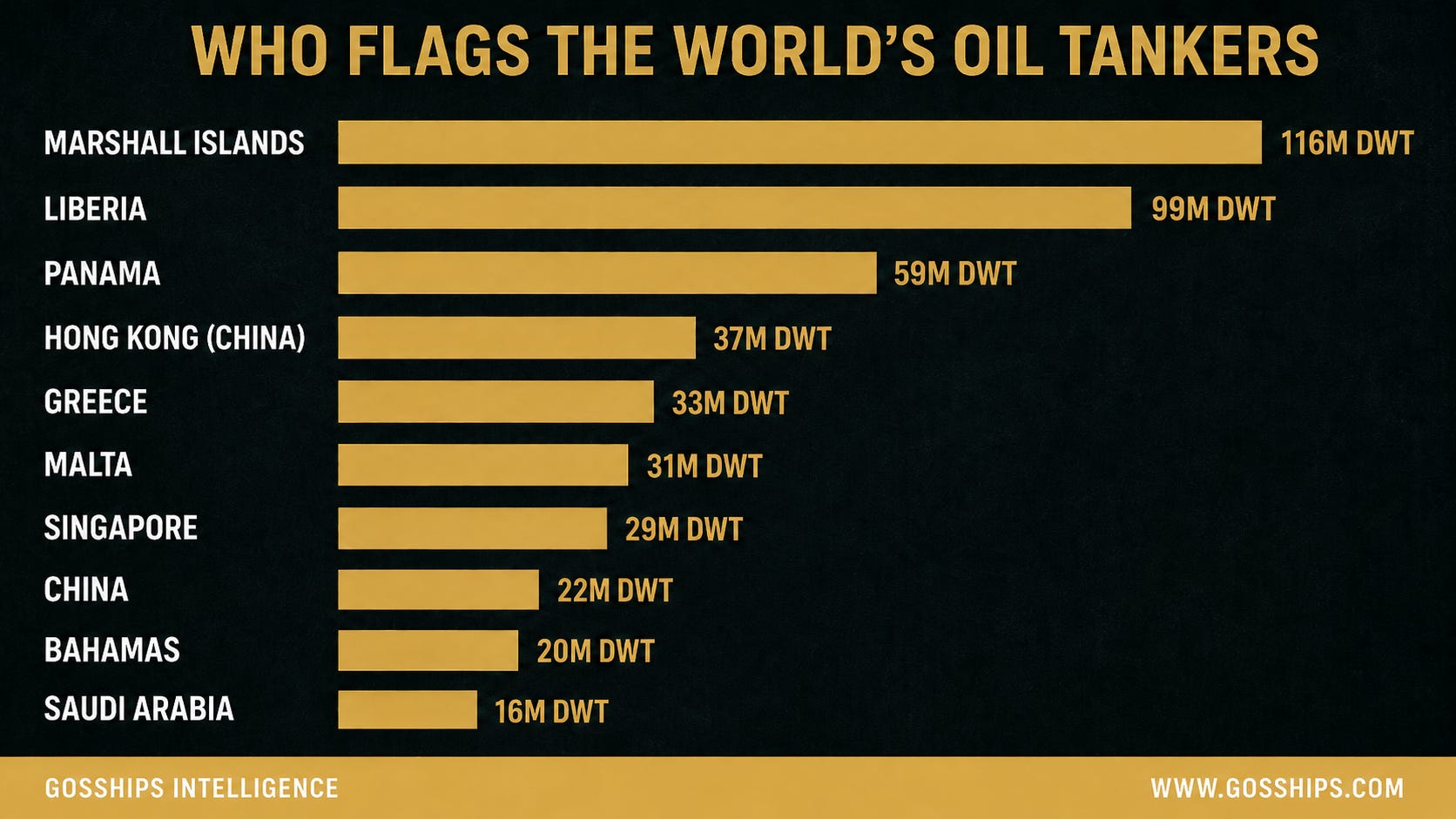
➡️ Marshall Islands - 115.9M DWT of oil tankers (1,019 ships)
➡️ Liberia - 99.3M DWT (855 ships)
➡️ Panama - 58.8M DWT (785 ships)
➡️ Hong Kong (China) - 36.8M DWT (344 ships)
➡️ Greece - 32.7M DWT (256 ships)
➡️ Malta - 31.1M DWT (331 ships)
➡️ Singapore - 29.1M DWT (607 ships)
➡️ China - 21.7M DWT (1,799 ships)
➡️ Bahamas - 20.3M DWT (167 ships)
➡️ Saudi Arabia - 16.4M DWT (75 ships)
Source: UNCTADstat, Merchant fleet by flag of registration (oil tankers), data as of 1 January 2026.
🛢️ The Story
Every merchant ship flies the Flag of the country where it is registered, and that Flag decides whose law the ship answers to, whose inspectors can board it, and whose insurance and courts stand behind it. For oil tankers, the ships that carry the world’s crude and refined fuel, the map of who flags them has just been redrawn. The newest official figures make the shift unmistakable.
According to UNCTADstat, the United Nations Conference on Trade and Development’s official fleet database, the world had 12,931 oil tankers on the water at the start of 2026, with a combined carrying capacity of roughly 683 million deadweight tons. Deadweight tonnage, or DWT, is the standard measure of how much cargo and stores a ship can carry, and it is the yardstick the industry uses to size a fleet. Measured that way, the concentration at the top is extreme. Just three Flags account for about 40 percent of all of it.
The Marshall Islands, a Pacific nation of a few tens of thousands of people, is the single largest oil-tanker Flag on earth. Its Register carries 115.9 million DWT of tankers across 1,019 ships, which is 17 percent of the entire world total by capacity. Liberia sits second with 99.3 million DWT across 855 tankers, and Panama third with 58.8 million DWT across 785 tankers. Together those three Registries flag 40 percent of the world’s oil-tanker capacity. Add Hong Kong and Greece, and five Flags account for roughly half of every deadweight ton of tanker capacity afloat.
This is the Open-Registry model, the system critics call the Flag of Convenience. Liberia, Panama and the Marshall Islands are Open Registers, meaning they accept foreign-owned ships, impose minimal nationality requirements on owners and crew, and compete on cost, service and tax treatment. A Greek or American or Japanese owner can register a supertanker in Monrovia or Majuro without the ship ever calling there. The International Transport Workers’ Federation, the seafarers’ union body that runs the long-standing campaign against these Registers, currently declares 48 Flags to be Flags of Convenience, and 17 of the 50 largest oil-tanker Flags are on that list. But being an Open Register is not the same as being a bad one, and that distinction is the whole story. Liberia recently overtook Panama to become the largest ship Registry in the world across all vessel types, and both, along with the Marshall Islands, run genuine, well-regarded operations. Convenience and quality are two different axes, and the Flags at the top of the tanker table mostly sit on the good side of both.
Then comes the twist that a raw ranking hides. By sheer number of ships, the biggest oil-tanker Flag in the world is not the Marshall Islands at all. It is China, with 1,799 tankers on its national Register, more hulls than any other Flag. Yet those Chinese-flagged tankers add up to only 21.7 million DWT, which ranks China eighth by capacity. The math tells the whole story. A Chinese-flagged oil tanker averages about 12,000 DWT, the size of a small coastal or river-sea product tanker serving domestic trade. A Marshall Islands-flagged tanker averages about 114,000 DWT, the size of an Aframax or Suezmax, with many being VLCCs of 300,000 DWT. China flags the most tankers. The Marshall Islands flags the biggest ones. Counting hulls and counting capacity produce two completely different league tables, and anyone who quotes one without the other is telling half the story.
The most consequential change, though, is in the middle of the table, and it did not come from the traditional shipping world at all. It came from the shadow fleet. Cameroon ranks twelfth by oil-tanker capacity, with 13.1 million DWT across 128 ships, more tanker capacity than Japan, more than India, and nearly three times that of the United States. Sierra Leone ranks thirteenth at 10.3 million DWT. Gambia, Comoros, Guinea and Palau all appear inside the top 30, and the extended top 50 pulls in still more: Benin, Sao Tome and Principe, Djibouti and Tanzania, Registries named repeatedly in reporting on Russia’s and Iran’s shadow trade. Two years ago, most of these Registers were rounding errors in the tanker world. Now they collectively flag tens of millions of tons of tanker capacity. The maritime intelligence firm Windward reported that Cameroon’s Register expanded by 126 percent in a single year and that most of the tankers on the Cameroon Flag are now shadow-fleet vessels, making Cameroon the second-largest Flag for sanctioned tankers after Russia itself.
Which brings in the second map, the one that turns a capacity ranking into an intelligence document. Alongside the Flag-of-Convenience question sits a completely separate measure of quality: the Paris Memorandum of Understanding’s White, Grey and Black List. Every year, the Paris MoU, the Port State Control body covering Europe and the North Atlantic, ranks Flags by how often their ships are detained during inspection over a three-year window. Quality Flags land on the White List, middling ones on the Grey List, and the worst performers on the Black List, graded from medium to very high risk. The current lists took effect on 1 July 2026.
Run the tanker Flags through it and the split is stark. The world’s single best-performing Flag, ranked first on the entire White List, is the Cayman Islands, which is also an ITF-declared Flag of Convenience, proof that an Open Register can be a quality Register. The big three tanker Flags all sit comfortably on the White List: Marshall Islands, Liberia and Panama are Open Registries with clean enough detention records to be rated quality Flags. So are Malta, the Bahamas, Singapore, Greece, Cyprus, Hong Kong, Japan, Denmark, Norway and Italy.
Now look at the other end. Cameroon, the twelfth-largest oil-tanker Flag in the world, sits at the very bottom of the Black List with an excess detention factor of 7.14, the single worst score of any Flag on the planet. That pairing is not a coincidence. For a tanker carrying sanctioned oil, a Register with the worst inspection record on earth is not a liability but a selling point: it is cheap, it is quick, and it almost never puts an inspector on deck. The worse the Flag, the more useful it is to a fleet that needs to stay invisible, which is why the shadow trade migrated to precisely these Registries rather than to the quality ones. Cameroon is not the only case. Tanzania and Comoros, the two Flags just above it at the bottom of the list, are the only other Registers rated very high risk anywhere in the world, and both also rank inside the top 50 oil-tanker Flags. Palau sits on the Black List too, and Vietnam joins them. Then there is the category that tells its own story: not listed at all. Iran, Gambia, Djibouti, Benin, Sao Tome and Principe, Curaçao, Guinea and others carry too few inspections at well-run ports to earn any rating, because their ships call at those ports too rarely to be caught. For a domestic fleet like Indonesia’s that is innocent enough. For a shadow Flag, avoiding the ports that inspect you is the entire point.
Put it all together and the Flag map of the world’s oil tankers now reads as three overlapping worlds. A handful of quality Open Registries dominate the legitimate fleet. A cluster of Black-listed and unrated Flags has absorbed the sanctioned trade almost overnight. And a few sanctioned states carry their own, with Iran eleventh and Russia fourteenth. The tanker has not changed. Its Flag now tells you, on two separate axes at once, which of those three worlds it belongs to.
