


⚓ Gosships Intelligence
Gosships Intelligence Is Published At Gosships.com
For Sponsorship And Partnership Inquiries Contact intelligence@gosships.com
|⚓ About Us | 🛢️ Exclusive Report | 📋 SwiftAction Training |
🏅Black Gold Membership (*53 Slots Left)
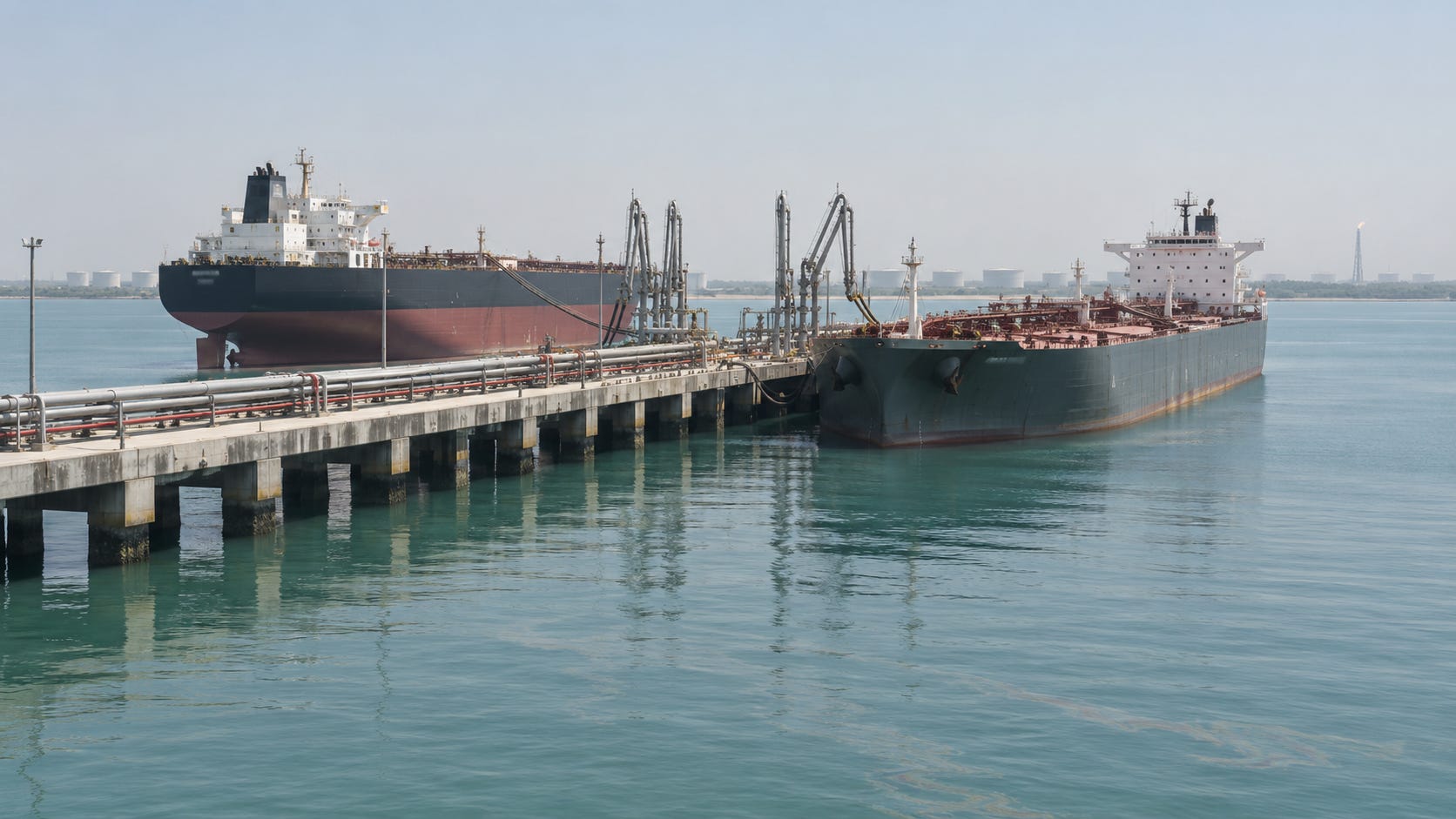
Every figure published about Venezuela’s oil recovery measures barrels leaving. Kpler’s head of crude oil analysis, Homayoun Falakshahi, described to The National what is actually in the ground there: “They have very low API gravity, sometimes under 10 degrees, which is extremely heavy, very viscous. It’s almost like solid. You can almost compare it with the tar sands in Canada.” Argus put Orinoco Belt crude at eight to 10 degrees API in 2021, the most recent published assessment this desk could find, against a Merey 16 export grade at 16 degrees. Water sits at exactly 10. Below that a crude does not float, does not gravity-feed and does not load. To become a cargo it has to be cut with something lighter, and the volumes arriving by sea say Venezuela is not making enough of that lighter material itself. So there is a second tanker trade running in the opposite direction to the one everybody is watching, and it has to arrive first. Reuters reported on September 1 that the country imported some 166,000 barrels a day of fuel in August, mostly American naphtha, more than double July’s 81,000. That inbound leg has a class, a licence and a freight rate of its own. Argus came closest to describing the tonnage on it: buyers, it wrote on January 28, “primarily import naphtha on long range 1 (LR1) tankers, while the US Gulf coast spot market for refined product shipments is typically dominated by medium range (MR) tankers.” That is one size up from where the United States Gulf clean market normally clears, on a short Caribbean voyage, into a country whose berths are already the acknowledged constraint on everything going the other way. The dependency itself is not a new observation, and this brief names the people who got there first. What has not been assembled anywhere is the shipping: the hulls, the class, the licence written for this one cargo, and what any of it does to a fixture.
📋 In This Issue:
⚖️ The Story:
Why extra-heavy crude cannot load without an import, what the published Reuters naphtha prints actually show and where the series breaks, the licence Washington wrote specifically for this cargo and the two revisions since, the Russian barrels the American ones displaced, the first cargo and the vessel that carried it, why the class is LR1 rather than MR, what the tankage constraint at the terminals does to a discharge that has to happen before a loading, the six-week rule one analyst published almost exactly six weeks before the first cargo loaded, and what two drilling rigs say about how far away the barrels are.
📊 By The Numbers:
The 166,000 barrels a day and the two words that qualify it, the published series and the month Reuters left blank, the 2025 imports across three origins and the split that does not close, the first cargo, the two vessels named on the Vitol run, the ratios and who published them, the wait behind the export ceiling and the two drilling rigs under all of it.
🔍 Why It Matters:
What changes for the LR1 owner, the Aframax owner, the crude trader and the marine underwriter.
👀 What To Watch:
The five markers, including the finding that would prove this reading wrong.
🚨 Gosships Signal:
What it means when the number nobody models has to arrive before the number everybody models can move.
🔔 Not A Member?
Unlock The Full Analysis, Data Cards, Archive, & More!
📊 Order Our Exclusive Report
→ Global Tanker Market Outlook Q3 2026 Edition
📋 Competency-Based Maritime Training
→ SwiftAction
📌 Gosships Data Card

May 19, 2021: Argus reports on Venezuela’s blending problem. This desk has found no more recent published gravity assessment. It puts Orinoco Belt extra-heavy crude at 8 to 10 degrees API and the Merey 16 export grade at 16 degrees, and quotes an official of PDVSA’s Orinoco division on the arithmetic of closing that gap: “It’s only about 30,000 b/d of condensate, but the 45-52°API grades mean we can produce more Merey with less light crude.” The same report puts total condensate, naphtha and light cracked product running into the blend at around 60,000 to 70,000 barrels a day.
Week to July 23, 2025: Vessel-tracking data reported by TankerTrackers.com, and on that single source alone, has the Barbados-flagged tanker Telesto discharging about 700,000 barrels of Russian-origin heavy naphtha at the Jose terminal, having departed a ship-to-ship location off Russia’s Taman port with an origin the tracker put at Tuapse. This desk has not corroborated it against a second tracker. It is the clearest public trace of the supply line American cargoes later displaced.
December 2, 2025: Kpler publishes a scenario note on Venezuelan supply under a United States military intervention. Its analyst Florian Grunberger states the constraint before it became news: “The main bottleneck in terms of supply is the access to diluents such as naphtha or condensate. If diluents are not imported in sufficient quantity for more than six weeks, a drop in upstream operations in the Orinoco Belt could become visible.” The same note sets out the supply history: “The main sources include Iranian condensate (2020-2023) and naphtha from the US (Jan-23 until May-25). However, in H2 2025, Russian naphtha has replaced most US volumes.”
January 10, 2026: Reuters reports, under the headline “Exclusive-Vitol to load first diluent cargo under Venezuela supply deal this weekend, sources say”, that the trading house is expected to load the first naphtha cargo from the United States to Venezuela under a new supply agreement. Rory Johnston, described by Reuters as a Commodity Context analyst, is quoted in the same report: “Total diluent imports into Venezuela have been pretty flat over the past year, and assuming the current situation cuts off Russian naphtha flow, then the U.S. will need to replace ASAP to avoid further upstream shut-ins.”
January 11, 2026: The cargo loads. Argus reports the following day, citing Kpler, that 460,000 barrels of naphtha were loaded on the Hellespont Protector on January 11, out of Pasadena, Texas. General Licence 47, the instrument written specifically for United States-origin diluents, postdates this loading by three weeks. This desk has not established which authorisation covered the January cargo and makes no suggestion that it moved without one. The vessel carries IMO 9351452, was built in 2007 at 69,998 deadweight tonnes and is registered on the Isle of Man to Valloeby Protector Ltd, with Hellespont Ship Management GmbH & Co as its safety management company. It has since been renamed VS Protector, and this desk has not established the date of the rename. Vessel databases disagree on its type: MaritimeOptima records it as a Panamax LR1 with epoxy coatings, while VesselFinder and MarineTraffic both record it as a crude oil tanker. Devdiscourse reported on January 23 that the vessel “was nearing Venezuela’s Jose port for a scheduled discharge”. This desk has found no report confirming that the discharge was completed.
January 12, 2026: Argus publishes the 2025 composition of the trade from which Russian barrels are about to be displaced: “Of its 88,000 b/d of naphtha imports last year, US shipments accounted for 47pc, while Russian receipts made up 41pc, or 36,000 b/d, while China shipped 8,000 b/d.”
January 28, 2026: Argus publishes the sentence that comes closest to a description of the vessel class on this run: "Buyers in the country primarily import naphtha on long range 1 (LR1) tankers, while the US Gulf coast spot market for refined product shipments is typically dominated by medium range (MR) tankers." Riviera Maritime Media, Lloyd's List and TradeWinds have all published on the naphtha leg as well, and this desk claims no first on the trade itself. The same report puts United States loadings for Venezuela at 970,000 to 1.22 million barrels in the month to January 28 against 560,000 to 1.21 million barrels across the whole of the fourth quarter of 2025, on ranges that overlap, and records Caribbean-bound MR freight rising from $625,000 lumpsum on January 23 to $900,000 on January 27, while noting it was unclear whether the second cargo was naphtha or another refined product. It runs under the headline "US naphtha displaces Russian flows to Venezuela".
February 3, 2026: The United States Treasury issues General Licence 47, “Authorizing the Sale of U.S.-Origin Diluents to Venezuela”, under the Venezuela Sanctions Regulations at 31 CFR part 591. It authorises all transactions “ordinarily incident and necessary to the exportation, reexportation, sale, resale, supply, storage, marketing, delivery, or transportation of U.S.-origin diluents to Venezuela”. It is signed “Bradley T. Smith, Director, Office of Foreign Assets Control. Dated: February 3, 2026.” It carries no expiry date. Firms relying on it must report to the State Department and the Department of Energy within 10 days of the first covered transaction and every 90 days thereafter.
February 6, 2026: Bloomberg Linea reports that Russian naphtha shipments have disappeared and that all imports are now coming from the United States, in its own words: “los envíos de nafta rusa han desaparecido y todas las importaciones han provenido de EE.UU.” The same report names two product tankers on the Vitol naphtha run, citing shipping reports rather than a named data provider, and names a Chevron-chartered vessel loading 500,000 barrels of naphtha in the United States Virgin Islands rather than on the United States Gulf coast.
February 24, 2026: Reuters reports on the compliant tonnage being fixed for the reopened trade and separates the two legs in one line: “Vitol and Chevron have also hired similar-sized vessels to supply naphtha to PDVSA, the shipping data showed.” The same report records that “Chevron and some US refiners have hired dozens of Aframaxes and Panamaxes, mostly under time-charter contracts for Venezuela”.
June 10, 2026: General Licence 47A is issued, superseding General Licence 47.
August 18, 2026: Kyle Haustveit, Under Secretary of Energy, tells an event in Houston that north of 100,000 barrels per day of American naphtha is moving to Venezuela, and that north of 500,000 barrels a day of Venezuelan production is coming to United States refineries. Of the two-way trade he says: “This is a beautiful energy partnership. The distance makes sense. It’s an open market. Real value is being created on both sides of the trade. I just don’t think there’s a cleaner partnership.”
August 21, 2026: Reuters publishes an exclusive by Marianna Parraga headed “Tankers stack up as Venezuela sells oil faster than its ports can handle”. It records tankers “having to wait up to 30 days to load because of aging infrastructure, power outages and quality issues”, that “In mid-August, only two of Guaraguao’s seven docks were fully in service, a worker from the terminal said”, and that PDVSA and its partners “have been unable to surpass 1.25 million barrels per day of exports even amid rising crude output” against terminals that once handled over 2.5 million. A PDVSA source is quoted on what happens when a cargo arrives to discharge rather than to load: “The speed of crude transfers from tanks to vessels is incredibly slow, which forces tankers to occupy docks for longer than their assigned loading windows. And if a ship arrives to discharge imports, it takes even longer due to lack of fuel storage capacity.” PDVSA vice president Jovanny Martinez is quoted: “We are today in a phase of recovery, but the infrastructure is there. There are deficiencies and reliability must improve.” The words naphtha and diluent do not appear anywhere in the report.
August 27, 2026: General Licence 47B is issued in a tranche of eight reissued Venezuela licences, replacing General Licence 47A. The material change is the removal of the condition requiring the contract to be construed and interpreted in accordance with the laws of a United States jurisdiction. The four permitted dispute forums, the United States, the United Kingdom, France and Singapore, were already set by 47A on June 10 and are unchanged.
September 1, 2026: Reuters reports August exports at about 1.17 million barrels a day, almost unchanged. In the same report: “The country also imported some 166,000 bpd of fuel last month, mostly U.S. naphtha to dilute its extra-heavy crude output, more than double the 81,000 bpd imported in July.”
September 2, 2026: Chevron announces an expanded position in Venezuela, stating that “The enhancements underpin joint venture plans to invest over $7 billion over the next five years, more than doubling production to approximately 600,000 barrels a day compared to 2026.” The money is the joint ventures’, not Chevron’s alone. The figure matters here only as an input: on the published blending ratios, an increment of that size carries a diluent requirement of its own.
⚖️ The Story
Start with the physical fact, because everything else in this brief is downstream of it.
Orinoco Belt crude does not behave like oil. Argus put it at eight to 10 degrees API in 2021, the most recent published assessment this desk could find, and Falakshahi’s description to The National is the one worth keeping in your head when you look at any Venezuelan production forecast: “It’s almost like solid.” Water is 10 degrees API. A crude below that sinks. It will not gravity-feed through a pipeline, it will not strip through a pump at ambient temperature and no tanker will load it as it comes out of the ground. To become a cargo it has to be cut with something light. The result is Merey 16, a 16-degree blend carrying between 2.5 and 3.4 percent sulphur, which is the grade the United States Gulf coast coking refineries were built for and the grade that shows up in the export figures everybody quotes.
The something light is naphtha, and the volumes arriving by sea say Venezuela is not making enough of it. This desk has not established the current yield at the Paraguana complex, which is where domestic supply would show up.
That is the whole mechanism, and it produces an unusual shape for an oil exporter: the export capacity is a function of an import. Not of reservoir pressure, not of drilling, not of berth depth. Of whether a product tanker turned up. Stillwater Associates put it in one line on January 27, and it is the cleanest statement of the constraint this desk has found from any consultancy: “short-term volumes are bounded as much by diluent availability as by reservoir capacity.”
Kpler had said it earlier and harder. In a scenario note published on December 2, before any of this was a trade story, Florian Grunberger wrote that “The main bottleneck in terms of supply is the access to diluents such as naphtha or condensate”, and attached a clock to it: “If diluents are not imported in sufficient quantity for more than six weeks, a drop in upstream operations in the Orinoco Belt could become visible.” Six weeks. That is the tolerance on a supply line that runs by sea.
