


⚓ Gosships Intelligence
Gosships Intelligence Is Published At Gosships.com
For Sponsorship And Partnership Inquiries Contact intelligence@gosships.com
|⚓ About Us | 🛢️ Exclusive Report | 📋 SwiftAction Training |
🏅Black Gold Membership (*53 Slots Left)
On September 2 the Office of Financial Sanctions Implementation published a penalty notice against Citibank, N.A., London Branch. The number that travelled was £4,732,830.58, the largest financial sanctions penalty the United Kingdom has imposed since the two Standard Chartered penalties were fixed on ministerial review in February 2020. The reason travelled thinly. Trade Finance Global and FStech each gave it a clause. This desk has found no account that read it against the ownership and control test the same regulator sets charterers, brokers and owners, and no maritime coverage of it anywhere. Buried at paragraph 17 of a 16-page document is a finding that describes, in the regulator’s own words, the exact check a charterer, owner or underwriter is told to perform and told almost nothing about how to perform. The bank’s screening system, OFSI writes, “perceived a material difference” between two spellings of one company: “Sovcomflot” on OFSI’s own list, and “PAO Sovcomflot” in the bank’s customer records. Those three letters are not a different company. PAO is the Russian abbreviation for a public joint stock company, the exact thing the letters PJSC say in English. Because the system did not account for them, it produced no alerts. Twenty-nine companies that Sovcomflot owned or controlled held 32 accounts at the branch. Those accounts were not promptly restricted, and 328 transactions worth about £5.4 million ran through them before the restrictions came, most of them while a wind-down licence was live that nobody checked. None of those 29 entities is named in the notice, and they did not need to be on any list: they were caught because their parent was, under the ownership and control test that OFSI separately instructs charterers, ship brokers and owners to apply themselves. The bank did not volunteer this group at all. OFSI wrote to it first, and the real cause did not surface until August 2025, three years after the money moved. Nor is the lesson confined to banks, because OFSI says so itself: firms outside financial services that run automated systems, it writes at paragraph 61, should also consider these risks. The market treats sanctions compliance as a question of knowing who is designated. It is a question of whether two strings of characters match, and this notice is the most detailed official British account this desk has found of that comparison failing on a name nobody hid, published into a market that has never been told a single word about how to make those strings match.
📋 In This Issue:
⚖️ The Story:
What paragraph 17 actually says and why a three-letter prefix produced silence rather than an alert, why 29 companies were exposed to an asset freeze without appearing on any list, the wind-down licence that covered most of those payments and the check nobody performed, the second failure in the same notice that was human judgement rather than software, the three years it took OFSI’s own scrutiny to surface the real cause, the comparable Russian name failure OFSI penalised nine months earlier, where OFSI itself says these lessons reach beyond banks, the UK maritime guidance that names charterers and brokers and never mentions name variations once, the two British sanctions lists that are not the same file, and the call for evidence the Treasury and OFSI closed in April and have not answered.
📊 By The Numbers:
The £4,732,830.58 penalty and how it was built, the 29 entities and their 32 accounts, the 328 transactions, the roughly £6.9 million OFSI says was never voluntarily disclosed, the three years to the real cause, the 518 days, the Level 4 rating, the nine named subsidiaries that carry no designation of their own, and the one count this brief will not give.
🔍 Why It Matters:
What changes for the VLCC owner, the charterer, the crude trader and the marine underwriter.
👀 What To Watch:
The five markers, including the finding that would prove this reading wrong.
🚨 Gosships Signal:
What it means when the whole system rests on two strings matching.
🔔 Not A Member?
Unlock The Full Analysis, Data Cards, Archive, & More!
📊 Order Our Exclusive Report
→ Global Tanker Market Outlook Q3 2026 Edition
📋 Competency-Based Maritime Training
→ SwiftAction
📌 Gosships Data Card
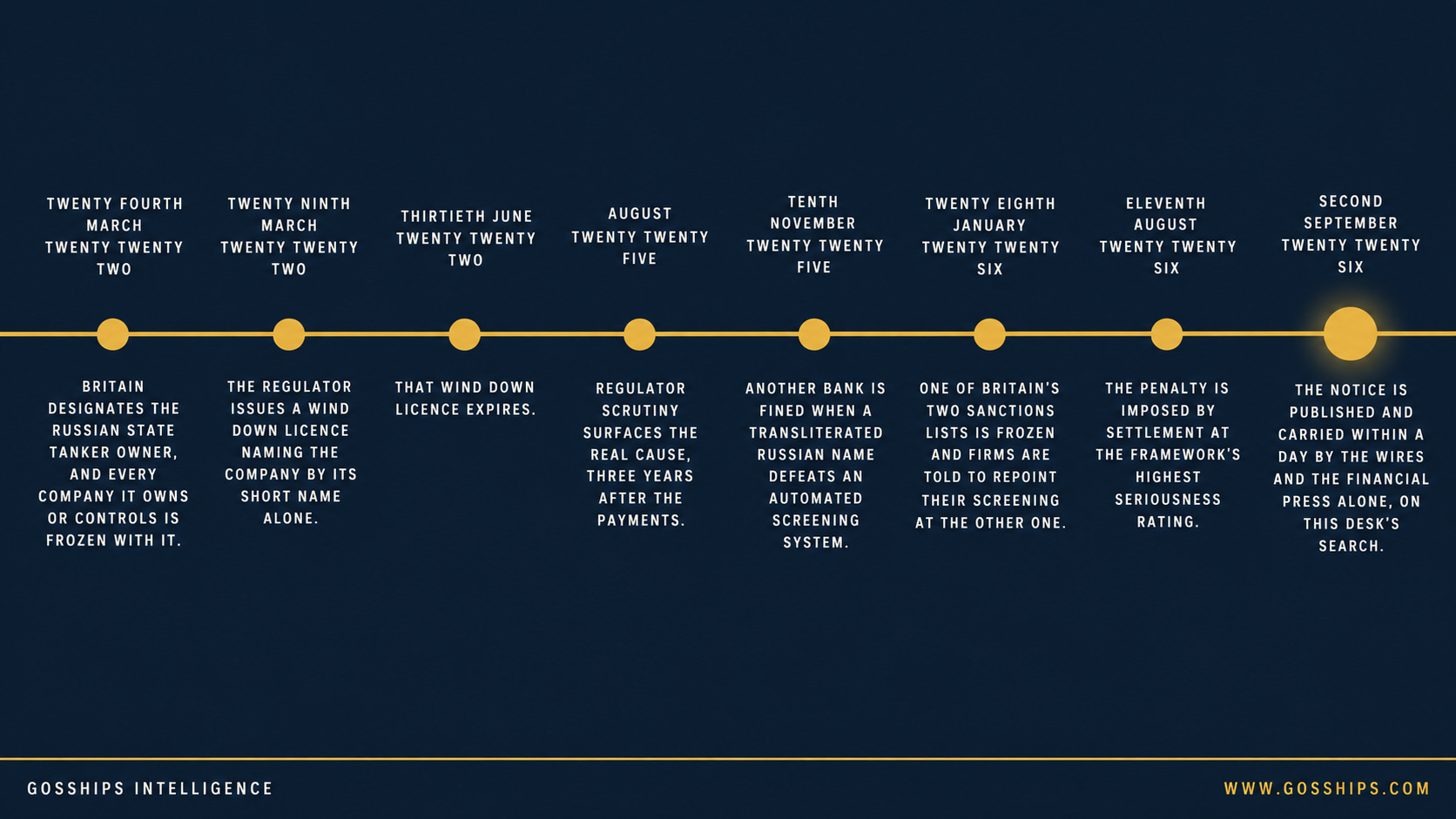
March 24, 2022: The United Kingdom designates Public Joint Stock Company Sovcomflot under the Russia (Sanctions) (EU Exit) Regulations 2019. The UK Sanctions List gives the reference RUS1097 and the legacy OFSI group identifier 15040, and records the reason as involvement in “obtaining a benefit from or supporting the Government of Russia by carrying on business in a sector of strategic significance to the Government of Russia”, naming the energy sector. The entry carries three further spellings of the same company, each typed as a primary name variation rather than an alias: “PAO SOVCOMFLOT”, “PJSC SOVCOMFLOT” and “PUBLICHNOE AKSIONERNOE OBSCHESTVO SOVREMENNYY KOMMERCHESKIY FLOT”. The first two carry the identical Cyrillic string ПАО СОВКОМФЛОТ. What the entry carried on the day of designation this desk has not established and does not assert.
March 29, 2022: OFSI issues General Licence INT/2022/1469378, “Wind Down of Positions Involving Sovcomflot”, under regulation 64 of the Russia Regulations. Its definitions clause defines four terms, and the first two are the ones that matter here: “The ‘DP’ means Sovcomflot” and “’Subsidiary’ means Any entity owned or controlled by the DP”. It permits a person other than the designated party or a subsidiary to “wind down any transactions to which it is a party, involving the DP or a Subsidiary including the closing out of any positions”. OFSI’s own licence therefore identifies the designated person by the short name alone and defines the whole exposed population by the ownership test rather than by any list.
February to November 2022: The majority of the breaches later penalised occur. OFSI records that Citibank, N.A., London Branch “had particularly high exposure to future Russia sanctions risks in February 2022 due to its Russian client base, correspondent banking operations involving Russian financial institutions and payments relating to its Russian affiliate, AO Citibank”.
June 30, 2022: General Licence INT/2022/1469378 expires. The licence had taken effect on March 29 with a window running to May 15, and OFSI’s publication notice records that on May 13 it was extended to June 30.
November 8, 2022: OFSI writes to the bank. The notice records the request as one for “details of all remaining undisclosed matters”, and the bank responds on November 25 with what OFSI describes as “a comprehensive summary” of the matters it was then reviewing.
April 11, 2025: OFSI imposes a £5,000 penalty on Svarog Shipping & Trading Company Limited, published on May 8. The notice describes Svarog as “a UK-registered company operating as a fuel transportation company in the maritime oil shipment sector” whose business operations are carried out in Cyprus. It records that General Licence INT/2022/1469378 had been issued to allow “the orderly winding down of positions involving designated person, Sovcomflot”, that the licence’s applicability “became relevant to a large and complex investigation into suspected breaches of the Russia Regulations”, and that as part of that wider investigation “OFSI learned that Svarog had transacted with a subsidiary of SCF”. Svarog was penalised for failing to answer a regulation 72 information request issued on January 26, 2024 with a deadline of February 9, 2024, in breach of regulation 74(1)(a). OFSI “ultimately concluded that Svarog had not breached financial sanctions other than in respect of this failure to respond offence”.
July 31, 2025: The Commercial Court hands down Tonzip Maritime Ltd v 2Rivers Pte Ltd [2025] EWHC 2036 (Comm), before Mr Andrew Hochhauser KC sitting as a deputy judge of the High Court. A tanker owner had refused a charterer’s orders to load a cargo after its screening identified an individual designated under UK and EU sanctions law behind the shipper and supplier of the cargo. The judgment records at paragraph 21 that “The Claimant’s sanctions screening checks revealed that Neftisa was associated with Mr Gutseriev, who was designated under EU and UK Sanctions Laws, and identified him as the indirect owner of Neftisa and the Chairman of its Board of Directors (reported July 2015-July 2021) and (no further information reported after August 2021)”, and at paragraph 113 that the vessel’s managers ran standard due diligence processes that “included use of third party tools, including Refinitiv/World-Check”. At paragraph 132 the judge finds that “there is nothing in them which evidences Mr Gutseriev’s control, direct or indirect, of Netfisa in November 2021”, using the court’s own spelling. The conclusion at paragraph 134 is that “the Claimant was not entitled to refuse the Defendant’s orders to load the Neftisa Cargo, and its claim fails”. The sum claimed was US$1,020,099.80.
August 2025: OFSI’s scrutiny surfaces the real cause of the Sovcomflot breaches. The notice records that the bank’s “initial description of the cause did not reflect the full facts, which only came to light following scrutiny by OFSI in August 2025, three years after the breaches occurred and at a late stage in OFSI’s investigation”.
November 10, 2025: OFSI imposes a £160,000 penalty on Bank of Scotland PLC, published on January 26, 2026. The cause is a name that did not match. A designated person opened an account with a UK passport carrying “a spelling variation” of the name on OFSI’s list, and OFSI records that “The character changes are common equivalents in Russian to English translations”. OFSI records “two key issues” that “contributed to the screening system being unable to identify a potential match”: “the screening system did not reconcile the character changes between the spelling variations”, and the system “lacked sufficient enhancement, from either commercial third parties or the bank itself, to reconcile the spelling variations”.
January 28, 2026: At 9am UK time the UK Sanctions List becomes, in the government’s own words, “the only sanctions list which details sanctions designations published by the UK government”, and “The OFSI Consolidated List and its search tool are no longer being updated”. The guidance instructs users that “You will need to ensure that any systems that use the OFSI Consolidated List for sanctions screening purposes are instead using the data from the UK Sanctions List”. It records the difference in scope: the consolidated list “provided information on those subject to UK financial sanctions only”, while the UK Sanctions List covers restrictions that “can include financial, immigration, trade or transport sanctions”.
February 16, 2026: HM Treasury and OFSI open a call for evidence titled “Ownership and Control Test in UK Financial Sanctions Regulations”. It records that “Industry stakeholders report that perceived ambiguity in the legislation can impact business operations, introduce litigation risk and create significant difficulty in achieving consistent sanctions implementation”, and states plainly that “This call for evidence does not seek to propose options for reforming the control test or to recommend significant changes to its drafting”.
April 20, 2026: The call for evidence closes at 11.59pm. No government response has been published.
June 15, 2026: OFSI issues the bank a Notice of Intention to impose a monetary penalty. The parties agree to enter formal settlement discussions on June 29, commencing July 1.
August 11, 2026: Settlement is agreed and the penalty is imposed: £4,732,830.58, under section 146 of the Policing and Crime Act 2017. OFSI rates the case Level 4, the highest in its seriousness framework, with severity High and conduct Aggravating. The baseline penalty of £7,888,050.97 is reduced by 20 percent for voluntary disclosure and cooperation and a further 20 percent for settlement, a total discount of 40 percent. As a condition of settlement the bank waives its rights to a ministerial review and to appeal to the Upper Tribunal.
September 2, 2026: OFSI publishes the notice at 10.22am British Summer Time. The government’s own content record shows a single change history entry reading “First published.”, and the notice has not been amended since. A Citi spokesperson tells City AM: “We are pleased to conclude this matter with OFSI. Citi takes sanctions compliance extremely seriously and continues to invest significantly in its global sanctions compliance framework.” Reuters, Bloomberg, City AM, Trade Finance Global, Law360 and others carry the penalty within 24 hours. This desk has searched Lloyd’s List, TradeWinds, Splash247, gCaptain, Riviera, Seatrade Maritime and ShippingWatch and has found no maritime coverage of it.
⚖️ The Story
What Paragraph Seventeen Says
The penalty notice runs to 16 pages and covers eight separate groups of breaches, which OFSI calls the Matters. Most of them are the sort of thing that happens to a large correspondent bank in a year when the designation lists move faster than the alert queues. Payment chains rescreened too late. Bank identifier codes never enriched onto internal lists. Alert handlers making the wrong call under volume. Those are real failures and OFSI penalised them, but they are recognisable, and the trade press reported them accurately enough.
Paragraph 17 is different, and it travelled as a subordinate clause rather than as a story. Trade Finance Global recorded the “screening gaps that failed to flag Russian state shipping group Sovcomflot (because its ‘PAO’ corporate prefix was not recognised by Citi’s systems)”, and FStech reported that “OFSI said Citi’s screening software failed to generate alerts for PJSC Sovcomflot because it did not recognise the Russian corporate prefix ‘PAO’ in the company’s name”. Neither took it past the sentence. Neither carried the 29 entities, the 32 accounts, the 328 transactions or the £5.4 million. And FStech, following the wires, told its readers Citi had voluntarily disclosed the majority of the breaches, which is true of the case and false of this Matter, as paragraph 56 shows.
