


⚓ The Gosships Team
Gosships Intelligence Is Published At Gosships.com
For Sponsorship And Partnership Inquiries Contact intelligence@gosships.com
|⚓ About Us | 🛢️ Exclusive Report | 📋 SwiftAction Training |
🏅Black Gold Membership (*53 Slots Left)
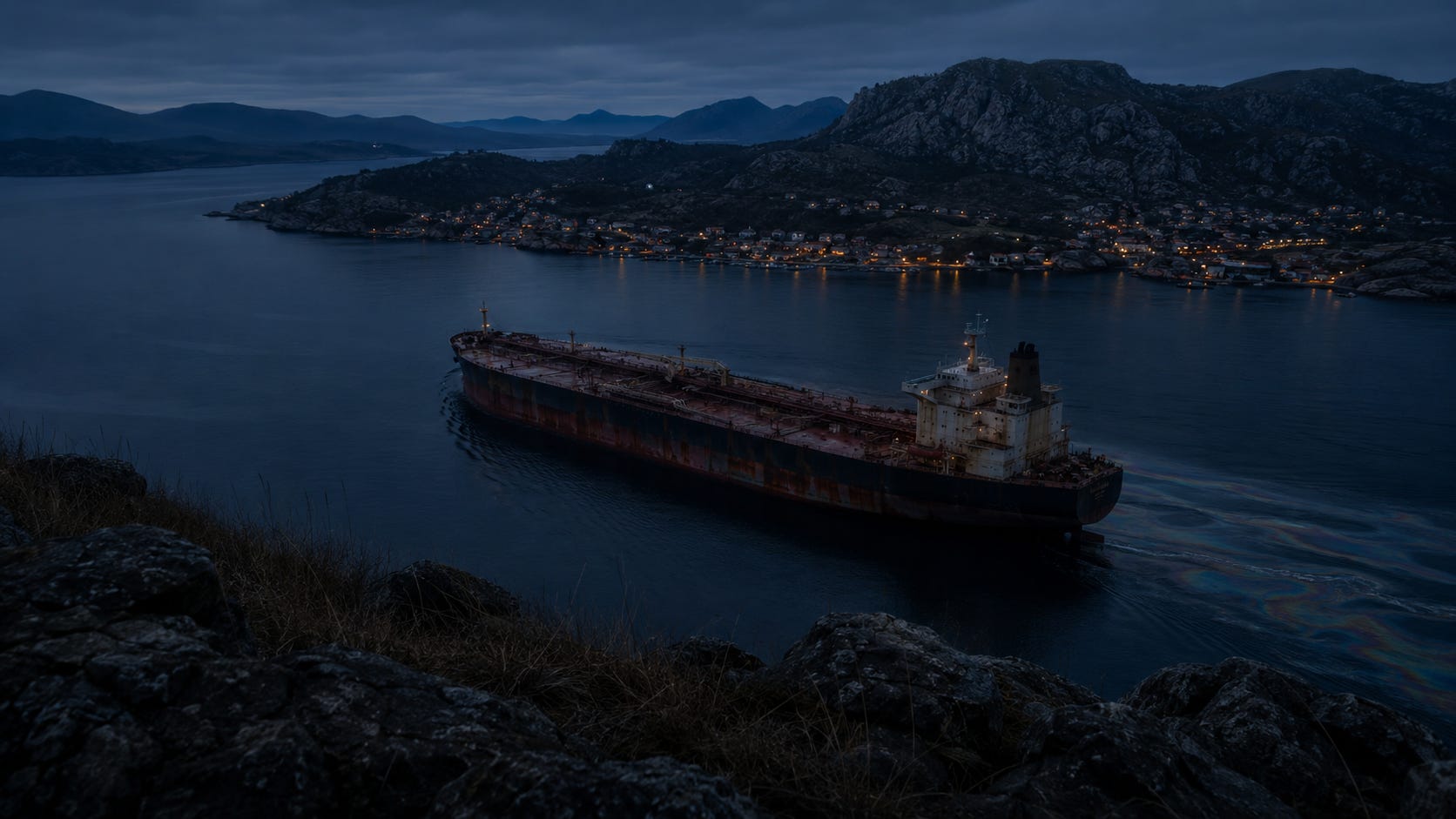
A sanctioned oil tanker was crossing European waters insured by a company whose head office turns out to be a residential apartment.
The insurer, “Seaguard P&I,” claims German registration. Its website was built in 2024, its phone number rings in Sweden, and, according to Ukrainian intelligence documents reviewed by Bloomberg, no company by that name exists in Germany at all. Ukraine’s intelligence service says at least five sanctioned tankers have sailed on its worthless paper. If one breaks apart on a coastline, the people who clean it up will find there is no one to bill.
📋 In This Issue:
🛢️ The Story
📊 By The Numbers
🔍 Why It Matters
👀 What To Watch
🚨 Gosships Signal
🔔 Not Subscribed? Gosships Intelligence Delivers Oil Shipping Intelligence. Subscribe Here!
📊 Order Our Exclusive Report
→ Global Tanker Market Outlook Q3 2026 Edition
📋 Competency-Based Maritime Training
→ SwiftAction
📌 Gosships Data Card
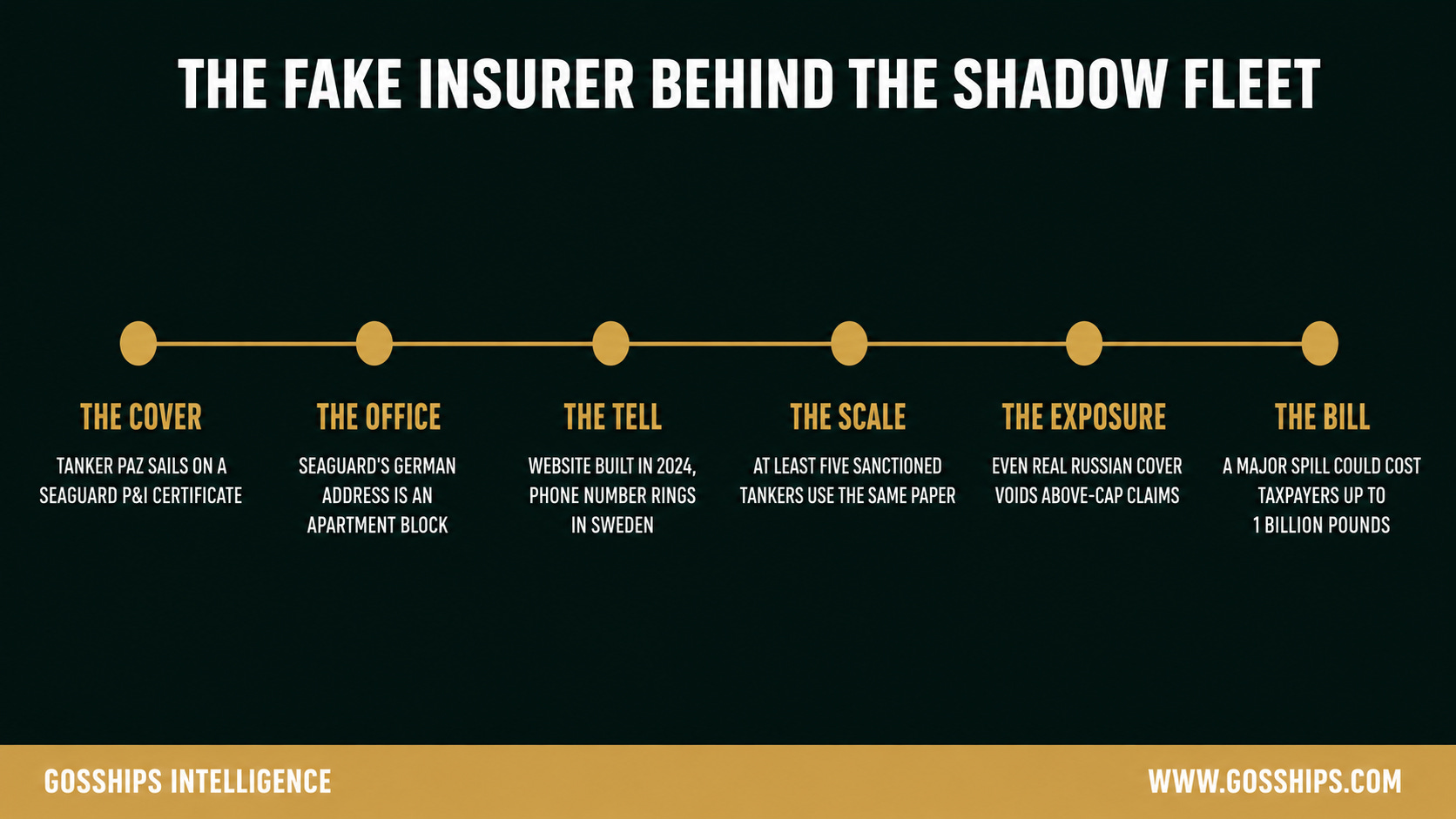
→ The cover: The sanctioned tanker Paz was found carrying an insurance certificate from Seaguard P&I (Insurance Journal; Bloomberg, April 16, 2026).
→ The office: Seaguard’s stated German address in Pinneberg, near Hamburg, is a residential apartment building, and no such commercial entity exists in Germany (Association of Reintegration of Crimea).
→ The tell: The Seaguard website was created in 2024 and its listed contact number is registered in Sweden (Association of Reintegration of Crimea).
→ The scale: At least five sanctioned tankers carried Seaguard certificates, per the intelligence assessment (Bloomberg, April 16, 2026).
→ The exposure: Even Russian-issued cover carries a “sanctions exclusion clause” that voids claims on oil sold above the price cap (KSE Institute).
→ The bill: Cleanup from a single shadow-fleet spill could run from £99 million to £1.05 billion, likely borne by taxpayers (KSE Institute; UK Parliament evidence).
🛢️ The Story
The shadow fleet’s most dangerous weakness has never been the ships. It has always been the insurance. And Ukraine just showed the world how fake that insurance can be.
In April 2026, Bloomberg reported that Ukrainian intelligence had uncovered a scheme in which sanctioned Russian oil tankers were sailing with insurance certificates from a company that does not exist. The insurer, calling itself “Seaguard P&I,” had issued a certificate for the tanker Paz, a vessel sanctioned by the United States, the United Kingdom and the European Union, according to Insurance Journal. Protection and indemnity cover, known as P&I, is the insurance that pays for oil-spill cleanup, wreck removal and third-party damage. It is the single document that separates a legitimate tanker from a floating liability. Seaguard’s version of it was worthless.
The details, laid out by the Association of Reintegration of Crimea, read like a cheap forgery because that is what they are. Seaguard P&I claimed to be registered in Germany, at an address in Pinneberg, a suburb of Hamburg. Investigators found that the address on the certificate and the company’s website was, in the group’s words, “the location of a residential apartment building.” No such commercial insurer exists in Germany. The website had been created in 2024. The contact number listed on it was registered in Sweden, not Germany. And the name itself was borrowed from a legitimate service based in Nigeria, apparently to lend the operation a veneer of history and confuse anyone who tried to check. After the first reports surfaced in April, the Association of Reintegration of Crimea noted, the Seaguard website went offline entirely, which is not how a real insurer responds to questions about its policies. Every element was designed to survive a glance and collapse under a phone call.
This was not a single rogue ship. According to the intelligence assessment reported by Bloomberg, at least five sanctioned tankers were found carrying Seaguard certificates. One of them, the Deyna, had been seized by French authorities in March on suspicion of circumventing sanctions on Russia. The vessels tied to the scheme displayed the classic dark-fleet behaviour that makes them so dangerous in the first place: disabling their automatic identification transponders, conducting ship-to-ship transfers of petroleum at anchorages, and otherwise operating outside the safety and environmental norms that govern the legitimate fleet. A fake insurance certificate is not a paperwork problem sitting on top of a safe ship. It is the paper that lets an unsafe ship keep sailing.
To understand why a forged certificate matters so much, you have to understand the machinery it is imitating. The world’s mainstream tankers are insured through the International Group of P&I Clubs, a London-centred system that covers roughly 90 percent of world tonnage and provides liability cover of more than a billion dollars per vessel. That concentration is the West’s single most powerful sanctions lever, because a ship without recognised P&I cover is, in practice, uninsurable, unwelcome in reputable ports, and uninsured against the catastrophe it might cause. When the Group’s clubs withdrew cover from sanctioned Russian trades, they did not just raise costs. They tried to make those ships un-sailable.
The shadow fleet’s answer was to manufacture its own insurance reality, and it exists on a spectrum from real-but-hollow to entirely fake. At the real-but-hollow end sits Moscow-based Ingosstrakh, sanctioned by the US and UK, backstopped by Russia’s state reinsurer, and issuing P&I-equivalent policies to shadow operators. According to analysis compiled by the KSE Institute, those policies carry a “sanctions exclusion clause” that would void any claim involving oil sold above the G7 price cap, which means that a vessel caught breaking the very sanctions it was structured to evade would find its cover invalid at the exact moment it was needed. As maritime commentators including Baird Maritime have put it, this is how a major oil spill from the dark fleet may not be covered at all, even when the ship is waving a certificate. Further down the spectrum sit obscure “alternative” insurers registered in jurisdictions with weak oversight, from Gabon to Cameroon, as documented by Reinsurance News and Asia Sentinel. And at the very bottom sits Seaguard P&I: not a weak insurer, not a sanctioned insurer, but no insurer at all.
The scale of the underlying exposure is what turns this from a fraud story into a coastal-catastrophe story. The KSE Institute estimates that roughly 90 percent of shadow-fleet vessels lack cover from International Group clubs, carrying instead policies from Russian or unknown insurers with limits as low as 5 to 50 million dollars, orders of magnitude below the billion-dollar-plus cover standard on mainstream tankers. Russia’s shadow fleet is estimated at between 600 and 900 vessels, many of them aging, poorly maintained and crossing crowded European chokepoints like the Baltic, the English Channel and the Danish straits. UK parliamentary evidence and the KSE Institute have put the potential cleanup cost of a single major shadow-fleet spill at between 99 million and 1.05 billion pounds, a bill that, absent valid P&I cover, would fall on the coastal state and its taxpayers.
That is the trap Ukraine has exposed. A certificate from Seaguard P&I is designed to get a sanctioned tanker past a port-state inspector, an insurer verification, a flag registry. It is not designed to pay for anything. So the question underneath the whole scheme is not whether the paper is fake. Ukraine has answered that. The question is what happens on the day one of these ships runs aground, splits open, and the coastal government pulls the certificate, dials a number that rings in Sweden, and reaches a company that never existed. Who actually pays, how exposed the compliant market really is, and what underwriters and port states can do before that day rather than after, is where this becomes everyone’s problem.
🔗 Related Coverage
Maritime Sanctions 2026: Shadow Fleet Under Siege, Sanctions Enforcement Redux
The Shadow Fleet Under Fire: Arctic Metagaz Blaze Signals New Phase in Maritime Sanctions Warfare
Hormuz Shut Down: Tankers Hit, War Risk Cover Pulled
Ukraine exposed the paper as fake. That is the easy part. The hard part is what it means for the compliant market that has to share sea lanes with these ships, which vessels and flags to screen for right now, and the specific liability trap waiting for the first coastal state that trusts a shadow certificate. That analysis is below.
