


⚓ The Gosships Team
Gosships Intelligence Is Published At Gosships.com
For Sponsorship And Partnership Inquiries Contact intelligence@gosships.com
|⚓ About Us | 🛢️ Exclusive Report | 📋 SwiftAction Training |
🏅Black Gold Membership (*53 Slots Left)
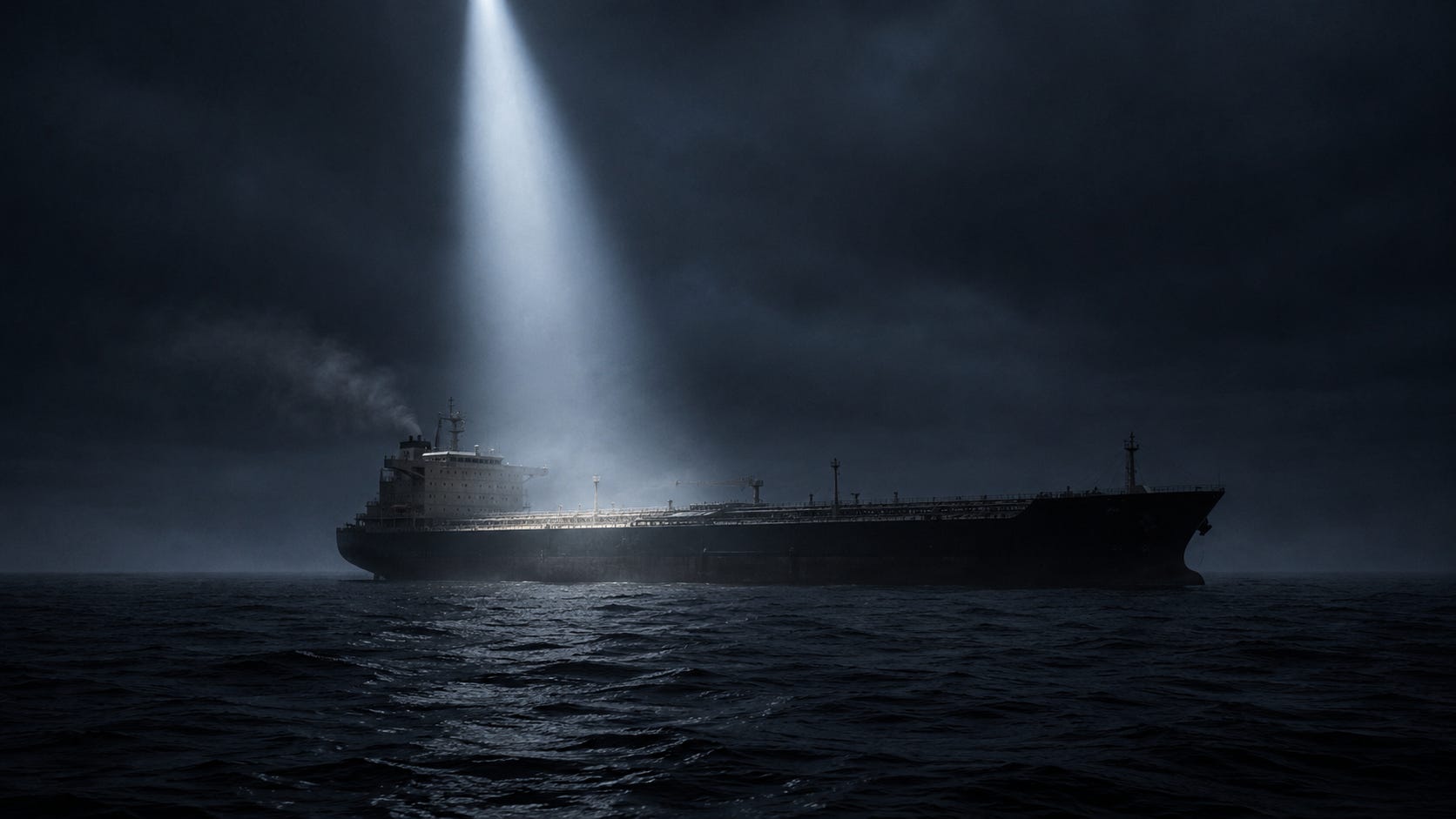
On Monday, a US Navy fighter jet flew off an aircraft carrier and put a precision munition into a civilian oil tanker, the seventh vessel disabled since the blockade began in April. US Central Command says 134 ships have obeyed its warnings and turned around. Seven have not, and every one of them has been disabled for it. Yet Iran’s shadow fleet keeps sailing at the line, and by Lloyd’s List’s count, nearly 20 more shadow-fleet tankers are sitting just outside it right now, engines running, deciding whether to be number eight.
📋 In This Issue:
🛢️ The Story
📊 By The Numbers
🔍 Why It Matters
👀 What To Watch
🚨 Gosships Signal
🔔 Not Yet Subscribed? Gosships Intelligence Delivers Oil Shipping Intelligence. Subscribe For Free!
📊 Order Our Exclusive Report
→ Global Tanker Market Outlook Q3 2026 Edition
📋 Competency-Based Maritime Training
→ SwiftAction
📌 Gosships Data Card
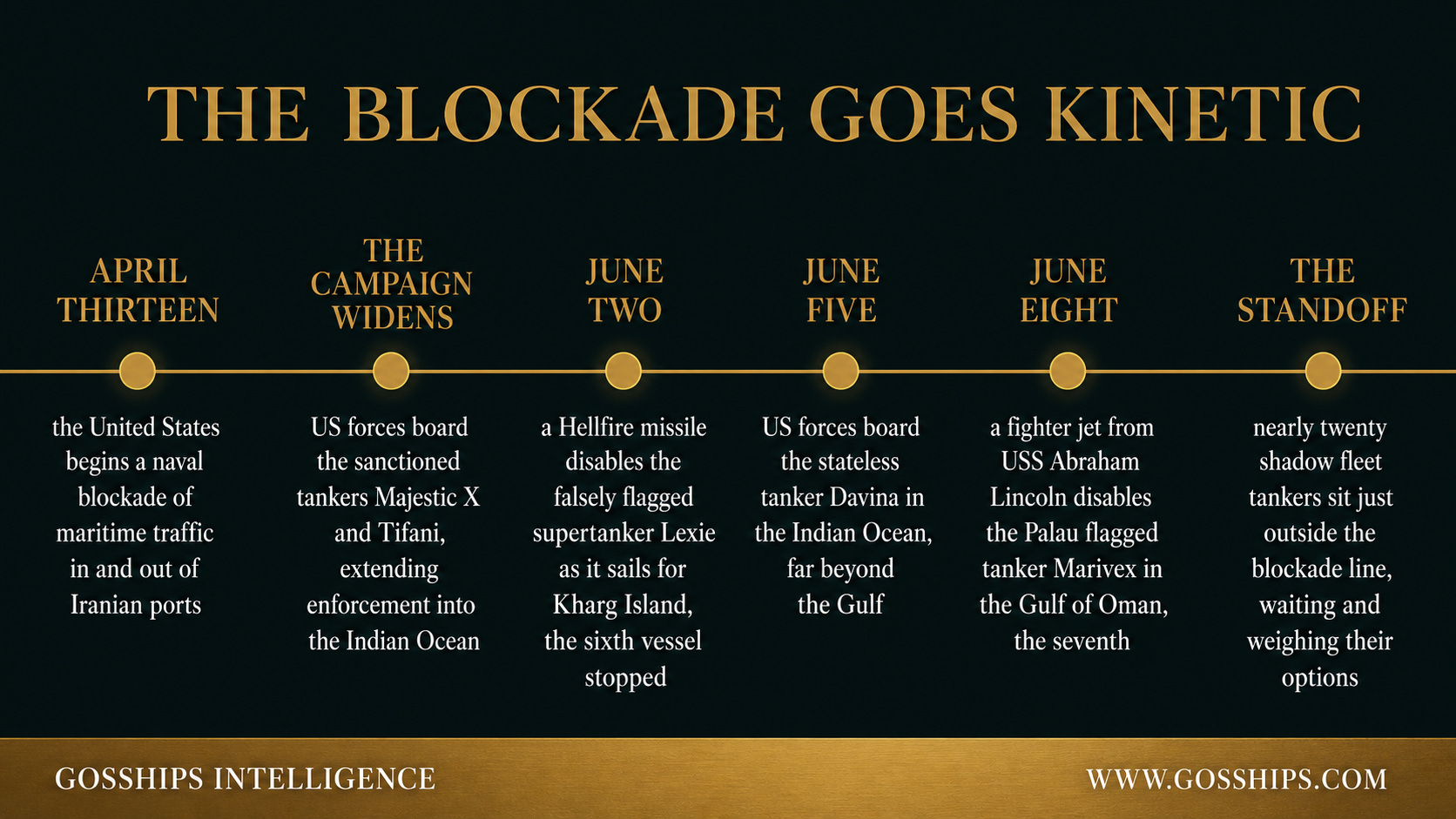
→ April 13: The United States Begins A Naval Blockade Of Maritime Traffic In And Out Of Iranian Ports
→ The Campaign Widens: US Forces Board The Sanctioned Tankers Majestic X And Tifani, Extending Enforcement Into The Indian Ocean
→ June 2: A Hellfire Missile Disables The Falsely Flagged Supertanker Lexie As It Sails For Kharg Island, The Sixth Vessel Stopped
→ June 5: US Forces Board The Stateless Tanker Davina In The Indian Ocean, Far Beyond The Gulf
→ June 8: A Fighter Jet From USS Abraham Lincoln Disables The Palau-Flagged Tanker Marivex In The Gulf Of Oman, The Seventh
→ The Standoff: Nearly 20 Shadow Fleet Tankers Sit Just Outside The Blockade Line, Waiting And Weighing Their Options
🛢️ The Story
The ship that became number seven was empty. On Monday, June 8, US Central Command announced that an F/A-18 Super Hornet flying from the aircraft carrier USS Abraham Lincoln had fired a precision munition into the engineering and steering spaces of the Marivex, a Palau-flagged tanker transiting international waters in the Gulf of Oman toward an Iranian port. The crew, CENTCOM said, had failed to comply with directions from US forces. The strike left the roughly 135-meter vessel disabled but afloat, with no injuries immediately reported, and the command summarized the outcome in seven words: “Marivex is no longer sailing to Iran.”
The tanker was not a stranger to the US government. According to Treasury Department records cited by gCaptain, the Marivex was previously named the Arihant, IMO 9464156, and was sanctioned by the Office of Foreign Assets Control in December 2025 as part of a crackdown on Iran’s sanctions-evasion network. Treasury identified it as part of Iran’s shadow fleet and said it had carried hundreds of thousands of barrels of Iranian fuel oil and bitumen around the Persian Gulf. Six months after that designation, the same ship found out what designation now means.
To understand why a fighter jet is shooting at an empty tanker, go back to April 13. That day, after talks between Washington and Tehran broke down, the United States began enforcing a naval blockade of maritime traffic entering and leaving Iranian ports, according to Stars and Stripes. The Washington Times reports the operation is designed to squeeze Iran’s economy and improve Washington’s leverage in negotiations over lifting the blockade and reopening the Strait of Hormuz, and that Iranian media have described rampant inflation and unemployment inside the country as exports are choked. Advisories distributed through the US military’s Joint Maritime Information Center have spelled out the terms with unusual bluntness: vessels attempting to enter or leave Iranian ports face “disabling and destructive fires” if they fail to comply with military instructions, per gCaptain.
CENTCOM’s own scoreboard, published alongside Monday’s announcement, shows what that has meant in practice. Since April 13, US forces have disabled seven non-compliant vessels, redirected 134 ships that obeyed instructions, and allowed 42 vessels carrying humanitarian aid to pass. Read those numbers together and the campaign comes into focus. The overwhelming majority of shipping that approaches the line gets a warning, turns around, and sails away with a story to tell. A humanitarian corridor stays open. And a small, hard core of tankers, almost all of them sanctioned, falsely flagged, or stateless, keeps testing the blockade anyway, and keeps getting disabled for it.
The sixth vessel shows what that hard core looks like. On June 2, CENTCOM forces tracked the Lexie, a very large crude carrier of 298,900 deadweight tonnes built in 2001 according to Splash247, ballasting toward Kharg Island, the terminal that Gulf News reports handles roughly 90 percent of Iran’s crude exports. The ship claimed the flag of Botswana, which The Maritime Executive notes is a landlocked country with no international ship registry, and had previously claimed Comoros and Samoa. OFAC sanctioned the vessel in March 2025, and TankerTrackers.com data cited by Splash247 indicates it had been violating Iran sanctions since August 2019, moving approximately 47 million barrels of Iranian oil in that time. US forces ordered it to stop. The crew ignored the warnings for 24 hours. A US aircraft then fired a Hellfire missile into its engine room.
There is a detail in the Lexie episode that explains the whole enforcement logic, and The Maritime Executive spelled it out: the tanker was empty. An empty tanker sailing toward Kharg Island is not exporting anything yet, but it is about to become either a loaded export cargo or floating storage that extends Iran’s ability to keep producing with nowhere to sell. CENTCOM has been blocking that inbound traffic specifically, and with what the outlet called substantial success. That is why the blockade keeps shooting at ships with nothing in them. The empty ones are the supply chain.
The campaign is no longer confined to the Gulf, either. On Friday, June 5, the US Department of War announced that American forces had conducted a right-of-visit boarding of the stateless tanker Davina in the Indian Ocean, inside US Indo-Pacific Command’s area of responsibility, at least the third such Indian Ocean interdiction since April after the earlier boardings of the Majestic X and the Tifani, per gCaptain. The department’s statement promised to interdict vessels supporting Iran “wherever they operate.” A blockade drawn around Iranian ports has quietly become a global enforcement net for the Iranian shadow fleet.
Gosships Read: What changed on April 13 is the meaning of a sanctions designation. For years, an OFAC listing was a paperwork problem: lost insurance, banking friction, a narrower list of ports. The shadow fleet was built precisely to absorb that damage and keep sailing. A blockade enforced by carrier aviation turns the same list into something closer to a targeting file. The Marivex was designated in December and disabled in June. No fine, no detention hearing, a munition into the steering gear. That is a different deterrence model than anything the sanctions architecture has produced in years of pressure on Iran, and on Russia's parallel fleet the lesson will not be lost.
Tehran has not absorbed this quietly. Splash247 reported that the Lexie strike was followed by explosions at Qeshm Island and air raid sirens across Kuwait amid Iranian missile and drone activity, describing a recurring cycle of US interdiction followed by Iranian retaliation. Monday’s strike on the Marivex landed in the middle of the most dangerous week of that cycle so far, with Iran and Israel trading direct fire over the weekend and President Trump posting Monday that the two should “stop the shooting” while insisting peace negotiations were proceeding, per The Washington Times. The blockade, in other words, is being enforced inside an active escalation, one wrong boarding away from becoming the story itself.
And then there is the most telling picture of all, the one at the line itself. Lloyd’s List reports that nearly 20 shadow-fleet tankers have stopped just outside the US blockade line or are diverting on approach, appearing to be waiting and weighing their options. Nearly 20 shadow-fleet ships, idling within sight of an enforcement perimeter that has disabled seven of their kind, doing the same arithmetic their owners are doing ashore: the value of an Iranian cargo against the odds of a Hellfire. Some will turn around and join the 134. Some will wait for a deal to lift the blockade. And if the pattern of the last eight weeks holds, at least one of them will decide the cargo is worth it. Who is paying them to take that gamble, what it does to the rest of the tanker market while Iranian barrels stay locked in, and what the seven disabled hulls now drifting through the world’s insurance market mean for everyone underwriting these waters, is below.
📊 By The Numbers
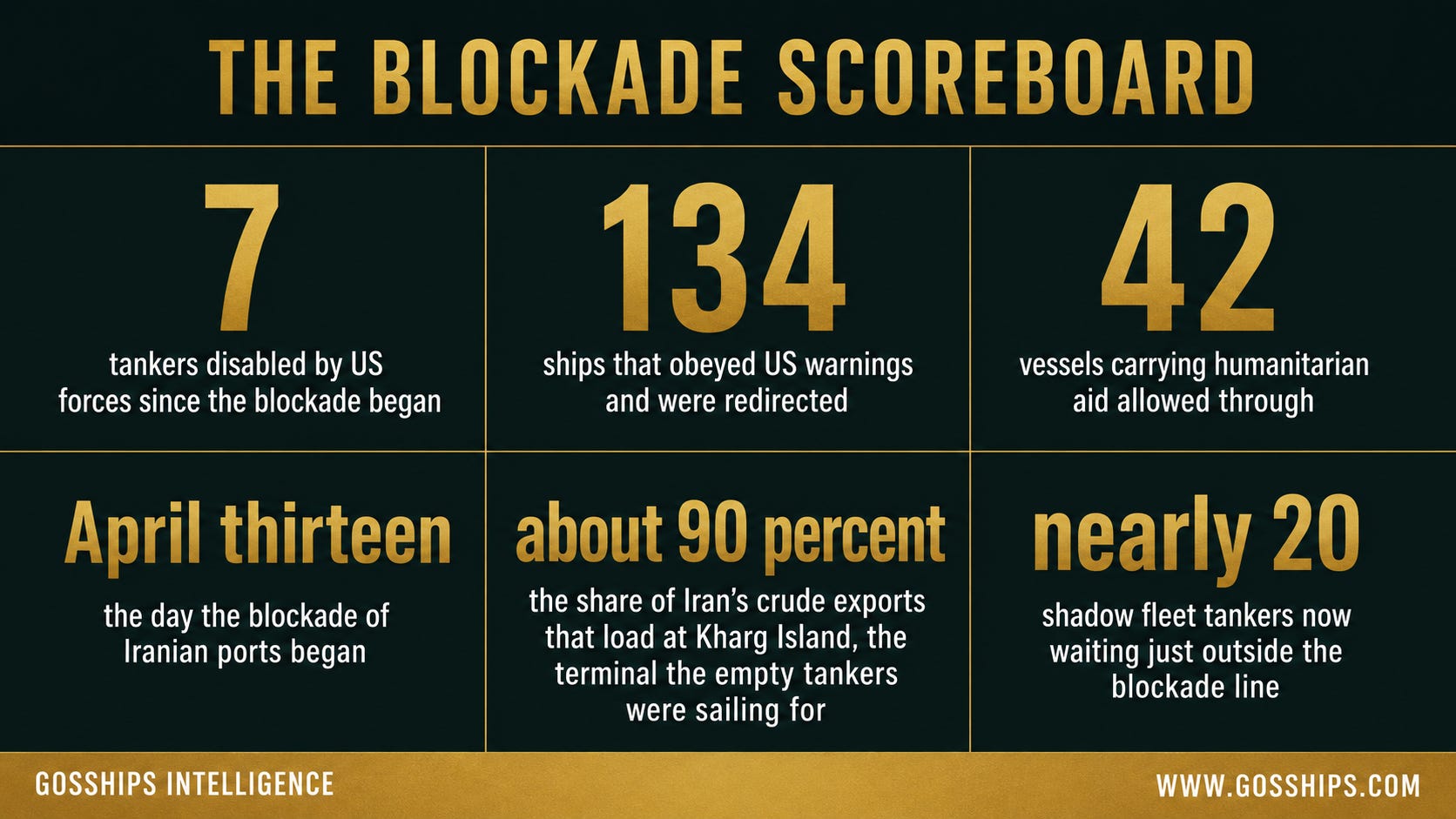
→ 7: Tankers Disabled By US Forces Since The Blockade Began (CENTCOM)
→ 134: Ships That Obeyed US Warnings And Were Redirected (CENTCOM)
→ 42: Vessels Carrying Humanitarian Aid Allowed Through (CENTCOM)
→ April 13: The Day The Blockade Of Iranian Ports Began (CENTCOM)
→ About 90%: The Share Of Iran’s Crude Exports That Load At Kharg Island, The Terminal The Empty Tankers Were Sailing For (Gulf News)
→ Nearly 20: Shadow Fleet Tankers Now Waiting Just Outside The Blockade Line (Lloyd’s List)
Related Coverage
Sinokor Is Charging $20 Per Barrel to Ship Oil. Last Year It Was $2.50. They Control 40% of Available Tankers. Nobody Can Do Anything About It.
Seven disabled hulls, 134 ships turned back, and nearly 20 tankers idling at the line are the visible part of this story. The invisible part is the money: who keeps sending sanctioned ships into a shooting blockade, what Iran’s locked-in barrels are doing to freight rates and to the value of every compliant tanker, and why the seven drifting wrecks have quietly become an insurance problem nobody has priced. That analysis, and the signals that will tell you whether this blockade ends in a deal or a disaster, is below.
