


⚓ The Gosships Team
Gosships Intelligence Is Published At Gosships.com
For Sponsorship And Partnership Inquiries Contact intelligence@gosships.com
|⚓ About Us | 🛢️ Exclusive Report | 📋 SwiftAction Training |
🏅Black Gold Membership (*53 Slots Left)
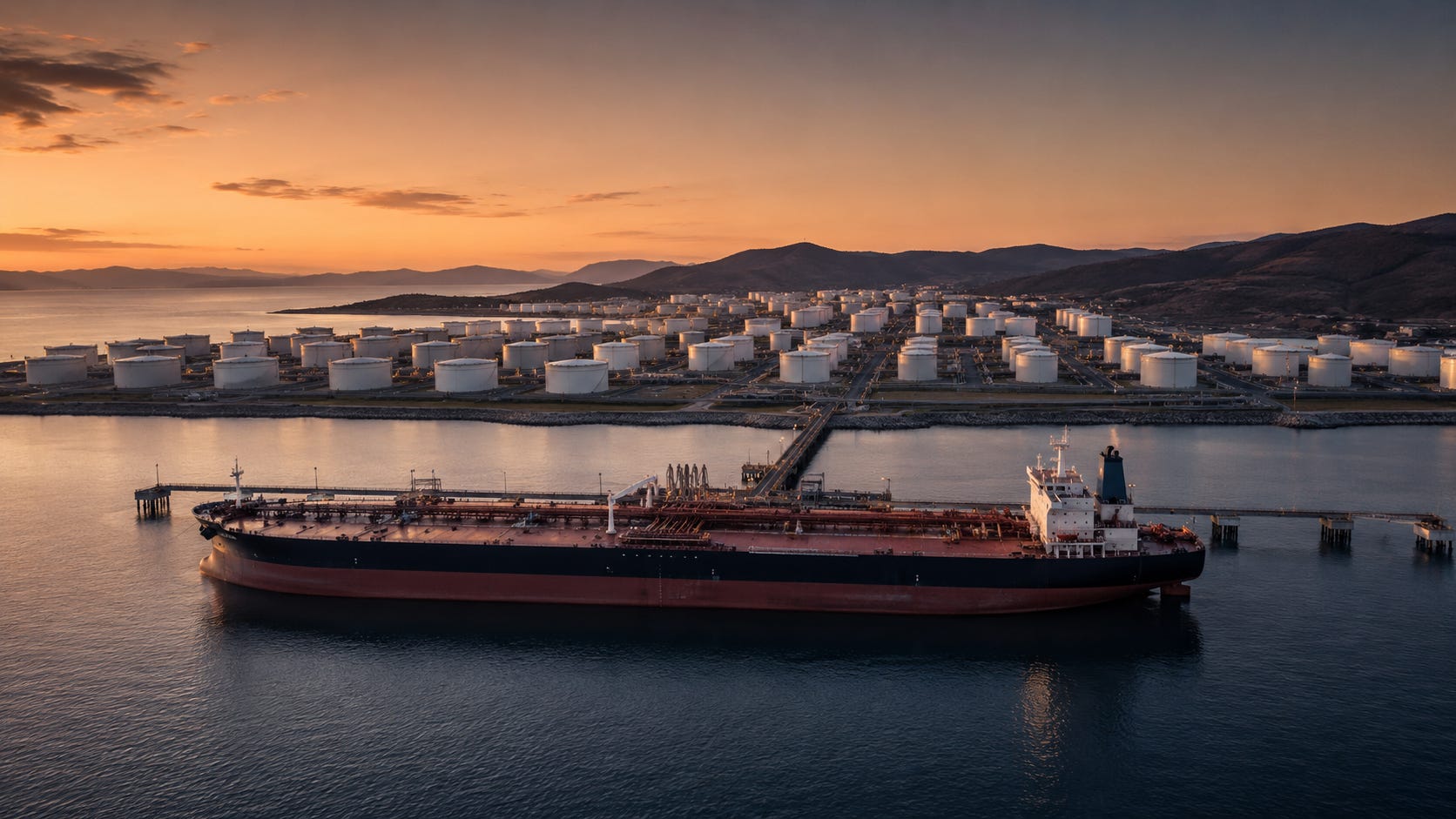
China spent 2025 making the year’s biggest oil bet in plain sight, and the market barely noticed. While the world fixated on the Strait of Hormuz, Beijing had quietly built the largest oil stockpile of any nation on Earth, an estimated 1.4 billion barrels by December. Then the Iran war shut the strait, and China leaned on that hoard to keep its refineries running while its imports collapsed. The war chest worked exactly as designed. Now the strait is reopening, the war premium is draining out of the price, and Beijing is positioned to reload, the kind of buying power that ends up deciding what the world pays at the pump. The question every broker, trader and OPEC delegate is now asking: when the post-war glut hits, does Saudi Arabia set the price, or does China?
📋 In This Issue:
🛢️ The Story
📊 By The Numbers
🔍 Why It Matters
👀 What To Watch
🚨 Gosships Signal
🔔 Not Yet Subscribed? Gosships Intelligence Delivers Oil Shipping Intelligence. Subscribe Here!
📊 Order Our Exclusive Report
→ Global Tanker Market Outlook Q3 2026 Edition
📋 Competency-Based Maritime Training
→ SwiftAction
📌 Gosships Data Card
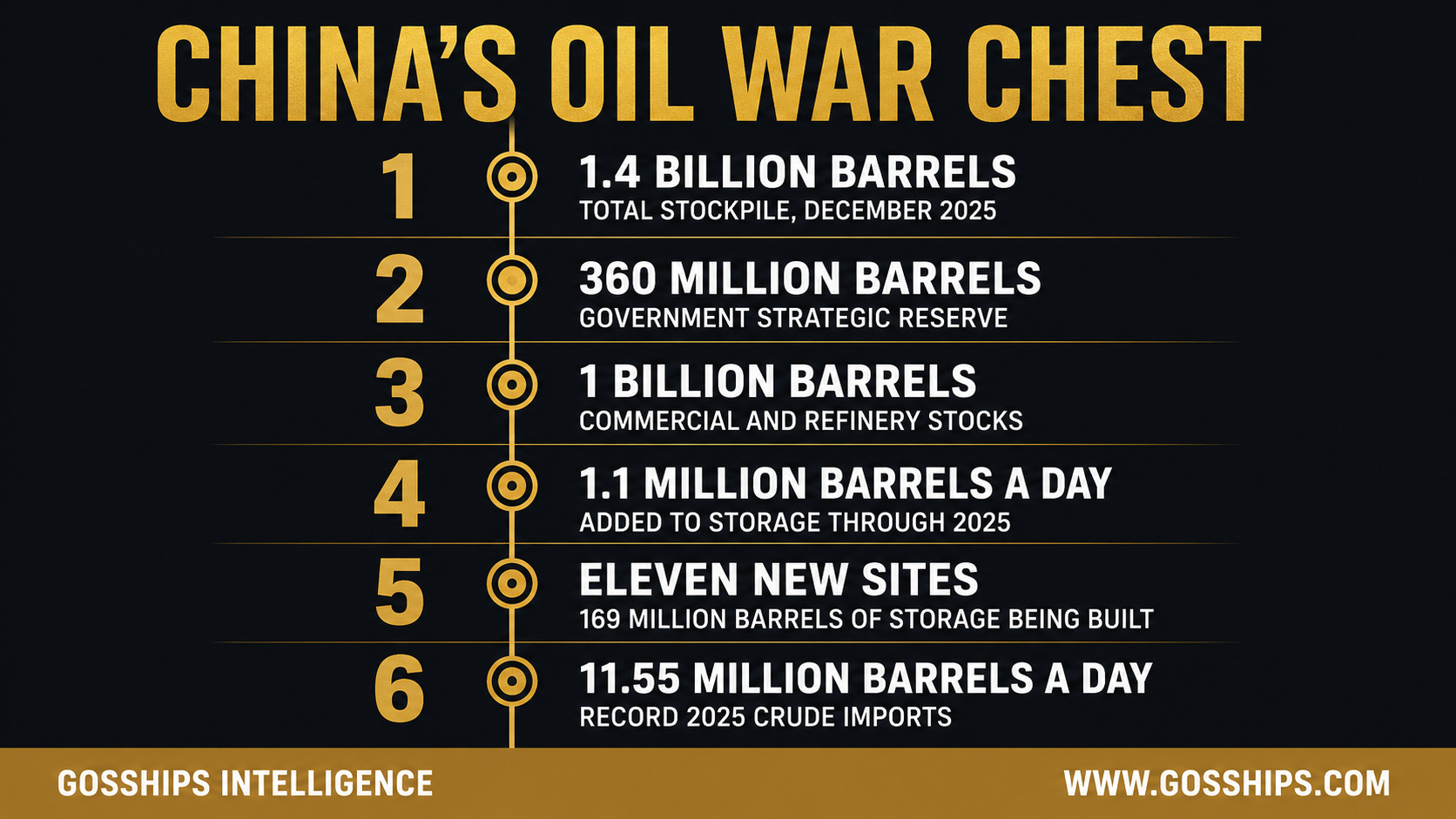
→ 1.4 BILLION BARRELS - China’s total crude stockpile, December 2025
→ 360 MILLION BARRELS - Government strategic reserve
→ 1 BILLION BARRELS - Commercial and refinery stocks
→ 1.1 MILLION BARRELS A DAY - Added to storage through 2025
→ ELEVEN NEW SITES - 169 million barrels of storage under construction
→ 11.55 MILLION BARRELS A DAY - Record 2025 crude imports
Source: U.S. Energy Information Administration (China, the United States, and Japan hold most strategic oil inventories in 2025); Reuters.
🛢️The Story
For most of 2025, the oil market told a simple story: weak Chinese demand, a looming glut, and a price that kept sliding toward $60 a barrel. Beijing read the same data and reached the opposite conclusion. Cheap crude was not a problem to manage. It was a sale.
According to the U.S. Energy Information Administration, China’s total crude oil inventories climbed to nearly 1.4 billion barrels by December 2025, the largest national stockpile on the planet. The EIA breaks that figure into two pools. Government-held strategic reserves stood at roughly 360 million barrels, a level the agency notes is broadly similar to the United States Strategic Petroleum Reserve at about 414 million barrels. The second pool is where the scale becomes clear. China’s commercial inventories, which include crude held at refineries, had swelled to an estimated 1 billion barrels. The entire United States commercial stockpile, by comparison, sat near 411 million barrels.
The distinction matters because, since 2024, Chinese national oil companies have been directed to add emergency crude to those commercial tanks. In the EIA’s assessment, that commercial crude now effectively functions as a second strategic reserve, one that does not appear in any official reserve figure and that Beijing never has to announce. China does not publish data on its oil inventories. Every number here is an estimate built by outside analysts from import, export, refining and satellite data. That opacity is not a bug. It is the strategy.
The build was relentless. The EIA estimates China added an average of 1.1 million barrels a day to inventories across 2025, and it assumes Beijing will keep filling tanks at close to 1.0 million barrels a day through 2026 before easing in 2027. The buying did not stop when the calendar turned. Chinese crude imports jumped 15.8 percent in the first two months of 2026 from a year earlier, reaching 11.99 million barrels a day, according to customs data reported by Reuters. That is above the record 11.55 million barrels a day China averaged across all of 2025. Ship-tracker Kpler logged seaborne crude arrivals of 10.88 million barrels a day in January and 11.47 million in February, each at least 1.7 million barrels a day above the prior year.
The reason is not a refining boom. Emma Li, an analyst at ship-tracking firm Vortexa, attributed the early-2026 surge to a combination of stronger refinery runs and outright stockpiling, with a meaningful share of the crude flowing into tanks rather than through refineries. In plain terms, China is importing far more crude than it needs to burn and pouring the difference into storage.
To hold it all, Beijing is pouring concrete. A Reuters analysis found that state oil companies including Sinopec and CNOOC are building at least 169 million barrels of new storage capacity across 11 sites during 2025 and 2026, of which about 37 million barrels had already been completed. Once finished, Reuters calculated, those sites alone could hold roughly two weeks of China’s net crude imports, a staggering buffer for the world’s largest oil importer. One new Sinopec facility on Hainan island, sized at 20 million barrels, has been described in state media as both commercial storage and a contribution to national reserves, the same deliberate blurring the EIA flagged.
That is what turns a storage story into a power story. Reuters columnist Clyde Russell has argued that China has overtaken OPEC+ to become the primary maker of the global oil price, because the cartel can cut output to defend a floor, but it is Beijing’s appetite that decides whether barrels actually clear the market. The Iran war proved the thesis in real time. As the blockade choked Hormuz, China’s crude imports tumbled to multi-month lows in May 2026, by some estimates close to half their pre-war pace, and refiners drew down the commercial stocks Beijing had spent a year building. The war chest was not theoretical. It was the difference between rationing fuel and riding out a shooting war without flinching. With the strait now reopening, that buffer is part-spent and ready to be refilled.
Wall Street expects the buying to resume with force. Goldman Sachs, whose head of oil research is Daan Struyven, has projected China will keep adding on the order of 500,000 barrels a day to inventories over the next five quarters. The bank’s base case for 2026 is a well-supplied market with a surplus of roughly 2.3 million barrels a day, and in June 2026 it raised its fourth-quarter Brent forecast to $71 a barrel after the war on Iran disrupted Gulf flows. Now that Hormuz is reopening and the war premium is draining out of the price, that surplus is swinging back into view. Stack the forecasts together and the implication is hard to miss: a large share of next year’s oversupply may not depress prices at all. It may simply disappear into Chinese tanks.
For the tanker market, this is the demand engine hiding in plain sight. Every barrel China stores is a barrel that had to be shipped, almost always aboard a VLCC hauling around 2 million barrels at a time. Chinese stockpiling has underpinned VLCC employment even as headlines fixated on sanctions and the shadow fleet. The full picture of what 1.4 billion barrels means for freight, for the looming surplus, and for who actually controls the price floor is where this gets dangerous for anyone short the market.
📊 By The Numbers
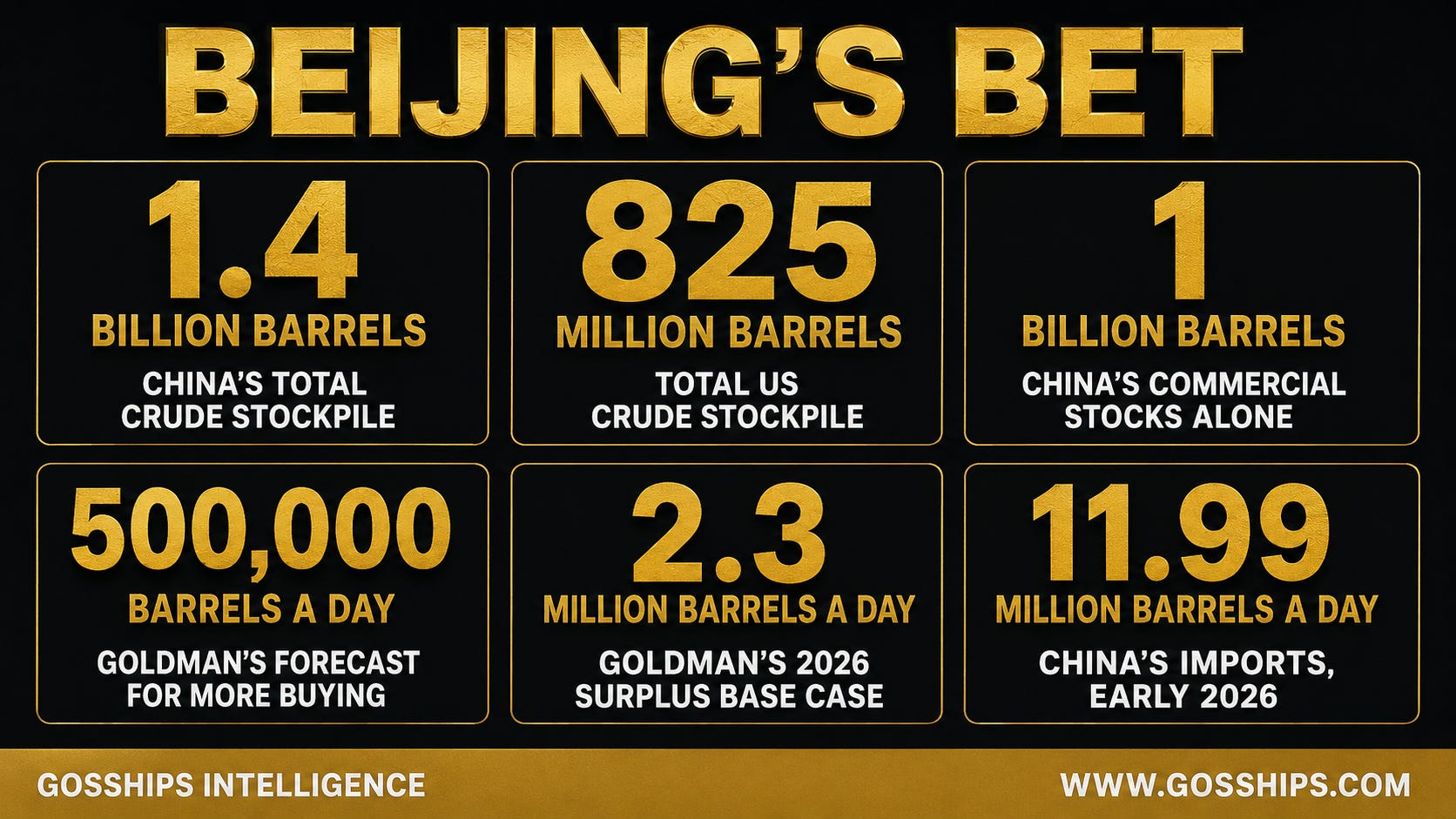
→ 1.4 billion barrels - China’s total crude stockpile, December 2025 (EIA)
→ 825 million barrels - Total US crude stockpile, SPR plus commercial (EIA)
→ 1 billion barrels - China’s commercial stocks alone, more than double the entire US SPR (EIA)
→ 500,000 barrels a day - Goldman Sachs forecast for additional Chinese buying over five quarters
→ 2.3 million barrels a day - Goldman’s base-case 2026 global oil surplus
→ 11.99 million barrels a day - China’s crude imports in the first two months of 2026, up 15.8 percent year on year (Reuters)
Sources: U.S. Energy Information Administration; Goldman Sachs; Reuters; Kpler; Vortexa.
Related Coverage
Sinokor Cornered the VLCC Market. Now They Just Bought Their First Three Suezmaxes. Brokers Expect an Avalanche.
Record VLCC Tanker Rates Hit $423,736 Per Day
MSC, COSCO, HMM and Other Container Giants Are Quietly Building Crude Tanker Fleets. What’s the Strategy?
🔍 Why It Matters
The headline number is 1.4 billion barrels. The real story is leverage, and it reshapes the calculus for everyone with a position in oil or freight.
