


|⚓ About Us | 🛢️ Deep Water Reports | 📋 SwiftAction Training |
🏅 Black Gold Membership (*53 Slots Left)

On March 22, Goldman Sachs raised its oil price forecast for the third time since the war began. The bank now calls the Strait of Hormuz closure “the largest supply shock in the history of the global crude market.” Gas in America has risen from $2.98 to $3.96 in 23 days. The last time the world’s most important investment bank used the word “largest” and “history” in the same sentence about oil was never.
📋 In this issue:
🛢️ The Story
📊 By The Numbers
🔍 Why It Matters
👀 What to Watch
🚨 Gosships Signal
📊 Get The Global Tanker Market Outlook
→ Deep Water Report
📋 Competency-Based Maritime Training
→ SwiftAction
📌 Gosships Data Card
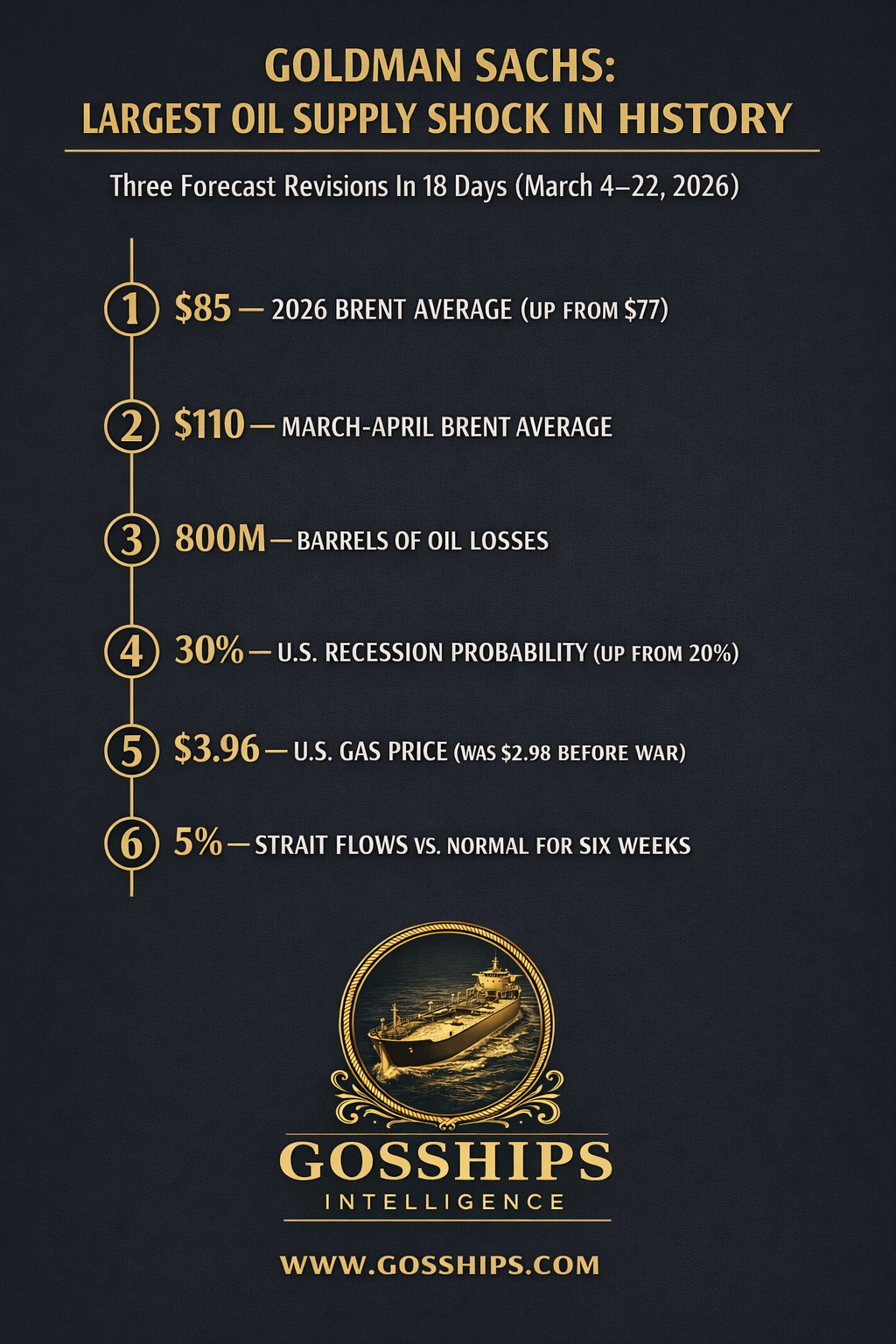
Substack post text (paste this into the article below the image):
→ Goldman Sachs 2026 Brent Average Raised To $85/Bbl From $77 (Goldman Sachs, March 22)
→ March-April Brent Average Forecast At $110/Bbl (Goldman Sachs, March 22)
→ Cumulative Oil Losses Projected To Exceed 800 Million Barrels (Goldman Sachs, March 22)
→ U.S. 12-Month Recession Probability Raised To 30% From 20% (Goldman Sachs, March 22)
→ U.S. Gas Price: $3.96/Gallon, Up From $2.98 Before The War (AAA, March 23)
→ Goldman Base Case: Hormuz At 5% Of Normal For 6 Weeks, Then 1-Month Recovery (Goldman Sachs, March 22)
🛢️ The Story
On March 22, Goldman Sachs raised its oil price forecast for 2026 for the third time since the war began, calling the Strait of Hormuz closure “the largest supply shock in the history of the global crude market.” The note, led by analyst Daan Struyven, was published as the U.S.-Israeli war with Iran entered its fourth week with no resolution in sight, according to Bloomberg.
The revision timeline tells the story of a bank watching a crisis outpace its models in real time.
On March 4, Goldman raised its Q2 2026 Brent forecast by $10 to $76 per barrel and WTI by $9 to $71, according to Reuters. That revision assumed a few days of low Hormuz flows followed by a gradual recovery.
By March 11, the bank raised again. Q4 2026 Brent was lifted to $71 from $66 and WTI to $67 from $62, according to TheStreet. Goldman now expected Brent to average above $100 in March and $85 in April. OilPrice.com reported that the bank warned prices could surge even higher if the disruption extended into months rather than weeks.
Then on March 22, the third and most significant revision. Goldman raised its full-year 2026 Brent average to $85 from $77 and WTI to $79 from $72, according to Bloomberg. The near-term March-April forecast was raised to $110 per barrel. Goldman’s base case assumes Hormuz flows remain at just 5% of normal levels for six weeks, followed by a gradual one-month recovery. Under that scenario, the bank estimates cumulative oil losses would exceed 800 million barrels, according to Bloomberg and TheStreet.
The risk scenarios are where the math breaks. If the disruption stretches to two months, Goldman’s Q4 Brent estimate rises to $93 per barrel. In extreme scenarios where flows remain severely constrained longer, Goldman warns that daily Brent prices could exceed the 2008 all-time record, according to Investing.com.
Goldman is not the only bank raising. Every major Wall Street commodity desk has revised upward since the war began on February 28.
HSBC raised its 2026 Brent average by $15 to $80 from $65 on approximately March 11, according to Investing.com. Barclays raised to $85 on March 13, warning that Brent could reach $100 if the market internalizes a four-to-six-week disruption, according to OilEDigital. JP Morgan raised its full-year 2026 Brent forecast to $68 from $63 on March 18, flagging what it called a dangerous “misalignment” between Atlantic Basin benchmarks and the actual severity of the Gulf disruption, according to Rigzone. Citi raised its Q1 Brent forecast to $75 and Q2 to $78, according to TheStreet. Standard Chartered raised its 2026 average to $70 from $63.50, according to TheStreet.
The International Energy Agency’s Executive Director Fatih Birol, speaking at a media event in Canberra, Australia, on Monday March 23, described the current situation as equivalent to the two major oil crises in the 1970s and the 2022 natural gas crisis after Russia invaded Ukraine, “all put together,” according to Bloomberg.
This is no longer a shipping story. Goldman has pushed back its Federal Reserve rate cut forecast directly because of the oil shock. The bank no longer expects a June cut, moving its first call to September with a second in December, according to TheStreet. The Fed held rates unchanged at its March 18 meeting for the second straight time. Chair Jerome Powell acknowledged that higher oil prices push inflation up and growth down simultaneously.
Goldman has raised its 12-month U.S. recession probability to 30% from 20% before the war, according to TheStreet. The bank estimates that a sustained 10% rise in oil prices raises headline PCE inflation by approximately 0.2 percentage points while shaving 0.1 points off GDP growth. Goldman now projects PCE inflation will end 2026 at approximately 2.9%, well above the Fed’s 2% target, according to TheStreet.
Gas at the pump tells the consumer version of this story. The national average hit $3.956 per gallon on March 23, according to AAA. Before the war started on February 28, it was $2.98, according to Fortune. That is a $0.98 increase in 23 days, a 33% surge. California has exceeded $5.56 per gallon. Diesel has reached $5.07, its highest since 2022, according to AAA.
Brent crude closed at approximately $103.67 on March 24 after rebounding 3.8% from Monday’s 11% crash, which was triggered by Trump’s announcement of a five-day diplomatic pause with Iran, according to CNBC and Bloomberg. WTI settled near $91.27. Before the war, Brent was trading at approximately $73 per barrel on February 27, according to IRU, citing market data. It peaked at nearly $120 on March 9, according to Al Jazeera and IRU. That is a 65% increase from pre-war levels in ten days.
The tanker market has priced in the severity well ahead of the banks. VLCC day rates on the MEG-China TD3C route hit an all-time record of $423,736 per day on March 3, according to the Baltic Exchange via Lloyd’s List, surpassing the 2008 peak of approximately $350,000 by 21%. Rates have since eased to approximately $270,000 per day but remain at historically unprecedented levels, according to TradeWinds.
Goldman’s note frames it this way: “The largest oil supply shock ever will likely lead policymakers and markets to recognize the structural risks from the high concentration of production and spare capacity in West Asia and from the vulnerability of energy infrastructure,” according to Bloomberg.
The question for every person reading this is not whether it will get worse. Goldman has already answered that. The question is what the next revision looks like if the March 28 diplomatic deadline fails. What every major bank now forecasts, what the tanker market is pricing in that the banks are not, and what happens if Trump’s five-day window closes without a deal, is below.
📊 By The Numbers
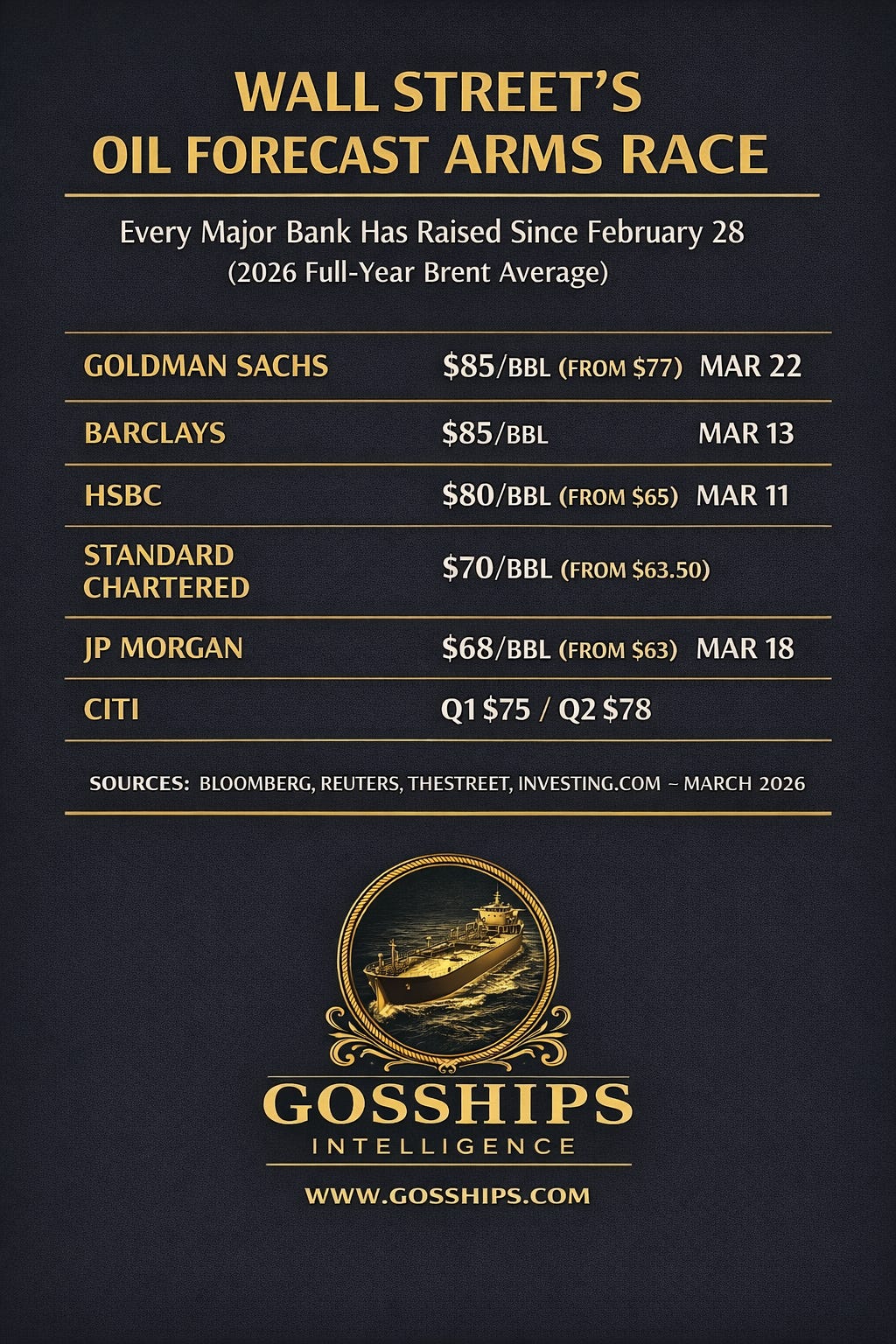
Wall Street’s Oil Forecast Arms Race — 2026 Brent Averages:
→ Goldman Sachs: $85/Bbl (Up From $77), Third Revision In 18 Days (Bloomberg, March 22)
→ Barclays: $85/Bbl, Warns $100+ If 4-6 Week Disruption (OilEDigital, March 13)
→ HSBC: $80/Bbl (Up $15, From $65) (Investing.com, ~March 11)
→ Standard Chartered: $70/Bbl (Up From $63.50) (TheStreet, March)
→ JP Morgan: $68/Bbl (Up From $63), Flags “Dangerous Misalignment” (Rigzone, March 18)
→ Citi: Q1 $75/Bbl, Q2 $78/Bbl (TheStreet, March)
Additional Verified Data:
→ Goldman March-April Brent Average: $110/Bbl (Goldman Sachs, March 22) → Goldman Q4 Risk Scenario (2-Month Disruption): $93/Bbl Brent (Goldman Sachs, March 22)
→ Goldman Extreme Scenario: Could Exceed 2008 Record High (Goldman Sachs, March 22)
→ Goldman 12-Month U.S. Recession Probability: 30% (Up From 20%) (Goldman Sachs, March 22)
→ Brent Pre-War: ~$73/Bbl On February 27 (IRU); Peaked ~$120 On March 9 (Al Jazeera, IRU)
→ VLCC TD3C Peak: $423,736/Day, All-Time Record (Baltic Exchange Via Lloyd’s List, March 3)
→ U.S. Gas Price: $3.956/Gallon (AAA, March 23) vs. $2.98 Pre-War (Fortune) → IEA: Equivalent To 1970s Crises + 2022 Gas Crisis “All Put Together” (Bloomberg, March 23)
Related Coverage
Record VLCC Tanker Rates Hit $423,736 Per Day (March 2026)
VLCC Day Rates Record $423,736 Gulf Crisis (March 2026)
Iran Built a Toll Booth on the Strait of Hormuz (March 2026)
Hormuz Shut Down: Three Tankers Hit (March 2026)
Maritime Sanctions 2026: Shadow Fleet Surge (March 2026)
The question is not whether the oil market is in crisis. Goldman, Barclays, HSBC, JP Morgan, Citi, Standard Chartered, and the IEA have all confirmed that. The question is whether the March 28 diplomatic deadline produces a deal or a fourth Goldman revision. What every bank’s forecast means for VLCC rates, why the tanker market is pricing in a longer disruption than the banks are modeling, and what three specific signals will tell you whether $110 Brent holds or breaks higher, is below.
