


⚓ The Gosships Team
Gosships Intelligence Is Published At Gosships.com
For Sponsorship And Partnership Inquiries Contact intelligence@gosships.com
|⚓ About Us | 🛢️ Exclusive Report | 📋 SwiftAction Training |
🏅Black Gold Membership (*53 Slots Left)
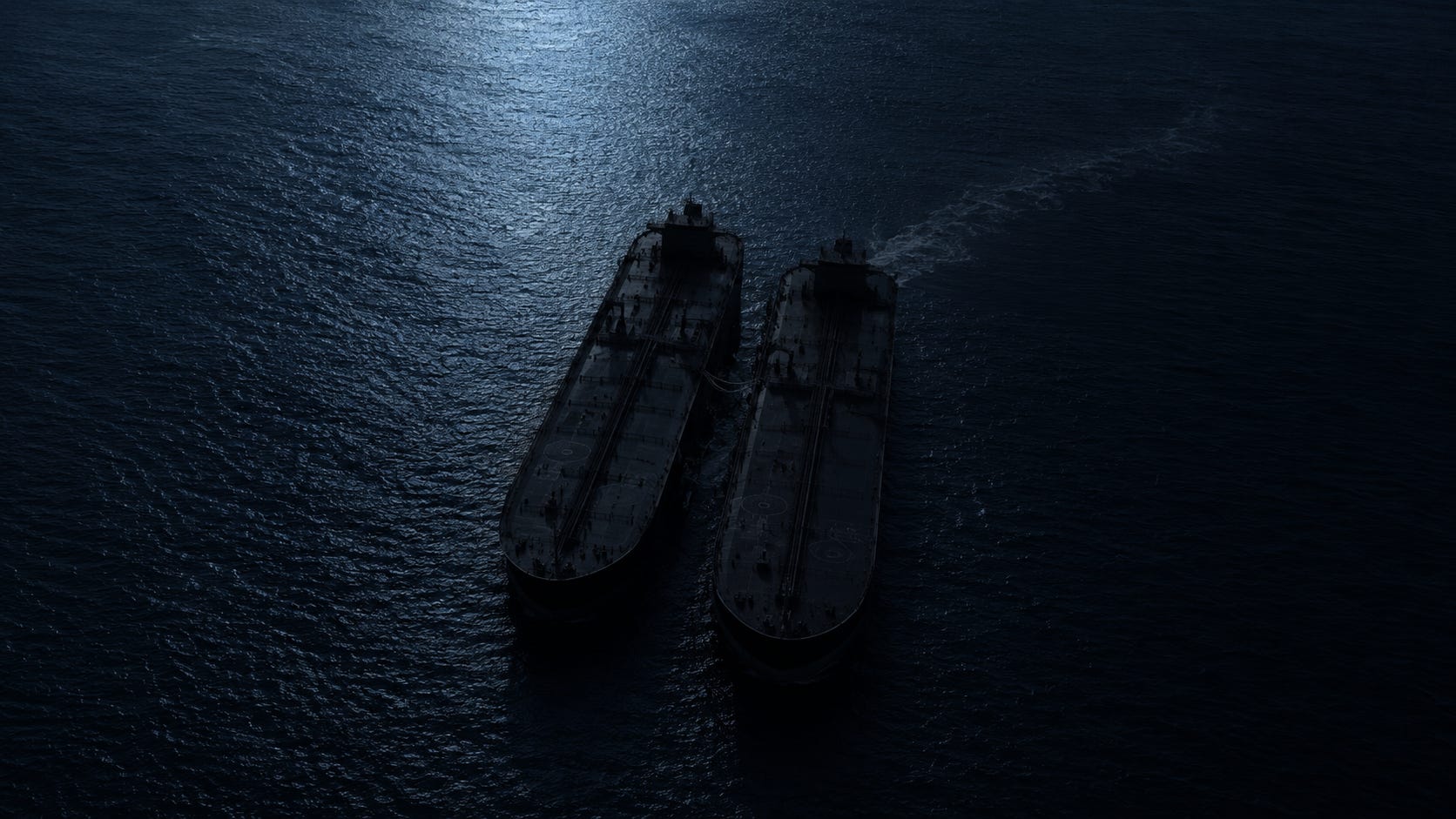
The world’s most legitimate oil fleet has started behaving like the shadow fleet. Bloomberg revealed Wednesday that Gulf producers’ tankers are switching off their transponders to slip past Iran and out of the Strait of Hormuz, sharply lifting the volume of oil getting out. The tracking screens the entire market relies on show almost nothing moving. The satellites show 16 tankers clustered off Oman over the weekend, transferring millions of stranded barrels in a patch of ocean that was completely empty a month ago. And by Wednesday evening, President Trump had confirmed the operation himself, while Iran answered by declaring the strait closed to every ship afloat and claiming it had already struck two tankers that tried to pass.
📋 In This Issue:
🛢️ The Story
📊 By The Numbers
🔍 Why It Matters
👀 What To Watch
🚨 Gosships Signal
🔔 Not Yet Subscribed? Gosships Intelligence Delivers Oil Shipping Intelligence. Subscribe Here!
📊 Order Our Exclusive Report
→ Global Tanker Market Outlook Q3 2026 Edition
📋 Competency-Based Maritime Training
→ SwiftAction
📌 Gosships Data Card
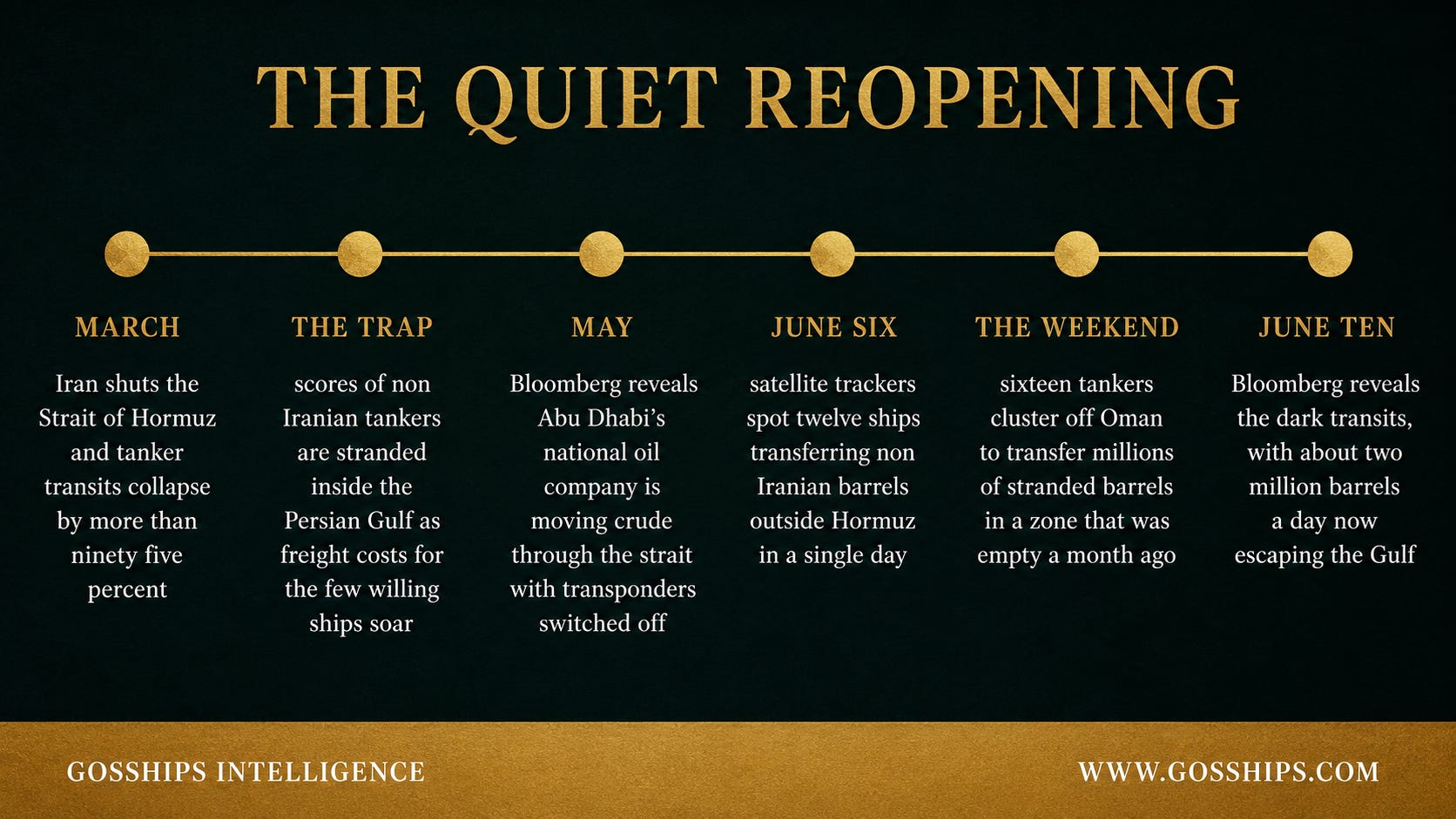
→ March: Iran Shuts The Strait Of Hormuz And Tanker Transits Collapse By More Than 95%
→ The Trap: Scores Of Non-Iranian Tankers Are Stranded Inside The Persian Gulf As Freight Costs For The Few Willing Ships Soar
→ May: Bloomberg Reveals Abu Dhabi’s National Oil Company Is Moving Crude Through The Strait With Transponders Switched Off
→ June 6: Satellite Trackers Spot 12 Ships Transferring Non-Iranian Barrels Outside Hormuz In A Single Day
→ The Weekend: 16 Tankers Cluster Off Oman To Transfer Millions Of Stranded Barrels In A Zone That Was Empty A Month Ago
→ June 10: Bloomberg Reveals The Dark Transits, With About 2 Million Barrels A Day Now Escaping The Gulf
🛢️ The Story
The most important oil story of the week is invisible on every tracking screen in the market, and that is exactly the point. On Wednesday, Bloomberg revealed that a growing number of tankers carrying Gulf producers’ oil are turning off their transponders to slip through the Strait of Hormuz undetected by Iran, turning what had been a handful of risky crossings into a steady and growing flow out of the world’s most important chokepoint. The vessel-tracking screens the market relies on register almost none of it. But the people and tools that see past transponders, senior shipping executives, Asian crude buyers, and satellite imagery, agree on the real picture: the strait is meaningfully more open than it appears, and the transits are getting steadier and bigger.
The proof showed up off the coast of Oman over the weekend. Satellite imagery from the European Union’s Copernicus browser captured 16 tankers clustered together, moving millions of barrels that the war had trapped inside the Persian Gulf. A month ago, Bloomberg notes, that patch of ocean was entirely empty. TankerTrackers.com, which monitors vessels by satellite rather than by transponder, said it identified 12 ships conducting transfers of non-Iranian Middle Eastern barrels outside Hormuz on June 6 alone, and put the finding in one sentence: “Yet another reason why oil isn’t $200 a barrel right now.”
The scale is starting to register in the numbers that matter. Rapidan Energy Group now puts the Gulf’s outbound flow at roughly 2 million barrels a day of oil and related products, still well short of normal but a long way above the conflict’s early depths. The hole those barrels are filling is historic: Rystad Energy estimates the war has shut in 11.8 million barrels a day of production across six Gulf producers, the most severe oil supply disruption in modern history, with cumulative losses already at a billion barrels, per CNBC. Stack the dark flows on top of a collapse in Chinese buying, booming US exports, and the overland pipelines that bypass the strait entirely, and crude had given back almost 30 percent from its wartime peak as of Bloomberg’s Wednesday report, even with prices jumping again Wednesday afternoon, US crude up 3.5 percent past $91 and Brent near $94, as Washington and Tehran traded fresh strikes. This is the waterway that fed the world about one barrel in every five before the war, in a market consuming more than 100 million a day, which is why even a partial, hidden revival is moving the entire price complex.
Washington is not just watching this happen, and as of Wednesday evening it is not even pretending otherwise. The dark transits coincide, Bloomberg reports, with a stretch in which American forces have been helping ships find their way through the waterway, and the Financial Times reported the same day that the dark runs are being made under American air cover, helping hold crude below 100 dollars a barrel. The President then confirmed the operation on the record at the White House on Wednesday: “we’ve been taking out millions of barrels of oil,” Trump told reporters, saying Iran had no idea because US strikes had destroyed its radar systems, describing it as a secret mission he directed, and declaring on Truth Social that America, not Iran, now controls the strait. By Wednesday night the administration was putting a number on it, with an official telling reporters that more than 100 million barrels have moved through under American protection, per NBC News. A day earlier, Energy Secretary Chris Wright told a conference that tanker traffic through the strait is climbing substantially.
The confirmation landed in the middle of the war’s most dangerous week. An American Apache helicopter was downed near Hormuz on Monday, the US struck roughly 20 targets inside Iran in response, Iranian missiles and drones hit US bases in the region, Jordan and Bahrain among them, and a fresh round of US strikes began at 5:15 PM Eastern on Wednesday by CENTCOM’s own announcement, with the Pentagon promising a busy night. Iran’s answer arrived within hours: the IRGC declared the Strait of Hormuz completely closed to all vessels, oil tankers and commercial ships included, warning through state media that any passage will be targeted, and then claimed it had struck two non-compliant tankers that attempted the transit anyway. CENTCOM publicly called the closure claim false, posting that commercial ships were continuing to move in and out of the strait Wednesday night. The ceasefire in place since April 8 has been extended open-ended by Trump even as the strikes continue, with the blockade running until negotiations conclude either way. The oil is sneaking out of a strait whose gatekeeper just promised, again, to shoot, and now says it has.
And that is what makes this story bigger than a logistics update. Going dark, until this year, was the signature move of the pariah fleet: the sanctioned Iranian shuttle tankers, the Russian shadow ships with their false flags and forged documents. Switching off the transponder was the thing that got a vessel blacklisted, boarded, or worse. Now the national oil champions of America’s Gulf allies are doing it as standard operating procedure, with US forces easing the way, and the entire market-data industry built on transponder signals is blind to the most consequential oil movements on earth.
📊 By The Numbers
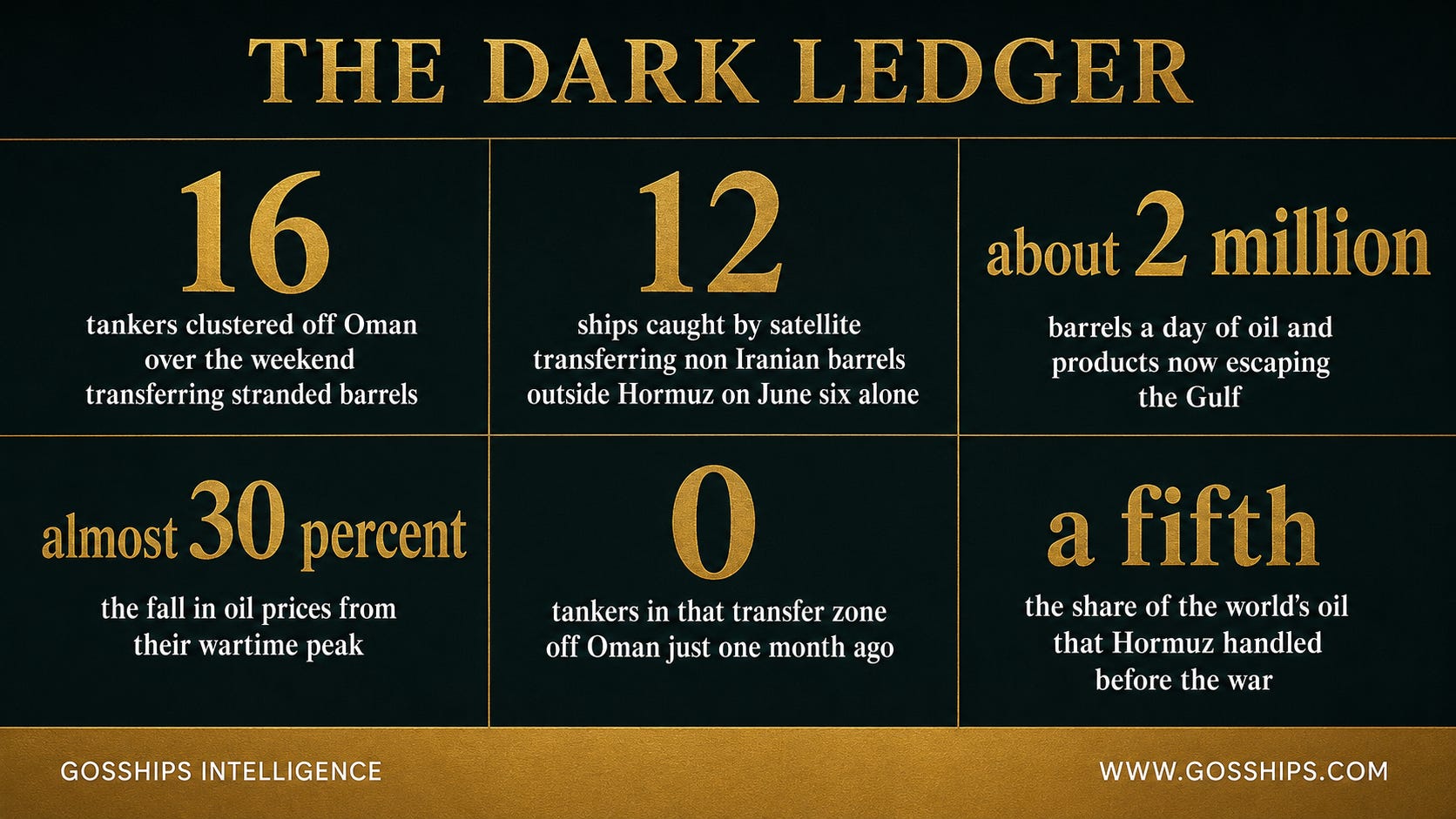
→ 16: Tankers Clustered Off Oman Over The Weekend Transferring Stranded Barrels (Copernicus, Via Bloomberg)
→ 12: Ships Caught By Satellite Transferring Non-Iranian Barrels Outside Hormuz On June 6 Alone (TankerTrackers.com)
→ About 2 Million: Barrels A Day Of Oil And Products Now Escaping The Gulf (Rapidan Energy Group)
→ Almost 30%: The Fall In Oil Prices From Their Wartime Peak (Bloomberg)
→ 0: Tankers In The Transfer Zone Off Oman Just One Month Ago (Bloomberg)
→ A Fifth: The Share Of The World’s Oil That Hormuz Handled Before The War (Bloomberg)
Related Coverage
A US Fighter Jet Just Disabled the Seventh Tanker to Defy the Iran Blockade. 134 Ships Turned Back When Warned. The Shadow Fleet Keeps Coming. Why?
Sinokor Is Charging $20 Per Barrel to Ship Oil. Last Year It Was $2.50. They Control 40% of Available Tankers. Nobody Can Do Anything About It.
Which producers are running the dark route, how the ship-to-ship relay actually works, what it is doing to the trapped fleet inside the Gulf, and what it means for every rate, every war-risk premium, and every tracking-data subscription you pay for, is below.
