


⚓ Gosships Intelligence
Gosships Intelligence Is Published At Gosships.com
For Sponsorship And Partnership Inquiries Contact intelligence@gosships.com
|⚓ About Us | 🛢️ Exclusive Report | 📋 SwiftAction Training |
🏅Black Gold Membership (*53 Slots Left)
International Seaways ran five charter books through the same quarter and the same war. Three of them lost to the spot market they had been withdrawn from, by roughly $30,600 to $62,700 a day. One beat it by $95,333, and a fifth had no spot fleet to measure against. The difference between the three that lost and the one that won is six words in a footnote, public since last summer.
The record has been reported, and correctly. Seaways posted net income of $294.9 million on August 10, the largest quarterly profit in its history, alongside the largest dividend it has ever declared. On the call that morning the CFO went further: crude tanker revenues of $253 million, of which $51 million was profit sharing, per two independent renderings of a webcast the Company has not transcribed. The $51 million is new. Nothing that produced it is.
What has not been set against it is the rest of the same table. Seaways runs time charters in five vessel classes. In all three classes where it reported both a spot rate and a flat-rate charter, spot won: Suezmaxes at $100,543 against $37,854, Aframaxes at $69,127 against $38,501, MRs at $60,342 against $22,099. Only the VLCC book inverted, and only the VLCC charters carry a profit share.
The terms are on slide 19 of the earnings presentation, in a table of 14 time charter-out rows. Three of them read “2023-Built DF VLCC” at $31,000 a day, expiring February, March and April 2030. Those three rows carry an asterisk. The other 11 do not. The footnote reads: “Excludes 50/50 profit share, if applicable.”
That footnote has been printed in the same table since at least the second-quarter presentation of 2025. The clause paid about $2 million a quarter then. In the quarter just reported it paid $50.2 million, close to 40 percent of everything those three vessels are still contracted to earn between now and 2030.
So there are three readings available. That Seaways got lucky with a war. That period cover is simply working as intended. Or that the most valuable term in the Company’s charter book has been sitting on a public slide for a year and nobody had a reason to read it. Only one of the three survives the filings, and the third quarter is already testing how long it lasts.
📋 In This Issue:
⚖️ The Story:
One clause, four books without it and a floor set when Seaways’ own VLCCs were earning $15,721 a day.
📊 By The Numbers:
The arithmetic reconciled against the Company’s own disclosure, figure by figure.
🔍 Why It Matters:
Why the charterer, the analyst and the credit committee read the same table three different ways.
👀 What To Watch:
The third-quarter settlement, the reference nobody has named, and the number that would prove this brief wrong.
🚨 Gosships Signal:
What it means when the most valuable term in a charter book is disclosed, public and unwritten about for a year.
🔔Not A Member?
Unlock The Full Analysis, The Data Cards,
The Archive, & MORE!
📊 Order Our Exclusive Report
→ Global Tanker Market Outlook Q3 2026 Edition
📋 Competency-Based Maritime Training
→ SwiftAction
🔗 Related Coverage


📌 Gosships Data Card
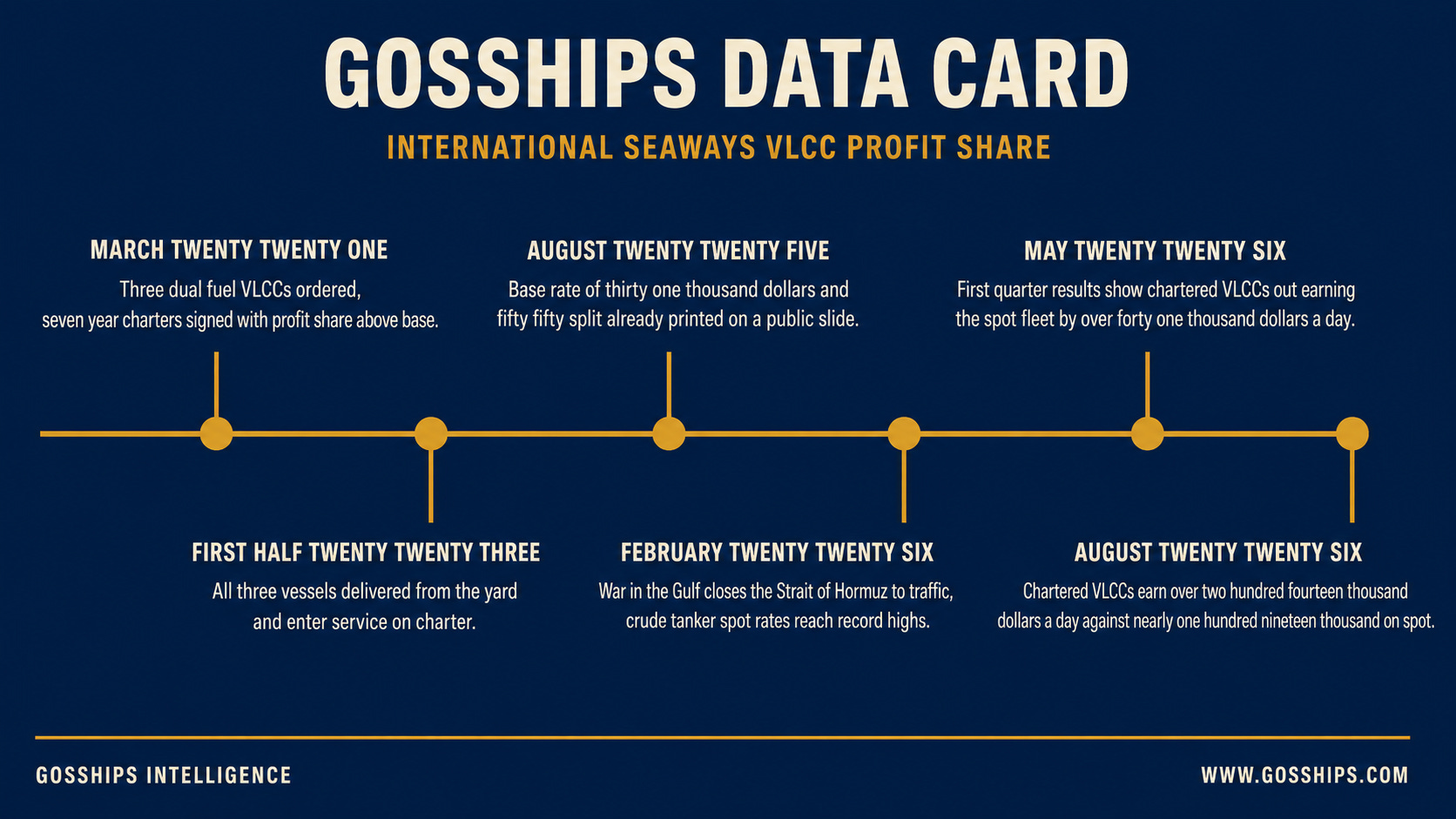
March 11, 2021: International Seaways orders three dual-fuel LNG VLCCs from DSME, all three to go on seven-year charter to Shell when they deliver. The announcement states the charters carry “added upside due to profit sharing above the base rate” (International Seaways Form 8-K dated March 11, 2021).
March 7 to May 24, 2023: The three vessels deliver from the yard and commence employment under the seven-year charters shortly afterwards. Each is simultaneously bareboat chartered in from BoComm at $21,700 a day under a $244.8 million sale and leaseback agreed in November 2021 (International Seaways FY2025 Form 10-K).
August 2025: The $31,000 base rate and the footnote reading “Excludes 50/50 profit share, if applicable” are already printed in the Time Charter-Out table of the second-quarter earnings presentation. The three vessels earned $38,809 a day that quarter (International Seaways Q2 2025 earnings presentation and results).
February 28, 2026: Iran goes to war with the United States and Israel. Seizures and attacks on merchant vessels follow in the Arabian Gulf, the Red Sea and the Gulf of Aden, the Strait of Hormuz effectively closes, and crude tanker spot rates reach record highs (International Seaways Q2 2026 Form 10-Q; Teekay Tankers Q2 2026 results).
May 7, 2026: Seaways reports first-quarter VLCC time charter earnings of $128,264 a day against $86,693 on spot, a gap of $41,571 and the first time in six quarters the two books diverge by more than $7,000 either way (International Seaways Q1 2026 results).
August 10, 2026: Seaways reports second-quarter VLCC time charter earnings of $214,216 a day against $118,883 on spot. On the earnings call the same morning, the CFO tells analysts crude tanker revenues included $51 million of profit sharing (International Seaways Q2 2026 results and Form 10-Q; Q2 2026 earnings call, per third-party transcript).
Sources: International Seaways Form 8-K and Exhibit 99.1 dated August 10, 2026; International Seaways Form 10-Q for the quarter ended June 30, 2026; International Seaways Q2 2026 earnings presentation, slides 4, 8, 11, 19 and 20; International Seaways Q2 2025 and Q4 2025 earnings presentations; International Seaways Forms 10-K for 2021, 2023, 2024 and 2025; International Seaways Form 8-K dated March 11, 2021; International Seaways quarterly results releases for Q1 2025 through Q1 2026; Fearnleys Weekly Report, VLCC Modern one-year time charter assessments; Teekay Tankers Q2 2026 earnings release; DHT Holdings Q2 2026 results; Okeanis Eco Tankers Q2 2026 results; Baltic Exchange Tanker Report, week 31, 2026; International Seaways Q2 2026 earnings call, per third-party transcript.
⚖️ The Story
What The Table Shows
There is one table in the International Seaways second-quarter filing that does not behave. It sits in the Crude Tankers section of the Form 10-Q, splitting each vessel class into spot and fixed earnings and printing an average rate and a revenue day count for each.
The VLCC row reads $118,883 on 522 spot revenue days and $214,216 on 274 fixed revenue days.
Divide 274 by the 91 days in the quarter and the answer is 3.01, matching the 10-Q's statement that Seaways was "party to time charter out contracts with customers on three VLCCs" as of June 30. Three vessels, locked away for the entire quarter, out-earning the seven left free to trade by $95,333 a day. The seven turned in 522 revenue days against a theoretical 637, the gap being drydock, repairs and lay-up, ninety days of it new this year. At the quarter's own spot rate those 115 lost days are about $13.7 million the seven never had the chance to earn.
Flat period cover is not supposed to do that. The whole logic of taking a vessel off the spot market at a fixed price is that the owner trades the tail for the floor. In the sharpest crude tanker market since the Gulf closures began, the owner who fixed should be the owner watching the rally from the beach. Seaways fixed and collected nearly twice what its own free vessels did, which is the first clue that whatever these three are on, it is not a fixed price.
One Clause, And Four Books Without It
The reason is easier to see from the rows underneath.
