


⚓ The Gosships Team
Gosships Intelligence Is Published At Gosships.com
For Sponsorship And Partnership Inquiries Contact intelligence@gosships.com
|⚓ About Us | 🛢️ Deep Water Reports | 📋 SwiftAction Training |
🏅 Founding Black Gold Membership (*53 Slots Left)
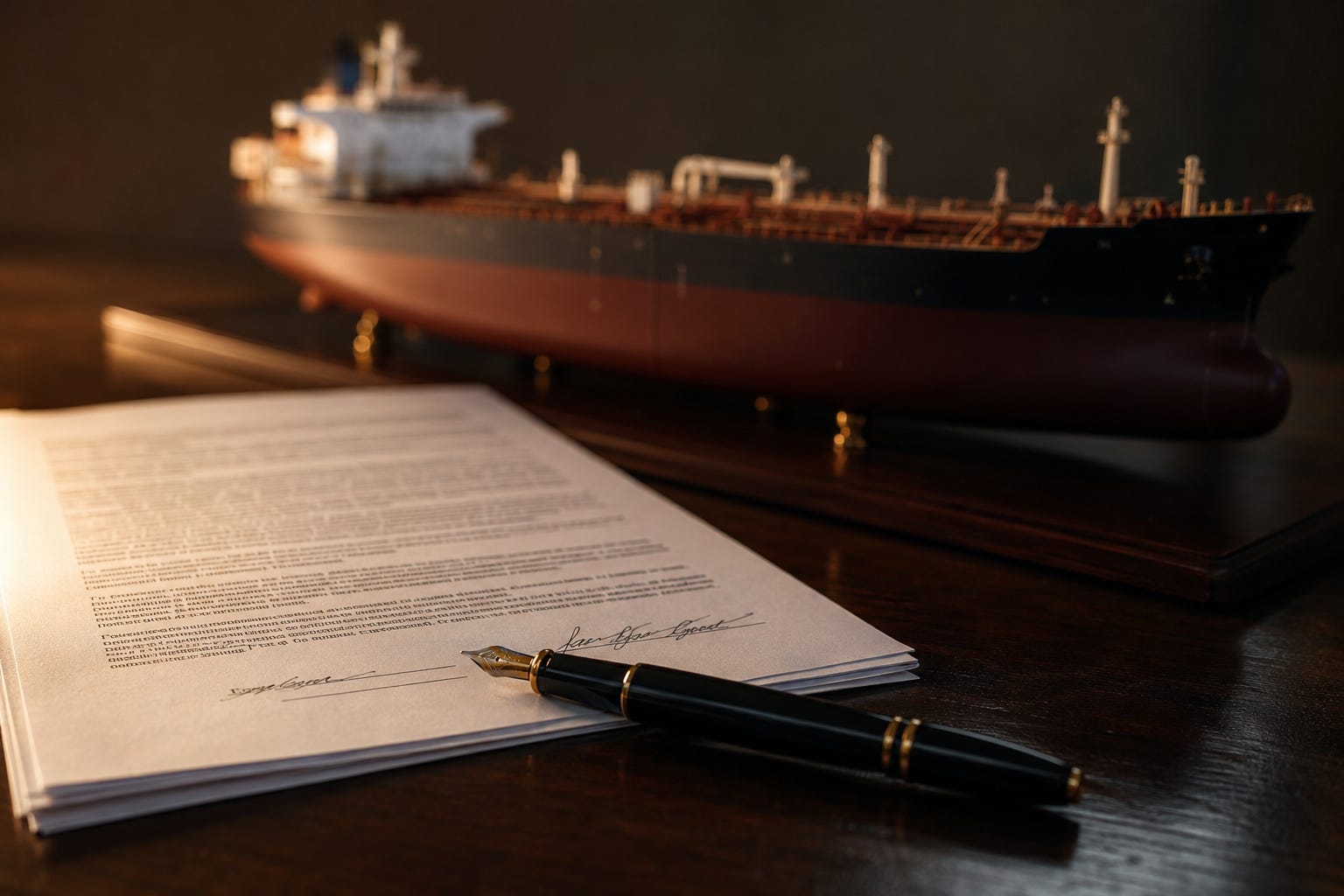
As Posidonia opens in Athens this week, one of the most closely watched names in Greek shipping has put four new supertankers on the table and a phrase that explains why.
On May 21, in its first-quarter results, New York-listed Navios Maritime Partners disclosed that it had agreed to buy four scrubber-fitted VLCC newbuildings, the largest class of crude oil tanker afloat, for an aggregate $482.0 million. Every one of the four is already chartered out for about five years before a single hull has been built. The company, led by chairwoman and chief executive Angeliki Frangou, also secured options for up to four more, which could take the program to eight.
What makes the move worth a closer look is not just the money. It is the reasoning Frangou attached to it, a framing she returned to repeatedly: that trade itself is being turned into an instrument of national policy, and that shipping capital now has to be allocated with that in mind.
📋 In this issue:
🛢️ The Story
📊 By The Numbers
🔍 Why It Matters
👀 What to Watch
🚨 Gosships Signal
📊 Get The Deep Water Report
→ Global Tanker Market Outlook Q2 2026
📋 Competency-Based Maritime Training
→ SwiftAction
📌 Gosships Data Card
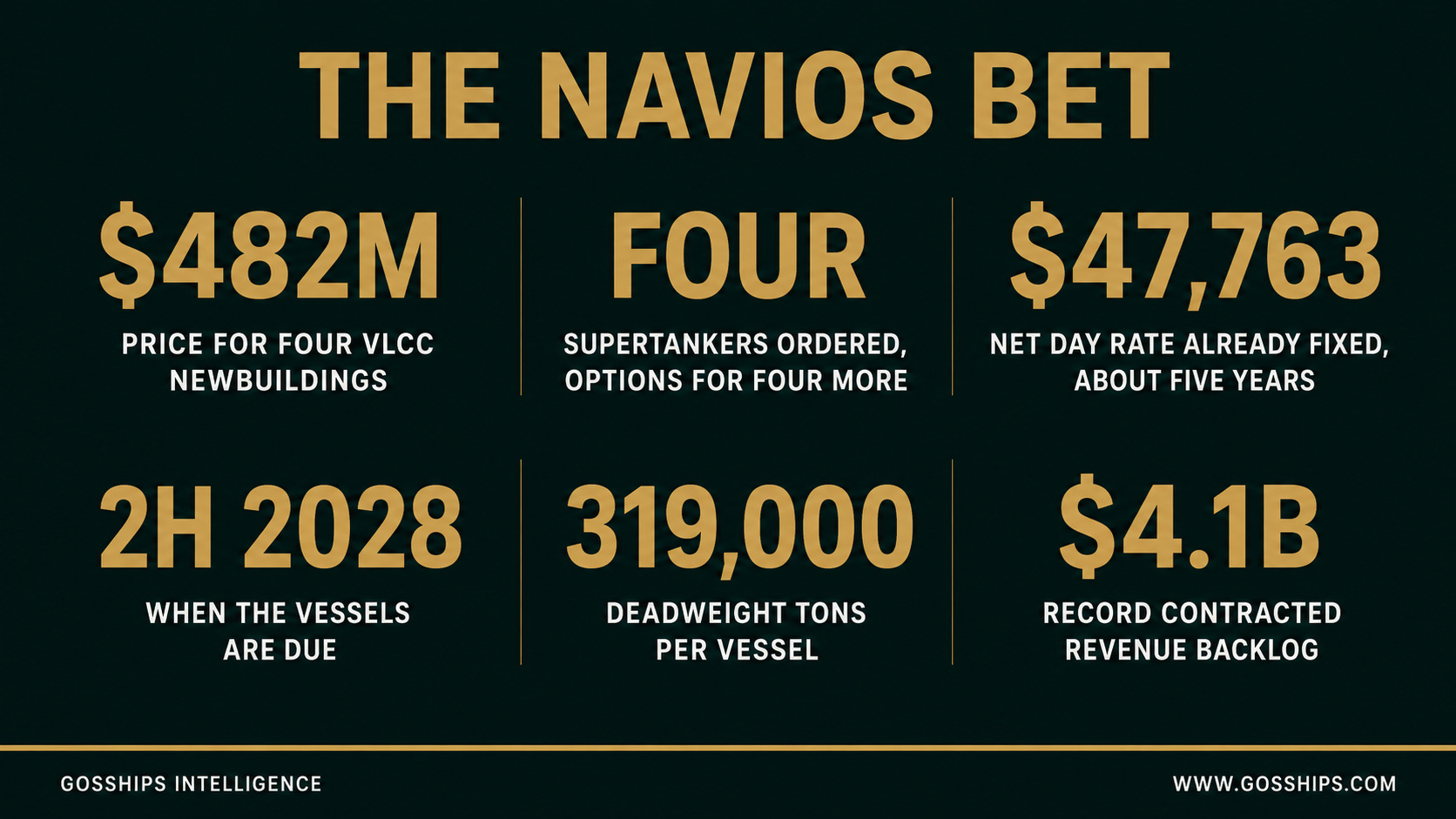
→ The Order: Navios Agreed To Buy Four Scrubber-Fitted VLCC Newbuildings For $482.0 Million Per Navios Maritime Partners Via GlobeNewswire
→ The Vessels: Each Is a 319,000-DWT VLCC, Due In the Second Half Of 2028 Per Riviera and Navios
→ The Charters: Each Vessel Is Fixed For About Five Years At $47,763 Net Per Day Per Navios Maritime Partners
→ The Option Year: The Charterer Holds an Option For One More Year At $52,650 Net Per Day Per Navios Maritime Partners
→ The Options: Navios Holds Options For Two Plus Two More VLCCs With No Capital Commitment Yet Per Navios Maritime Partners
→ The Backlog: Contracted Revenue Backlog Rose To a Record $4.1 Billion Per Navios Q1 2026 Earnings Call
🛢️ The Story
This is a story about timing, and about an owner who has done this before.
The order. In its first-quarter 2026 results, released May 21 through GlobeNewswire, Navios Maritime Partners said it had agreed to acquire four newbuilding scrubber-fitted VLCC tankers from an unrelated third party for an aggregate purchase price of $482.0 million. Riviera reported each vessel as a 319,000-deadweight-ton VLCC. The ships are expected to deliver in the second half of 2028. According to Navios, the company also secured options to acquire two plus two additional newbuilding VLCCs for future consideration, without committing any capital at this stage. Splash247 reported that the latest order brought Navios’s total newbuilding program to 26 vessels, representing an investment of roughly $2.1 billion.
The charters. The detail that separates this from a simple bet on the market is that the revenue is already locked. Each of the four VLCCs has been chartered out for a firm period of about five years at a net rate of $47,763 per day, according to Navios. TipRanks reported that rate as roughly 24% above the 20-year average. The charterer holds an option for one additional year at $52,650 net per day. In other words, the income on ships that do not yet exist is contracted before the steel is cut. That is a deliberate structure, not an accident of the market.
The recycling. The new ships are partly funded by getting out of old ones at the top. Navios said it agreed to sell two VLCCs, built in 2009 and 2011 and averaging around 16 years of age, for $136.5 million. On the company’s Q1 earnings call, Frangou said those sale prices were 102% above the 20-year average and 18% above the prior historical peak, a figure reported by Ticker Report’s account of the call. The 2011-built vessel was delivered to its new owner in April, with the 2009-built unit due to change hands in the second quarter. The pattern is clean: sell aging tonnage into a hot secondhand market, redeploy into modern ships with charters attached.
The quarter underneath it. The capital commitment rests on a strong set of numbers. Navios reported first-quarter net income of $106.3 million, more than double the $41.7 million it posted a year earlier, on revenue of $357.0 million, up from $304.1 million. EBITDA was $212.7 million. Earnings were $3.64 per common unit, and the company declared a distribution of $0.06 per unit. Chief operating officer Efstratios Desypris said on the call that the contracted revenue backlog had risen 16%, or about $549 million, to a record $4.1 billion.
The wider program. The VLCC order is one piece of a much larger build-out. Splash247 reported that the move took Navios’s total newbuilding program to 26 vessels, worth roughly $2.1 billion. Navios also agreed to acquire two Japanese-built scrubber-fitted capesize dry bulk vessels under 12-year bareboat arrangements, with an implied acquisition value of about $134.3 million, expected to join the fleet in late 2028 and early 2029. Those capesizes are a separate dry bulk commitment, not part of the VLCC tanker order, but they illustrate the same approach: modern tonnage secured with long employment attached. Between February and May, Splash247 reported, Navios took delivery of five newbuilding vessels, four tankers and one container ship, all employed under long-term charters. The company is not simply ordering ships. It is taking delivery of them and putting them to work as it goes.
The fleet logic. Frangou framed the modernization as the core of the strategy. On the earnings call she said the overall fleet now averages 9.1 years against an industry average of 13.7 years across its segments, and that the tanker fleet specifically averages 5.5 years, which she described as more than 60% younger than the global tanker fleet. “We expanded our VLCC fleet by almost 60% with minimal risk in a volatile time,” she said, according to Ticker Report’s account of the call. The phrase captures the whole design: growth in the large-crude segment, but structured so that the downside is contained.
The framing. Threaded through all of it was Frangou’s read on the world. “We are witnessing the emergence of a new world order,” she said in the Navios release, “one in which trade is used as an instrument of national policy.” She added that national security considerations are increasingly central to decision-making and that governments are asserting greater control over strategic supply chains, pointing to the Iranian conflict as evidence of the shift. She singled out the Strait of Hormuz as a vital artery for the movement of crude oil, refined products and LNG. The capital plan and the worldview are presented as one piece: a fleet built young, modern and contracted, for a world she expects to be more contested.
For brokers and traders, the question that follows is what it means to see one of Greece’s most prominent owners lock in five years of supertanker revenue before delivery. The full read is below.
📊 By The Numbers
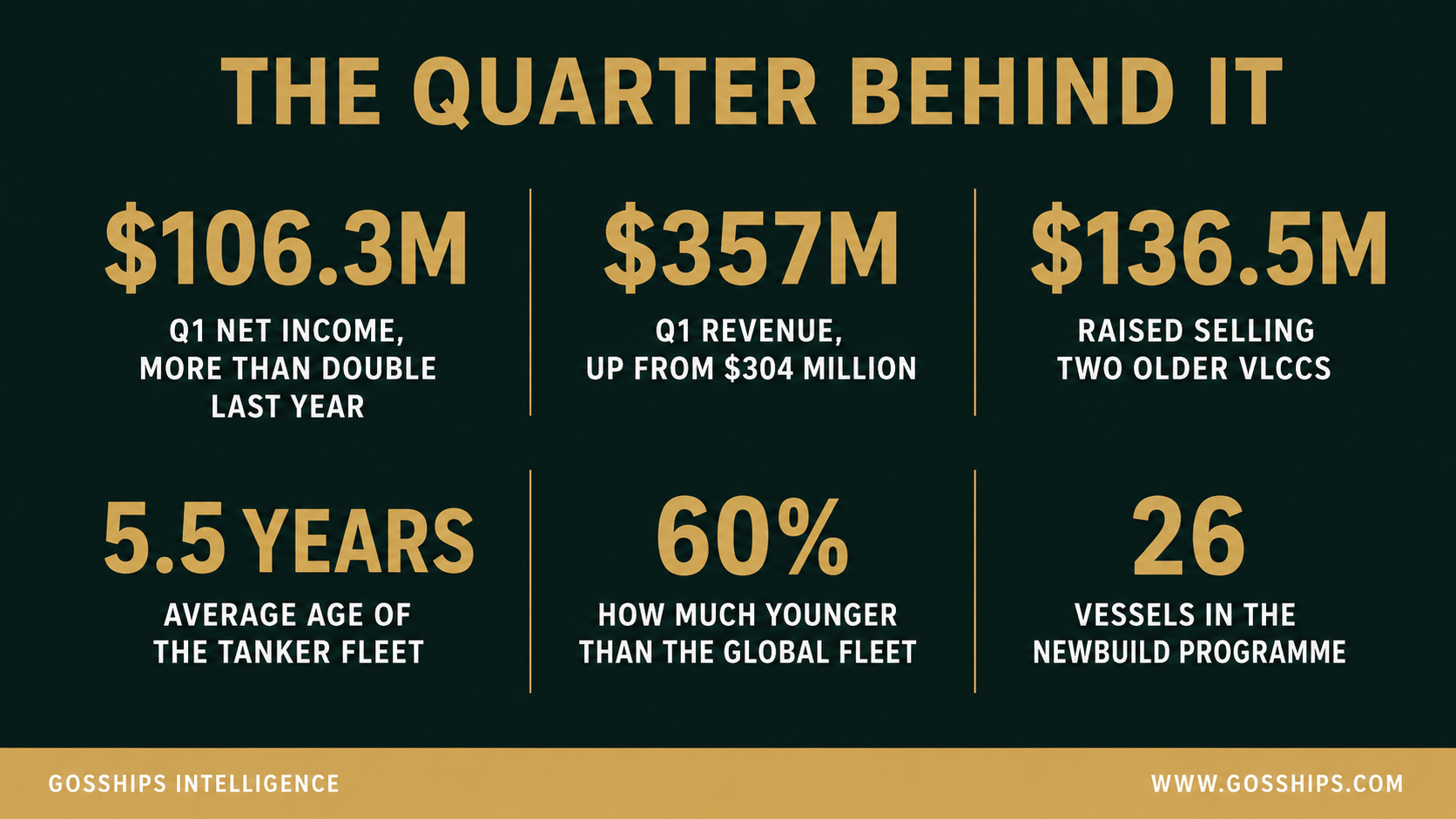
→ Net Income: $106.3 Million In Q1 2026, Up From $41.7 Million a Year Earlier Per Navios Maritime Partners
→ Revenue: $357.0 Million In Q1 2026, Up From $304.1 Million a Year Earlier Per Navios Maritime Partners
→ EBITDA: $212.7 Million For the Quarter Per Navios Maritime Partners
→ The Sale: Navios Sold Two VLCCs Averaging 16 Years Old For $136.5 Million Per Navios Q1 2026 Earnings Call
→ The Premium: Frangou Said Those Sale Prices Were 102% Above the 20-Year Average Per Navios Q1 2026 Earnings Call
→ The Fleet: Tanker Fleet Averages 5.5 Years, More Than 60% Younger Than the Global Fleet Per Navios Maritime Partners
📰 Related Coverage
Iran Built a Toll Booth on the Strait of Hormuz
Trump Gave Iran 48 Hours to Open Hormuz
Hormuz Shut Down: Three Tankers Hit, P&I Clubs Pull War Risk Cover as Iran War Escalates
Found this useful? Share Gosships Intelligence with a colleague.
Why an owner would fix five years of revenue before a hull exists. What the secondhand sale prices reveal about the top of the cycle. The one number that tells you how much of this bet is already de-risked. Below.
🔍 Why It Matters
The headline figure is the $482 million. The more important figure is $47,763 a day, fixed for five years, on ships that do not yet float.
