


|⚓ About Us | 🛢️ Deep Water Reports | 📋 SwiftAction Training |
🏅 Founding Black Gold Membership (*52 Slots Left)
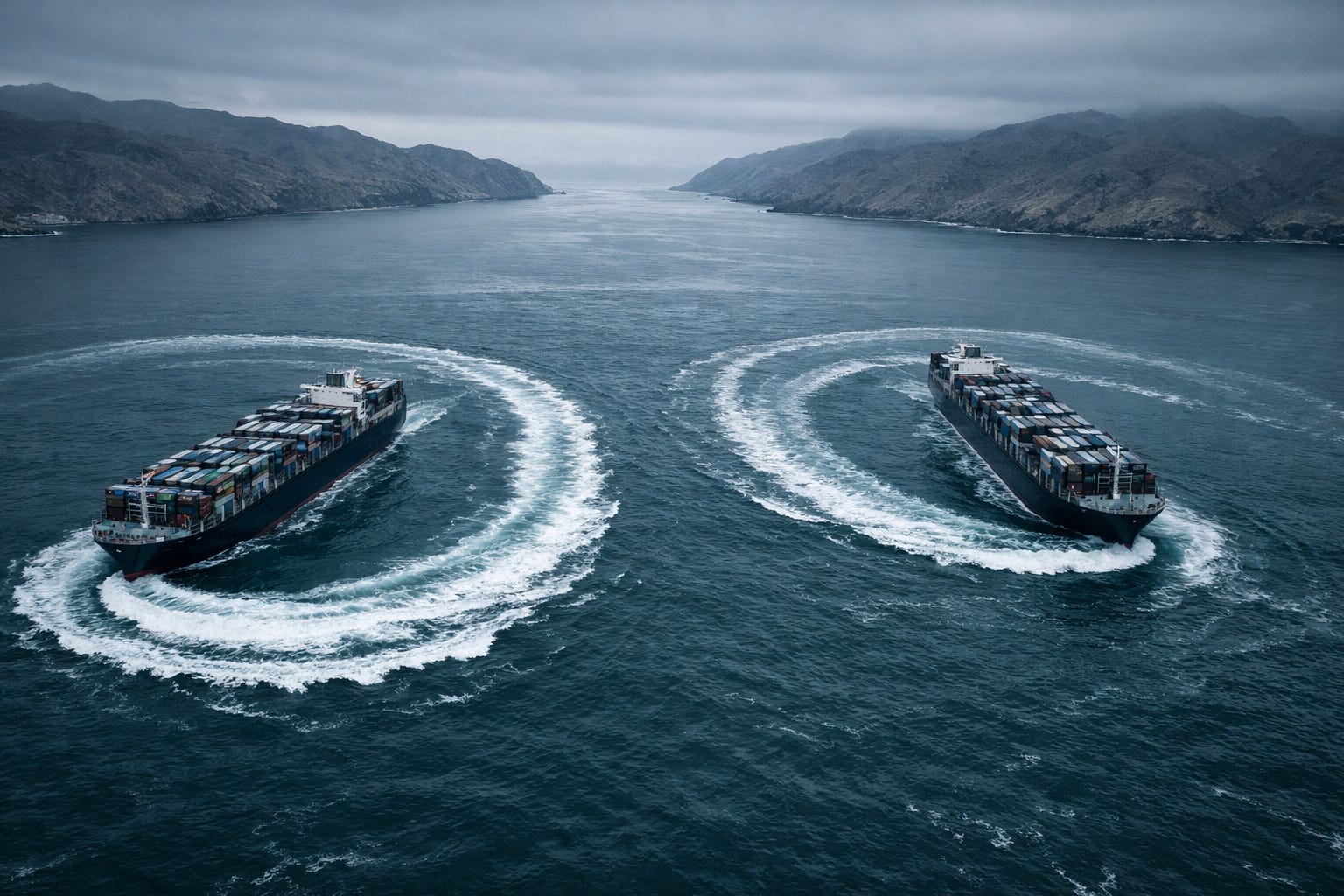
Iran’s Foreign Minister Abbas Araghchi announced on March 25 that China is a “friendly nation” with safe passage through the Strait of Hormuz, according to Reuters, Bloomberg, and Al Jazeera. Two days later, on March 27, Iran’s Islamic Revolutionary Guard Corps turned back two of China’s biggest container ships at the entrance to the Strait, according to Newsweek, the Foundation for Defense of Democracies, and MarineTraffic vessel tracking data. The CSCL Indian Ocean and the CSCL Arctic Ocean, both owned by China’s state-run COSCO Shipping, made U-turns near Larak Island at 3:20 AM and 3:50 AM UTC after being denied passage, according to MarineTraffic. The IRGC then declared the Strait of Hormuz “closed” and said any movement through it “will be met with a harsh response,” according to Newsweek and CBS News. Iran’s foreign ministry says friendly nations can pass with coordination. Iran’s military says nobody passes. It is unclear whether COSCO completed the coordination process Iran’s foreign ministry required before the ships attempted transit. Two branches of the same government gave two different signals on the same waterway within 48 hours. Gas in America went from $2.98 to $3.98 in 30 days.
📋 In this issue:
🛢️ The Story
📊 By The Numbers
🔍 Why It Matters
👀 What to Watch
🚨 Gosships Signal
📊 Get The Deep Water Report
→ Global Tanker Market Outlook Q2 2026
📋 Competency-Based Maritime Training
→ SwiftAction
📌 Gosships Data Card
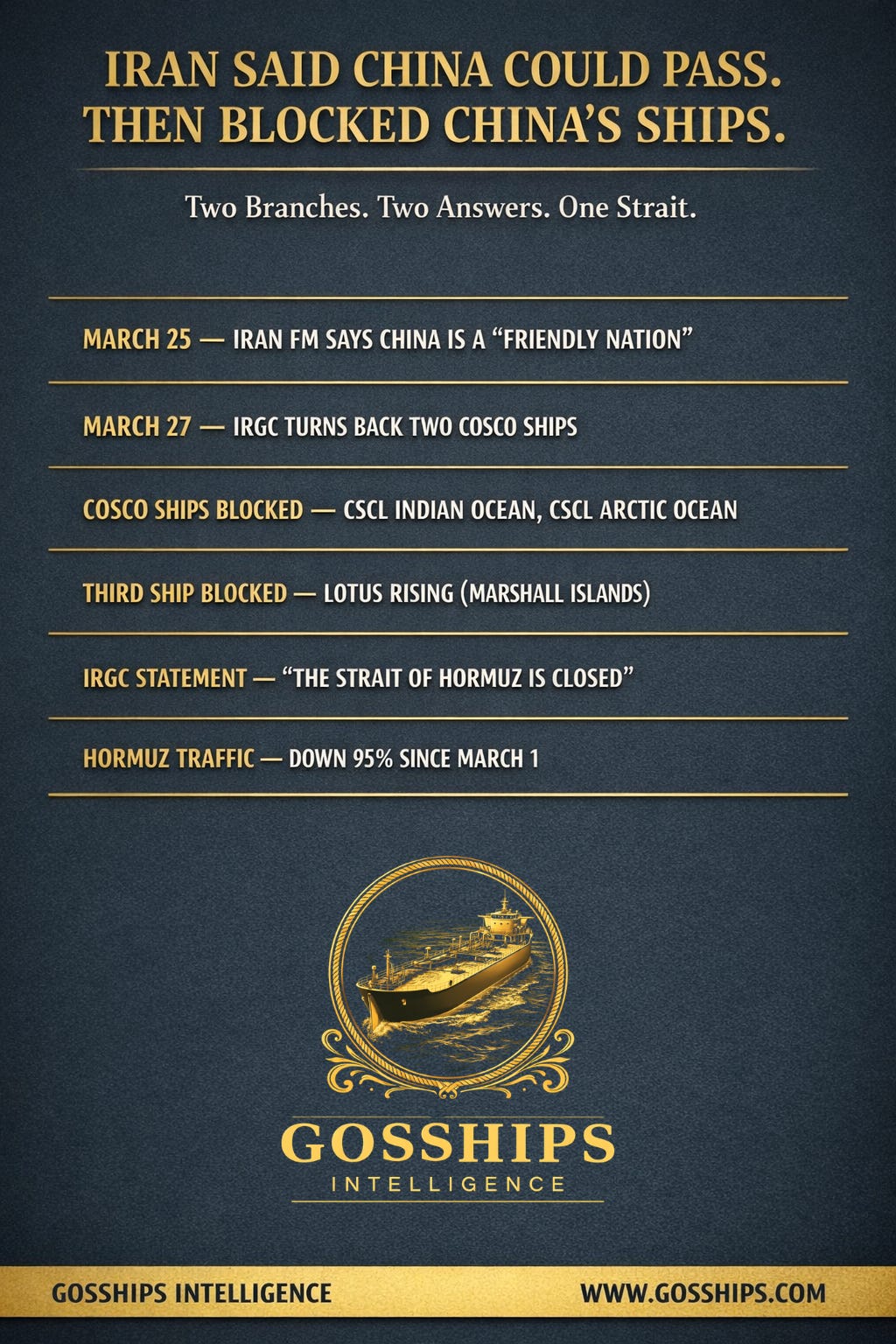
→ March 25: Iran FM Araghchi Announces China Is A “Friendly Nation” With Safe Passage Through Hormuz (Reuters, Bloomberg, Al Jazeera)
→ March 27: IRGC Turns Back Two COSCO Ships At Larak Island, 3:20 AM And 3:50 AM UTC (MarineTraffic, Newsweek, FDD)
→ COSCO Ships: CSCL Indian Ocean And CSCL Arctic Ocean, Both Hong Kong-Flagged, Chinese-Owned And Crewed (MarineTraffic, The National)
→ Third Ship Turned Back: Marshall Islands-Flagged Lotus Rising (FDD)
→ IRGC Statement: “The Strait Of Hormuz Is Closed. Any Movement Will Be Met With A Harsh Response.” (Newsweek, CBS News)
→ IRGC Reason: “Following The False Statements Of The Corrupt US President Claiming The Strait Is Open” (CBS News, The Week)
🛢️ The Story
On March 25, Iran’s Foreign Minister Abbas Araghchi told Iranian state television that Tehran had permitted passage through the Strait of Hormuz for “friendly nations including China, Russia, India, Iraq, and Pakistan,” according to Reuters, Bloomberg, and Al Jazeera. The Consulate General of Iran in Mumbai posted the statement on social media. It was the clearest signal since the war began on February 28 that the Strait might partially reopen.
On March 25, COSCO Shipping, China’s largest shipping company and the world’s fourth-largest container carrier by capacity, issued a customer advisory confirming it had resumed accepting bookings for cargo shipments to Gulf destinations including the UAE, Saudi Arabia, Bahrain, Qatar, Kuwait, Iraq, and Oman, according to The National and Newsweek. It was the first major ocean carrier to resume bookings since the war began.
On March 27, two COSCO mega container ships attempted to exit the Persian Gulf through the Strait of Hormuz. The CSCL Indian Ocean and the CSCL Arctic Ocean, both ultra-large container vessels operating on COSCO’s MEX service within the Ocean Alliance network, approached the waters between Larak and Qeshm islands, where Iran has been running an unofficial transit corridor, according to MarineTraffic, Newsweek, and the Maritime Executive. Both ships had changed their AIS displays to broadcast “Chinese Owner & Crew,” according to the Maritime Executive and Newsweek.
Both ships made abrupt U-turns. The CSCL Indian Ocean reversed course at approximately 3:20 AM UTC. The CSCL Arctic Ocean followed at 3:50 AM UTC, according to MarineTraffic tracking data confirmed by Newsweek, The National, and Kpler. The ships had been stuck in the Persian Gulf since the start of the war, according to Newsweek and The Week.
A third ship, the Marshall Islands-flagged Lotus Rising, was also turned back, according to the Foundation for Defense of Democracies.
Hours later, the IRGC issued a statement on its Sepah News website, in an apparent reference to the COSCO vessels: “This morning, following the false statements of the corrupt US president claiming that the Strait of Hormuz is open, three container ships of different nationalities moved toward the designated corridor for authorized vessel traffic, but were turned back after warnings from the IRGC Navy,” according to Newsweek, CBS News, and The Week.
The IRGC then went further: “The Strait of Hormuz is closed. The movement of any vessel ‘to and from’ ports of origin belonging to allies and supporters of the Zionist-American enemies, to any destination and through any corridor, is prohibited,” according to Newsweek, CBS News, and Manila Times.
The timing matters. Trump had said on Thursday, March 26, during a Cabinet meeting, that Iran had allowed 10 oil tankers through Hormuz as a “present” to show it was serious about negotiations, according to CNBC and CBS News. The IRGC explicitly cited Trump’s claim as the reason for blocking the ships. Iran’s military turned back its own ally’s ships to publicly contradict the American president.
This creates an extraordinary situation. Iran’s foreign ministry, through FM Araghchi, announced on March 25 that Chinese ships have safe passage with coordination. Iran’s military, through the IRGC, turned back Chinese ships on March 27 and declared the Strait closed. It remains unclear whether COSCO completed the coordination process that Iran’s foreign ministry required as a condition of transit. Araghchi’s announcement specified that passage was available “in coordination with the competent Iranian authorities.” If COSCO attempted to transit without completing that process, the IRGC may have been enforcing the conditions rather than contradicting the foreign ministry. But the IRGC’s own statement did not cite a lack of coordination. It cited Trump’s claim that the Strait was open. The effect is the same: two branches of the same government issued signals that produced opposite outcomes within 48 hours.
COSCO has at least six crude oil tankers stuck in the Gulf in addition to the two container ships that were turned back, according to Bloomberg. Traffic through the Strait of Hormuz is down 95% from pre-war levels in the period from March 1 to March 26, according to Kpler. Since March 1, 24 commercial vessels including 11 tankers have been attacked or reported incidents in the Gulf, the Strait of Hormuz, or the Gulf of Oman, according to the UKMTO.
Only 26 ships have been approved by Iran to transit the Strait using a pre-approved IRGC route around Larak Island, according to Lloyd’s List. At least two of those vessels paid approximately $2 million in Chinese yuan to use the corridor, according to Lloyd’s List analysts. Iran’s parliament is actively drafting legislation to formalize permanent toll collection.
The FDD’s Edmund Fitton-Brown, a senior fellow, offered one explanation: “Whilst Iran probably does not seek to alienate China, which has been sympathetic to its plight in the war with America and Israel, access through the Strait of Hormuz may be affected by a range of considerations. This incident could reflect a lower-level or more localized shakedown of the vessels in question.”
What this means for every shipping company that believed Iran’s safe passage guarantee, for Sinokor’s 130 to 150 VLCCs that may have been counting on Korean non-hostile access, and for the fundamental question of who actually controls the Strait of Hormuz is below.
📊 By The Numbers
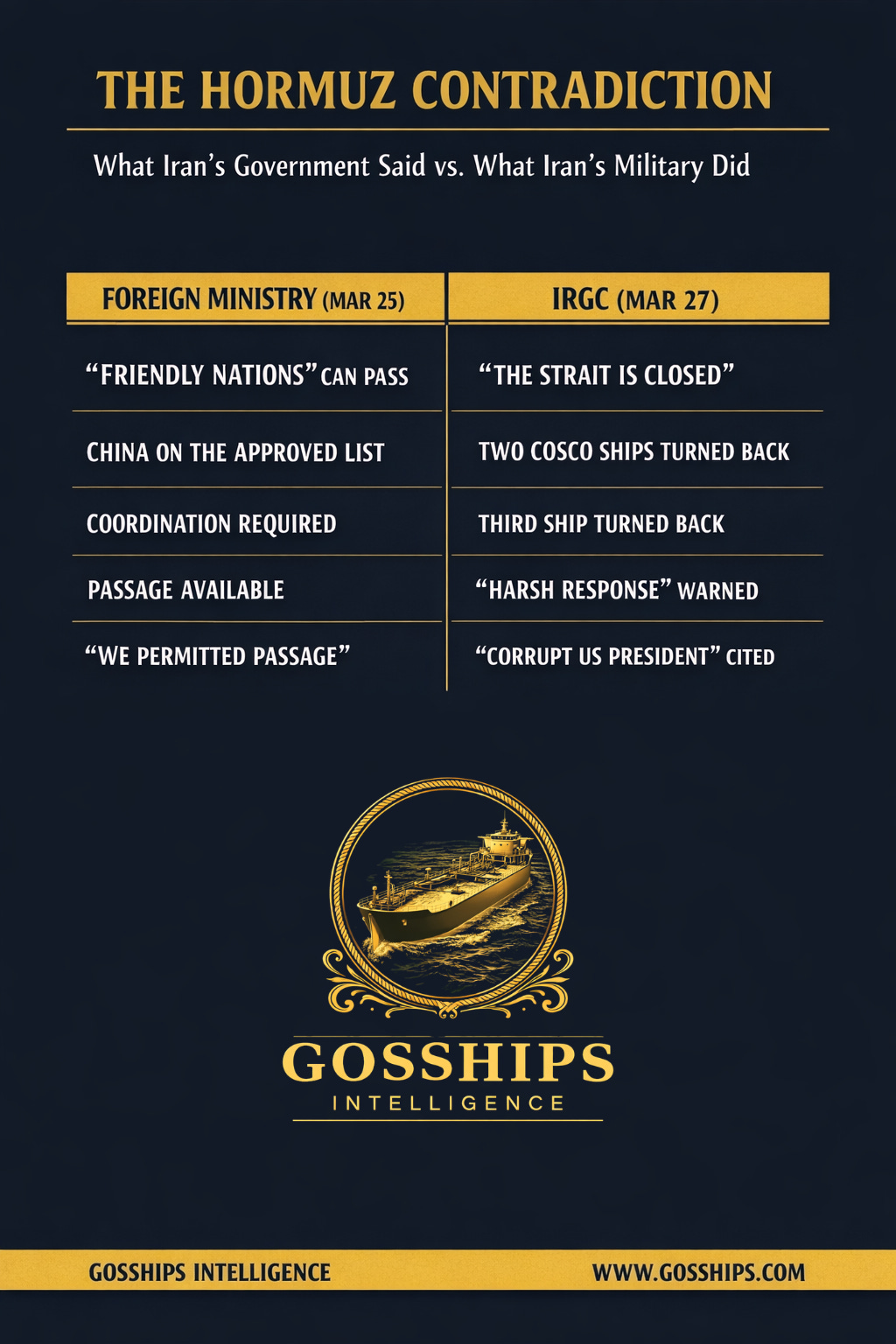
What Iran’s Foreign Ministry Said (March 25):
→ “We Permitted Passage Through The Strait Of Hormuz For Friendly Nations Including China, Russia, India, Iraq, And Pakistan” (Iran FM Araghchi Via Reuters, Bloomberg)
→ Passage Available “In Coordination With The Competent Iranian Authorities” (Iran UN Mission Via Reuters)
→ COSCO Resumed Bookings To Gulf Destinations March 25 (The National, Newsweek)
What Iran’s Military Did (March 27):
→ IRGC Turned Back CSCL Indian Ocean At 3:20 AM UTC (MarineTraffic, Newsweek)
→ IRGC Turned Back CSCL Arctic Ocean At 3:50 AM UTC (MarineTraffic, Newsweek, Kpler)
→ Third Ship Lotus Rising Also Turned Back (FDD)
→ IRGC: “The Strait Of Hormuz Is Closed. Any Movement Will Be Met With A Harsh Response.” (Newsweek, CBS News)
→ IRGC Reason: “Following The False Statements Of The Corrupt US President” (CBS News, The Week)
Additional Verified Data:
→ Hormuz Traffic Down 95% From Pre-War Levels, March 1-26 (Kpler)
→ 24 Commercial Vessels Attacked Since March 1, Including 11 Tankers (UKMTO)
→ 26 Ships Approved Via IRGC Corridor Since March 15 (Lloyd’s List)
→ At Least Two Vessels Paid ~$2 Million In Yuan To Transit (Lloyd’s List)
→ COSCO Has 6+ Crude Oil Tankers Also Stuck In The Gulf (Bloomberg)
→ Brent Crude: $111/Barrel On March 27 After COSCO Incident (Trading Economics)
Related Coverage
Sinokor Cornered the VLCC Market. Now They Just Bought Their First Three Suezmaxes. Brokers Expect an Avalanche. (March 2026)
Sinokor Is Charging $20 Per Barrel to Ship Oil. Last Year It Was $2.50. They Control 40% of Available Tankers. Nobody Can Do Anything About It. (March 2026)
What this means for every shipping company that believed Iran’s safe passage guarantee, for Sinokor’s 130 to 150 VLCCs that may have been counting on Korean non-hostile access, and for the fundamental question of who actually controls the Strait of Hormuz is below.
