


|⚓ About Us | 🛢️ Deep Water Reports | 📋 SwiftAction Training |
🏅 Founding Black Gold Membership (*53 Slots Left)
MSC, the world’s largest container shipping company, invested $3.3 billion in South Korea’s Sinokor Maritime. The 50% stake was confirmed by regulatory filings on March 19, according to Bloomberg and Splash247. Sinokor used the money to buy 60+ tankers, building a fleet of 130 to 150 VLCCs that controls up to 37% of the short-term charter market, according to iMarine, Bloomberg, and Fearnleys. One week later, on March 26, Iran’s ambassador to South Korea announced that Tehran considers South Korea “a non-hostile country” and that Korean vessels may transit the Strait of Hormuz with prior coordination, according to the Korea Times and Korea Herald. The ambassador added that Iran “appreciates that South Korea did not join the US proposal,” referring to Trump’s call for a military coalition, according to the Korea Herald. The country that controls the largest supertanker fleet in the world may have just been given access to the most valuable shipping route on earth while most Western-linked competitors are locked out. Gas in America went from $2.98 to $3.96 in 23 days.
📋 In this issue:
🛢️ The Story
📊 By The Numbers
🔍 Why It Matters
👀 What to Watch
🚨 Gosships Signal
📊 Get The Deep Water Report
→ Global Tanker Market Outlook Q2 2026
📋 Competency-Based Maritime Training
→ SwiftAction
📌 Gosships Data Card
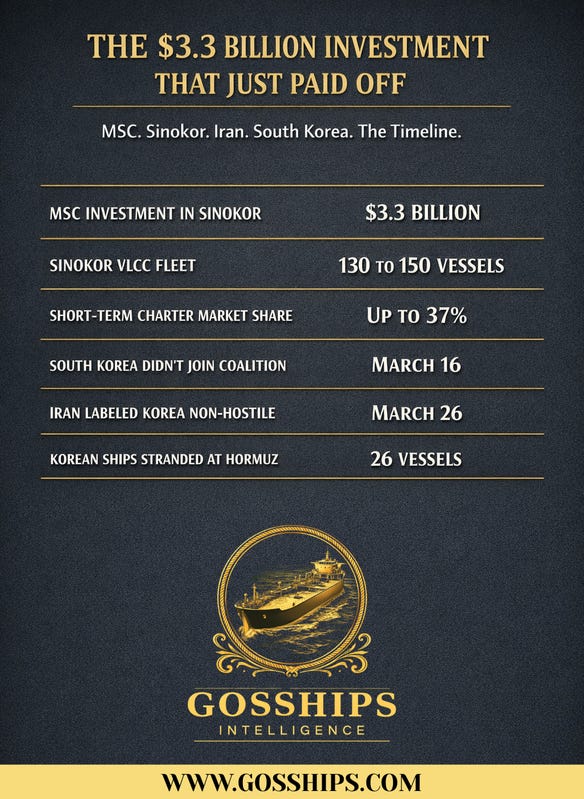
→ MSC Acquired 50% Stake In Sinokor, Confirmed By Regulatory Filings March 19 (Bloomberg, Splash247)
→ Sinokor Spent Approximately $3.3 Billion On 60+ Tankers (Veson Nautical, Forbes)
→ Sinokor Controls 130 To 150 VLCCs, Up To 17% Of The Global Fleet, Up To 37% Of The Short-Term Charter Market (iMarine, Bloomberg, Fearnleys)
→ South Korea Did Not Join Trump’s Military Coalition At Hormuz, Said It Would “Consider The Proposal” (Al Jazeera, The Diplomat, March 16)
→ Iran’s Ambassador: “South Korea Is A Non-Hostile Country” (Korea Times, Korea Herald, March 26)
→ Iran’s Ambassador: Tehran “Appreciates That South Korea Did Not Join The US Proposal” (Korea Herald, March 26)
🛢️ The Story
Three events happened in the span of ten days. Each one is verified. Together, they tell a story no one else is connecting.
On March 14, Trump posted on Truth Social calling on South Korea, Japan, China, France, and the United Kingdom to send warships to the Strait of Hormuz to help American forces reopen the passage, according to Al Jazeera. “Hopefully China, France, Japan, South Korea, the UK, and others, that are affected by this artificial constraint, will send Ships to the area,” he wrote, according to Al Jazeera.
On March 16, Germany, Japan, France, the UK, Australia, and China all explicitly refused, according to Al Jazeera and The Diplomat. South Korea did not refuse. Seoul said it would “consider the proposal and hold consultations,” according to Al Jazeera, The Diplomat, and multiple sources. South Korea was the only country among those Trump named that did not reject the request outright.
On March 19, regulatory filings from Greek and Cypriot competition commissions confirmed that Gianluigi Aponte, founder of MSC and the world’s richest shipowner, is acquiring a 50% stake in South Korea’s Sinokor Maritime, according to Bloomberg, Splash247, and TradeWinds. The filing formalized the funding behind what shipbrokers are calling the most aggressive fleet acquisition in tanker history. Sinokor spent approximately $3.3 billion purchasing 60+ tankers, according to Veson Nautical and Forbes. The company now controls 130 to 150 VLCCs through ownership and time charter, according to iMarine and Bloomberg. That represents up to 17% of the total global VLCC fleet of approximately 880 vessels, according to iMarine. Norwegian shipbroker Fearnleys estimated that Sinokor’s market share in the short-term VLCC charter market could reach as high as 37% by February 2026, according to iMarine. In January 2026 alone, Sinokor purchased 35 of 45 VLCCs sold globally, according to Veson Nautical. BRS stated: “There has never before been a single VLCC operator with such a dominant market share.”
On March 26, Iran’s Ambassador to South Korea, Saeed Koozechi, held a press conference at the Iranian Embassy in Seoul. He announced that Iran considers South Korea “a non-hostile country,” according to the Korea Times and Korea Herald. He added that Tehran “appreciates that South Korea did not join the US proposal,” in an apparent reference to Trump’s call for a military coalition at Hormuz, according to the Korea Herald. The ambassador said Korean vessels may transit the Strait of Hormuz with prior coordination with Tehran, according to the Korea Herald and UPI.
“There is no problem with safety, but any vessel must coordinate with the Iranian government in advance. Passage is only possible through prior agreement,” Koozechi said, according to the Korea Times.
The diplomatic cause and effect is explicit. Iran’s ambassador did not just label Korea non-hostile. He explained why. He said Tehran appreciates that South Korea did not join the US proposal. South Korea’s decision to say “we’ll consider it” instead of refusing was enough. Every other country Trump named said no. Korea was the only one that left the door open. Ten days later, Iran opened the Strait for Korean ships.
Twenty-six South Korean vessels are currently stranded at the Strait of Hormuz, with 179 Korean crew members unable to leave the area, according to the Korea Herald. Iran has asked Seoul to provide a list of the stranded vessels and their details through diplomatic channels, according to the Korea Herald. “Iran is acting in good faith and is willing to allow South Korean ships to transit the Strait of Hormuz, but the process will depend on receiving the relevant information and the vessels list,” Koozechi said, according to the Korea Herald.
There is a condition. The ambassador drew a clear distinction regarding vessels tied to U.S. economic interests. “We have stated that we will not permit passage through the strait for any targets related to the United States or Israel,” Koozechi told Korean radio, according to the Korea Herald. “Companies currently doing business with US firms are subject to sanctions during wartime,” he added, according to the Korea Herald.
MSC is Swiss-Italian, not American. But MSC operates globally, including in the United States. Sinokor has Korean beneficial ownership but is now 50% owned by a European conglomerate. The question is whether Sinokor, now half-owned by MSC, qualifies under Iran’s definition of “non-hostile.” The ambassador’s condition was clear: no links to U.S. companies. MSC is not American. But the compliance line is razor thin.
South Korea gets approximately 70% of its oil from the Middle East, according to The Diplomat. The country has been telling its citizens to take shorter showers and charge their phones during the day to conserve energy, according to Reuters and CNBC. South Korea’s Prime Minister warned the government must prepare for “worst-case scenarios,” according to Bloomberg.
Sinokor is a South Korean company. It controls 130 to 150 VLCCs. Iran just told South Korea its ships can transit Hormuz. If Sinokor’s VLCCs qualify as Korean vessels unlinked to U.S. interests, the company that dominates the short-term VLCC charter market may have access to the Strait of Hormuz while virtually every Western-linked competitor is locked out. VLCC rates from the Gulf to Asia hit $423,736 per day on March 3, according to CNBC. One Yanbu-to-India fixture reportedly hit $770,000 per day on March 6, according to Veson Nautical.
MSC’s Aponte invested $3.3 billion in a South Korean shipping company. South Korea didn’t join Trump’s coalition. Iran opened the Strait for Korean ships. What this means for every VLCC fixture through Hormuz, whether Sinokor qualifies under Iran’s conditions, and why the compliance line between South Korean and Western-linked tonnage may determine who controls the most valuable shipping route on earth is below.
📊 By The Numbers
The Timeline:
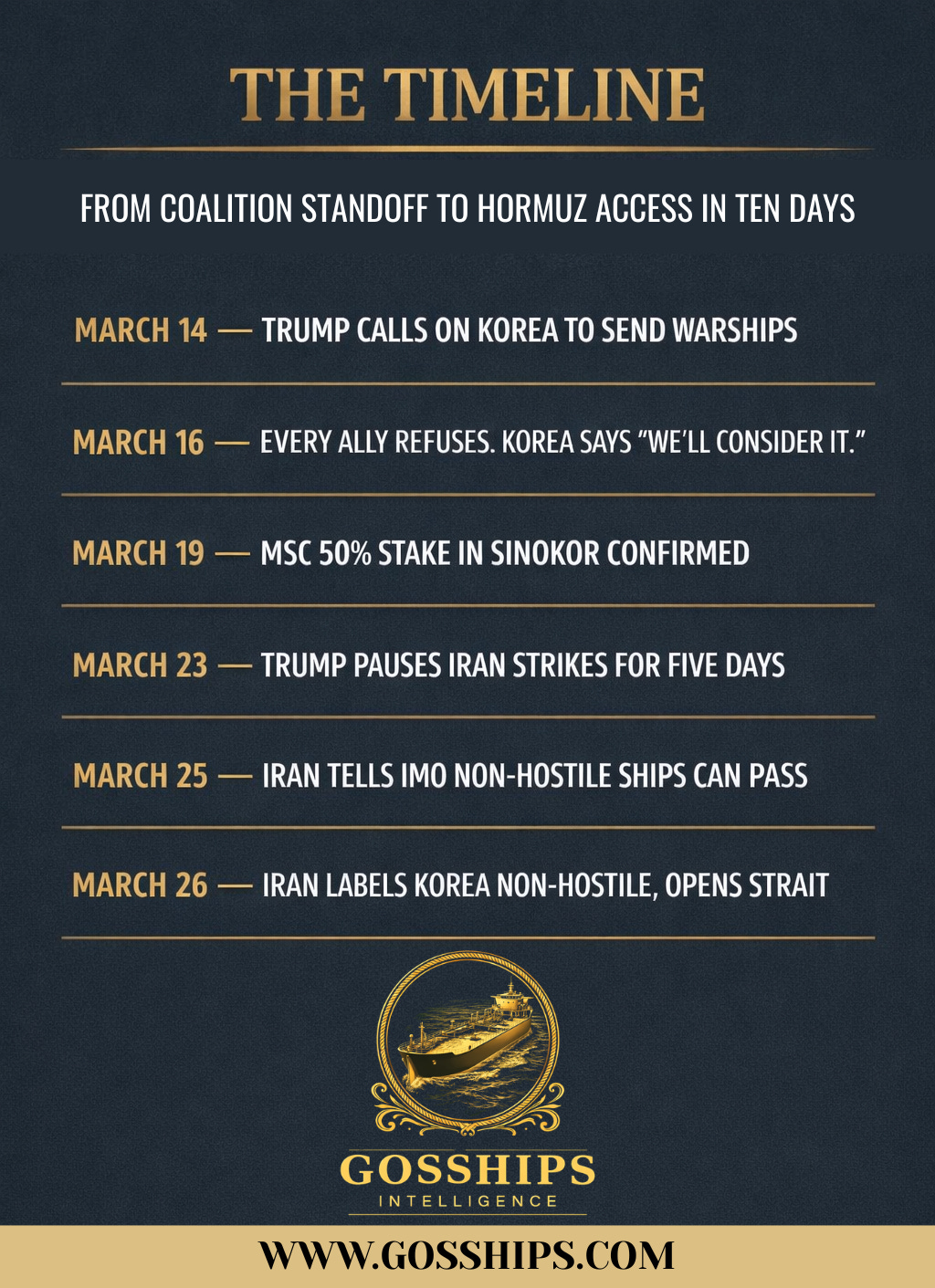
→ March 14: Trump Posts On Truth Social Calling On South Korea, Japan, China, France, UK To Send Warships To Hormuz (Al Jazeera)
→ March 16: Germany, Japan, France, UK, Australia, China All Explicitly Refuse. South Korea Says It Will “Consider The Proposal And Hold Consultations.” Only Country Not To Refuse. (Al Jazeera, The Diplomat)
→ March 19: Greek And Cypriot Filings Confirm MSC Acquiring 50% Of Sinokor. $3.3 Billion Fleet Investment Formalized. (Bloomberg, Splash247, TradeWinds)
→ March 23: Trump Pauses Strikes On Iranian Energy Infrastructure For Five Days, Citing “Productive” Talks. Oil Drops 11%. (CNBC, NBC News)
→ March 25: Iran Tells The UN And IMO That “Non-Hostile Vessels” May Transit Hormuz With Coordination. (Reuters, Bloomberg, Al Jazeera)
→ March 26: Iran’s Ambassador To Seoul Says “South Korea Is A Non-Hostile Country.” Tehran “Appreciates That South Korea Did Not Join The US Proposal.” Korean Ships May Transit With Prior Agreement. (Korea Times, Korea Herald, UPI)
Additional Verified Data:
→ Sinokor Controls 130 To 150 VLCCs Through Ownership And Time Charter (iMarine, Bloomberg)
→ Up To 17% Of The Total Global VLCC Fleet Of ~880 Vessels (iMarine)
→ Up To 37% Of The Short-Term VLCC Charter Market (Fearnleys Via iMarine)
→ Sinokor Purchased 35 Of 45 VLCCs Sold Globally In January 2026 (Veson Nautical)
→ BRS: “There Has Never Before Been A Single VLCC Operator With Such A Dominant Market Share” (BRS)
→ 26 South Korean Ships Stranded At Hormuz, 179 Crew Members (Korea Herald)
→ South Korea Gets ~70% Of Its Oil From The Middle East (The Diplomat)
→ VLCC Rate Record: $423,736/Day On March 3 (CNBC)
→ Single Fixture: $770,000/Day On March 6, Yanbu-India (Veson Nautical)
→ Iran’s Condition: Ships Linked To U.S. Or Israel Will Not Be Permitted (Korea Herald)
Related Coverage
Sinokor Cornered the VLCC Market. Now They Just Bought Their First Three Suezmaxes. Brokers Expect an Avalanche.
(March 2026)
Sinokor Is Charging $20 Per Barrel to Ship Oil. Last Year It Was $2.50. They Control 40% of Available Tankers. Nobody Can Do Anything About It.
(March 2026)
MSC invested $3.3 billion in Sinokor. South Korea didn’t join Trump’s coalition. Iran opened the Strait for Korean ships. Sinokor controls 130 to 150 of the world's supertankers. Whether Sinokor qualifies under Iran’s definition of “non-hostile,” what this means for every VLCC fixture through Hormuz, and why the compliance line between South Korean and Western-linked tonnage may determine who controls the most valuable shipping route on earth is below.
🔍 Why It Matters
For VLCC brokers, this is the most significant competitive development in the tanker market since the Hormuz closure. If Sinokor’s VLCCs can transit
