


⚓ The Gosships Team
Gosships Intelligence Is Published At Gosships.com
For Sponsorship And Partnership Inquiries Contact intelligence@gosships.com
|⚓ About Us | 🛢️ Exclusive Report | 📋 SwiftAction Training |
🏅Black Gold Membership (*53 Slots Left)
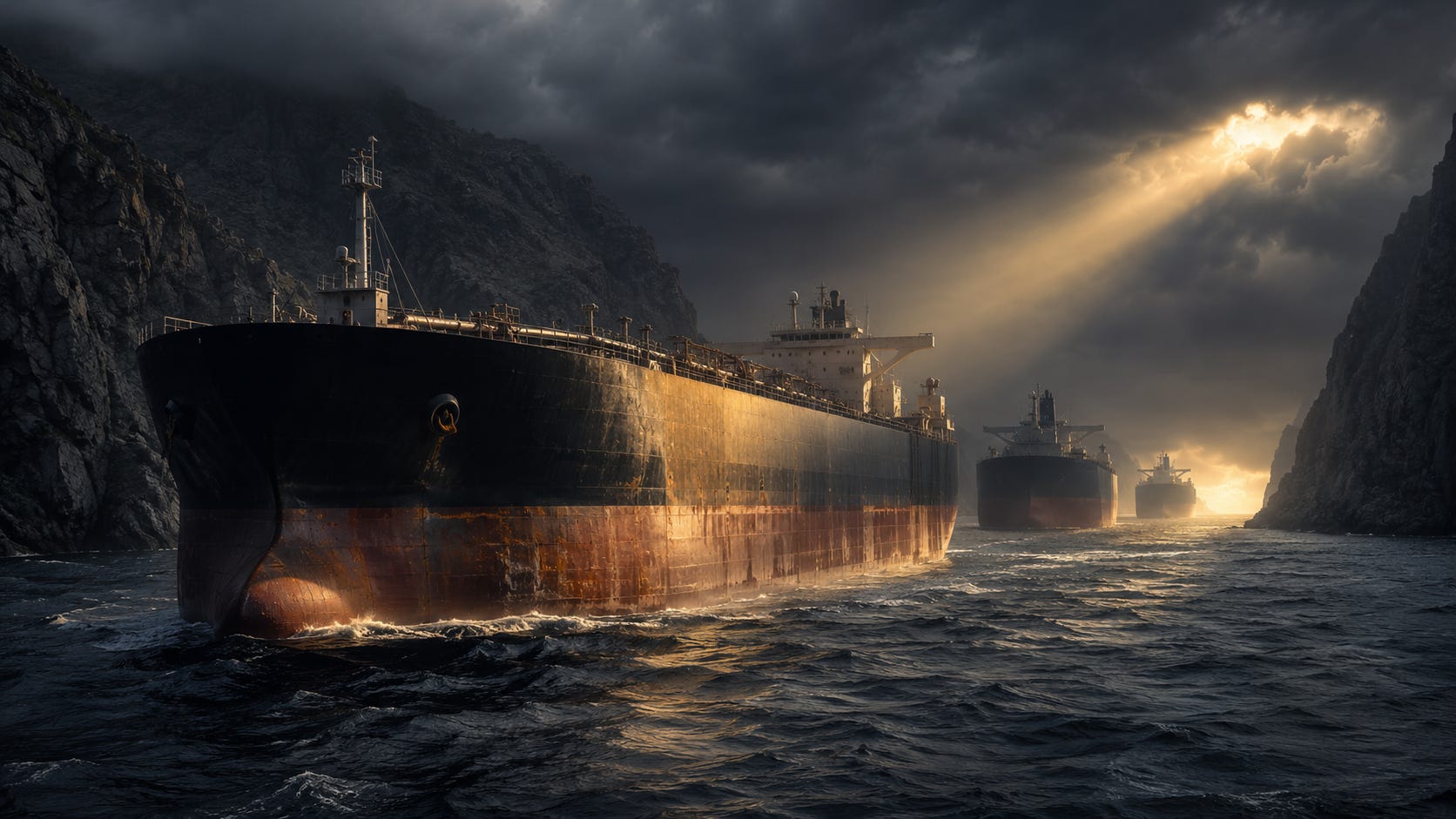
One signature could erase the largest war premium the tanker market has ever priced. On Friday, Pakistan said the text of a U.S.-Iran peace deal was finally agreed. Within hours, Iran said nothing was signed and President Trump called Iran’s negotiators “very dishonorable people,” even as a fresh exchange of fire flared over the Strait of Hormuz. Crude slid regardless. For a fleet sitting on the richest rates in its history, the next 48 hours decide everything.
📋 In This Issue:
🛢️ The Story
📊 By The Numbers
🔍 Why It Matters
👀 What To Watch
🚨 Gosships Signal
🔔 Not Yet Subscribed? Gosships Intelligence Delivers Oil Shipping Intelligence. Subscribe Here!
📊 Order Our Exclusive Report
→ Global Tanker Market Outlook Q3 2026 Edition
📋 Competency-Based Maritime Training
→ SwiftAction
📌 Gosships Data Card
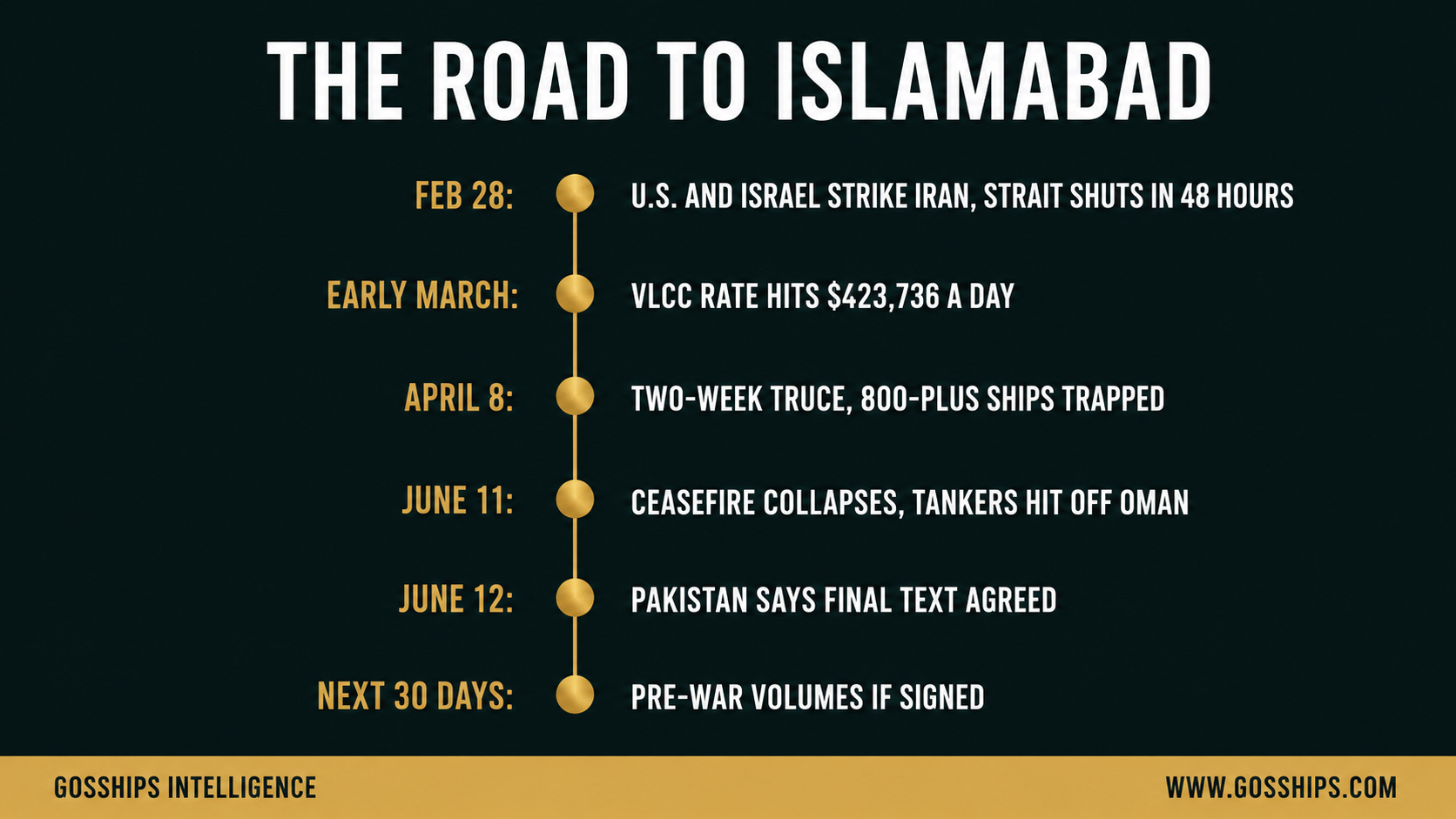
→ Feb 28: U.S. And Israel Strike Iran, And The Strait Of Hormuz Effectively Shuts Within 48 Hours
→ Early March: The Middle East Gulf To China VLCC Rate Hits An All-Time High Of $423,736 A Day (CNBC)
→ April 8: A Pakistan-Brokered Two-Week Truce Briefly Holds, With More Than 800 Vessels Stranded Inside The Gulf (Bloomberg)
→ June 11: The Hormuz Ceasefire Collapses As U.S. And Iranian Forces Trade Strikes And Tankers Burn Off Oman (Splash247)
→ June 12: Pakistan Says A Final, Agreed Upon Text Is Reached, While Iran Says Nothing Is Signed
→ Next 30 Days: The Text Calls For Pre-War Shipping Volumes To Return If The Deal Is Signed (Axios)
🛢️ The Story
Pakistan’s prime minister, Shehbaz Sharif, announced on Friday that mediators had reached a “final, agreed upon text” of a peace deal between the United States and Iran, the document that negotiators hope will end a war that has choked the Strait of Hormuz for much of the past four months. Iran did not confirm it. Within the same news cycle, the deal swung from agreement to denial and back, leaving the world’s most important oil chokepoint, and the tanker market built around it, suspended between war and peace.
The framework, described to Axios by a diplomat from one of the mediating countries and a U.S. official, is a memorandum of understanding built around two clocks. It would hold the ceasefire in place for another 60 days, Lebanon included, and run nuclear talks in parallel. The shipping language is unusually concrete. Hormuz would open at once, with no transit toll, and traffic would be rebuilt to its pre-war level inside a month. Washington, in exchange, would stand down its blockade of Iran’s ports. Once cargoes are moving again, Tehran would get a 60-day reprieve from sanctions to put its crude back on the open market, with anything more durable tied to compliance and, the diplomat told Axios, carrying no fixed start date.
The mediators are confident. “The U.S. and Iran have agreed on the text of a deal,” the same diplomat said, while conceding it still needed a final signature. Qatar and Pakistan ran the talks jointly, and the deal would carry the name of Pakistan's capital and lead mediator: the Islamabad Declaration. The breakthrough, Axios reported, came late Wednesday in Tehran, where Qatar’s Ali Al-Thawadi spent hours with Foreign Minister Abbas Araghchi and worked the phones with Trump envoys Steve Witkoff and Jared Kushner. By Thursday the logistics were already in motion: four U.S. Air Force C-17s flew equipment to Europe, pre-positioning for a Geneva ceremony that Vice President JD Vance could attend.
Tehran’s account was cooler. Speaking on Iranian state television late Friday, Araghchi said the deal had “never been closer” but insisted nothing had been signed and that the text could still change. A foreign ministry spokesperson said Iran had not made a final decision. Senior Iranian officials had signed off on the wording by Thursday evening, two sources told Axios, though the country’s Supreme Leader most likely had not.
Then the day turned. Iranian state-linked media published what they described as details of the draft, a version suggesting Iran would preserve key elements of its nuclear program, keep influence over the Strait of Hormuz and potentially receive compensation for war damage. Trump rejected it outright. In a Truth Social post, he said the leaked terms bore no relation to the truth and dismissed Iran’s negotiators as dishonorable people he could not deal with in good faith. Hours earlier, he had decried what he called a totally rebuffed Iranian drone attack on Indian-crewed ships leaving Hormuz as totally unacceptable. A senior U.S. official told Fox News that American forces shot down two Iranian one-way attack drones in the strait on Thursday.
The backdrop to all of this is a shooting war at sea. A fragile Hormuz ceasefire had already collapsed on June 11, when U.S. and Iranian forces traded strikes and the product tanker Settebello, a 47,198 dwt vessel, was hit roughly 20 nautical miles off Sohar, Oman, leaving three seafarers missing. U.S. Central Command confirmed that American aircraft fired into the ship’s engine room after the crew failed to comply with forces enforcing the blockade, and said the Settebello was the eighth vessel it had disabled since mid-April. The International Maritime Organization has verified 43 attacks on international shipping in and around the strait since February 28, with 11 confirmed seafarer deaths.
Markets read through the noise to the destination. Brent crude fell more than 3% on Friday to its lowest in nearly two months, with U.S. West Texas Intermediate down a similar amount and prices off roughly 5% at the session low before Trump’s denial trimmed the move, according to CNBC. Traders, in other words, are betting that a deal arrives even as the two governments argue about what is in it. For the tanker market, that bet is worth hundreds of thousands of dollars a day.
Because the prize sitting underneath the diplomacy is enormous, and it is the part that does not fit in a headline. What a signature would actually do to freight rates, to the fleet stranded inside the Gulf, and to a newbuilding orderbook that just hit an all-time high, is where the real money moves. That is below.
📊 By The Numbers
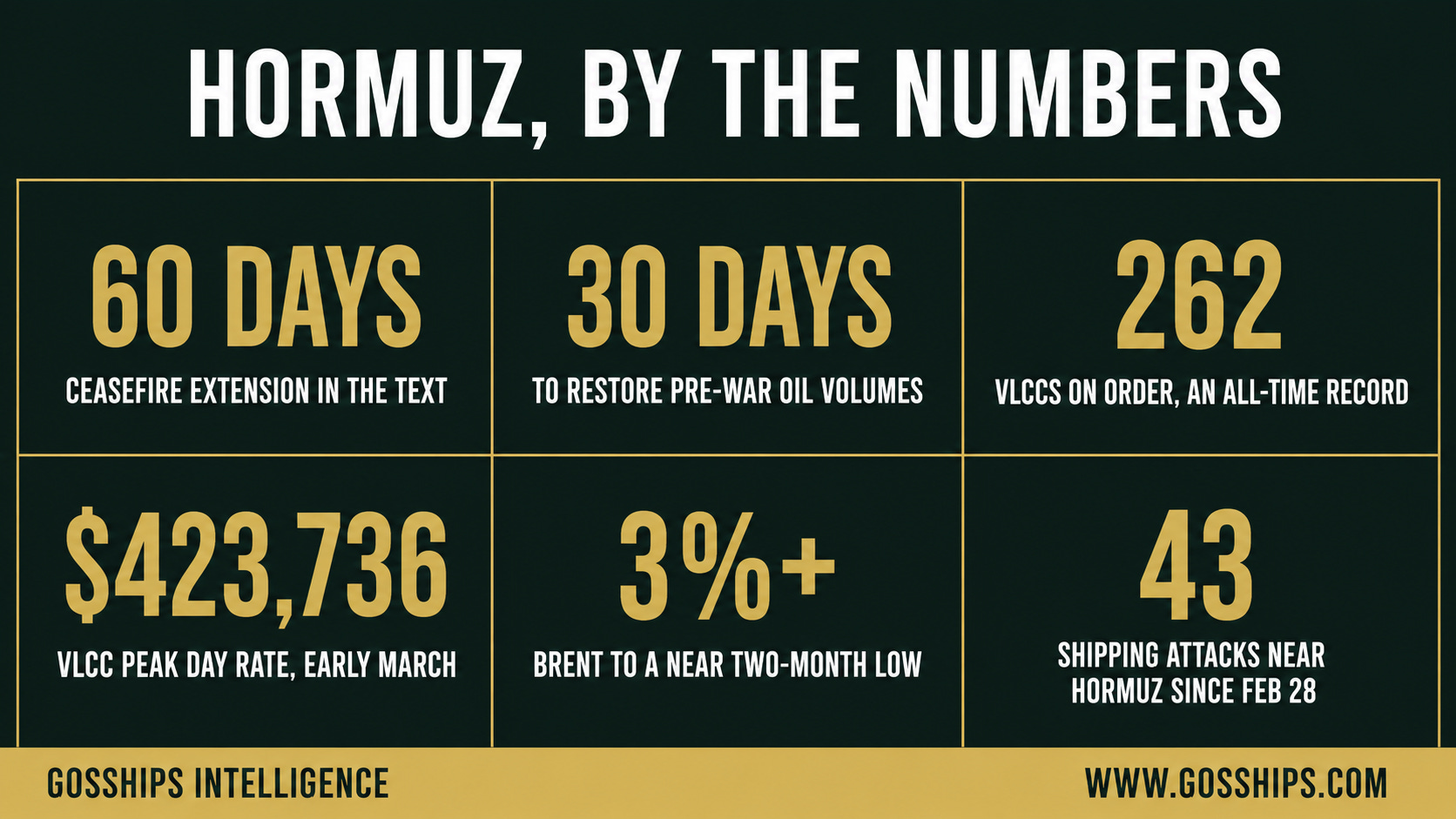
→ 60 Days: The Ceasefire Extension Written Into The Memorandum Of Understanding (Axios)
→ 30 Days: The Window For Pre-War Shipping Volumes To Return Through Hormuz (Axios)
→ 262: Very Large Crude Carriers On Order Worldwide, An All-Time Record (Clarksons Research, Via Splash247)
→ 127: VLCCs Ordered So Far This Year, The Most Since 1973 (Clarksons Research, Via Splash247)
→ $423,736: The All-Time-High Middle East Gulf To China VLCC Day Rate In Early March (CNBC)
→ More Than 3%: Brent’s Friday Fall To A Near Two-Month Low On Deal Hopes (CNBC)
→ 43: Attacks On International Shipping Near Hormuz Since February 28, With 11 Seafarer Deaths (IMO)
→ 13.7 Million: Barrels Of Crude Iran Has Exported Since February 28, Much Of It Through Dark-Fleet Channels (TankerTrackers.com)
Related Coverage
The Insurance Market Closed The Strait Of Hormuz Before Iran Did. Here Is What VLCC Rates Reveal.
VLCC Tanker Rates Surge Past $200,000 Per Day on Hormuz Crisis
MSC Invested $3.3 Billion in Sinokor. South Korea Didn’t Join Trump’s Coalition. Ten Days After, Iran Opened the Strait for Korean Ships. The Tanker Market Has Never Seen This Before.
Why a credible signature could vaporize a $423,736-a-day market in a single afternoon, which seat on your floor takes the hit first (broker, trader, compliance, underwriter, operator), and the one thing about a record 262-ship orderbook that should frighten every owner who chased these rates. That read is for members.
