


|⚓About Us |🛢️Deep Water Reports |📋SwiftAction Training |
🏅Black Gold (*53 Slots Left)
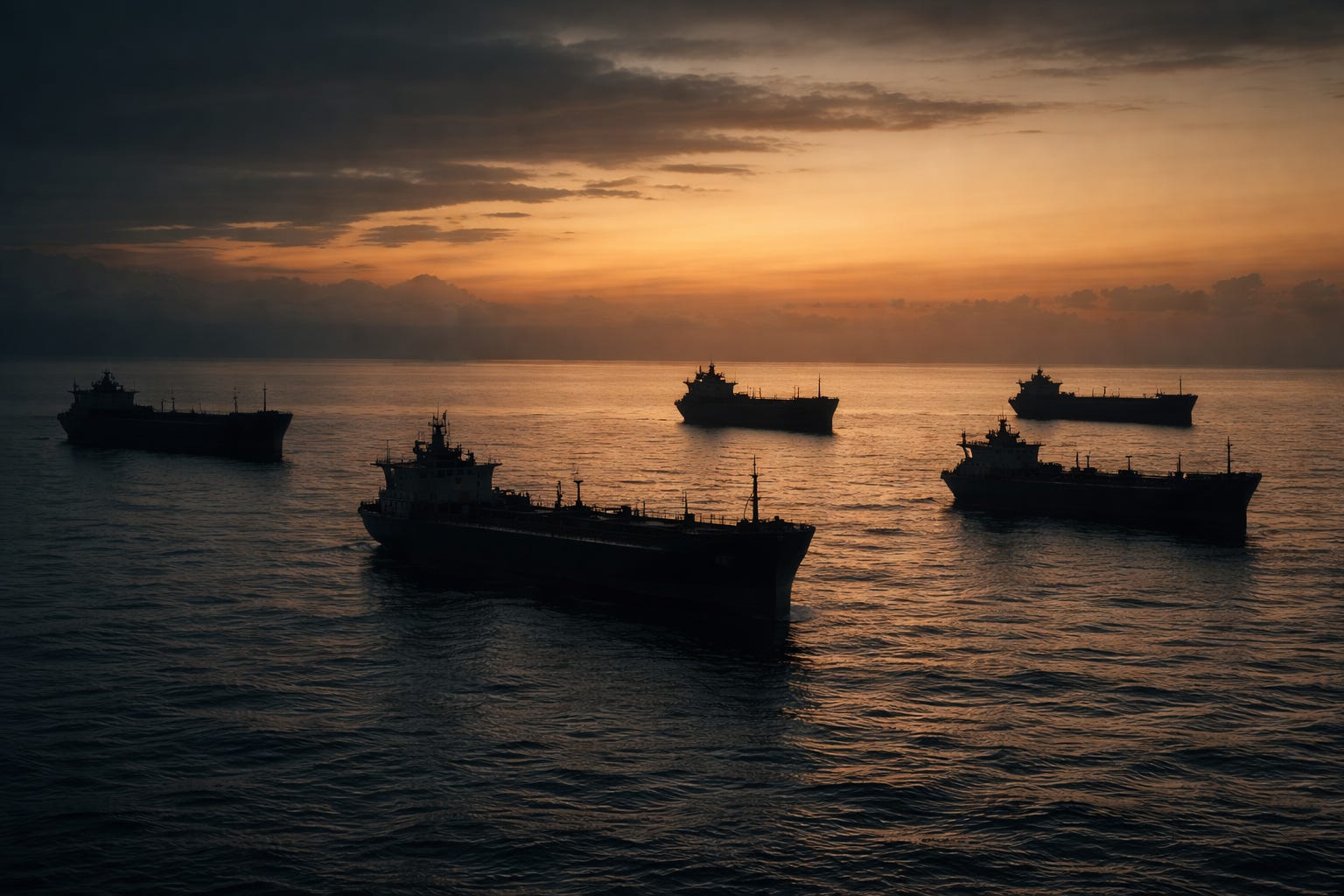
The Strait of Hormuz has been closed to commercial shipping for nearly four weeks. Gas in America just hit $3.96 a gallon, up from $2.98 before the war started. And the country that built the blockade has shipped 28 million barrels of its own oil through it, earning over $2 billion for the military wing currently firing missiles at U.S. bases across the Gulf.
📋 In this issue:
🛢️ The Story
📊 By The Numbers
🔍 Why It Matters
👀 What to Watch
🚨 Gosships Signal
📊 Get The Global Tanker Market Outlook
→ Deep Water Report
📋 Competency-Based Maritime Training
→ SwiftAction
📌 Gosships Data Card
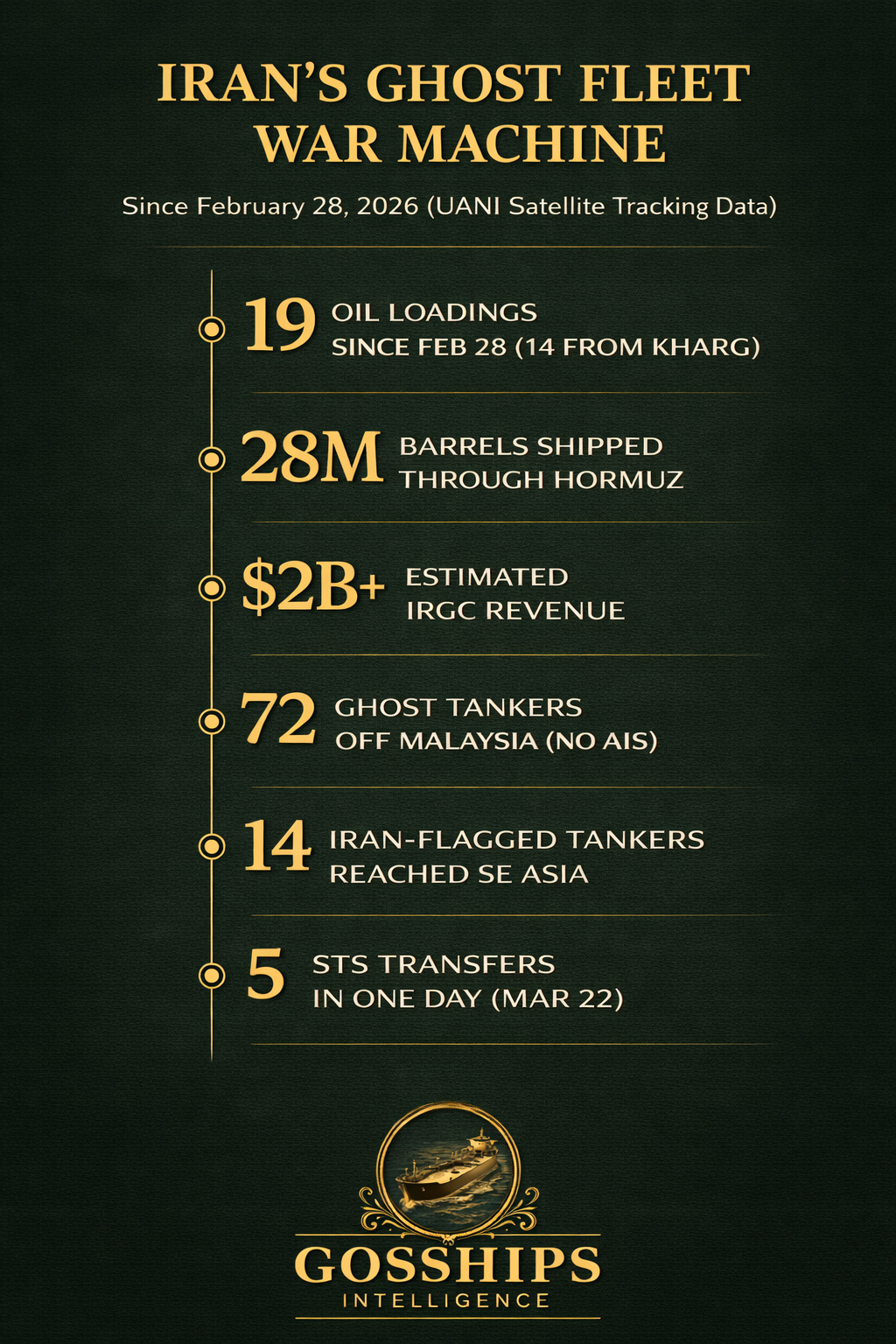
→ 19 Oil Loadings Since February 28 (14 From Kharg Island, 5 From Other Terminals) (UANI, March 23)
→ 28 Million Barrels Of Iranian Crude Shipped Through Hormuz (UANI, March 23)
→ $2 Billion+ Estimated IRGC Revenue From Wartime Oil Sales (UANI, March 23)
→ 72 Ghost Fleet Tankers Identified At EOPL Anchorage Off Johor, Malaysia, Via Satellite Imagery (UANI, March 23)
→ 14 Iranian-Flagged Tankers Have Reached Southeast Asian Waters Since The War Began (UANI, March 23)
→ 5 Ship-To-Ship Transfers Of Iranian Crude Observed Via Satellite In The EOPL Zone On March 22 (UANI, March 23)
🛢️ The Story
The Strait of Hormuz is functionally closed. On March 22, exactly one vessel openly transited the waterway with its AIS transponder broadcasting, according to United Against Nuclear Iran (UANI). Before the war began on February 28, roughly 138 ships crossed daily. That is a 99.3% collapse in visible traffic.
But Iran’s own tankers never stopped.
UANI’s daily shipping intelligence updates, which combine satellite imagery with AIS tracking data from MarineTraffic and Starboard Maritime Intelligence, reveal that the Islamic Revolutionary Guard Corps has continued loading crude oil at Kharg Island throughout the entire conflict. As of March 23, UANI has tracked at least 19 oil loadings since the war began. Fourteen of those originated from Kharg Island, Iran’s principal crude export terminal, which handles approximately 90% of the country’s oil exports, according to both UANI and Kpler, the satellite-tracking analytics firm.
Those 19 loadings represent approximately 28 million barrels of Iranian crude, generating an estimated revenue of over $2 billion for the IRGC, according to UANI’s March 23 update. UANI states that this revenue “continues to fund Iran’s active missile and drone programs central to the conflict.”
The Financial Times reported on March 17, citing data from Kpler and Vortexa, that Iran was earning approximately $140 million per day in crude oil revenue, exporting between 1.5 and 1.6 million barrels per day through the Strait of Hormuz. These volumes, the FT noted, remain “broadly consistent” with Iran’s average export levels over the past year.
The oil is moving through a ghost fleet that operates with near-total impunity.
UANI has recorded 72 Iranian oil-laden tankers in the East Outer Port Limits (EOPL) area, a ghost fleet hotspot approximately 70 kilometers off the coast of Johor, Malaysia. All 72 were identified via satellite imagery despite not broadcasting on AIS. On March 22, 26 tankers listed on UANI’s Ghost Armada were anchored or loitering in the EOPL area with their AIS signals active. Five ship-to-ship transfers involving Iranian crude were also observed via satellite imagery in the zone on the same day.
UANI’s assessment is blunt: “Despite the ongoing conflict, it is business as usual for the Iranian oil trade to China, where ghost fleet tankers continue to operate with impunity across Southeast Asia’s sea lanes.”
The pipeline runs from Kharg Island through the Strait of Hormuz to Southeast Asia. Since the conflict began, at least 11 ghost fleet tankers have left the Persian Gulf, some broadcasting their AIS and others operating dark. The true number is “likely significantly higher,” UANI reports, because many vessels switched off their AIS to avoid detection. These tankers transit the Indian Ocean to the EOPL anchorage off Malaysia, where they conduct ship-to-ship transfers with other ghost fleet vessels bound for China.
Fourteen Iranian-flagged tankers have reached Southeast Asian waters since the war began. The most recent, the STARK 1 (IMO 9171450), laden with crude from Kharg Island, appeared on AIS in the Strait of Malacca on March 21 before transiting the Singapore Strait on March 22 and arriving at the Malaysian anchorages. At least 15 Iranian-flagged tankers have also begun return voyages from the EOPL area back to Iran to reload.
On March 14, U.S. forces struck military installations on Kharg Island as part of a new phase of operations. The strikes specifically targeted IRGC-controlled military assets but avoided oil infrastructure. UANI reports that satellite imagery confirmed all 55 crude storage tanks remained intact. Two tankers were loading an estimated 2.7 million barrels of crude on the morning of March 14, the same day as the strike.
The U.S. military appears aware of the ghost fleet’s operations. On March 17, the USS Tripoli, an America-class amphibious assault ship transiting from Japan to the Middle East, passed near the ghost fleet tankers in the EOPL anchorage prior to entering the Singapore Strait, according to UANI, which published satellite imagery of the warship passing three of the five STS transfers taking place that day. CNN confirmed on March 17 that the Tripoli was “nearing the Malacca Strait off Singapore.” USNI News confirmed the Tripoli Amphibious Ready Group and the 31st Marine Expeditionary Unit were transiting to the Middle East.
The warship passed the transfers. It did not stop them.
Meanwhile, Treasury Secretary Scott Bessent told CNBC on March 16 that the U.S. is “allowing Iranian oil tankers to transit the Strait of Hormuz.” Bessent stated: “The Iranian ships have been getting out already, and we’ve let that happen to supply the rest of the world.” On March 20, the Treasury Department issued General License U, temporarily lifting sanctions on approximately 140 million barrels of Iranian crude already loaded on vessels, authorized through April 19. The Foundation for Defense of Democracies criticized the license for containing no escrow mechanism and no payment channel restrictions.
The scale of the operation is significant. In 2025, UANI documented $45.7 billion worth of sanctioned oil transported from Iran to buyers in China. The wartime trade is an acceleration, not an anomaly.
Kharg Island generates approximately $78 billion per year in energy revenue, according to Miad Maleki, a former U.S. Treasury sanctions official and senior advisor at the Foundation for Defense of Democracies, in a March 14 interview with TIME. Maleki told TIME that the military “physically takes possession of the barrels and sells much of the oil independently, mostly to China,” making Kharg “not just the backbone of Iran’s economy, but also the military’s primary revenue source.”
Kpler data shows that over the last 12 months, approximately 94% of Iran’s crude exports originated from Kharg. In the first two weeks of March alone, Kharg handled at least eight crude loadings totaling nearly 14 million barrels, according to Kpler.
The American consumer is paying for both sides of this war. Gas at the pump hit $3.96 per gallon nationally on March 23, according to AAA, the highest level since 2022. Before the war started, it was $2.98. California has exceeded $5.56 per gallon. Diesel has reached $5.07, according to AAA, its highest since 2022.
The blockade does not apply to the country that built it.
📊 By The Numbers
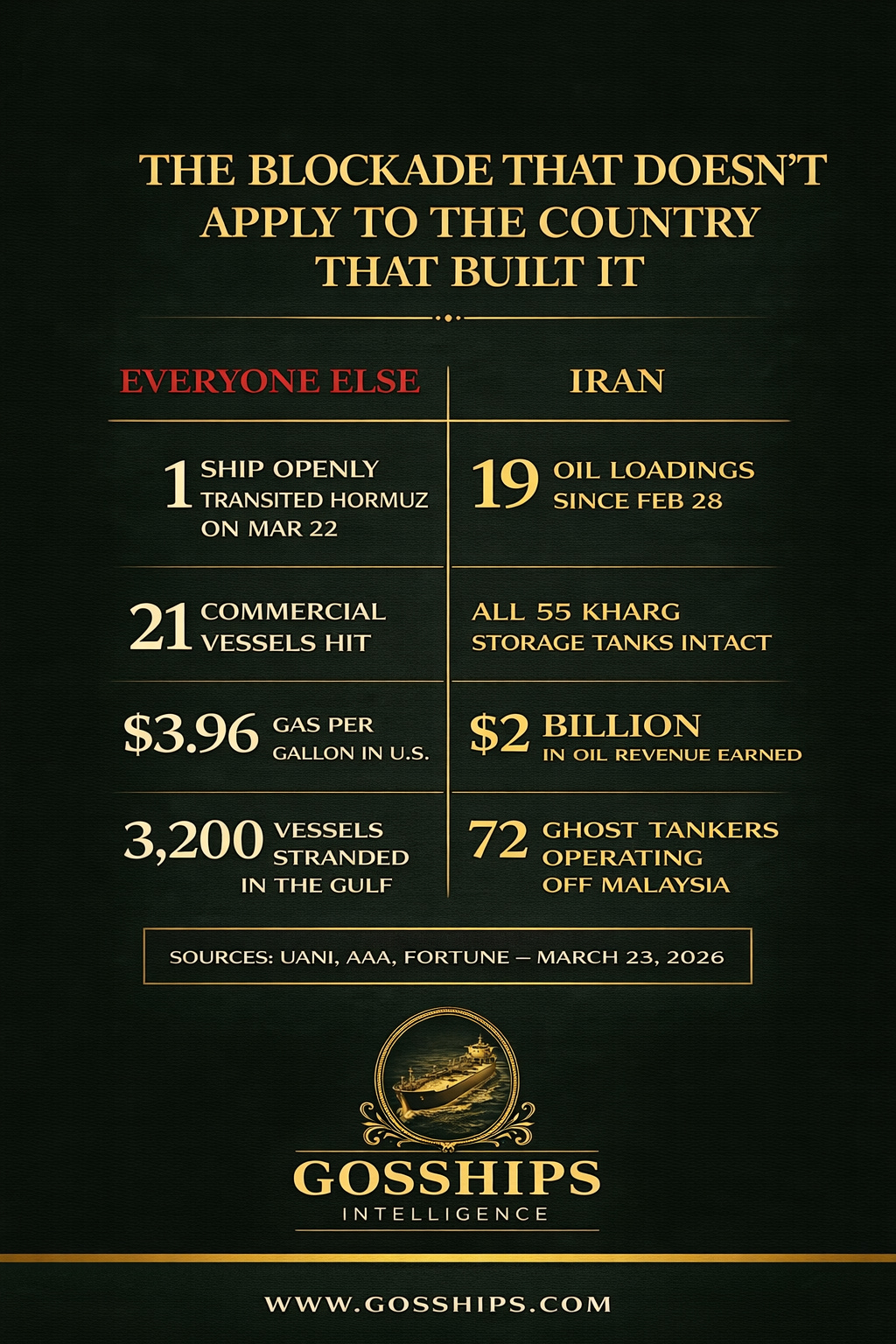
Everyone Else vs. Iran Since February 28:
→ Hormuz Transits On March 22: 1 Openly (Everyone Else) vs. 19 Oil Loadings Since War Began (Iran) (UANI, March 23)
→ Commercial Vessels Hit: 21+ (UANI, March 23) vs. All 55 Kharg Island Crude Storage Tanks Intact After U.S. Strike (UANI, March 16)
→ U.S. Gas Price: $3.96/Gallon On March 23 (AAA) vs. Iran Oil Revenue: $2 Billion+ Since Feb 28 (UANI, March 23)
→ Vessels Stranded In The Gulf: ~3,200 (CNBC, March 18) vs. 72 Iranian Ghost Fleet Tankers Operating At EOPL Off Malaysia (UANI, March 23)
Additional Verified Data:
→ 30 Iranian Oil-Laden Tankers Currently Inside The Persian Gulf West Of Hormuz (UANI, March 23)
→ 14 Iranian-Flagged Tankers Have Reached Southeast Asian Waters Since War Began (UANI, March 23)
→ Iran Exporting 1.5 To 1.6 Million Barrels Per Day, Earning ~$140 Million Daily (Financial Times, March 17)
→ 94% Of Iran’s Crude Exports Originated From Kharg Island Over The Last 12 Months (Kpler, March 16)
→ UANI’s Ghost Armada List: 573 Total Vessels Suspected Of Iranian Oil Involvement (UANI)
→ Iran’s 2025 Oil Trade To China Via Ghost Fleet: $45.7 Billion (Seatrade Maritime/UANI, February 2026)
Related Coverage
Maritime Sanctions 2026: Shadow Fleet Surge (March 2026)
Shadow Fleet Under Fire: Arctic Metagaz Sinking (March 2026)
The Shadow Beneath the Waves: The Rise of the Dark Fleet (January 2025)
Iran Built a Toll Booth on the Strait of Hormuz (March 2026)
Hormuz Shut Down: Three Tankers Hit (March 2026)
The question is not whether Iran is profiting from a war it started. The data confirms that. The question is why 72 tankers can sit off Malaysia with their tracking signals off, conduct ship-to-ship transfers in full view of satellite imagery and a passing U.S. Navy warship, and continue loading at Kharg Island the same day the U.S. bombs the military installations next door. What General License U means for compliance desks, why the EOPL anchorage has become the most important oil trading zone on earth, and what this operation tells us about the next phase of the war is below.
