


⚓ The Gosships Team
Gosships Intelligence Is Published At Gosships.com
For Sponsorship And Partnership Inquiries Contact intelligence@gosships.com
|⚓ About Us | 🛢️ Deep Water Reports | 📋 SwiftAction Training |
🏅 Founding Black Gold Membership (*52 Slots Left)
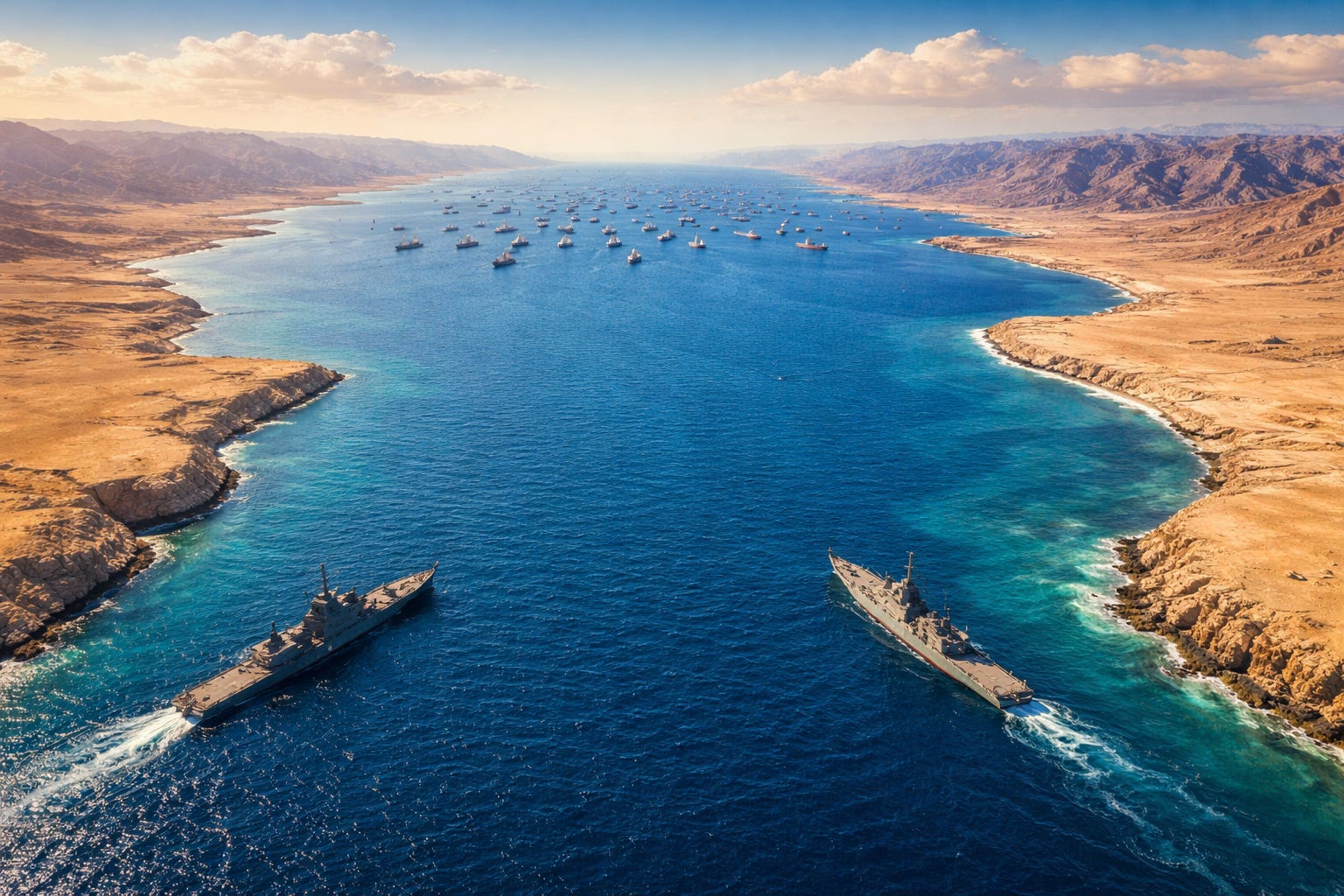
The US blockade of Iranian ports started at 10am Eastern Time this morning. But CENTCOM’s actual order is not what Trump announced. On Sunday, Trump posted on Truth Social that the US Navy would begin “BLOCKADING any and all Ships trying to enter, or leave, the Strait of Hormuz,” according to CBS News and CNBC. On Sunday night, CENTCOM issued a different statement. CENTCOM said the blockade would apply to “all maritime traffic entering and exiting Iranian ports” but that US forces “will not impede freedom of navigation for vessels transiting the Strait of Hormuz to and from non-Iranian ports,” according to CNBC, CNN, and Al Jazeera. That is a critical distinction. Trump’s version blockades the entire strait. CENTCOM’s version blockades Iran. For every shipowner with cargo bound for Saudi Arabia, the UAE, Kuwait, Qatar, or Iraq, the US military just said: you can pass. The problem is that Iran has not said the same thing.
📋 In this issue:
🛢️ The Story
📊 By The Numbers
🔍 Why It Matters
👀 What to Watch
🚨 Gosships Signal
📊 Get The Deep Water Report
→ Global Tanker Market Outlook Q2 2026
📋 Competency-Based Maritime Training
→ SwiftAction
📌 Gosships Data Card
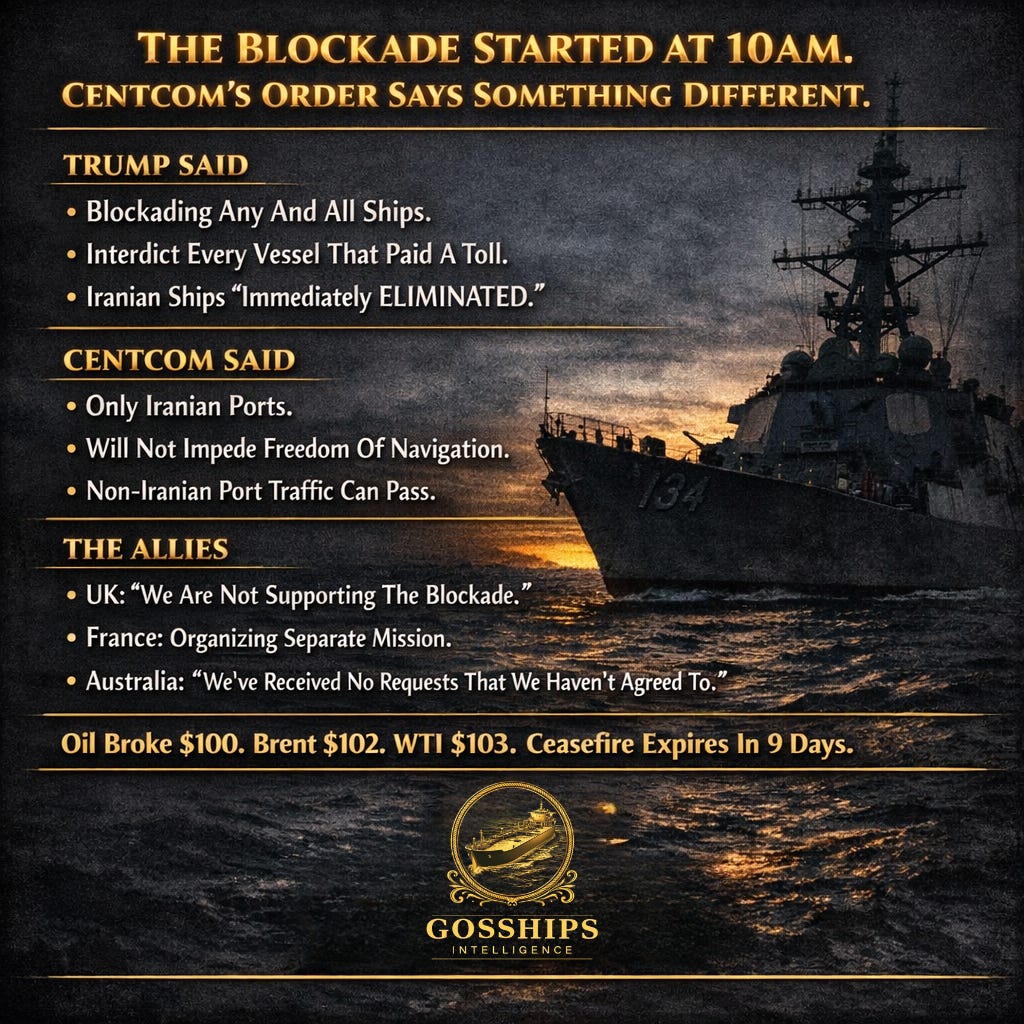
→ April 13, 10:00 AM ET: US Blockade Of Iranian Ports Began (CENTCOM Via CNBC)
→ April 13: CENTCOM: “Will Not Impede Freedom Of Navigation For Vessels Transiting To And From Non-Iranian Ports” (CNBC, CNN, Al Jazeera)
→ April 13: Trump: Iranian Fast Attack Boats Will Be “Immediately ELIMINATED” (Truth Social Via CNBC)
→ April 13: Brent Crude $102/Barrel. Up 7%. (CNN, AP) → April 13: WTI Crude $103-$104/Barrel. Up 7-8%. Oil Breaks $100. (CNBC, AP, NBC News)
→ April 13: UK Will Not Participate. Starmer: “We Are Not Supporting The Blockade.” (Al Jazeera, BBC)
→ April 13: France And UK Organizing Separate Freedom Of Navigation Conference (Macron Via Al Jazeera)
→ April 13: Australia: "We've Received No Requests That We Haven't Agreed To." (Albanese Via CNN)
→ April 13: IRGC: Any Approaching Military Vessels Breach The Ceasefire. “Severe Response.” (Al Jazeera)
→ April 13: FAO Warns Of Global Food Crisis If Strait Stays Closed (CNN)
→ April 13: Last Two Pre-War Tankers About To Deliver. World Will Have Exhausted Pre-War Crude. (JPMorgan Via CNN)
→ April 13: 250 Million Barrels Drawn From Reserves Since War Began (JPMorgan Via CNN)
→ April 13: 500-700 Vessels Stuck In The Gulf (Lloyd’s List Via USNI News)
🛢️ The Story
At 10:00 AM Eastern Time on Monday, April 13, the United States began its blockade of Iranian ports. The blockade applies to “all maritime traffic entering and exiting Iranian ports and coastal areas, including all Iranian ports on the Arabian Gulf and Gulf of Oman,” according to CENTCOM via CNBC and CNN. Trump warned on Truth Social that any Iranian fast attack boats that approach the blockade “will be immediately ELIMINATED, using the same system of kill that we use against the drug dealers on boats at Sea. It is quick and brutal,” according to CNBC.
But CENTCOM’s actual order contains a line that changes the entire calculus for shipowners. CENTCOM said US forces “will not impede freedom of navigation for vessels transiting the Strait of Hormuz to and from non-Iranian ports,” according to CNBC, CNN, and Al Jazeera. This is a significant scaling back from Trump’s original announcement on Sunday, which said the Navy would blockade “any and all Ships trying to enter, or leave, the Strait of Hormuz,” according to CBS News and CNBC.
The distinction matters. Trump’s version meant every ship in the strait was a target. CENTCOM’s version means only ships going to or coming from Iranian ports are targets. For a VLCC loading at Yanbu, or a container ship headed for Jebel Ali, CENTCOM just said: you are not in our crosshairs.
The problem is that Iran still controls the strait itself. The IRGC has not changed its position. Iran’s Revolutionary Guards said that any military vessel approaching the strait would be in breach of the ceasefire and would be met with a “severe response,” according to Al Jazeera. The ceasefire, which began on April 7, is set to expire on April 22, nine days from today.
The UK immediately distanced itself from the blockade. British Prime Minister Keir Starmer told BBC radio: “We are not supporting the blockade. The UK is not getting dragged in,” according to Al Jazeera. French President Emmanuel Macron announced that France and the UK would convene a separate conference aimed at “restoring freedom of navigation” in the strait, calling it a “strictly defensive” mission, according to Al Jazeera and CNN. Australian Prime Minister Anthony Albanese told reporters: "We've received no requests that we haven't agreed to," according to CNN.
Oil prices surged past $100 on the news. Brent crude rose 7% to $102 per barrel, according to CNN and AP. WTI jumped 7-8% to $103-$104 per barrel, according to CNBC, AP, and NBC News. This is the first time oil has broken $100 since Brent briefly touched $119 in the first week of the war, according to AP. Dow futures sank 517 points, and S&P 500 futures declined 1%, according to CNBC.
The UN’s Food and Agriculture Organization issued a warning today that a global food crisis could develop if normal shipping does not resume through the strait soon. “It’s essential for the ceasefire to continue, and that vessels can start to move, to avoid the problem of food inflation,” said FAO Chief Economist Maximo Torero, according to CNN. He warned the “clock is ticking.”
JPMorgan analysts noted that the last two oil tankers that left the strait before the war began on February 28 are about to deliver their cargo. The Ocean Thunder, carrying Iraqi crude to Malaysia, and the Yuan Ju Wan, carrying jet fuel to Australia, are the final vessels from the pre-war era still on the water, according to CNN. Once they deliver, the world will have exhausted its entire supply of pre-war Gulf crude and fuel. Global reserves have drawn down by 250 million barrels since the war began, according to JPMorgan via CNN.
Iran’s parliamentary speaker Ghalibaf responded to the blockade by posting a photo of gas prices at stations near the White House, writing on X: “Enjoy the current price of gasoline. With what is being called a ‘blockade,’ you will soon miss $4 to $5 gasoline,” according to CNN.
Iran has continued to export crude oil through the war, averaging 1.85 million barrels per day through March, up approximately 100,000 barrels per day from the December-February average, according to Kpler via CNN.
Between 500 and 700 vessels over 10,000 deadweight tons remain stuck in the Persian Gulf, according to Lloyd’s List via USNI News.
Related Coverage:
The Talks Failed. Trump Declared A Blockade.
The Strait Is Mined. The Minesweepers Are Gone.
The Ceasefire Arrived. The Strait Didn’t Open. Then Iran Hit The Pipeline.
What the blockade, the allied split, the CENTCOM scaling back, and the $100 oil price mean for every vessel in the region, is below.
📊 By The Numbers
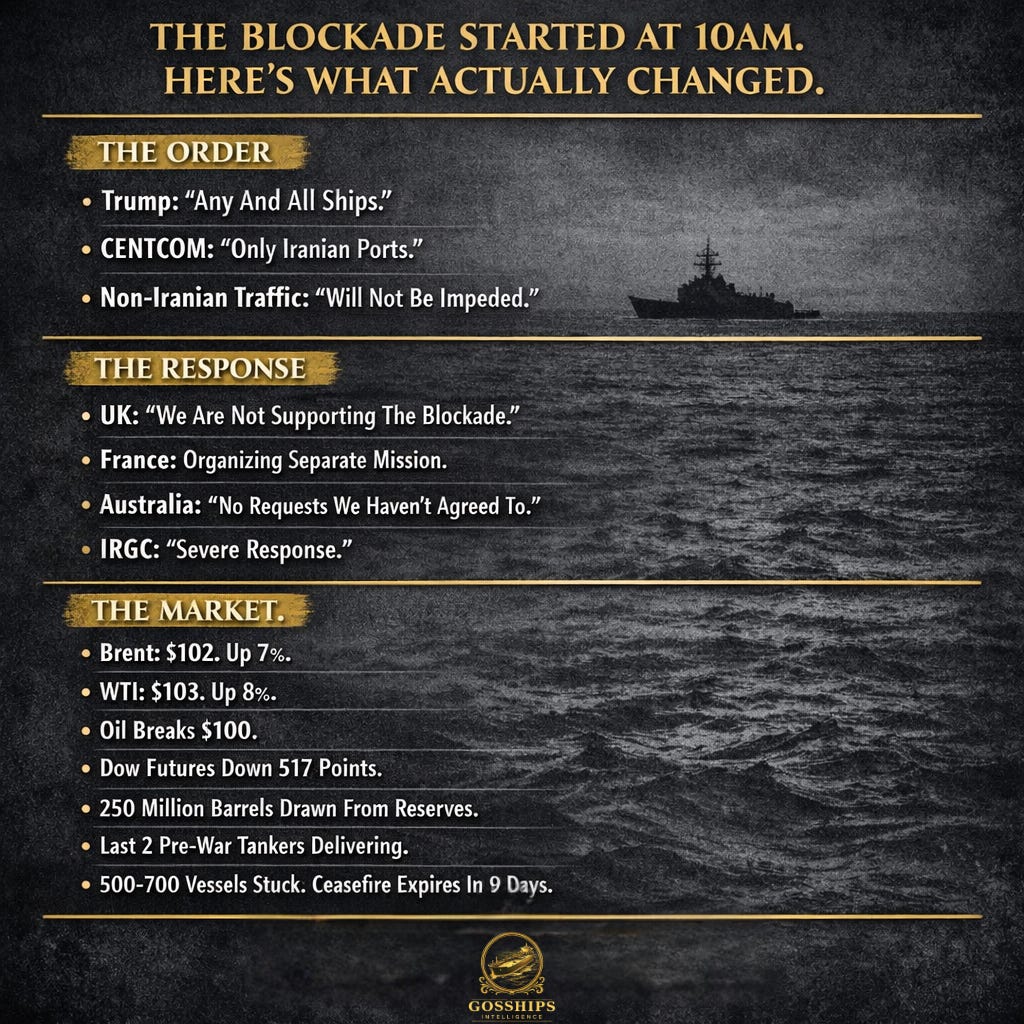
→ 10:00 AM ET: US Blockade Of Iranian Ports Began (CENTCOM Via CNBC)
→ $102: Brent Crude Per Barrel. Up 7% Today. (CNN, AP)
→ $103-$104: WTI Crude Per Barrel. Up 7-8% Today. (CNBC, AP)
→ $100+: Oil Breaks Triple Digits For The First Time Since Early March (CNBC, AP)
→ UK And France Declined The Blockade. Australia Cooperating On Separate Requests.
→ 250 Million: Barrels Drawn From Global Reserves Since War Began (JPMorgan Via CNN)
→ 2: Pre-War Tankers Still On The Water. The Last Ones. (JPMorgan Via CNN)
→ 1.85 Million: Barrels Per Day Iran Exported Through March. Up From Pre-War. (Kpler Via CNN)
→ 500-700: Vessels Still Stuck In The Gulf (Lloyd’s List Via USNI News)
→ 9: Days Until Ceasefire Expires
→ 517: Points Dow Futures Dropped On The News (CNBC)
🔍 Why It Matters
For shipowners, the CENTCOM statement is the only thing that changed
