


|⚓ About Us | 🛢️ Deep Water Reports | 📋 SwiftAction Training |
🏅 Founding Black Gold Membership (*52 Slots Left)
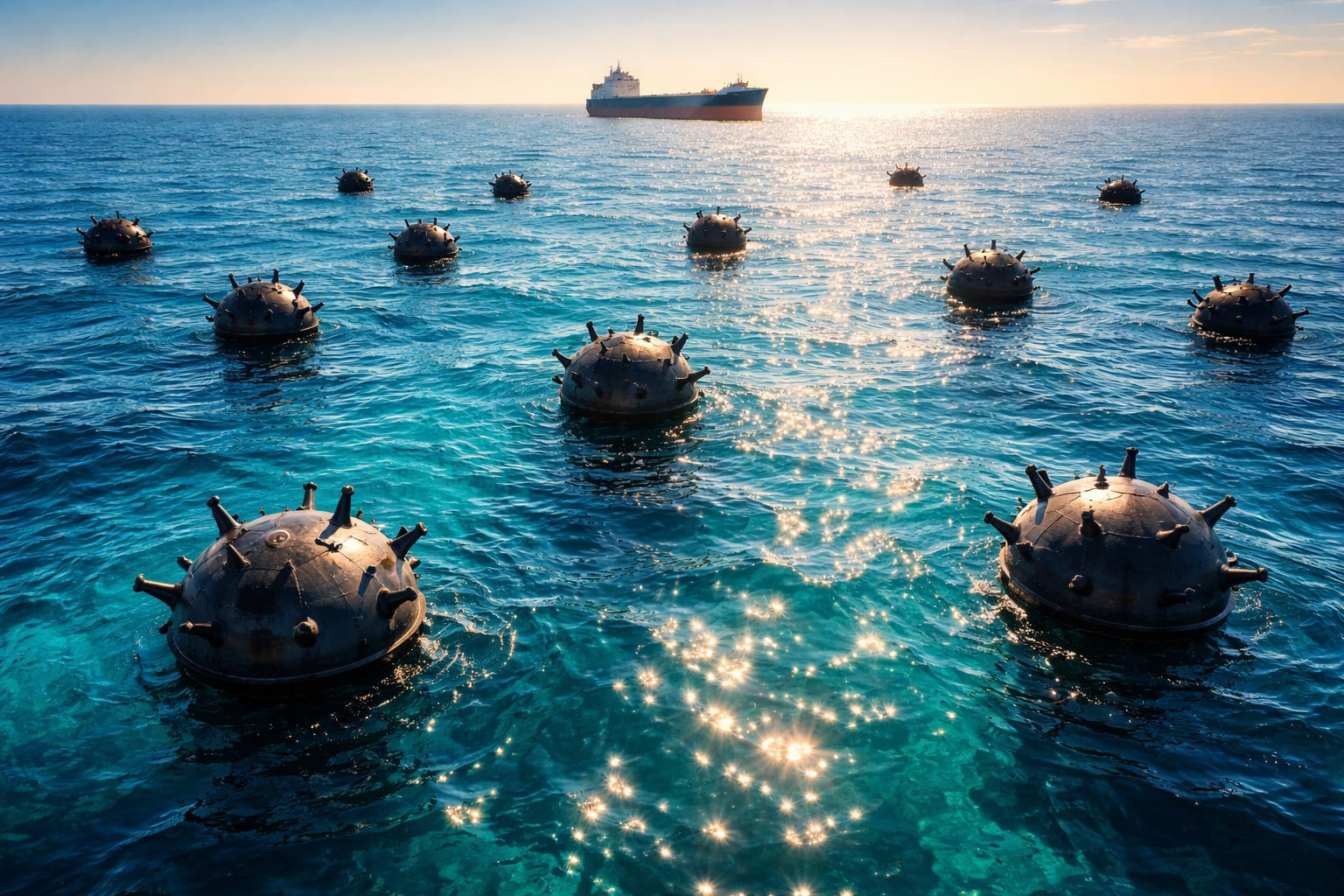
Three days into the ceasefire, the Strait of Hormuz remains at a standstill. On Wednesday, Iran published a chart through semiofficial news agencies ISNA and Tasnim showing a large circle marked “danger zone” over the Traffic Separation Scheme, the standard shipping lanes through the strait, according to the Associated Press. On Thursday, Kpler analysts estimated that safe transit capacity is constrained to a maximum of 10 to 15 passages per day if the ceasefire holds, according to Al Jazeera. Before the war, more than 135 ships crossed daily. On Friday morning, President Trump posted on Truth Social that “Iran is doing a very poor job, dishonorable some would say, of allowing Oil to go through the Strait of Hormuz,” according to Al Jazeera. Seven ships transited on Thursday, according to Kpler via Al Jazeera. Only two oil tankers have transited since the ceasefire began, one of which was Iranian, according to Kpler via CNBC. More than 600 vessels, including 325 tankers, remain stranded in the Gulf, according to Lloyd’s List via Al Jazeera. The ceasefire is three days old. The strait is mined. Iran controls who enters. The US decommissioned its minesweepers last year. And tomorrow, the two sides sit down in Islamabad to negotiate what “open” actually means.
📋 In this issue:
🛢️ The Story
📊 By The Numbers
🔍 Why It Matters
👀 What to Watch
🚨 Gosships Signal
🔔 Not Yet Subscribed? Gosships Intelligence Delivers Oil Shipping Intelligence. Subscribe For Free!
📊 Get The Deep Water Report
→ Global Tanker Market Outlook Q2 2026
📋 Competency-Based Maritime Training
→ SwiftAction
📌 Gosships Data Card
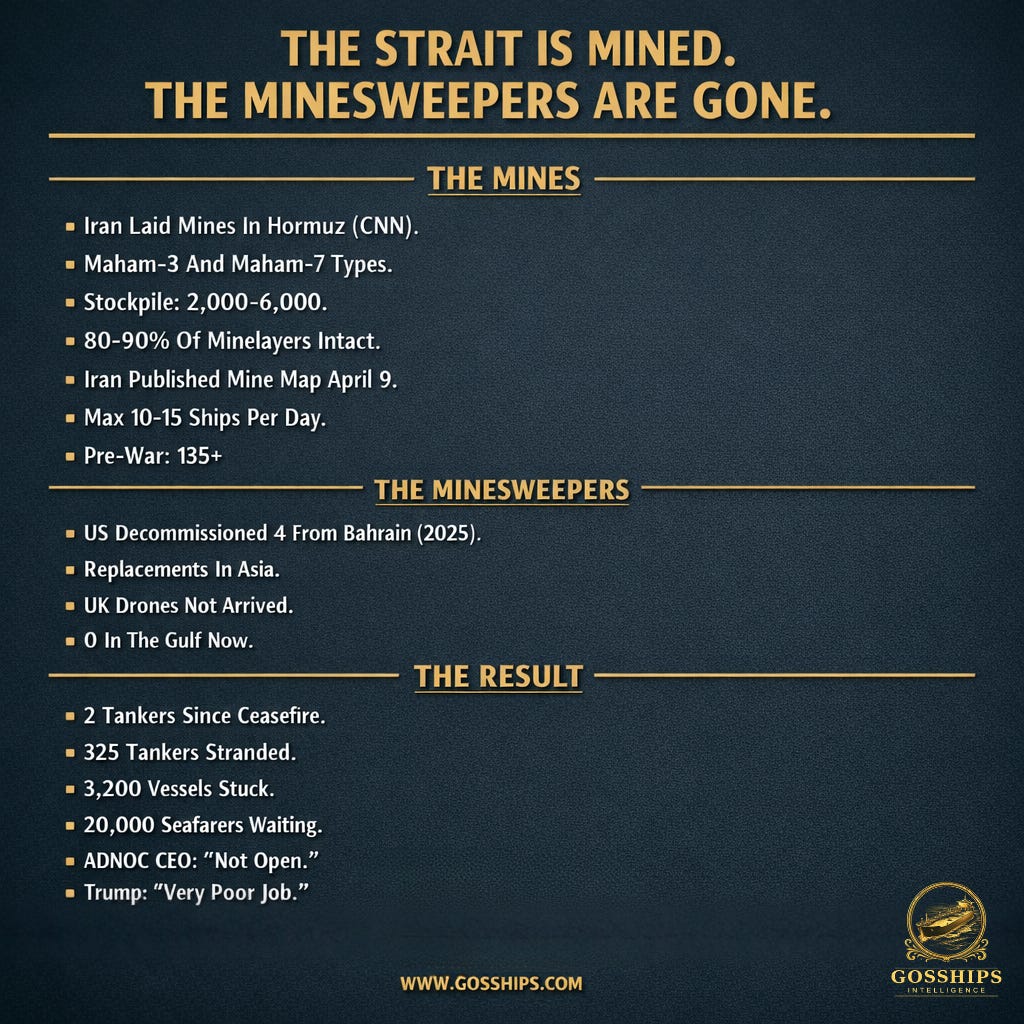
→ April 9: Iran Published Chart Showing “Danger Zone” Over Normal Shipping Lanes (AP)
→ April 10: Kpler Estimates Maximum 10-15 Ships Per Day Can Transit. Pre-War: 135+ (Kpler Via Al Jazeera)
→ April 10: Trump: Iran Doing “A Very Poor Job” Of Opening Hormuz (Truth Social Via Al Jazeera)
→ April 9: Only 2 Oil Tankers Have Transited Since Ceasefire, One Was Iranian (Kpler Via CNBC)
→ April 9: 7 Ships Transited Thursday (Kpler Via Al Jazeera)
→ April 10: 600+ Vessels Including 325 Tankers Stranded In The Gulf (Lloyd’s List Via Al Jazeera)
→ April 10: ~3,200 Vessels With ~20,000 Seafarers Still Stuck West Of Hormuz (Windward)
→ March 2026: Iran Laid “A Few Dozen” Mines In Hormuz, Maham-3 And Maham-7 Types (CNN, CBS News)
→ Iran Mine Stockpile Estimated At 2,000 To 6,000 (CBS News)
→ Late 2025: US Decommissioned All 4 Avenger-Class Minesweepers From Bahrain (19FortyFive, CS Monitor)
→ The 2 LCS Replacements (USS Tulsa, USS Santa Barbara) Are In Asia, Not The Gulf (The War Zone)
→ April 11: Islamabad Negotiations Begin. Vance, Witkoff, Kushner Leading US Side.
🛢️ The Story
The ceasefire says the strait is open. Iran published a map that says part of it is mined. The country that says it will guarantee safe passage decommissioned its minesweepers last year. And three days in, the president himself says Iran is doing “a very poor job.”
Iran began laying mines in the Strait of Hormuz in early March, according to CNN, citing two people familiar with US intelligence reporting. CBS News reported that Iran was using smaller crafts carrying two to three mines each. The mines deployed have been identified by open-source intelligence as Maham-3 and Maham-7, according to Gulf News. The Maham-3 is a moored mine using magnetic and acoustic sensors. The Maham-7 is a seabed mine designed to evade sonar detection. Both are equipped with triggers that allow them to detect and detonate near passing ships, according to Gulf News. CNN reported that Iran still retains 80% to 90% of its small boats and minelayers, meaning it could feasibly lay hundreds more mines. Iran’s total mine stockpile is estimated at 2,000 to 6,000, according to CBS News.
On March 10, US Central Command destroyed 16 Iranian minelayers near the strait, according to CENTCOM via CNBC. But by that point, mines had already been laid. On Wednesday, April 9, Iranian semiofficial news agencies ISNA and Tasnim published a chart of the Strait of Hormuz showing a large “danger zone” marked over the Traffic Separation Scheme, the internationally agreed shipping lanes that vessels have used for decades, according to the Associated Press. The chart directed ships to travel further north through waters closer to Iran’s mainland near Larak Island. The AP reported that the chart suggests the IRGC “put sea mines into the Strait of Hormuz during the war.”
Radio warnings broadcast to vessels in the region instruct captains to seek permission from Iranian naval forces and to follow alternative northerly routes, avoiding “areas of danger” potentially seeded with mines, according to HNGN via Reuters.
On Thursday, Kpler analysts estimated that safe transit capacity is constrained to a maximum of 10 to 15 passages per day if the ceasefire holds, according to Al Jazeera. Before the war, more than 135 ships crossed the strait daily, according to Kpler. That represents a reduction of more than 89% from normal vessel traffic.
The US Navy’s ability to clear the mines is severely limited. In late 2025, the US decommissioned all four Avenger-class minesweepers that were stationed in Bahrain, according to 19FortyFive and the Christian Science Monitor. These were the Navy’s dedicated mine countermeasures vessels for the Gulf. Their replacements, the Independence-class Littoral Combat Ships USS Tulsa and USS Santa Barbara, configured for minesweeping, are currently in Asia, not the Gulf, according to The War Zone via 19FortyFive. The Christian Science Monitor reported that during tests off the California coast, the LCS ships’ unmanned underwater vehicles “often failed to detect mines, or mistakenly ‘saw’ mines that weren’t there.” The UK has agreed to send minesweeping drones to the region, according to The Guardian, but they have not yet arrived.
On Wednesday, Bloomberg reported that three Chinese oil tankers approached the strait as the first real test of the ceasefire for oil traffic. The Cospearl Lake, a VLCC linked to China’s state-owned Cosco Shipping, and He Rong Hai, owned by a smaller entity, were traveling east at near-top speeds before coming to a virtual halt, according to Bloomberg. A third Cosco-linked VLCC, the Yuan Hua Hu, began its eastward journey a few hours later. As of Thursday, they had not completed transit. Shipping companies are “basically waiting until others test” passage, Flexport’s Phil Manders told CNN. “Oil tankers and vessels of Chinese origin will likely test these waters first,” Manders said.
ADNOC CEO Sultan Ahmed Al Jaber said Thursday: “This moment requires clarity. So let’s be clear: the Strait of Hormuz is not open. Access is being restricted, conditioned and controlled. Iran has made clear, through both its statements and actions, that passage is subject to permission, conditions and political leverage. That is not freedom of navigation. That is coercion,” according to CNBC.
Kpler oil analyst Matt Smith told CNBC that just two tankers, one of which was Iranian, have transited the waterway since the ceasefire was announced. S&P Global Market Intelligence reported nine vessels total across Wednesday and Thursday, according to NBC News. More than 600 vessels, including 325 tankers, remain stranded in the Gulf, according to Lloyd’s List via Al Jazeera. Windward reported that approximately 3,200 vessels with approximately 20,000 seafarers remain west of Hormuz, including nearly 800 tankers and cargo ships.
White House economic advisor Kevin Hassett told Fox Business on Thursday that getting “one of those big tankers through” would be “a huge chunk of what’s missing” because “that’s 2 million barrels,” according to CNBC. Kpler’s Amena Bakr noted that since the war began, “hundreds of millions of barrels have been taken off the market due to an inability to be shipped out of the Persian Gulf,” according to CNBC.
On Friday morning, Trump posted on Truth Social: “Iran is doing a very poor job, dishonorable some would say, of allowing Oil to go through the Strait of Hormuz,” according to Al Jazeera. Brent crude stood at $96.39 as of early Friday, according to Al Jazeera.
Related Coverage:
The Ceasefire Arrived. The Strait Didn’t Open. Then Iran Hit The Pipeline.
Hormuz Is More Than 90% Closed. Iran’s Parliament Speaker Just Threatened to Close the Bab El-Mandeb. If Both Chokepoints Shut, the Only Alternative Route Disappears. There Is No Third Option.
Goldman Sachs Just Called This “The Largest Supply Shock in the History of the Global Crude Market.”
Hapag-Lloyd, the fifth-largest shipping company in the world, has six container ships trapped in the strait and is “currently refraining” from transiting, according to CNBC. “Returning to normal for our industry is weeks away,” Hapag-Lloyd communications chief Nils Haupt told CNBC. Maersk said the ceasefire “does not yet provide full maritime certainty,” according to CNBC. An oil industry source told CNN: “You also must have a willingness of empty tankers to come back in through the strait, refill and then go back out. That whole process takes several days.”
Analysts say recovery will take months, not weeks. Lale Akoner, a global market analyst at eToro, told CNN it could take six months to normalize traffic. Nikos Petrakakos, managing director at maritime investment manager Tufton, told CNBC: “In the Red Sea with the Houthis, the ceasefire agreement was last January and traffic has not returned.” Jennifer Parker, writing in The Conversation, stated: “Shipping will return to the Strait of Hormuz not when it is declared open, but when it is assessed to be safe enough.”
What the mines, the missing minesweepers, the 10-to-15-ship transit constraint, and the Islamabad negotiations mean for every shipowner with a vessel west of Hormuz, is below.
📊 By The Numbers
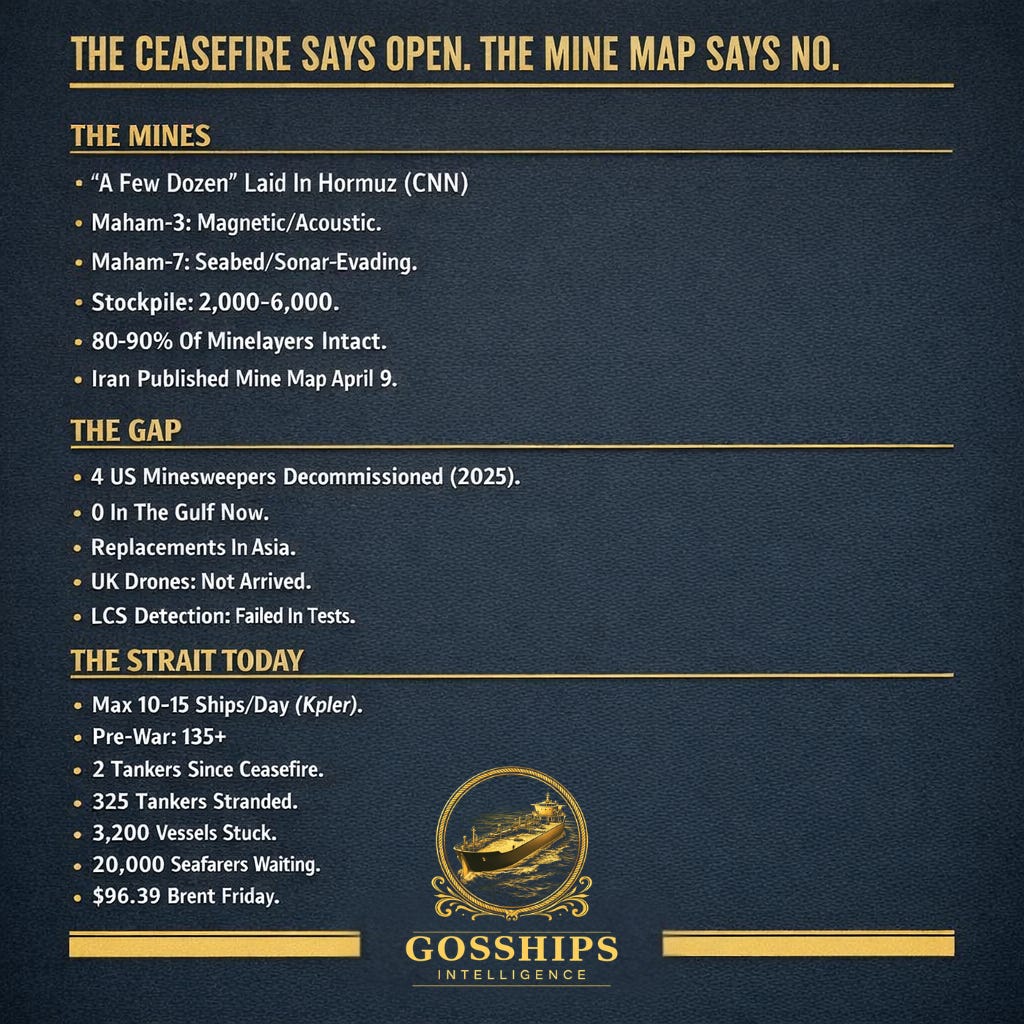
→ “A Few Dozen”: Mines Laid In Hormuz By Iran (CNN)
→ Maham-3, Maham-7: Mine Types Deployed, Magnetic/Acoustic And Seabed (Gulf News)
→ 2,000-6,000: Iran’s Estimated Total Mine Stockpile (CBS News)
→ 80-90%: Iran’s Small Boats And Minelayers Still Intact (CNN)
→ 16: Iranian Minelayers Destroyed By US On March 10 (CENTCOM Via CNBC)
→ 4: Avenger-Class Minesweepers Decommissioned From Bahrain In Late 2025 (19FortyFive, CS Monitor)
→ 0: US Dedicated Minesweepers Currently In The Gulf (19FortyFive, The War Zone)
→ 10-15: Maximum Estimated Daily Ship Transits Under Current Conditions (Kpler Via Al Jazeera)
→ 135+: Ships Per Day Through Hormuz Pre-War (Kpler)
→ 2: Oil Tankers Transited Since Ceasefire, One Was Iranian (Kpler Via CNBC)
→ 7: Ships Transited Thursday (Kpler Via Al Jazeera)
→ 325: Tankers Stranded In The Gulf (Lloyd’s List Via Al Jazeera)
→ ~3,200: Vessels Still Stuck West Of Hormuz (Windward)
→ ~20,000: Seafarers Awaiting Evacuation (Windward, IMO)
→ $96.39: Brent Crude Friday Morning (Al Jazeera)
→ 6 Months: Estimated Time To Normalize Traffic (eToro Via CNN)
🔍 Why It Matters
The mines change everything. A ceasefire can be negotiated. Insurance can be restored. Tolls can be debated. But mines in the water are a physical
