


|⚓ About Us | 🛢️ Deep Water Reports | 📋 SwiftAction Training |
🏅 Founding Black Gold Membership (*52 Slots Left)

On Friday, April 3, Mohammad Bagher Ghalibaf, speaker of the Iranian parliament, posted two questions on X: “What share of global oil, LNG, wheat, rice, and fertilizer shipments transits the Bab-el-Mandeb Strait?” and “Which countries and companies account for the highest transit volumes through the strait?” according to NBC News. The questions were rhetorical. The threat was not. The Strait of Hormuz, which carried 20 million barrels of oil per day before the war, is more than 90% closed, with only 12 vessels transiting on April 2 versus approximately 138 pre-war, according to JMIC and UANI data. The Bab el-Mandeb, which carried approximately 4.2 million barrels per day in 2025 according to the IEA via The Conversation, is the route Saudi Arabia is using to bypass the closed Hormuz. If both chokepoints close, the workaround for the first crisis runs directly through the second crisis. And there is no third option.
📋 In this issue:
🛢️ The Story
📊 By The Numbers
🔍 Why It Matters
👀 What to Watch
🚨 Gosships Signal
📊 Get The Deep Water Report
→ Global Tanker Market Outlook Q2 2026
📋 Competency-Based Maritime Training
→ SwiftAction
📌 Gosships Data Card
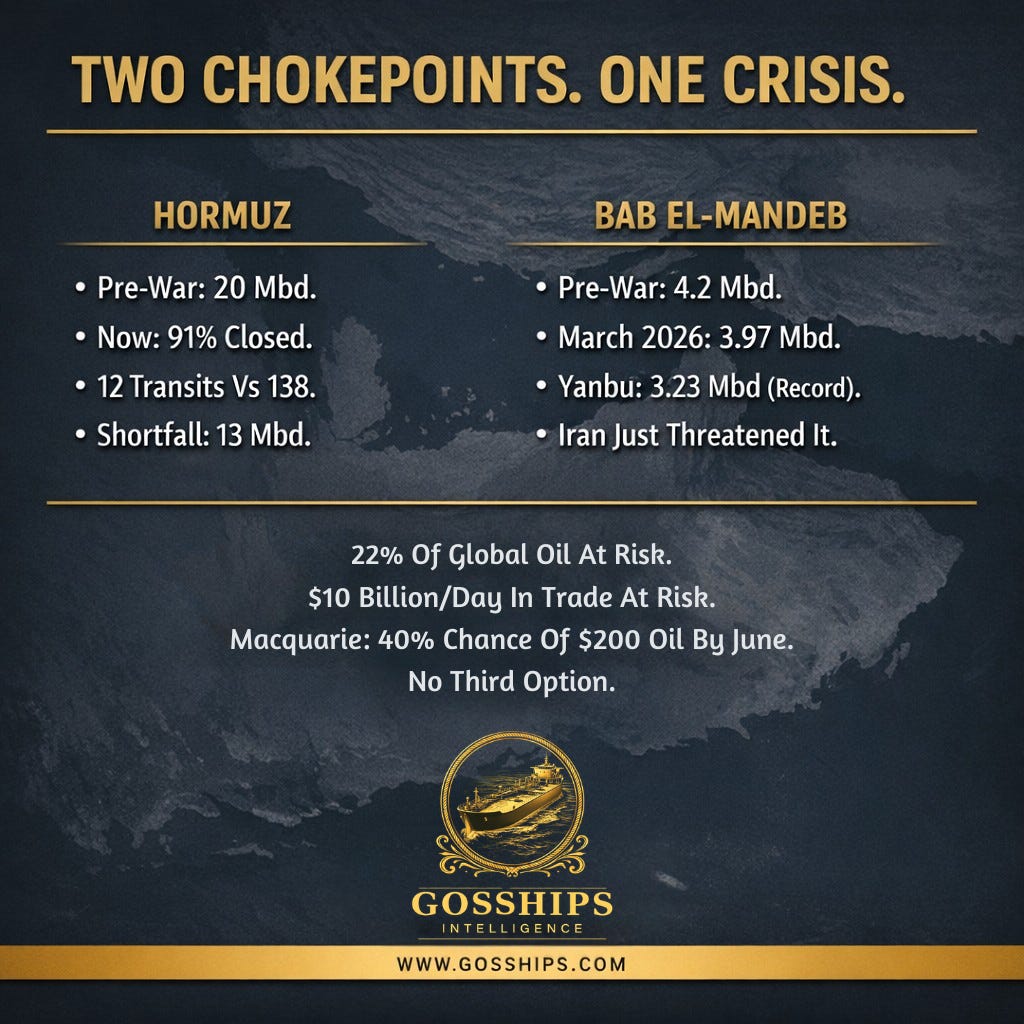
→ Strait Of Hormuz Pre-War: ~20 Million Barrels Per Day, ~20% Of Global Oil (EIA)
→ Strait Of Hormuz Now: More Than 90% Closed, 12 Transits Vs. 138 Pre-War (JMIC/UANI)
→ Bab El-Mandeb Pre-War: ~4.2 Million Barrels Per Day, ~5% Of Global Oil (IEA Via The Conversation)
→ Bab El-Mandeb March 2026: 3.97 Mbd Transited, Highest Since October 2023 (Kpler)
→ Yanbu Loadings March 2026: 3.23 Mbd, Highest On Record. Pre-War: 750-850 Kbd (Kpler)
→ East-West Pipeline: 5 Mbd Normal Capacity, Temporarily Expanded To 7 Mbd In 2019 (EIA)
→ Russian Crude Via Bab El-Mandeb: ~1.9 Mbd (Kpler)
→ World Already Short ~13 Mbd From Hormuz Closure (Kpler Via ABC News)
→ Combined Trade At Risk If Both Close: ~$10 Billion Per Day (Middle East Insider)
→ Macquarie: 40% Chance Oil Hits $200 By June (CBS News)
🛢️ The Story
The Strait of Hormuz and the Bab el-Mandeb are not two separate crises. They are one system. Understanding why requires understanding the geography.
The Strait of Hormuz sits at the mouth of the Persian Gulf, between Iran and Oman. Before the war, approximately 20 million barrels of oil per day transited the strait, roughly 20% of global petroleum liquids consumption, according to the U.S. Energy Information Administration. Approximately 84% of that crude went to Asian markets, with China, India, Japan, and South Korea as the top destinations, according to the EIA. The strait also carried over 20% of global LNG trade, primarily from Qatar, according to the EIA.
Iran effectively closed Hormuz on March 1. Traffic has collapsed more than 90%. Only 12 vessels transited on April 2, according to JMIC and UANI. Lloyd’s List tracked 33 transits via Iran’s Larak Island toll corridor in the second half of March, but zero transits through the normal southern route, according to CBS News. The world is currently short approximately 13 million barrels per day that once flowed through Hormuz, according to Kpler’s lead oil analyst Matt Smith via ABC News.
Saudi Arabia’s response was the East-West pipeline. The 1,200-kilometer Petroline runs from the Abqaiq oil processing center near the Persian Gulf to the port of Yanbu on the Red Sea. The pipeline has a normal capacity of 5 million barrels per day, according to the EIA. Saudi Aramco temporarily expanded the pipeline’s capacity to 7 million barrels per day in 2019 by converting some natural gas liquids pipelines to accept crude oil, according to the EIA. In March 2026, Yanbu loaded 3.23 million barrels per day of crude, the highest level on record and roughly four times its pre-war average of 750 to 850 thousand barrels per day, according to Kpler. The UAE also operates a 1.5 to 1.8 million barrel per day pipeline from Habshan to the port of Fujairah on the Gulf of Oman, bypassing Hormuz, according to Al Jazeera. Fujairah exports averaged 1.62 million barrels per day in March, up from 1.17 million in February, according to Kpler via Al Jazeera.
These pipelines are the world’s only workaround. And both exit points face threats.
The Bab el-Mandeb Strait sits on the opposite side of the Arabian Peninsula from Hormuz, between Yemen on the Arabian Peninsula and Djibouti and Eritrea on the Horn of Africa. It is 30 kilometers wide at its narrowest point, according to The Conversation. In 2025, approximately 4.2 million barrels of crude oil and petroleum liquids crossed the strait per day, roughly 5% of global production, according to the IEA via The Conversation. In March 2026, Kpler recorded 3.97 million barrels per day transiting the strait, the highest since October 2023, driven by the surge in Yanbu loadings. Of this, 1.75 million barrels per day was loaded at Yanbu and 1.79 million barrels per day was Russian crude bound for Asia, according to Kpler.
The Bab el-Mandeb is the southern gateway to the Red Sea. Every barrel loaded at Yanbu that is bound for Asia must pass through it. Every LNG cargo from Qatar that was rerouted through the Red Sea must pass through it. The strait is not an alternative to Hormuz. It is the exit ramp from the alternative to Hormuz.
On March 28, the Houthis entered the war, launching ballistic missiles at Israel for the first time since the conflict began, according to Kpler and The Conversation. Bloomberg reported that Iran is pushing the Houthis to prepare for a renewed campaign against Red Sea shipping. An unnamed Houthi leader told Reuters that the group remains “fully militarily ready with all options,” according to Al Jazeera. Iran’s semiofficial Tasnim news agency quoted an unnamed Iranian military source saying Iran could open a new front in the Bab el-Mandeb if attacks are carried out on Iranian territory, according to Al Jazeera.
The Houthis have proven they can disrupt the strait. In late 2023 and 2024, Houthi attacks on commercial shipping forced major container lines to reroute around the Cape of Good Hope, adding approximately 15 days to transit times from the Arabian Sea to Europe, according to the EIA. Houthi capabilities have expanded since then. They now possess Iranian-supplied anti-ship ballistic missiles with 200-kilometer range, sea-skimming cruise missiles, and one-way attack drones, according to the Middle East Insider. Traffic through the Bab el-Mandeb dropped from 9.3 million barrels per day in 2023 to approximately 4.1 million in 2024 after the initial Houthi campaign, according to the EIA via Anadolu Agency. The Houthis proved in 2024 that they can severely disrupt the strait, cutting traffic by more than half.
Related Coverage:
Goldman Sachs Just Called This “The Largest Supply Shock in the History of the Global Crude Market.”
MSC × Sinokor: 40% of the World’s Available Supertankers. $3.3 Billion. Zero Antitrust Investigations. Now It’s Official.
Iran Built a Toll Booth on the Strait of Hormuz. The IRGC Is Charging $2 Million Per Ship.
Now do the math nobody is doing publicly.
Hormuz carried 20 million barrels per day. The world has recovered approximately 7 million barrels per day through pipelines, strategic reserves, and the Larak toll corridor, leaving a shortfall of approximately 13 million barrels per day, according to Kpler via ABC News. Of the 7 million barrels recovered, the single largest source is Yanbu, which loaded 3.23 million barrels per day in March, according to Kpler. Every Yanbu barrel bound for Asia transits the Bab el-Mandeb.
If the Houthis close the Bab el-Mandeb, those 3.23 million barrels per day either stop moving or reroute around the Cape of Good Hope, adding approximately 50 days to Middle East to East Asia voyage times, more than double the current transit, according to Kpler. The 1.9 million barrels per day of Russian crude also transiting the strait would face the same choice. The approximately 7 million barrels per day of partial recovery from the Hormuz closure collapses to roughly 2 to 3 million barrels per day, all flowing through the UAE’s Fujairah pipeline and whatever trickles through Hormuz via the Larak toll corridor.
The world would then be short approximately 17 to 18 million barrels per day of its pre-war supply from the region. That is not an oil crisis. That is the removal of approximately 17% of global oil supply with no replacement available at any price in any timeframe measured in weeks.
If both Yanbu and Fujairah were compromised, moving oil out of the Arabian Peninsula would become “virtually impossible,” according to energy analyst Ben Smith, as quoted by ABC News. Analysts at Macquarie are warning of a 40% chance that oil could hit $200 per barrel by June if both chokepoints are disrupted, according to CBS News. JPMorgan analysts estimate that problems with Bab el-Mandeb passage alone could add $20 per barrel to oil prices, according to ABC News.
The combined trade at risk if both straits close simultaneously is estimated at approximately $10 billion per day, according to the Middle East Insider. Approximately 30% of global container shipping would be blocked from normal routing, according to the Middle East Insider. Approximately 22% of global oil supply would face transit disruption when combining Hormuz’s roughly 20% and Bab el-Mandeb’s roughly 5%, with some overlap for Gulf producers routing through both, according to the Middle East Insider.
The Federal Reserve Bank of Dallas published research in March 2026 warning that “a complete cessation of oil exports from the Gulf region amounts to removing close to 20 percent of global oil supplies from the market, about 80 percent of which is shipped to Asia,” according to the Dallas Fed. The Dallas Fed noted that Yanbu is “within range of both Iranian and Houthi missiles from Yemen, as are the waterways in the Red Sea.”
What the dual chokepoint scenario means for VLCC rates, for gas prices, for the countries that run out of oil first, and for the tanker operators who will be asked to move through both straits, is below.
📊 By The Numbers
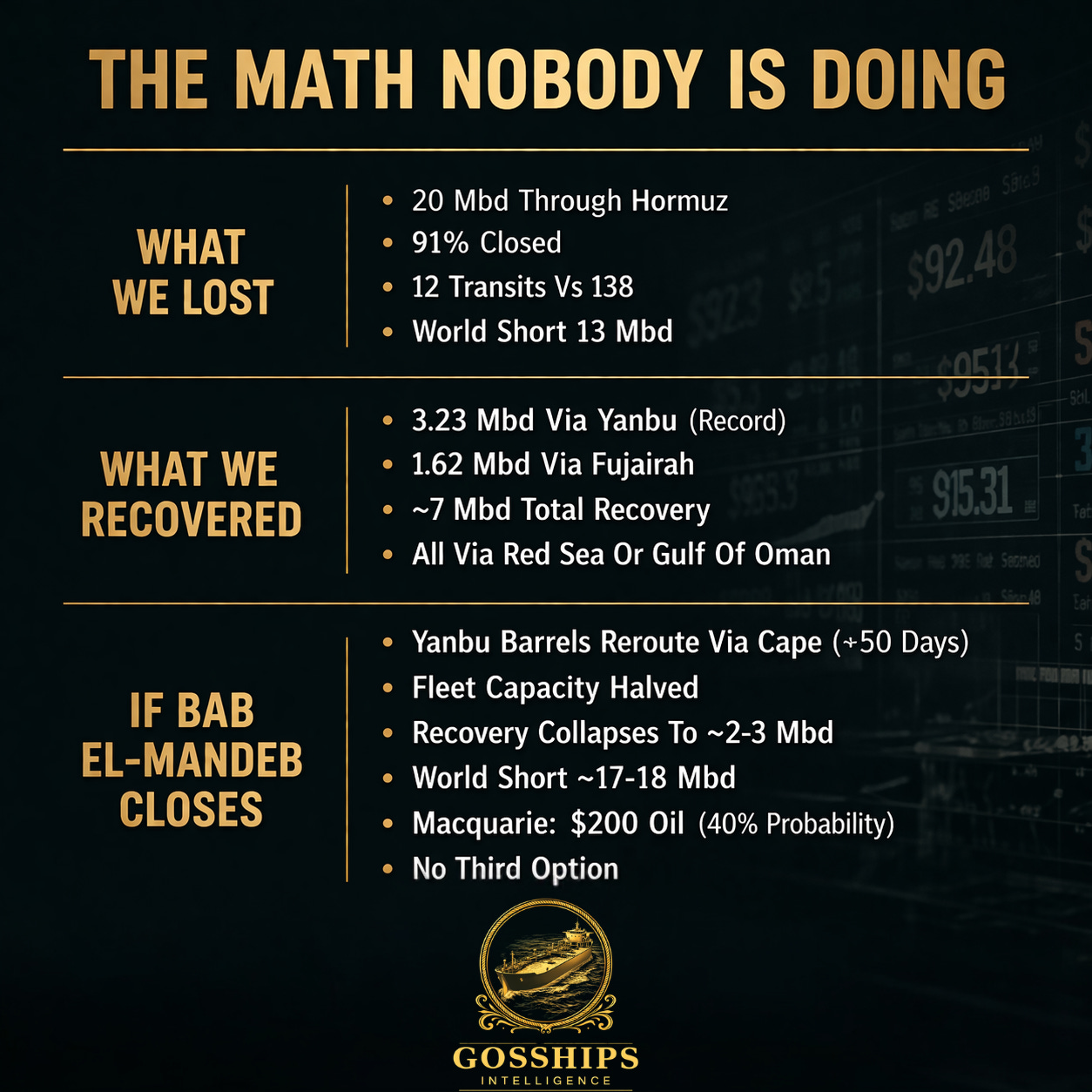
→ 20 Mbd: Pre-War Hormuz Oil Flow (EIA)
→ 4.2 Mbd: Pre-War Bab El-Mandeb Oil Flow (IEA Via The Conversation)
→ 91%: Hormuz Traffic Collapse, 12 Transits Vs. 138 Pre-War (JMIC/UANI)
→ 13 Mbd: Current Shortfall From Hormuz Closure Alone (Kpler Via ABC News)
→ 3.23 Mbd: Yanbu Loadings March 2026, Highest On Record (Kpler)
→ 1.9 Mbd: Russian Crude Transiting Bab El-Mandeb (Kpler)
→ 50 Days: MEG-Asia Voyage If Bab El-Mandeb Closes And Ships Reroute Via Cape (Kpler)
→ $10 Billion/Day: Combined Trade At Risk (Middle East Insider)
→ $200/Barrel: Macquarie Warning, 40% Probability By June (CBS News)
→ $20/Barrel: JPMorgan Estimated Price Impact Of Bab El-Mandeb Disruption Alone (ABC News)
→ 22%: Global Oil Supply At Risk From Dual Closure (Middle East Insider)
🔍 Why It Matters
The dual chokepoint scenario is not theoretical. One chokepoint is already
