


⚓ Gosships Intelligence
Gosships Intelligence Is Published At Gosships.com
For Sponsorship And Partnership Inquiries Contact intelligence@gosships.com
|⚓ About Us | 🛢️ Exclusive Report | 📋 SwiftAction Training |
🏅Black Gold Membership (*53 Slots Left)
Bahri reported first half profit attributable to shareholders of SAR 4.896 billion, about $1.306 billion at the riyal peg, up 421 percent. Note 17 of the same filing shows where the money came from. Revenue from Saudi Aramco and its subsidiaries was SAR 7.800 billion, about $2.080 billion, which is 69.21 percent of everything the company earned.
A year earlier that share was 46.54 percent.
Aramco is also, through Saudi Aramco Development Company, a 20 percent shareholder in Bahri. The Public Investment Fund holds another 22.55 percent. Bahri’s own related party note lists Aramco under the heading “shareholder” and states that “PIF and Aramco exercise significant influence over the Group.”
So the customer is the owner, and this year the customer paid more than three and a half times what it paid last year.
Now set that against what the Kingdom actually shipped. Saudi crude exports fell to 3.434 million barrels a day in May, a record low in data going back to 2002, and were still only 3.993 million in June against 7.100 million in October 2025. Aramco’s own liquids production fell 27.8 percent year on year in the second quarter.
Less oil left the country than at any point in the series. The fleet that carries it had the best six months in its history.
📋 In This Issue:
⚖️ The Story:
What Note 17 discloses, how a record was made on collapsing volumes, why all 49 VLCCs were exposed to it, what the company calls the war in its own filing and where the oil now leaves from.
📊 By The Numbers:
The shareholder, the profit, the volumes, the margin, the subsidy that fell and the dividend that was not declared.
🔍 Why It Matters:
What changes for the VLCC owner, the charterer, the underwriter and the equity investor.
👀 What To Watch:
The five markers that will show whether this is a rate cycle or a permanent rerouting.
🚨 Gosships Signal:
What it means when a state pays itself freight.
🔔 Not A Member? Unlock The Full Analysis, Data Cards, Archive, & More!
📊 Order Our Exclusive Report
→ Global Tanker Market Outlook Q3 2026 Edition
📋 Competency-Based Maritime Training
→ SwiftAction
🔗 Related Coverage


📌 Gosships Data Card
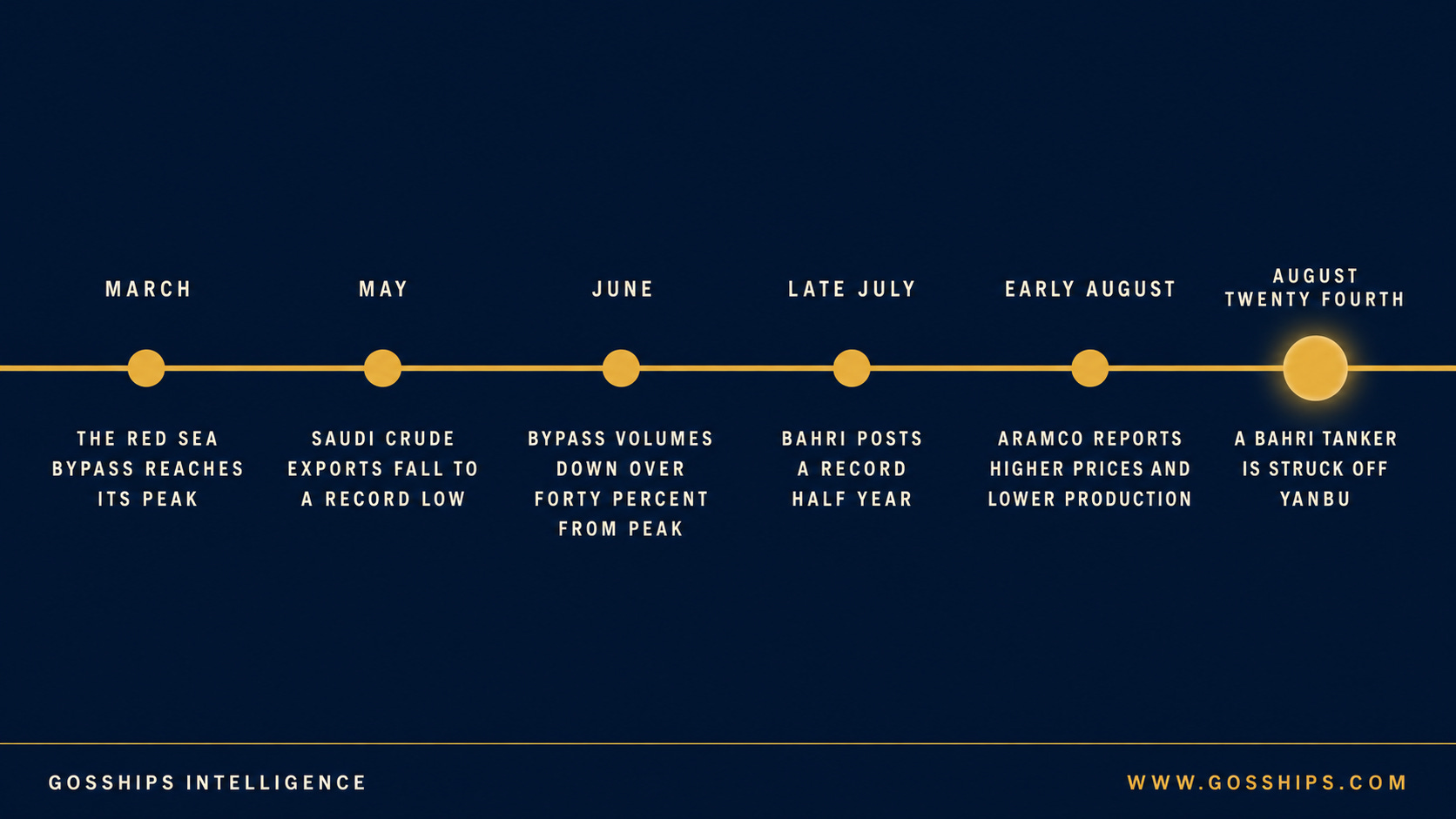
March 2026: Saudi Arabia routes crude to the Red Sea after Hormuz shuts. Wood Mackenzie vessel tracking puts the peak at about 4.07 million barrels a day, with 86.7 percent of Saudi liftings leaving from Yanbu (Wood Mackenzie, July 24, 2026).
May 2026: Saudi crude exports fall for a third straight month to 3.434 million barrels a day, the lowest in a series that begins in 2002 (Joint Organizations Data Initiative via Reuters, July 21, 2026).
June 2026: The Red Sea bypass is down to about 2.39 million barrels a day, a 41 percent fall from the March peak, and 98.6 percent of Saudi liftings now leave from Yanbu. Exports recover slightly to 3.993 million barrels a day (Wood Mackenzie, July 24, 2026; JODI via Reuters, August 20, 2026).
July 28 and 29, 2026: Bahri authorizes and then releases interim statements showing first half profit attributable to shareholders of SAR 4.896 billion, up 421 percent, on revenue of SAR 11.270 billion. Note 1 records that the geopolitical situation has “a positive impact” on the accounts. No interim dividend is declared (Bahri interim condensed consolidated financial statements and results release, July 2026).
August 3, 2026: Aramco reports first half net income of $65.229 billion and a second quarter average realized crude price of $108.1 a barrel against $66.7 a year earlier, with liquids production down 27.8 percent. It declares a base dividend of SAR 0.3393 a share and no performance linked dividend (Saudi Aramco second quarter and half year interim report 2026, August 4, 2026).
August 24, 2026: The Bahri VLCC Amzan is struck by a projectile about 63 nautical miles west of Yanbu and a fire breaks out on the main deck. All crew are safe. Houthi military spokesman Yahya Saree claims the attack (UKMTO via Splash247 and gCaptain, August 24 and 25, 2026; Al Jazeera, August 24, 2026).
Sources: The National Shipping Company of Saudi Arabia interim condensed consolidated financial statements for the three and six month periods ended June 30, 2026, reviewed by Ernst and Young and authorized July 28, 2026; Bahri second quarter 2026 results release, July 29, 2026; Bahri consolidated financial statements for the year ended December 31, 2025; Bahri corporate website, fleet and about us pages; Saudi Aramco second quarter and half year interim report 2026, August 4, 2026; Joint Organizations Data Initiative via Reuters, July 21 and August 20, 2026, and via Argaam, December 18, 2025; Wood Mackenzie, July 24, 2026; Splash247, January 21 and August 25, 2026; Argus Media, February 19, 2026; gCaptain, August 24, 2026; Al Jazeera, August 24, 2026; The National, July 17, 2026; Frontline plc second quarter and six months 2026 results, August 28, 2026.
⚖️ The Story
What Note 17 Actually Says
Start with the related party note, because it is the part of this filing nobody has opened.
Bahri reports revenue from “ARAMCO and its subsidiaries” of SAR 7.800 billion for the six months to June 30, against SAR 2.154 billion a year earlier. In dollars at the riyal peg that is $2.080 billion against $574 million, a rise of 262.1 percent. Group revenue over the same period was SAR 11.270 billion.
So one customer supplied 69.21 percent of everything the company earned. A year ago the same customer supplied 46.54 percent.
The note describes that customer in its own heading. Aramco appears under “shareholder,” and the text reads: “The Group’s majority shareholder, PIF and Aramco, are fully/majorly owned by the Government of the Kingdom of Saudi Arabia. PIF and Aramco exercise significant influence over the Group.”
The shareholdings are public and precise. The Public Investment Fund holds 22.55 percent. Saudi Aramco Development Company, a subsidiary of Aramco rather than Aramco itself, holds 20 percent. Together that is 42.55 percent, a controlling bloc without either holder having a majority alone. The remaining 57.45 percent trades on the Tadawul, so this is a listed company with a state bloc rather than a wholly owned arm of the state.
The commercial link is public too, though the company states it less prominently than the coverage suggests. Bahri's corporate timeline records it as a 2014 milestone, alongside the merger with Vela, in eight words: "Exclusive VLCC carrier for Saudi Aramco CIF sales." That is a dated entry rather than a present tense claim, and nothing on the fleet pages restates it. What the current filing shows is the result rather than the terms: 69.21 percent of group revenue from that one counterparty.
Put those three disclosures together and the mechanism is not complicated. When Aramco sells crude on cost, insurance and freight terms, Aramco pays the freight. It pays that freight to a carrier it part owns, on an exclusive basis, at whatever the market charges. This year the market charged a great deal more.
One number shows the size of the flow rather than any strain in it. Aramco's trade receivable balance owed to Bahri stood at SAR 2.096 billion at June 30, against SAR 977 million at the end of December, a rise of 114.7 percent. Revenue from the same counterparty rose 262.1 percent over the same half, so the balance grew at less than half the rate of the billings behind it. In days it went the right way, from about 75 days of Aramco billings at the end of 2025 to about 49 at June 30, and the Group's provision against trade receivables fell over the period rather than rising.
