


⚓ Gosships Intelligence
Gosships Intelligence Is Published At Gosships.com
For Sponsorship And Partnership Inquiries Contact intelligence@gosships.com
|⚓ About Us | 🛢️ Exclusive Report | 📋 SwiftAction Training |
🏅Black Gold Membership (*53 Slots Left)
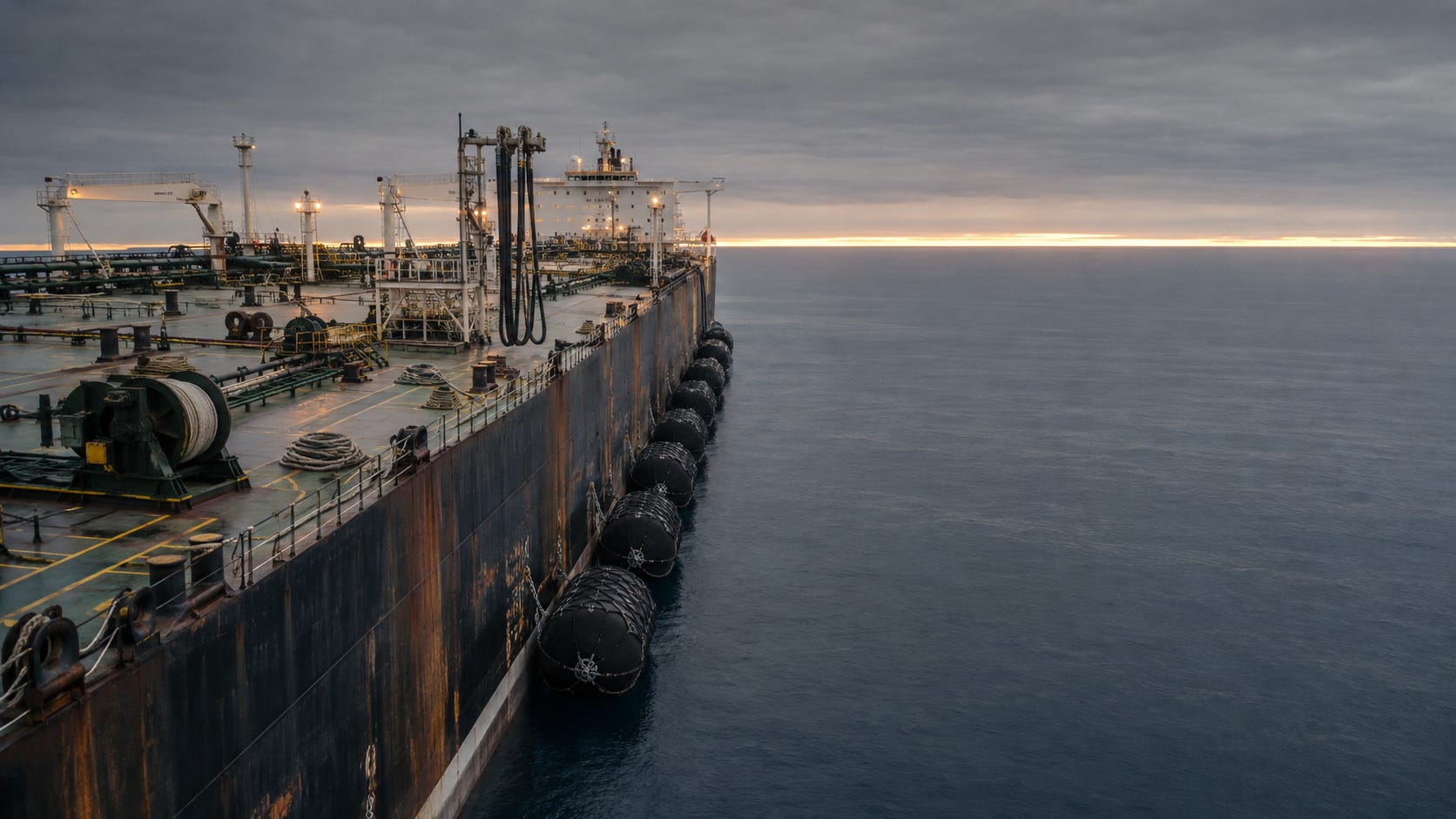
On August 23 the Persian Gulf Strait Authority, the body Iran created on May 5 to run the Strait of Hormuz, posted a blacklist of 45 vessels on X. Reuters reported that Tehran accused the vessels of breaking its rules for crossing the strait, that it may fine or detain them and seize what they carry, and that working a cargo transfer alongside any one of them is itself grounds to be added to the same list.
That last clause is the whole story, and almost nobody has read it properly. It is not a penalty on 45 vessels. It is a penalty that travels by contact.
Understand what it is aimed at. The oil still crosses the strait. It crosses dark, with transponders switched off, on shuttle runs that hand the barrels to larger tankers waiting in the Gulf of Oman. Vortexa puts what moves by ship-to-ship transfer out there at 3.1 million barrels a day since early July, against 5.6 million barrels a day of crude leaving the region altogether. More than half of it is changing hulls at sea.
That is not a workaround any more. It is the market.
Now count what the blacklist reaches into it. Braemar identifies 12 very large crude carriers among the names. Between them they moved about 900,000 barrels a day, which the broker measures at 16 percent of everything loaded inside the Middle East Gulf since the American and Iranian memorandum fell apart in early July. Narrow it to the cargo that then changed hulls beyond the strait and those same 12 account for 750,000 barrels a day, a quarter of it.
The buyers moved first. Reuters reported on August 26, on four people with direct knowledge of the decisions, that at least three Indian refiners and a global energy major intend to stop taking the listed hulls altogether, transfers included.
So Iran did not close the strait this week. It went after the one leg of the voyage it can actually see, and it did it with a rule that spreads.
📋 In This Issue:
⚖️ The Story:
What the blacklist says, the fleet it is aimed at, the clause that makes it spread, who has already refused the vessels and what Iran and Oman signed on the same weekend.
📊 By The Numbers:
The list, the barrels, the share, the transfers, the transits and the corridor.
🔍 Why It Matters:
What changes for the crude charterer, the owner, the underwriter and the refiner.
👀 What To Watch:
The five markers that will show whether the clause is enforced or abandoned.
🚨 Gosships Signal:
What it means when a state stops policing a waterway and starts policing a counterparty.
🔔 Not A Member? Unlock The Full Analysis, Data Cards, Archive, & More!
📊 Order Our Exclusive Report
→ Global Tanker Market Outlook Q3 2026 Edition
📋 Competency-Based Maritime Training
→ SwiftAction
🔗 Related Coverage


📌 Gosships Data Card
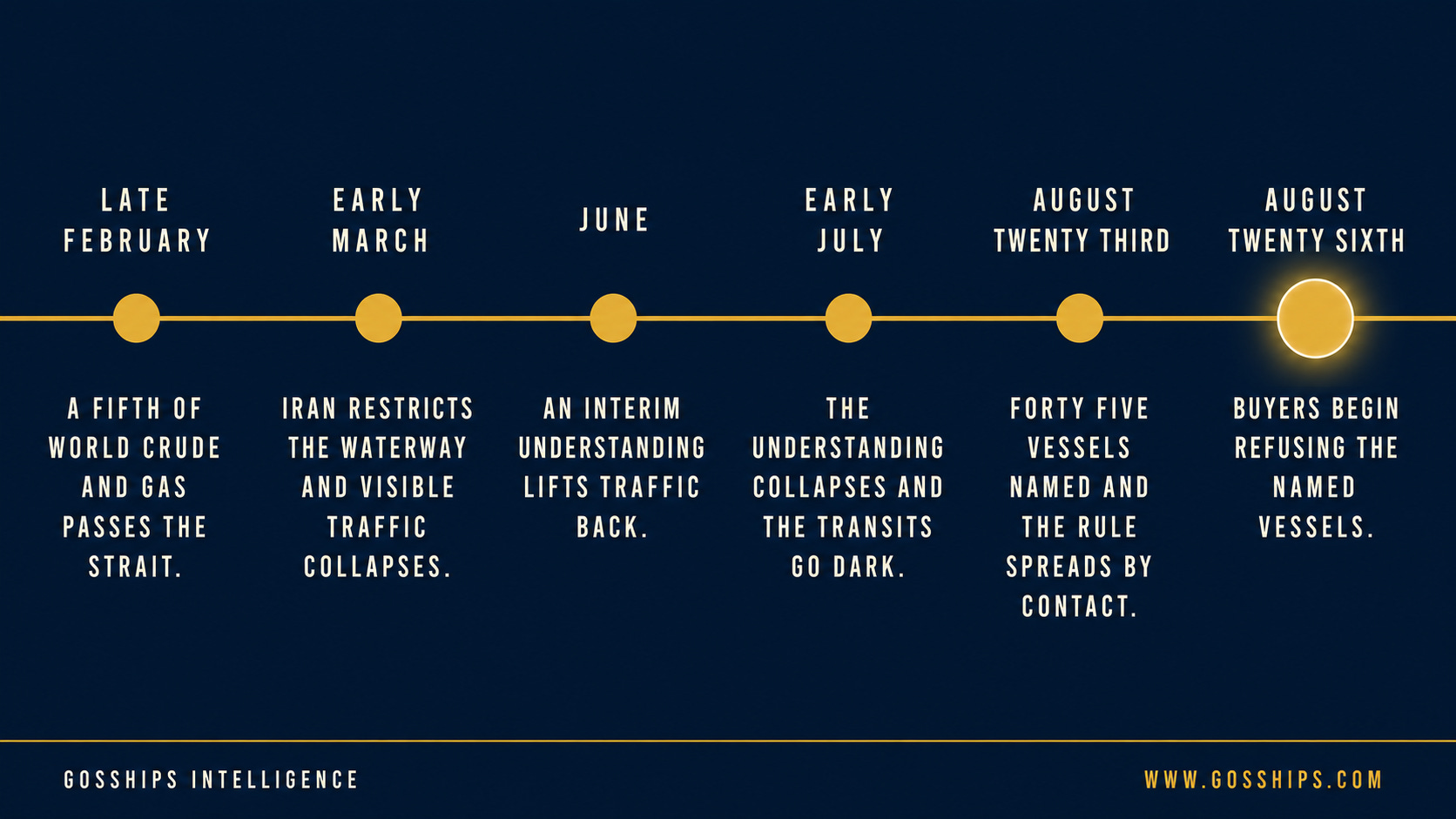
Late February 2026: Close to a fifth of the world’s crude and liquefied natural gas moves through the Strait of Hormuz, on daily traffic of 95 to 130 vessels (Gulf News, August 26, 2026).
Early March 2026: Commodity carrier traffic falls to an average of about 10 transits a day after Iran restricts the waterway (Gulf News, August 26, 2026).
June 2026: Traffic rebounds temporarily to around 36 transits a day during an interim understanding (Gulf News, August 26, 2026).
Early July 2026: The memorandum of understanding between the United States and Iran collapses. Visible traffic settles near 15 transits a day, and Middle East Gulf crude handed to larger tankers by ship-to-ship transfer in the Gulf of Oman averages 3.1 million barrels a day (Gulf News, August 26, 2026; Vortexa via Splash247, August 27, 2026).
August 16, 2026: Fortune reports around 150 vessels of all types floating off the coast of Oman on European Union Sentinel 1 satellite data, against roughly 40 in January, many of them waiting for cargo transfers from hulls crossing Hormuz with transponders turned off. Pankaj Khanna, chief executive officer of Heidmar Maritime Holdings Corp, calls it a dark trade and the only option available right now (Fortune, August 16, 2026).
August 23, 2026: The Persian Gulf Strait Authority posts a blacklist of 45 vessels on X, warning that Tehran may fine or detain them and seize their cargoes, and that working a transfer alongside a listed hull is itself grounds for listing (Reuters via MarineLink, August 24, 2026).
August 26, 2026: Reuters reports, on four people with direct knowledge, that a global energy major and at least three Indian refiners intend to stop taking the listed tonnage, ship-to-ship transfers included. Saudi Aramco and ADNOC both decline to comment, and named tonnage sits in the fleets they own and charter (Reuters via MarineLink, August 26, 2026).
Sources: Reuters via MarineLink, August 24 and August 26, 2026; Braemar via Splash247, August 27, 2026; Vortexa via Splash247, August 27, 2026; TankerTrackers.com via Splash247, August 27, 2026; TankerTrackers.com via Gulf News, August 26, 2026; Kpler via Gulf News, August 26, 2026; Vortexa via Gulf News, August 26, 2026; Fortune, August 16, 2026; Joint Statement between the Sultanate of Oman and the Islamic Republic of Iran, Ministry of Foreign Affairs of Oman, August 25, 2026; Islamic Revolutionary Guard Corps spokesman Hossein Mohebbi via Sepah News, reported by Bloomberg and Insurance Journal, August 26, 2026; Deputy Foreign Minister Kazem Gharibabadi via Al Jazeera, August 26, 2026; Africanews, August 26, 2026.
⚖️ The Story
What The List Actually Says
On August 23 the Persian Gulf Strait Authority published a blacklist of 45 vessels on X. Reuters reported that Tehran accused them of breaking its rules for the passage.
The consequences are specific. Tehran says it may fine these hulls. It may detain them. It may seize what is in their tanks.
Then comes the sentence that matters more than the list. Reuters reported that Tehran can put another vessel on the same list purely for having worked a transfer alongside one already on it.
Read that as an owner would. The exposure is no longer a function of what your vessel did. It is a function of what your vessel touched.
One further point, and Reuters made it plainly. Tehran published the penalty without publishing the rule. What sits on the record is only what it has demanded before, clearance from Iran to make the passage and payment to Iran for security and other services. So the offense for which 45 vessels have been named is not published, and the penalty for it is.
That combination is worth stating precisely, because it is the part an owner cannot plan around. An unpublished rule with a published punishment is not a regulation. It is a discretion.
The Fleet It Is Aimed At
To see what the list is reaching for, start with the two numbers that appear to contradict each other.
