


⚓ Gosships Intelligence
Gosships Intelligence Is Published At Gosships.com
For Sponsorship And Partnership Inquiries Contact intelligence@gosships.com
|⚓ About Us | 🛢️ Exclusive Report | 📋 SwiftAction Training |
🏅Black Gold Membership (*53 Slots Left)
President Donald Trump announced on Truth Social that the United States had secured “majority U.S. control of more than 65 BILLION BARRELS of proven Oil Reserves in Venezuela.” For a day the announcement carried no rate at all. Then Venezuela’s interim president, Delcy Rodríguez, went on state television on Saturday night and supplied one: “a production target of more than 1.5 million barrels per day.”
That number is the most useful thing either government has said all week, and not in the way Caracas intended.
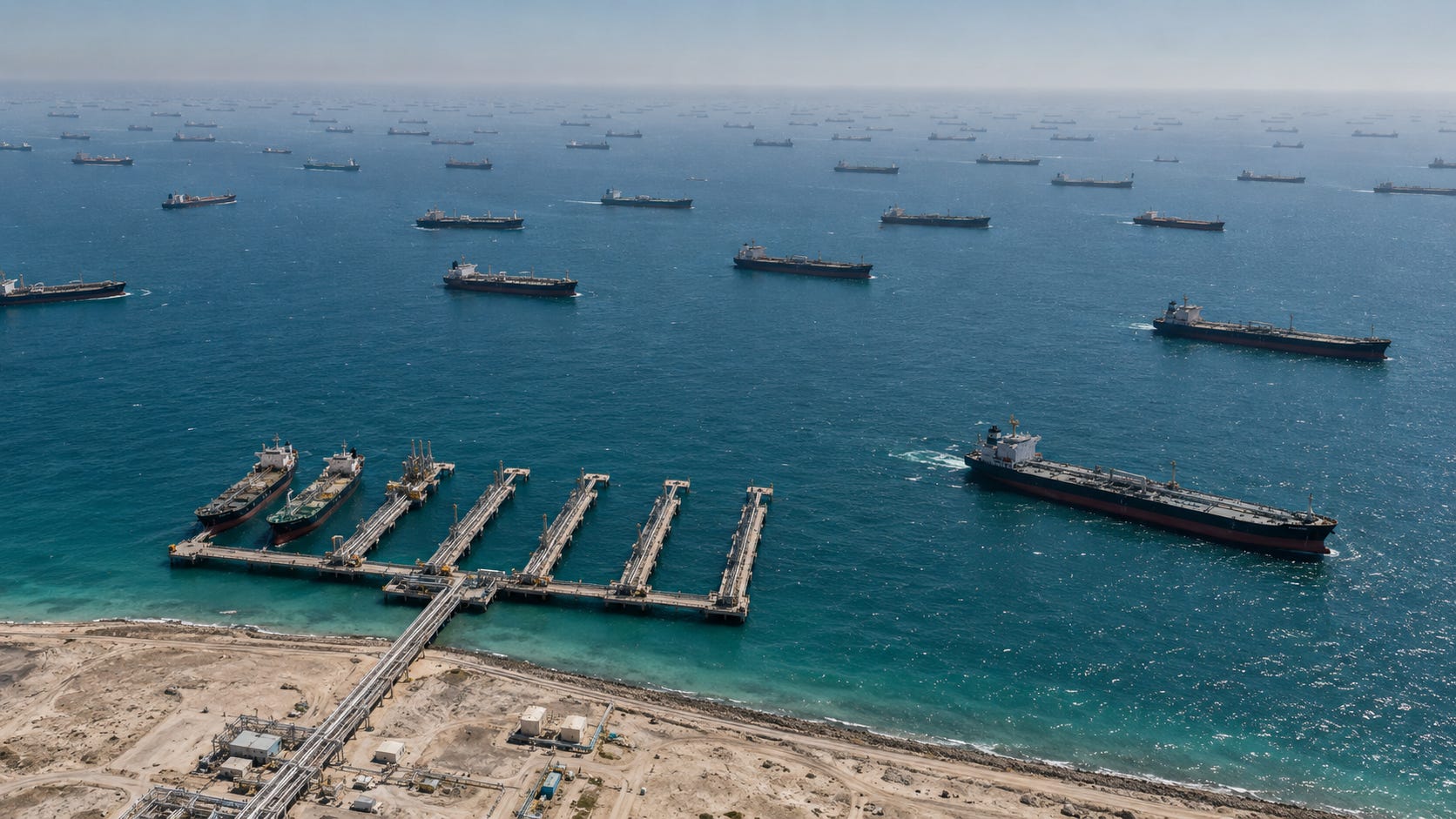
Venezuela has not exported more than 1.25 million barrels a day in any month this year. Reuters reported on August 21 that tankers were waiting up to 30 days to load, and that Venezuela’s terminals were imposing what it called a de facto export cap. The target sits 250,000 barrels a day above that ceiling.
Then there is the second number in the same address, which nobody has set against the first. Reuters reports the $209 billion in state revenue was calculated on a benchmark price of $65 a barrel. At the $19 a barrel Rodríguez says reaches the state, that implies about 11 billion barrels sold across 25 years, which is roughly 1.2 million barrels a day.
Washington announced a stock. Caracas announced a flow, and then published a revenue basis that implies a smaller one. Nothing announced this week adds a berth.
📋 In This Issue:
⚖️ The Story:
What exists on paper and what does not, the target that arrived a day late, the two different words the two governments used for the same 65 billion barrels, the number that never reaches the water, what actually happens at the berth, the evidence that cuts the other way, where the reconstruction money is really going, what a reserve barrel is and the license that governs your next fixture.
📊 By The Numbers:
The barrels, the target, the ceiling, the gap between them, the wait, the arithmetic, the two prices per barrel Caracas has now published and the vessel count nobody screens against.
🔍 Why It Matters:
What changes for the VLCC owner, the charterer, the underwriter and the trader.
👀 What To Watch:
The five markers that will show whether this is a bottleneck or a build, including the one that would prove this reading wrong within days.
🚨 Gosships Signal:
What it means when a government sets a target its own quays cannot carry.
🔔 Not A Member? Unlock The Full Analysis, Data Cards, Archive, & More!
📊 Order Our Exclusive Report
→ Global Tanker Market Outlook Q3 2026 Edition
📋 Competency-Based Maritime Training
→ SwiftAction
🔗 Related Coverage


📌 Gosships Data Card
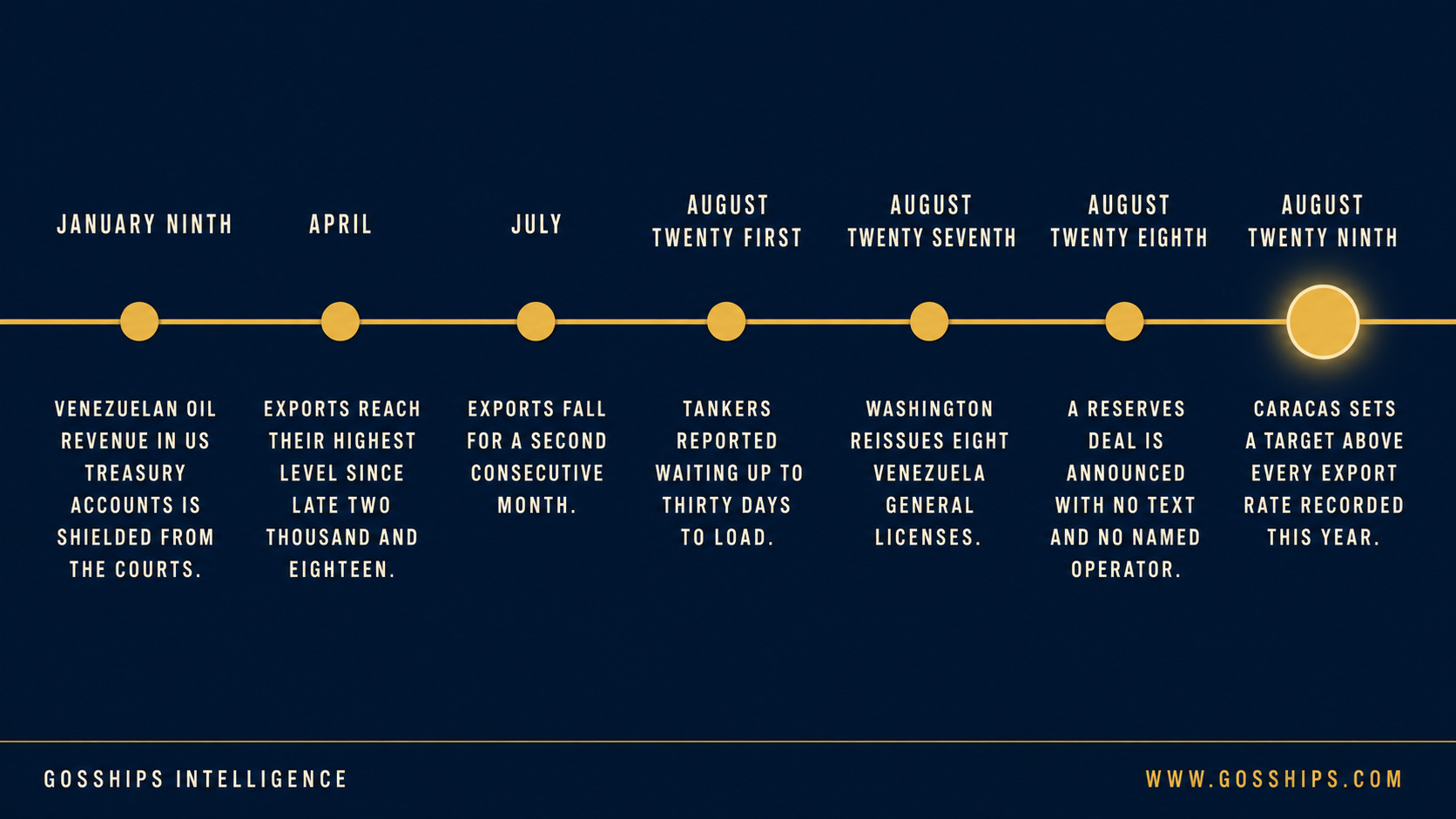
January 9, 2026: President Donald Trump signs Executive Order 14373, “Safeguarding Venezuelan Oil Revenue for the Good of the American and Venezuelan People.” It defines the Foreign Government Deposit Funds, money paid to or held by the United States Government in designated Treasury accounts on Venezuela’s behalf, derived from the sale of natural resources from Venezuela and from the sale of diluents to it, and directs that the funds be disbursed on the instruction of the Secretary of State. Its declared national emergency is not Venezuela. It is “the possibility of attachment or the imposition of judicial process against the Foreign Government Deposit Funds” (Federal Register, 91 FR 2045, January 15, 2026).
April 2026: Venezuelan oil exports reach 1.23 million barrels a day across 66 vessel departures, the highest monthly volume since late 2018 (Reuters tanker tracking, May 1, 2026).
July 2026: Exports fall to 1.16 million barrels a day, a second consecutive monthly decline from a May peak the same series puts at 1.24 million, while shipments to the United States reach 786,000 barrels a day, the highest since early 2019 (Reuters tanker tracking, August 3, 2026).
August 21, 2026: Reuters reports from Puerto La Cruz that “Venezuela’s dilapidated oil port terminals are imposing a de facto export cap on the country’s resurgent crude production, with tankers having to wait up to 30 days to load because of ageing infrastructure, power outages and quality issues, according to shipping data, sources and documents.” The same report states that repairs to terminals and refineries “are not being prioritized” under Washington’s reconstruction plan (Reuters, Marianna Parraga, August 21, 2026).
August 27, 2026: The Office of Foreign Assets Control reissues eight Venezuela general licenses, all signed by Director Bradley T. Smith. General License 50C authorizes oil and gas sector operations for six named companies. The vessel prohibition carries over unchanged (OFAC General License 50C and related licenses, August 27, 2026).
August 28, 2026: President Donald Trump announces “THE BIGGEST OIL DEAL IN WORLD HISTORY” and “majority U.S. control of more than 65 BILLION BARRELS of proven Oil Reserves in Venezuela.” Caracas issues its own communique the same night describing “a proven potential of 65 billion barrels.” No text of any agreement is released (Truth Social via Newsweek and Mediaite; Telesur and Descifrado, August 28 and 29, 2026; Associated Press, August 29, 2026).
August 29, 2026: In an address on state broadcaster VTV, Delcy Rodríguez puts the project at 25 years across the 17 fields plus eight further greenfield blocks, with “a production target of more than 1.5 million barrels per day.” Reuters reports the $209 billion in state revenue was calculated on a benchmark price of $65 a barrel, with roughly $19 a barrel flowing to the Venezuelan state (Reuters, August 30, 2026; La Patilla, August 29, 2026).
Sources: Truth Social post reproduced by Newsweek and Mediaite, August 28, 2026; Associated Press, Collin Binkley and Juan Pablo Arraez, August 29, 2026, via PBS NewsHour and WRAL; Reuters, August 28, 29 and 30, 2026; Reuters, Marianna Parraga and Jarrett Renshaw, August 27, 2026; Reuters, Marianna Parraga, Puerto La Cruz, August 21, 2026, read through gCaptain, Oil and Gas 360, MarineLink and BNN Bloomberg syndications; Reuters monthly tanker tracking series, Marianna Parraga and Mircely Guanipa, February to August 2026, read through EnergyNow, BOE Report, Invezz, Yahoo Finance and Baird Maritime; Axios, August 28, 2026; Bloomberg, August 27 and 28, 2026; Time, August 29, 2026; Telesur, August 29, 2026; Descifrado and Informe21, August 28 and 29, 2026; Infobae, August 29, 2026; El Nacional, August 28 and 29, 2026; La Patilla, August 29, 2026; EFE via Infobae, August 29, 2026; CNN en Espanol, August 28, 2026; The Wall Street Journal via Reuters and Quartz, August 28 and 29, 2026; OilPrice.com, Julianne Geiger, August 21, 2026; Al Jazeera, August 19 and 29, 2026; OFAC General Licenses 46C, 46D, 47B, 48C, 50, 50A, 50B, 50C, 51C, 52B, 54B and 61A; OFAC Frequently Asked Questions 1233, 1239, 1248, 1267 and 1268; OFAC Specially Designated Nationals list, publication dated August 28, 2026; OFAC Recent Actions, March 5 and August 18, 2026; Executive Order 14373, Federal Register 91 FR 2045, January 15, 2026; 31 CFR part 591, including section 591.406, via the eCFR; United States Geological Survey Fact Sheet 2009-3028; United States Energy Information Administration, U.S. Crude Oil and Natural Gas Proved Reserves, Year-end 2024, released April 7, 2026; Xclusiv Shipbrokers on Signal Ocean data, via Hellenic Shipping News, July 2026; AXSMarine voyage data, July 31, 2026, via Cyprus Shipping News, August 4, 2026; Robert Rapier in Shale Magazine; Fortune, Jordan Blum, January 9, 2026; RBN Energy, Lisa Shidler, May 14, 2026; AAA, August 27, 2026, and AAA via the Associated Press, August 29, 2026; Constitution of the Bolivarian Republic of Venezuela, Articles 12, 150 and 187.
⚖️ The Story
What Exists On Paper, And What Does Not
Start with the documentary record, because it is shorter than the coverage.
There is a social media post. There is a communique from Caracas. There is a statement from Secretary of State Marco Rubio. There is a television address. That is the whole of “THE BIGGEST OIL DEAL IN WORLD HISTORY.”
The Associated Press put it in one sentence on Saturday afternoon, and had not changed it in the version updated at 6:09 that evening: “No text of any agreement has been released.”
Reuters, reporting the announcement the same night, wrote that “Venezuelan officials are preparing to sign agreements next week granting new oil exploration and production rights to a number of companies, particularly U.S. firms.” Preparing to sign. Not signed.
Axios adds the confusion inside the administration. It reported that immediately after the announcement officials disagreed on whether the deal had been finalized, and that once Rodríguez issued her statement United States officials called it done, though more details might need to be worked out. A second source told Axios: “It’s going to happen. It’s just a question of when.” Meanwhile the ruling United Socialist Party of Venezuela issued a statement backing Delcy Rodríguez over “the agreements signed” [”los acuerdos firmados”], and the Ministry of Hydrocarbons has described the accords as suscritos, executed.
So the ruling party says signed. The ministry says executed. The wire says next week. Nobody has produced the instrument.
The gaps run further. None of the 17 fields has been named. What Reuters did publish about the list is worth reading twice by anyone fixing Venezuelan cargo: it combines green fields in the Orinoco Belt with mature areas in Lake Maracaibo, “some of which are currently operated by a small Chinese firm whose contract was signed during Maduro’s administration.” Hold that against the sanctions section below, because General License 50C treats a Chinese counterparty very differently from the license most Venezuelan cargo actually moves under.
Neither government has confirmed a single company as a party to the 17.
What did arrive, late on Saturday night, was a name for the vehicle. The Wall Street Journal, carried by Reuters, reported that Washington plans to take a 35 percent passive stake in North American Blue Energy Partners, a company controlled by the Venezuelan businessman Alejandro Betancourt, through penny warrants, together with preferential rights to buy 20 percent of its production at cost. That reporting rests on people involved in the negotiations, not on either government. And the Pentagon pushed back on the record within hours. Its spokesman, Sean Parnell, said the Office of Strategic Capital “does not take equity stakes in private companies.”
So the position on Sunday morning is this. Chevron declined to comment. ExxonMobil declined to comment. The Associated Press still calls the operator unnamed. A newspaper has named it. A Pentagon spokesman has denied the mechanism. No named official on either side has described how the thing actually works.
