


⚓ Gosships Intelligence
Gosships Intelligence Is Published At Gosships.com
For Sponsorship And Partnership Inquiries Contact intelligence@gosships.com
|⚓ About Us | 🛢️ Exclusive Report | 📋 SwiftAction Training |
🏅Black Gold Membership (*53 Slots Left)
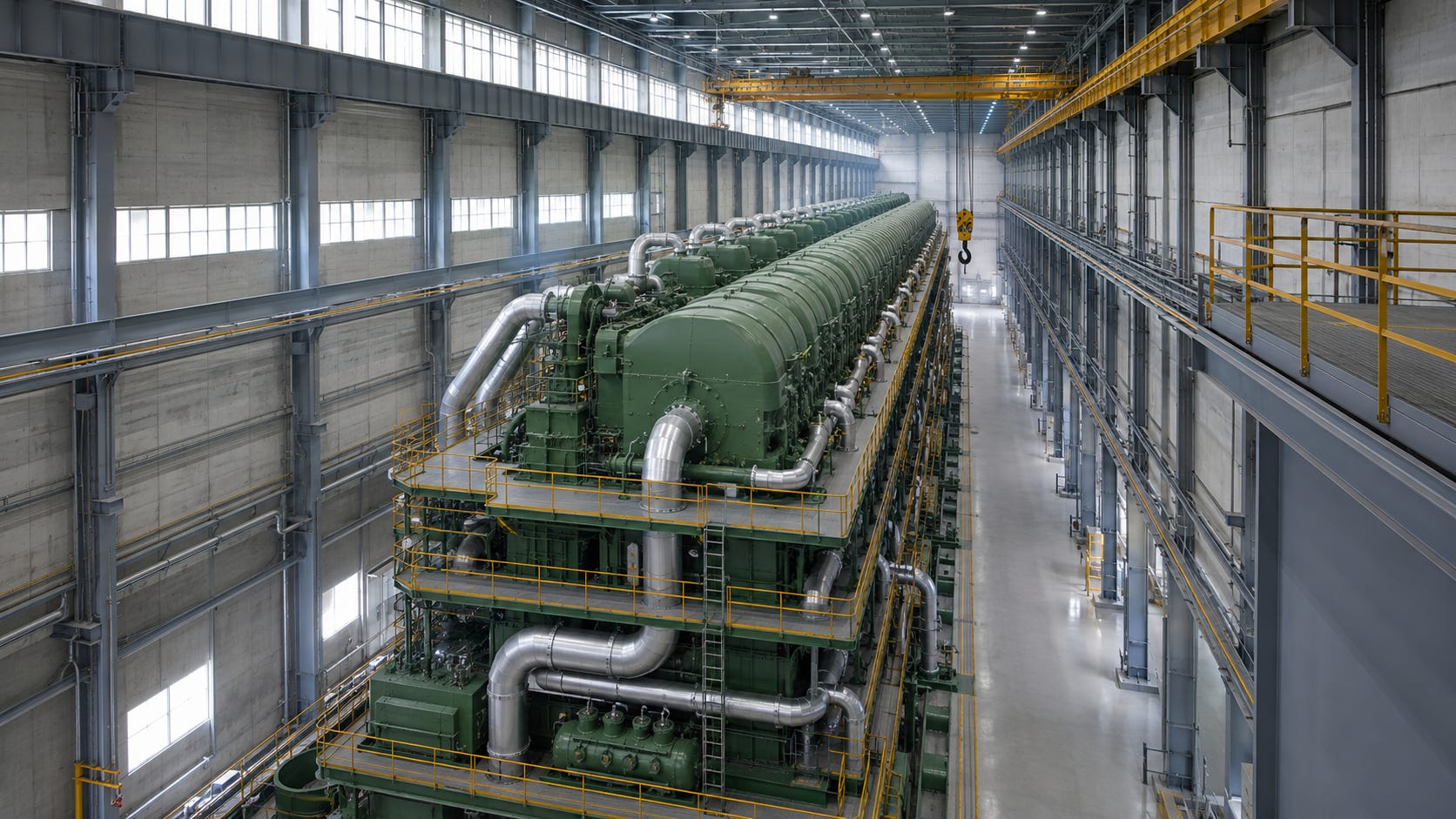
Why Is Bain Capital Buying A Marine Engine Designer?
Three companies design the engines in 55,000 vessels. A Chinese state group owns one, builds another under license and the third in its smaller bores.
On August 13 the European Commission cleared Bain Capital to take 51 percent of Everllence, the company that was MAN Energy Solutions until last year. It draws the low-speed engines that move the deepsea fleet. Volkswagen keeps 49 percent and puts its proceeds at approximately 7.4 billion euros, a figure its own footnote says covers the share together with expected debt. The Commission recorded the outcome as joint control rather than sole control. The transaction has not closed, and completion is targeted for the end of 2026.
Bain has never owned a marine two-stroke designer or a merchant vessel, though its history is not free of marine assets. In merchant shipping the only exposure this brief could locate was a stake it sold in 2023 in an Indian terminal operator.
Here is the part that rarely gets connected to a shipping story. Everllence does not build most of the engines it designs. It licenses the drawings to builders sitting next to the yards in China, Korea and Japan, and several of the Chinese licensees sit inside China State Shipbuilding Corporation, the state group that also owns Everllence's closest competitor outright.
Three companies in the world design these engines. Everllence is one. The second, WinGD, has been owned outright by China State Shipbuilding Corporation since 2016. The third, Japan Engine Corporation, has its designs built by that same Chinese group, in the smaller bores.
Everllence’s own pages, citing DNV, put 55,000 vessels at sea on two-stroke power. No institution anywhere publishes how that population splits between the three, and this brief went looking twice, with different researchers and different sources.
A shareholding in the two-stroke design house is cleared to move west. No two-stroke series production moves with it, because that sits with the licensees.
📋 In This Issue:
⚖️ The Story:
What Brussels cleared and what it did not, the company almost nobody in chartering can name, why the count of engine designers is three and not two, what China already builds under license, what Bain actually bought and what any of it does to a VLCC.
📊 By The Numbers:
The stake, the proceeds, the book value, the 2024 file that is not the same file, the engine population nobody splits and the two self-reported share figures that are not comparable.
🔍 Why It Matters:
What changes for the VLCC owner, the charterer, the underwriter and the trader.
👀 What To Watch:
The five markers that will show whether this is an ownership change or a supply-chain event, including the one that would prove this reading wrong.
🚨 Gosships Signal:
Why the drawings and the factories were never in the same place, and why that predates this deal by a decade.
🔔 Not A Member? Unlock The Full Analysis, Data Cards, Archive, & More!
📊 Order Our Exclusive Report
→ Global Tanker Market Outlook Q3 2026 Edition
📋 Competency-Based Maritime Training
→ SwiftAction
🔗 Related Coverage


📌 Gosships Data Card
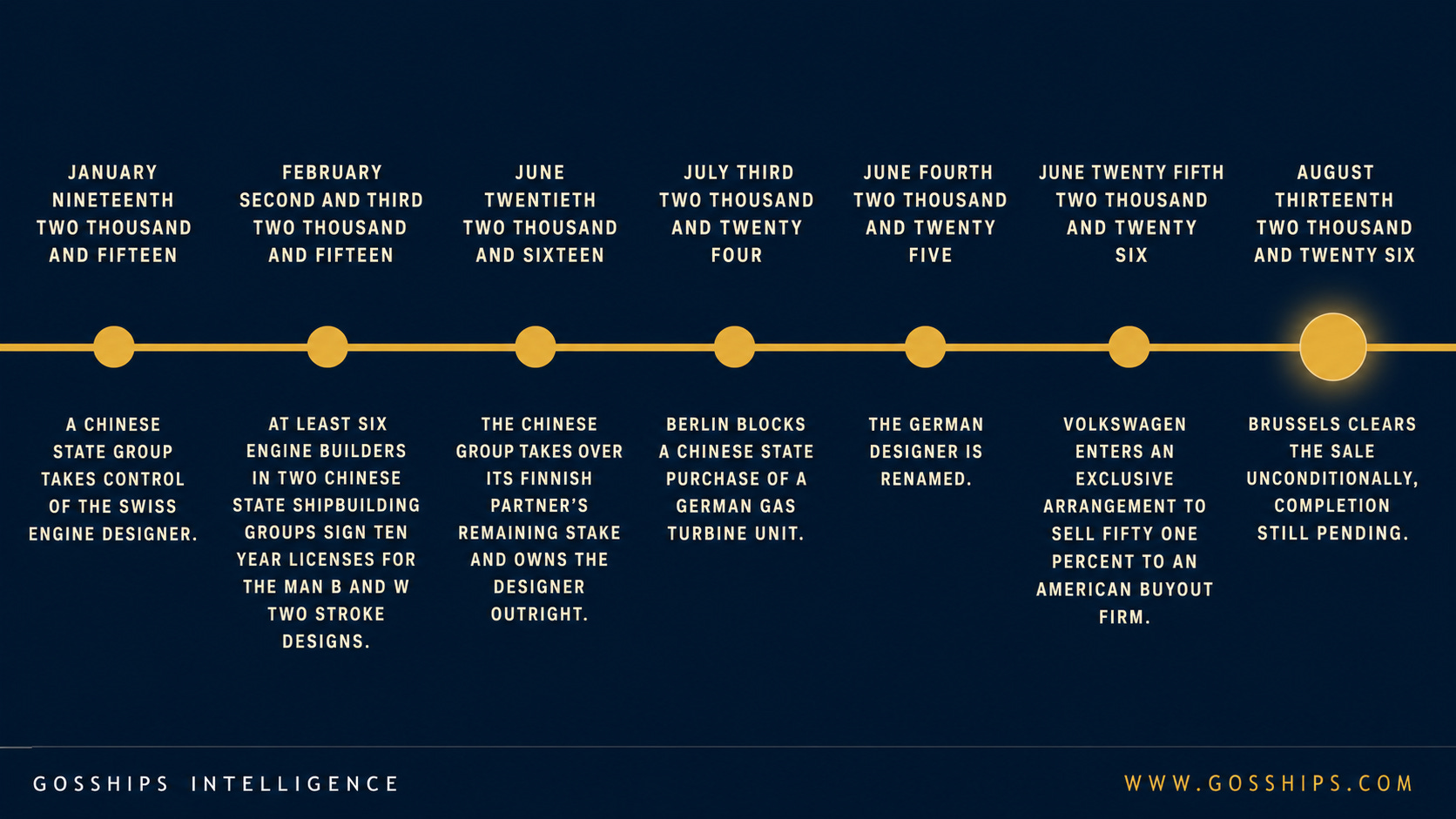
January 19, 2015: Wartsila and China State Shipbuilding Corporation complete a joint venture holding the two-stroke engine business Wartsila is selling, with China State Shipbuilding Corporation taking 70 percent and Wartsila 30. The company is Winterthur Gas and Diesel, known as WinGD, and it is one of the small number of houses that design the low-speed engines used in deepsea vessels (Wartsila, January 19, 2015).
February 2 and 3, 2015: MAN Diesel and Turbo renews 10-year licenses for its low-speed two-stroke designs, at two ceremonies in Beijing on February 2 and February 3, with at least six engine builders inside China's two state shipbuilding groups: CSSC-MES Diesel, Hudong Heavy Machinery and CSSC Marine Power, then under China State Shipbuilding Corporation, on February 2, and Dalian Marine Diesel, Qingdao Haixi Marine Diesel and Yichang Marine Diesel Engine, then under China Shipbuilding Industry Corporation, the following day. MAN dated both relationships to 1980 (MarineLink, February 5, 2015; Maritime Propulsion, February 10, 2015).
June 20, 2016: Wartsila sells its remaining 30 percent of WinGD to China State Shipbuilding Corporation, which becomes the sole owner (DieselNet and Marine Log, June 2016).
July 3, 2024: The German government blocks MAN Energy Solutions' sale of its gas turbine business, covering units up to eight megawatts, to Longjiang Guanghan of Harbin, a subsidiary of China State Shipbuilding Corporation. The decision is announced on national security grounds by the ministry then led by Robert Habeck, Federal Minister for Economic Affairs and Climate Action. Contemporaneous trade reporting referred to unconfirmed reports of military ties, which neither the ministry nor the company has confirmed. A foreign investment veto is not a finding of wrongdoing. MAN winds the unit down rather than sell it (Maritime Executive, July 3, 2024; Seatrade Maritime, July 8, 2024).
June 4, 2025: MAN Energy Solutions is renamed Everllence. Its two-stroke marine engines continue to carry the Everllence B and W designation, the initials of Burmeister and Wain (Everllence, June 4, 2025).
June 25, 2026: Volkswagen Group announces that it has granted Bain Capital exclusivity over the purchase of a majority holding in Everllence. Its release states that "51 percent of the shares are to be transferred" and that Volkswagen "intends to remain a major shareholder in Everllence with a 49 percent stake." Proceeds are put at approximately 7.4 billion euros, a figure Volkswagen's own footnote states is derived from the 51 percent share together with expected debt following completion, so it is not a price for the shares alone. Volkswagen separately states that Everllence SE was carried on its own balance sheet at approximately 3.4 billion euros as at May 31, 2026, a figure for the whole company rather than the 51 percent. Everllence is described as having revenue of 4.9 billion euros and around 16,000 employees (Volkswagen Group media information No. 60/2026, datelined Wolfsburg, June 24, 2026; Everllence, June 25, 2026).
August 13, 2026: The European Commission clears the transaction, on a Thursday, without conditions. German business outlets carried the decision the same afternoon, Handelsblatt timestamped at 13:54 and finanzen.at at 13:57, reporting that the Commission raised no competition concerns. The Commission's own daily news record, case M.12527, describes the decision as approving "the acquisition of joint control of Everllence SE by Volkswagen Aktiengesellschaft" and Bain Capital Investors, LLC, examined under the simplified merger review procedure. The transaction has not closed, and completion is targeted for the end of 2026, subject to further customary approvals (European Commission MEX/26/1734, August 13, 2026; Handelsblatt, finanzen.at and ad-hoc-news.de, August 13, 2026).
Sources: Volkswagen Group press release, June 25, 2026; Everllence press release, June 25, 2026; Bain Capital press release, June 25, 2026; European Commission MEX/26/1734, August 13, 2026, case M.12527; Handelsblatt, August 13, 2026, timestamped 13:54; finanzen.at, August 13, 2026, timestamped 13:57; ad-hoc-news.de, August 13, 2026; kapitalmarktexperten.de, August 18, 2026; Maritime Executive, July 3, 2024; Seatrade Maritime, July 8, 2024; Wartsila, January 19, 2015; DieselNet and Marine Log, June 2016; MarineLink, February 5, 2015; Maritime Propulsion, February 10, 2015; Seatrade Maritime, May 16, 2025; eworldship, May 16, 2025; Bloomberg via OEDigital and Baird Maritime, April 22, 2026; b4bschwaben.de, June 26, 2026; Japan Engine Corporation UE catalog and UE product pages; Japan Engine Corporation, February 1, 2023; The Motorship, February 2, 2023; Marine Log, June 27, 2023; Japan Engine Corporation, April 21, 2025, September 1, 2025, April 2 and April 8, 2026; WinGD, February 25, 2026; WinGD, April 2, 2026; Everllence, April 20, 2026; HD Hyundai Heavy Industries engine and machinery pages; KED Global, March 22, 2023; MarineLink, July 1, 2026; Splash247, November 23, 2023; Everllence two-stroke future technologies page citing DNV; Marine Log, February 5, 2026; Clarksons via Maritime Executive, July 8, 2026; SteelOrbis, August 14, 2026; Hellenic Shipping News, May 25, 2026; Hellenic Shipping News and Maritime Executive on the Hudong-Zhonghua agreement, August 2026; PortNews and iMarineNews, August 29 and 30, 2026; TradeWinds, August 29, 2026; Seatrade Maritime, April 2, 2026; Seatrade Maritime, July 15 and 16, 2026; Bain Capital, January 25, 2023.
⚖️ The Story
The 2024 File That Is Not This File
Start with a decision nobody in shipping noticed, and with the reason it is context rather than cause.
In the summer of 2024 the German government blocked the sale of a MAN Energy Solutions business to a Chinese buyer. The asset was small, a gas turbine line covering units up to eight megawatts. The buyer was Longjiang Guanghan of Harbin, a subsidiary of China State Shipbuilding Corporation. The ground was national security, and the reporting at the time cited unconfirmed accounts of military ties, which neither the ministry nor the company has confirmed. A foreign investment veto is not a finding of wrongdoing.
MAN did not find another buyer. It wound the unit down.
That is the precedent worth holding, and its limits have to be stated in the same breath. The asset was a small one and the process was a German foreign investment screen. What follows below is a far larger transaction, a different asset, a different buyer and a European merger review. No Chinese bidder took part in the 2026 process. No source links the two decisions and this brief does not either. The 2024 file is useful only because it shows that somebody in Berlin once priced that unit's strategic weight in the hands of that buyer, and priced it high enough to kill the sale.
