


⚓ The Gosships Team
Gosships Intelligence Is Published At Gosships.com
For Sponsorship And Partnership Inquiries Contact intelligence@gosships.com
|⚓ About Us | 🛢️ Deep Water Reports | 📋 SwiftAction Training |
🏅 Founding Black Gold Membership (*53 Slots Left)
The biggest gathering in shipping opened this week with the industry’s central question unresolved, and one of its oldest and most combative voices answered it without hedging.
On June 1, the first day of Posidonia week in Athens, more than 1,500 people filled the Capital Link Maritime Leaders Summit. The marquee panel brought together some of the most powerful names in Greek shipping, and the subject was the one hanging over the whole event: the Strait of Hormuz, still largely closed to commercial traffic months into the Iran war, and what owners should do about it. George Prokopiou, the 79-year-old founder of Dynacom Tankers, gave the bluntest reply. Freedom of navigation is essential, he said, and nobody can impose tolls or any other burden. Then he reached back several thousand years: Greece, he said, has the tradition of breaking blockades since antiquity.
Coming from Prokopiou, that was not rhetoric. He is one of the very few owners who has kept sending tankers toward the strait while most of the industry pulled back. That is what makes the moment worth examining: not a slogan about freedom of navigation, but a man who is acting on it with his own ships, and a serious argument on the other side about the seafarers aboard them.
📋 In this issue:
🛢️ The Story
📊 By The Numbers
🔍 Why It Matters
👀 What to Watch
🚨 Gosships Signal
📊 Get The Deep Water Report
→ Global Tanker Market Outlook Q2 2026
📋 Competency-Based Maritime Training
→ SwiftAction
📌 Gosships Data Card
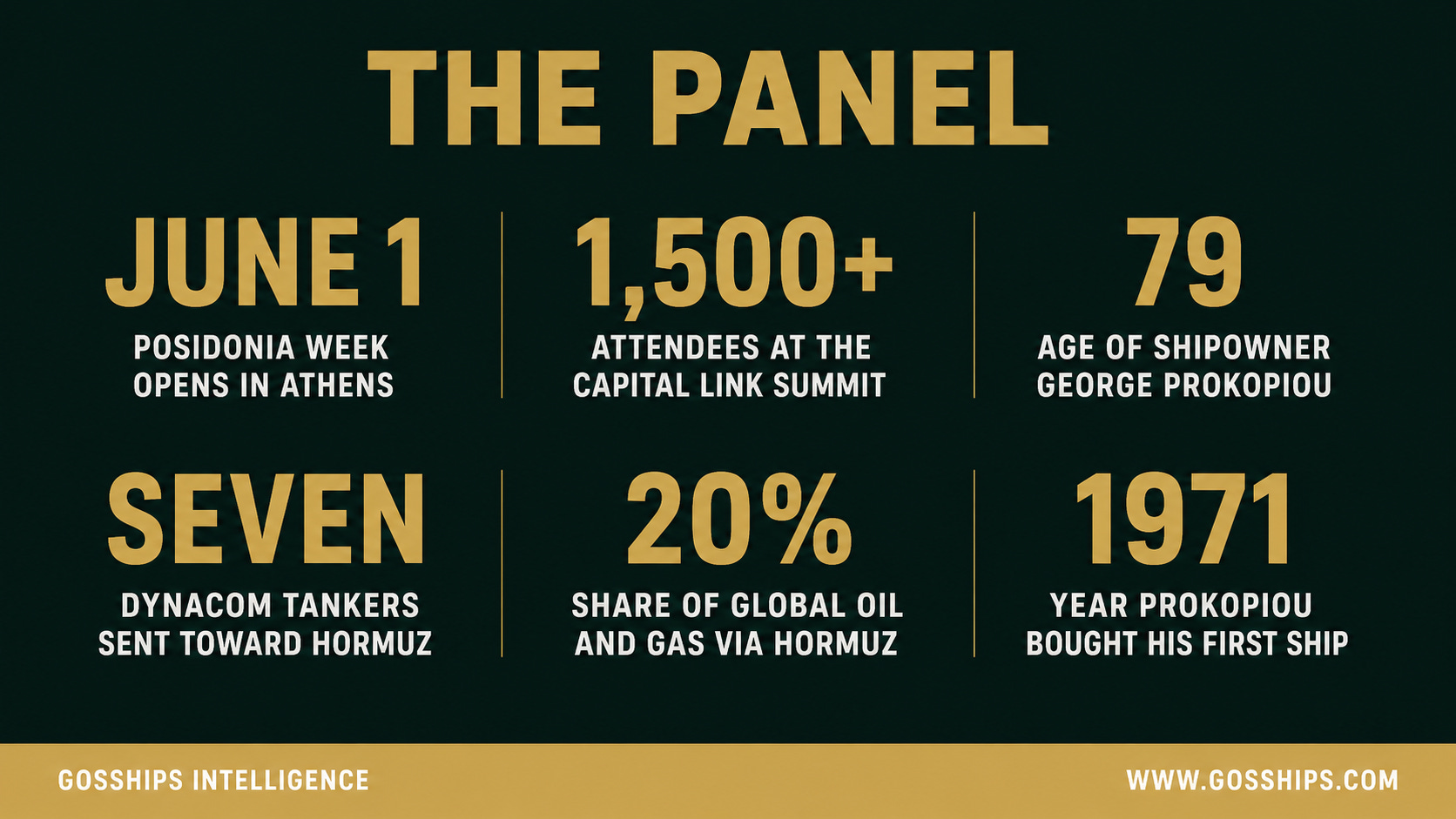
→ The Setting: The 10th Capital Link Maritime Leaders Summit Opened Posidonia Week in Athens on June 1 Per Capital Link Via Greek City Times
→ The Crowd: More Than 1,500 Greek and International Shipping Representatives Attended the Opening Day Per Greek City Times
→ The Panel: The Session Shipping and the Global Energy Landscape Featured Prokopiou, Marinakis, Angelicoussis and Bahri’s Alsubaey Per Greek City Times
→ The Line: Prokopiou Said Freedom of Navigation Is Essential and Nobody Can Impose Tolls or Any Other Burden Per MarineLink
→ The Tradition: Prokopiou Said Greece Has the Tradition of Breaking Blockades Since Antiquity Per MarineLink
→ The Risk Taker: Dynacom Has Sent Seven Tankers Through or Toward Hormuz Since the Iran War Began Per the Globe and Mail
🛢️ The Story
This is a story about conviction, and about the people who pay for it.
The stage. The Capital Link Maritime Leaders Summit is one of the anchor events of Posidonia week, the biennial Athens gathering that is the most important date on the calendar for the world’s largest shipping nation. This year’s opening-day panel, titled Shipping and the Global Energy Landscape, was moderated by George Palaikrassas and brought together George Prokopiou of Dynacom, Evangelos Marinakis of Capital Maritime and Trading, Maria Angelicoussis of the Angelicoussis Group, and Ahmed Ali Alsubaey of Saudi Arabia’s Bahri Group. According to Greek City Times, more than 1,500 representatives of the Greek and international industry packed the room. The timing gave the discussion its charge: the Strait of Hormuz, the chokepoint for roughly a quarter of the world’s seaborne oil, has been largely blocked since late February, and the room wanted to know what the people who actually own the ships intend to do.
The intervention. Prokopiou delivered what reporters described as one of the panel’s most forceful contributions. Freedom of navigation, he said, is essential, and nobody can impose tolls or any other burden, a direct rejection of the idea that any power can charge for or restrict passage through a strategic waterway. He framed it as a matter of principle older than the modern industry, saying Greece has the tradition of breaking blockades since antiquity. He also pushed back on the language of energy transition, arguing, according to Greek City Times, that the world is still in a phase of adding energy sources rather than replacing them, and that demand for oil, natural gas, LNG and even coal remains significant. High energy costs, he warned, threaten competitiveness.
The man behind the words. What gives Prokopiou’s position its weight is that he is living it. He is 79 years old, bought his first ship, a tanker, in 1971, and built Dynacom Tankers, Sea Traders and the gas carrier operator Dynagas over the following decades. According to the Globe and Mail, when US President Donald Trump called on tanker owners to show some guts and sail through Hormuz, Prokopiou was exactly the kind of owner he had in mind: Dynacom has had seven tankers that either transited the strait or set sail to do so since the Iran war began, while many competitors withdrew. A Lloyd’s List Intelligence analyst quoted in the same report put it plainly, saying Greek owners typically carry a higher risk tolerance.
The complication. Prokopiou’s willingness to operate where others will not has a controversial history. After Russia’s full-scale invasion of Ukraine in 2022, he continued carrying Russian oil, telling a conference that year that sanctions have never worked. Ukraine’s anti-corruption agency placed Dynacom on a list of international sponsors of war in 2022, then removed the company about a year later following negotiations, and that list was eventually pulled from public view in 2024. None of this is hidden, and it is part of why Prokopiou is a polarizing figure: to admirers he is a principled defender of open seas, to critics he is an owner who profits where others see unacceptable risk. Both readings draw on the same record.
The rest of the panel. Prokopiou was not the only voice. Maria Angelicoussis, who leads Greece’s largest shipping group, opened the session by describing the Iran conflict and the closure of Hormuz as one of the most serious disruptions to the global energy supply chain in recent decades. Yet she struck a notably measured tone, observing that the global economy had proven more resilient than many predicted. Oil prices rose 50 to 60 percent and Asian LNG nearly doubled, she noted, but neither reached the catastrophic levels some analysts had forecast, which she attributed to alternative fuels, softer demand in some regions, and the release of strategic petroleum reserves. Evangelos Marinakis of Capital Maritime argued the war should end immediately, saying the consumer pays the price all around the world, while suggesting the industry could afford to wait a little longer for a durable agreement that made everyone feel secure.
The counterweight. The same Posidonia week carried a very different emphasis from the head of the body that regulates global shipping. Arsenio Dominguez, secretary general of the International Maritime Organization, told the conference the industry must do all it can to always put the safety of seafarers first. That is the unavoidable other side of the freedom-of-navigation argument. The strait is not an abstraction; ships in the wider region have been hit and seafarers have been killed since the conflict began, and tens of thousands of crew, many from the global south, have been caught in or near the danger zone. The principle of keeping the sea open and the duty to protect the people who sail it are both real, and they pull in different directions.
For owners, charterers and the crews themselves, the question that runs underneath the whole event is simple to state and hard to answer. The full read is below.
📊 By The Numbers
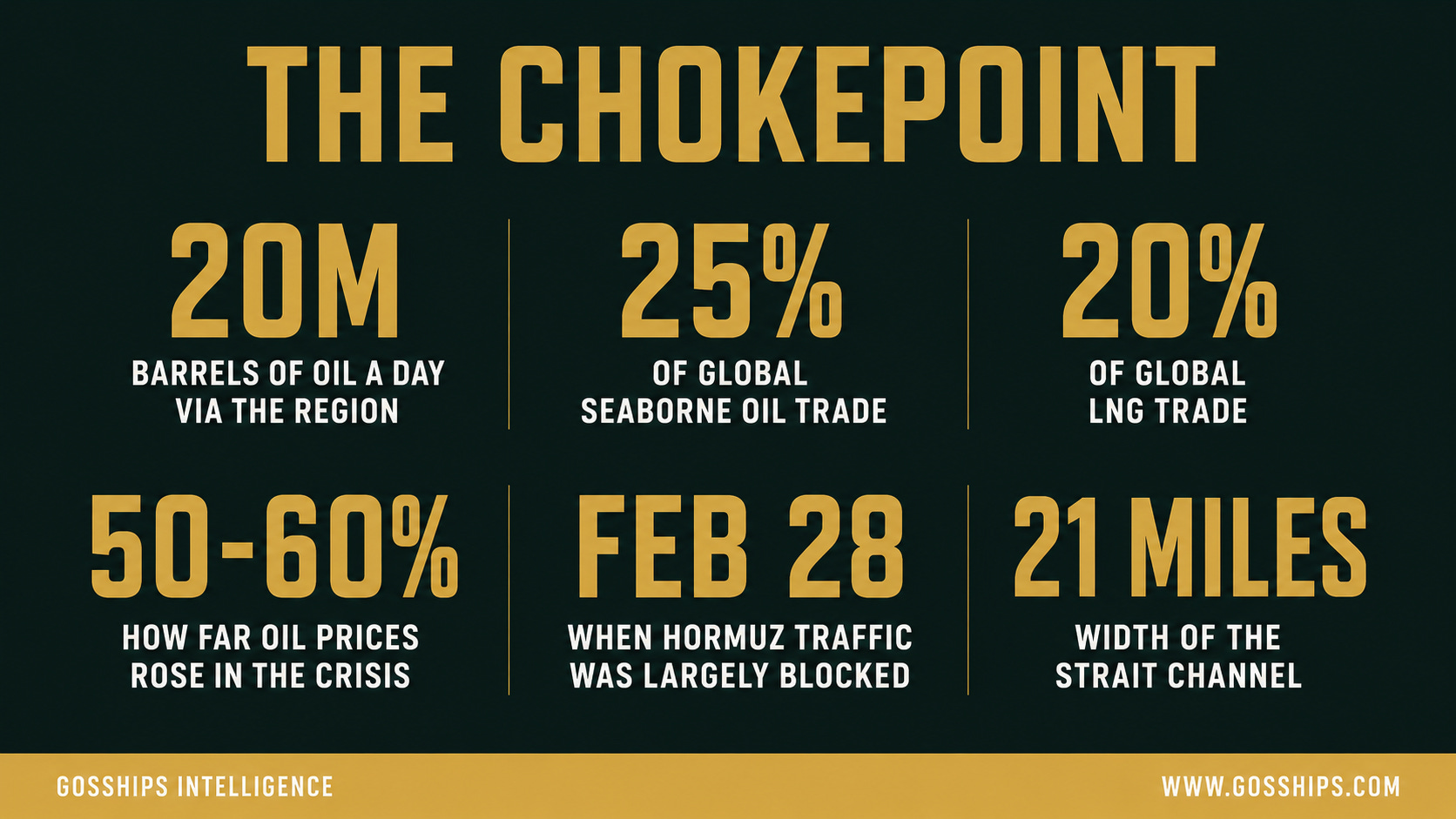
→ The Volume: The Region Handled Around 20 Million Barrels of Oil a Day Before the Crisis Per Safety4Sea
→ The Oil Share: The Strait Carries About 25% of Global Seaborne Oil Trade Per Safety4Sea
→ The Gas Share: The Strait Carries Nearly 20% of Global LNG Trade Per Safety4Sea
→ The Price Move: Oil Prices Rose 50 to 60% During the Crisis Per Maria Angelicoussis Via Greek City Times
→ The Start Date: Hormuz Traffic Has Been Largely Blocked Since February 28 Per Multiple Reports
→ The Channel: The Shipping Channel Through the Strait Is About 21 Miles Wide Per CNN
📰 Related Coverage
Iran Built a Toll Booth on the Strait of Hormuz
Trump Gave Iran 48 Hours to Open Hormuz
Hormuz Shut Down: Three Tankers Hit, P&I Clubs Pull War Risk Cover as Iran War Escalates
Found this useful? Share Gosships Intelligence with a colleague.
Why one owner’s words carry more weight than a dozen press releases. What the freedom-of-navigation argument leaves out. The number that decides who keeps sailing and who waits. Below.
🔍 Why It Matters
A panel quote is usually just a panel quote. This one matters because the man saying it has put his own fleet behind it.
