


⚓ The Gosships Team
Gosships Intelligence Is Published At Gosships.com
For Sponsorship And Partnership Inquiries Contact intelligence@gosships.com
|⚓ About Us | 🛢️ Deep Water Reports | 📋 SwiftAction Training |
🏅 Founding Black Gold Membership (*53 Slots Left)
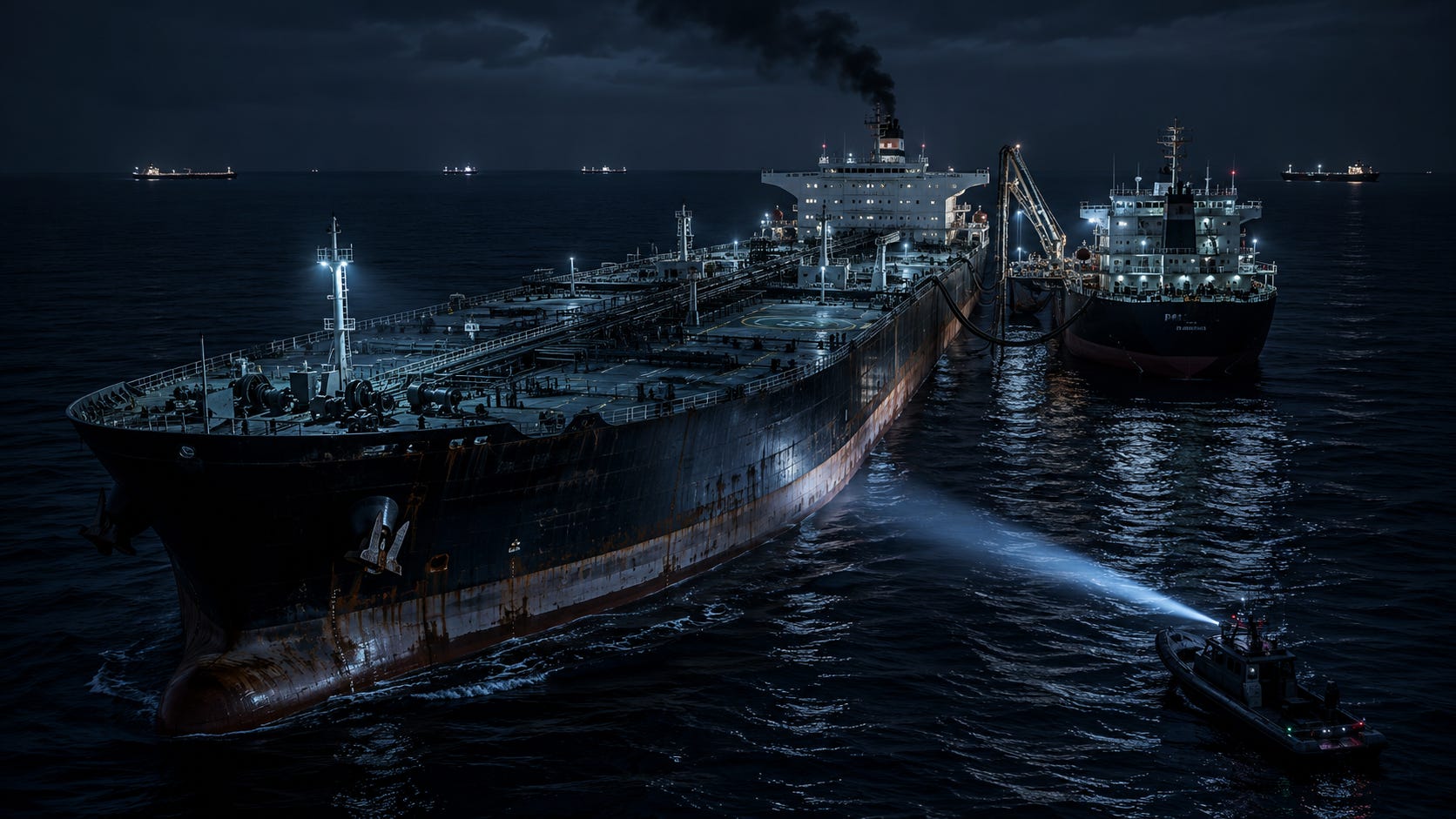
In March, a drone hit an oil tanker called the Altura in the Black Sea, near the mouth of the Bosphorus. It was carrying about a million barrels of Russian crude at the time. The blast shook its bridge and flooded its engine room. It did not sink.
The Altura survived, and it kept trading. On Thursday night, May 28, it came back to roughly the same patch of water off the Turkish coast. And whoever hit it the first time found it again.
This time the Altura was not alone. Two other sanctioned tankers, the James II and the Velora, were struck by drones in the same waters on the same night. Three ships, one night, all of them on Western sanctions lists as part of the shadow fleet that moves Russian oil around sanctions. Two of them, including the Altura, were caught while pumping cargo from one ship to another in a mid-sea transfer.
No crew were hurt. And as of now, no one has claimed carrying out the strikes, even as Ukraine’s intelligence service has publicly identified all three ships as part of Russia’s shadow fleet. Here is what happened and why the pattern, not any single strike, is the real story, sourced entirely from the Washington Post, Bloomberg, Reuters, the Tribeca shipping agency, and named reporting.
📋 In this issue:
🛢️ The Story
📊 By The Numbers
🔍 Why It Matters
👀 What to Watch
🚨 Gosships Signal
📊 Get The Deep Water Report
→ Global Tanker Market Outlook Q2 2026
📋 Competency-Based Maritime Training
→ SwiftAction
📌 Gosships Data Card
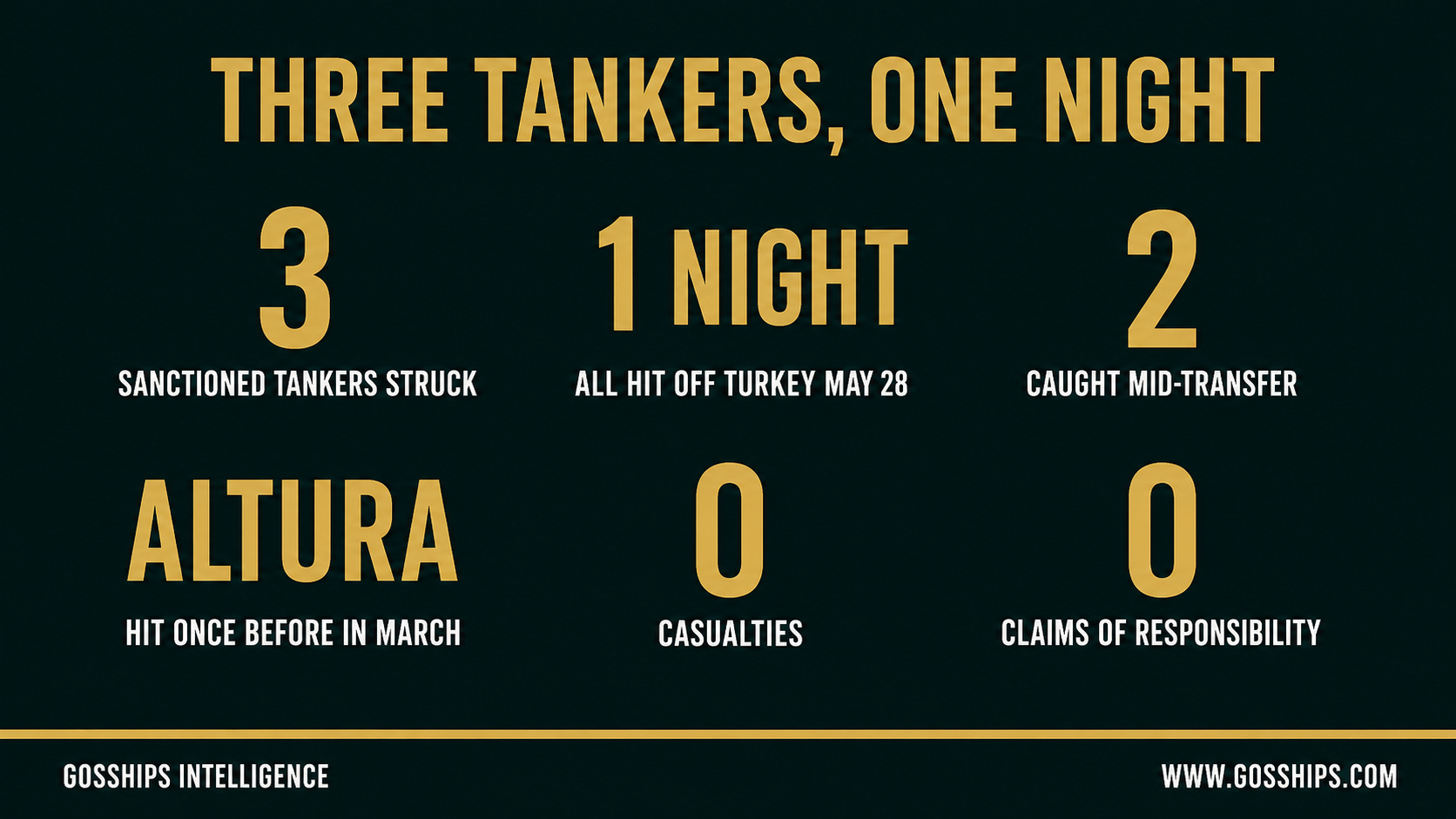
→ Tankers Attacked: 3, All On Western Sanctions Lists As Part Of Russia’s Shadow Fleet Per Washington Post And Bloomberg
→ Date And Location: Overnight May 28, 2026, In The Black Sea Off Northern Turkey Near Turkeli And Sinop Per Tribeca Shipping Agency Via Reuters
→ Vessels Named: James II (Palau Flag), Altura And Velora (Both Sierra Leone Flag) Per Tribeca Via Kyiv Independent And Splash247
→ Two Caught Mid-Transfer: Altura And Velora Were Conducting Ship-To-Ship Cargo Transfers When Struck Per Bloomberg
→ Repeat Target: Altura Was Also Struck In March 2026, Then Laden With About 1 Million Barrels Of Russian Urals Crude Per Bloomberg And World Oil
→ Casualties: None Reported Across All Three Vessels Per Tribeca Via Reuters
🛢️ The Story
The Black Sea has quietly become the most dangerous water in the world for a certain kind of ship.
That kind of ship is the shadow-fleet tanker, the aging, opaquely owned, often re-flagged vessel that carries Russian crude and refined products around Western sanctions. For two years the war over that trade was fought with sanctions lists, port bans, and insurance rules. Over the past several months it has moved into the water itself.
The Thursday Strikes.
Overnight on May 28, 2026, three tankers were attacked by drones in the Black Sea off the northern coast of Turkey, in international waters near Turkeli and Sinop, according to the Tribeca shipping agency as reported by Reuters, the Washington Post, and Bloomberg. All three appear on Western sanctions lists as part of Russia’s shadow fleet.
The first to be hit was the James II, a Palau-flagged tanker built in 2002 and managed by an Indian company, according to the Equasis database cited by Bloomberg. It was struck in the engine room roughly 50 miles north of Turkeli and about 47 miles from the mouth of the Bosphorus, with 20 crew aboard, according to Tribeca. The other two, the Altura and the Velora, both flying the flag of Sierra Leone, were hit in a nearby area while they were conducting a ship-to-ship cargo transfer, according to Bloomberg. No injuries were reported among any of the crews, and the Turkish coast guard dispatched vessels to the area.
The Ship That Was Hit Twice.
The detail that turns a single incident into a pattern is the Altura. This was not its first drone strike. In late March 2026, the Altura was hit near the Bosphorus while fully laden with about one million barrels of Urals crude loaded at the Russian port of Novorossiysk, according to Bloomberg and World Oil. That strike flooded its engine room and set off an explosion that shook the bridge, though all 27 crew survived and no oil spilled. Turkey’s transport minister said at the time the weapon may have been an unmanned underwater vehicle rather than an aerial drone.
The Altura is sanctioned by the European Union, which listed it in November 2025, followed by Switzerland and Ukraine in December 2025 and the United Kingdom in February 2026, according to the Open Sanctions portal cited by Kyiv Post. It is not sanctioned by the United States. Its ownership was transferred to a Turkish company in mid-2025. After the March strike, it was repaired and returned to service. Two months later, in nearly the same waters, it was found and hit again.
The Unclaimed War.
No party has formally claimed responsibility for carrying out the May 28 strikes. What has emerged since is a layer of attribution short of a claim. Ukraine’s military intelligence agency, the HUR, has publicly identified all three vessels as part of Russia’s shadow fleet, which it estimates moves up to 30 percent of Russia’s seaborne oil exports, and numerous outlets have attributed the strikes to Ukrainian sea drones. Ukraine has confirmed the targets are sanctions-evading tankers without confirming that it conducted the attack itself. That gap, between naming the targets and owning the operation, is the deniability the shadow war runs on.
The context makes the pattern unmistakable. Russia-connected tankers have been targeted inside Turkey’s exclusive economic zone in the Black Sea repeatedly over the past year, and long-range sea drones have struck shadow-fleet tankers off Turkey before. In late November 2025, Ukraine’s security service claimed strikes on two Russia-linked tankers, the Kairos and the Virat, off Turkey’s coast using domestically produced Sea Baby naval drones, with the Kairos catching fire and its crew evacuated. Turkish authorities have repeatedly urged both Russia and Ukraine to keep the fight away from the shipping lanes, with President Erdogan warning against the Black Sea becoming an area of confrontation. The strikes have continued anyway, and on May 28 there were three of them in a single night.
For the complete enforcement-risk analysis, Black Sea routing exposure, and shadow-fleet supply modeling for the compliant tanker market, see our Global Tanker Market Outlook.
📊 By The Numbers
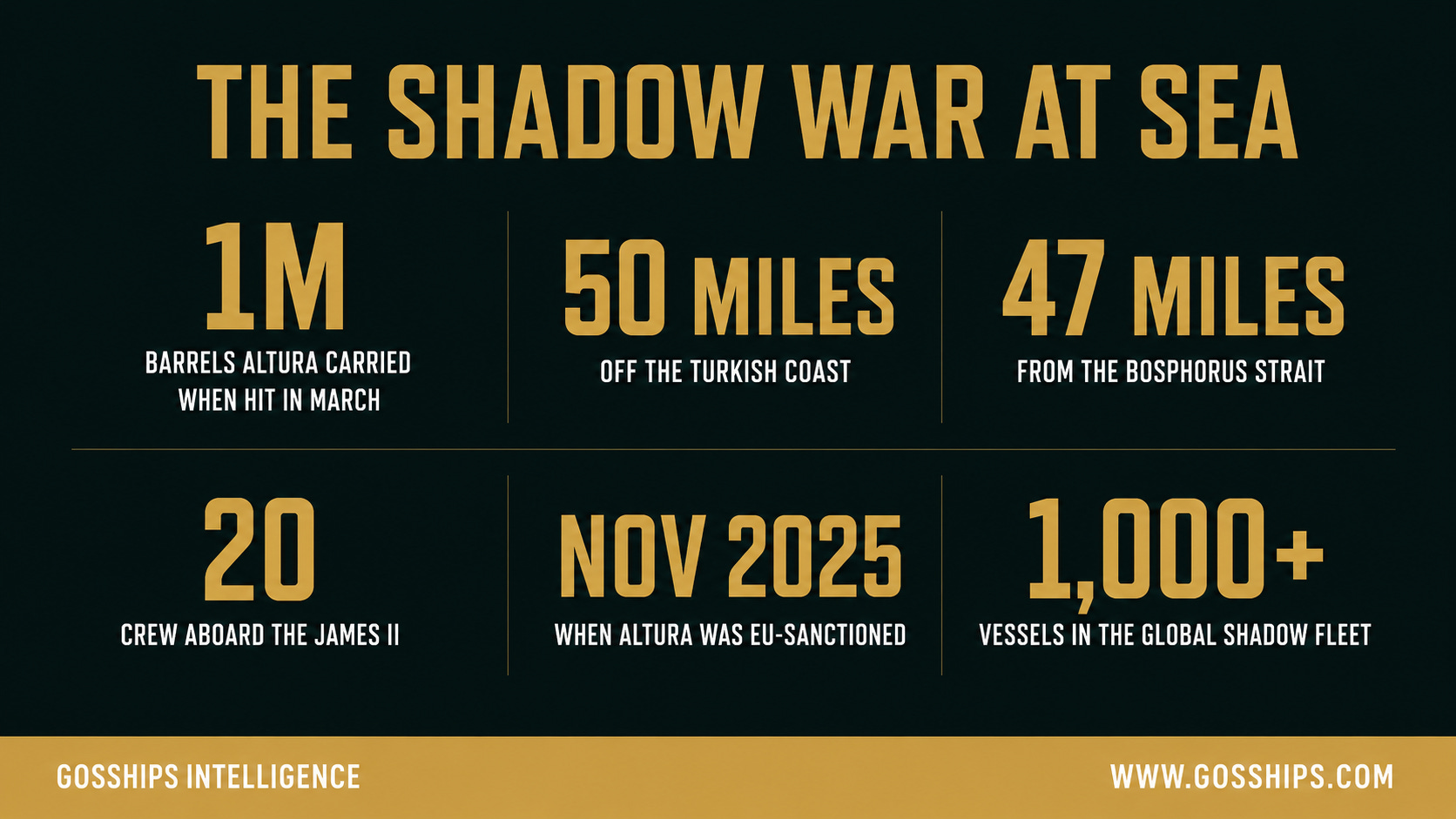
→ Altura Cargo In March Strike: About 1 Million Barrels Of Russian Urals Crude From Novorossiysk Per Bloomberg And World Oil
→ Distance From Turkish Coast: Roughly 50 Miles North Of Turkeli Per Tribeca Shipping Agency Via Kyiv Post
→ Distance From The Bosphorus: About 47 Miles, A Primary Gateway For Global Oil Per Tribeca Via Ukrainian Shipping Magazine
→ Crew Aboard James II: 20, Struck In The Engine Room Per Tribeca Via Ukrainian Shipping Magazine
→ Altura Sanctions Timeline: EU November 2025, Switzerland And Ukraine December 2025, UK February 2026, Not US Per Open Sanctions Via Kyiv Post
→ Global Shadow Fleet Size: More Than 1,000 Vessels Per TankerTrackers Via CBC
📰 Related Coverage
Someone Has Made $2 Billion Selling Oil During A War They Started. 72 Tankers Are Parked Off Malaysia With No Tracking Signal.
Iran Built A Toll Booth On The Strait Of Hormuz. The IRGC Is Charging $2 Million Per Ship.
War Risk Premiums Hit 1% Of Hull Value, Making Hormuz Transits Economically Impossible.
Found this useful? Share Gosships Intelligence with a colleague.
Why a strike 47 miles from the Bosphorus is more dangerous than it sounds. What it means that the same ship was hit twice. Why the attacker stays silent. And the one development that would turn this from a shadow war into an open one. Below.
🔍 Why It Matters
A drone strike on a sanctioned tanker is easy to file under distant conflict news. For the tanker market, the location and the repetition are what matter, and both point the same direction.
