


⚓ The Gosships Team
Gosships Intelligence Is Published At Gosships.com
For Sponsorship And Partnership Inquiries Contact intelligence@gosships.com
|⚓ About Us | 🛢️ Exclusive Report | 📋 SwiftAction Training |
🏅Black Gold Membership (*53 Slots Left)
A single run through the Strait of Hormuz can cost the charterer of a supertanker millions of dollars in war-risk premium, as much as ten to fourteen million for a ship with US ties, up from a couple of hundred thousand before the war. That price is built on a picture of a strait that is nearly dead and extremely dangerous, and that picture is drawn almost entirely from ship transponders. This week the US military said the picture is wrong in a specific and uncomfortable direction. More ships are crossing than the trackers can see, because the ones that move are going dark to survive. For the people who price marine war risk, that is not a curiosity. It is the difference between a strait that is closed and one that is quietly, and profitably, open.
📋 In this issue:
🛢️ The Story
📊 By The Numbers
🔍 Why It Matters
👀 What to Watch
🚨 Gosships Signal
🔔 Not Yet Subscribed? Gosships Intelligence Delivers Oil Shipping Intelligence. Subscribe Here!
📊 Order Our Exclusive Report
→ Global Tanker Market Outlook Q3 2026 Edition
📋 Competency-Based Maritime Training
→ SwiftAction
📌 Gosships Data Card
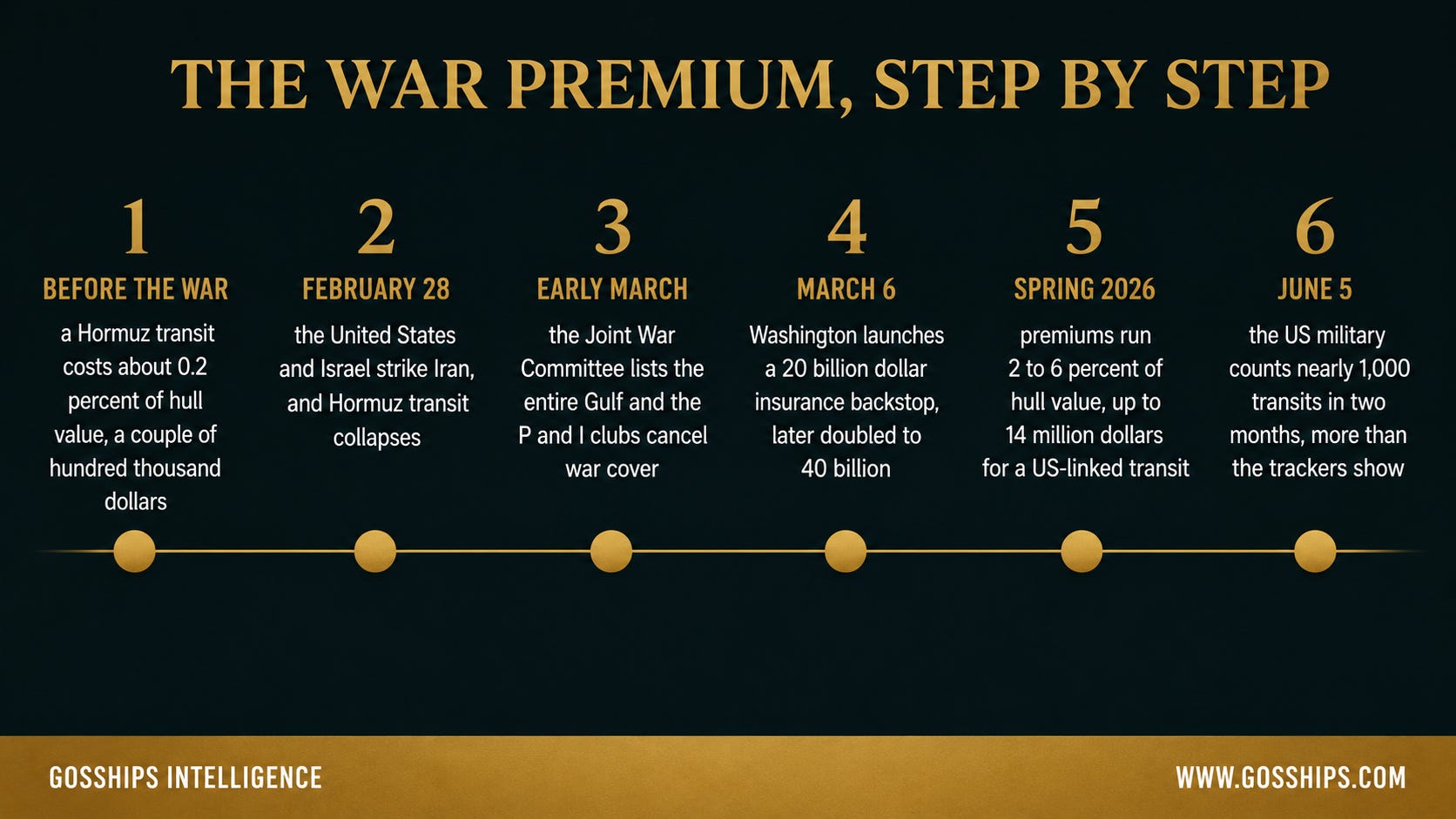
→ Before The War: A Hormuz Transit Cost About 0.2 Percent Of Hull Value, A Couple Of Hundred Thousand Dollars
→ February 28: The United States And Israel Struck Iran, And Hormuz Transit Collapsed
→ Early March: The Joint War Committee Listed The Entire Gulf And The P&I Clubs Cancelled War Cover
→ March 6: Washington Launched A 20 Billion Dollar Insurance Backstop, Later Doubled To 40 Billion
→ Spring 2026: Premiums Ran 2 To 6 Percent Of Hull Value, Up To 14 Million Dollars For A US-Linked Transit
→ June 5: The US Military Counted Nearly 1,000 Transits In Two Months, More Than The Trackers Show
🛢️ The Story
There is a single number that sits underneath every war-risk quote on the Strait of Hormuz, and this week the US military said it is wrong.
The number is the transit count, how many ships actually cross the strait, and it is what the entire marine war market leans on to judge whether the chokepoint is open, closed, or somewhere in between. Almost all of it comes from one source: the Automatic Identification System, the transponder every large ship is meant to broadcast under international rules. Tracking firms read those signals to count crossings, and the count has been brutal. Kpler put transits down roughly 92 percent from the week before the conflict. By early June, CNN reported that only seven ships crossed on a single day, five entering and two leaving, with Kpler’s Matt Smith calling the strait essentially closed. That is the picture underwriters have been pricing.
On June 5, Bloomberg reported a number that cuts hard against that. A US Central Command official, speaking anonymously because the data has not been made public, put the count of commercial crossings in and out of the strait over the prior two months at nearly a thousand, well above what the transponder trackers had logged. Bloomberg ran its own tally of the same transponder data and reached just over 650 crossings, 402 outbound and roughly 260 inbound. Set against the military’s near-thousand, that means the screens are missing something on the order of a third of the traffic. The official added a caveat that matters for anyone reading this as a tanker story: most of those vessels are large cargo and container ships rather than tankers, and the figure leaves out small craft entirely.
The military says it built the count by watching the strait without pause from the air, from ships, and from orbit in the months since the April 8 ceasefire, and it is no longer a passive observer. US forces are now in direct contact with merchant crews preparing to cross, passing along safe routing, timing, and warnings about Iranian threats through a radio, telephone, and messaging network that Admiral Brad Cooper, the current CENTCOM commander, set up during an earlier posting running the US Navy’s Middle East fleet, with transit plans routed through the Naval Cooperation and Guidance for Shipping cell in Bahrain. Asked last week how much oil was getting out, President Trump told reporters that “a lot of oil is coming into the world that people don’t even know about.”
Two things have to be said about that number before anyone builds on it. It comes from a single anonymous official, and it has not been independently verified. And even taken at face value, it does not mean the strait is back. Before the war, about 130 ships a day crossed Hormuz, according to the Congressional Research Service. Nearly a thousand over two months works out to roughly seventeen a day, somewhere near an eighth of normal. The honest reading is not that traffic has recovered. It is that more is moving than the trackers can see, and the gap between the two counts is the whole story.
The reason the trackers undercount is not a mystery, and it is the part that should make underwriters uneasy. The ships that run the strait are going dark. They switch off their transponders to avoid becoming an identifiable target, and some go further, spoofing their signals to broadcast false identities. In the weeks after the strikes, vessels were detected changing their AIS destination fields to read as Chinese-owned, or flagging themselves as Turkish or simply as a neutral vessel, then dropping the disguise once safely clear, according to wire reporting from the Gulf. The maritime risk firm Windward, which tracks this behavior, says AIS deactivation around Hormuz has become a defining operational trend, and notes that the shadow fleet, now estimated at close to a fifth of the internationally trading tanker fleet, is the fastest-growing slice of marine portfolios and the one underwriters can see least clearly. The little crude that does move tends to move this way: independent tracking identified three dark-transit supertankers in a single week carrying roughly six million barrels, almost all of it loaded quietly and run without a clean signal.
Now connect that to how the cover is actually priced. Hull war works on a baseline annual policy, but the real money is the additional premium an underwriter is entitled to charge for each transit through an area the Joint War Committee has listed as high risk, and Lloyd’s List notes that underwriters can set that additional premium as high as they see fit. After the February 28 strikes, they did. Al Jazeera reported quotes jumping from about 0.2 percent of a ship’s value to around 1 percent within forty-eight hours, which on a hundred-million-dollar tanker is the difference between roughly two hundred thousand dollars a transit and a million. In early March the Joint War Committee listed the entire Gulf, and S and P Global reported that all twelve International Group P and I clubs, which between them cover about 90 percent of the world’s oceangoing tonnage, issued seventy-two-hour notices cancelling certain war cover. By the spring, Marsh’s UK marine war lead Dylan Saunders-Mortimer told Marketplace that rates were running 2 to 6 percent of a ship’s value, with Lloyd’s List reporting quotes around 5 percent for vessels with US, UK, or Israeli links and a US-chartered supertanker facing somewhere between ten and fourteen million dollars for a single run.
Here is where the official narrative starts to come apart, and the people pulling it apart are the underwriters themselves. The widely repeated line that the strait closed because insurance vanished is one the Lloyd’s market has explicitly rejected. The Lloyd’s Market Association issued a formal statement calling reports that cover had been cancelled or was unaffordable “not accurate,” and a survey of its marine war participants found that 88 percent had retained appetite to write hull war risk and more than 90 percent were still offering cargo cover. Munro Anderson of the marine war specialist Vessel Protect described what the market was actually facing as a “perception of threat rather than a tangible blockade.” Brandan Holmes of Moody’s captured how the cover was still being written: insurers wanted a ship “pointed at the Strait with its engines on” and ready to move, and then they would put a price on it and give the owner forty-eight hours to complete the passage. The market never shut. It priced a lethal risk and told shipowners the answer they did not want to hear.
Put the transit gap and the open market together and the implication for pricing is sharp. A war-risk premium is, at bottom, a probability of loss multiplied by a severity, and the probability is the rate at which a ship that attempts the passage gets hit. The numerator there is reasonably visible: the UK Maritime Trade Operations centre logged 23 attacks on vessels between March 1 and April 29. The denominator is the number of voyages, and the denominator is exactly what the transponder count understates. The two windows do not line up neatly, so this is not a clean ratio, but the direction is unambiguous.
Gosships Read: If real transits are materially higher than AIS shows, then the realized attack-per-voyage rate is lower than the near-empty, every-ship-a-target picture implies, and that is the empirical case for the Gulf war premium to start coming down rather than climbing.
It is only half the case, though, and the other half is why premiums have not simply collapsed. The behavior generating those hidden voyages, going dark, is the same behavior that breaks the cover it would justify. Keeping an active transponder is a safety requirement under the international SOLAS convention and a baseline expectation in a war-risk policy; switching it off, or spoofing it, is the classic red flag underwriters associate with sanctions evasion and the shadow trade, and it leaves a carrier unable to verify the very voyage it is insuring. Then there is a deeper problem that one broker named directly. Saunders-Mortimer told Marketplace that US or Israeli involvement “almost removes the fortuity of the risk,” because war cover depends on a loss being uncertain, and when a belligerent controls the timing and a US-linked ship is all but certain to be targeted, the actuaries have nothing to model. Attacks, meanwhile, have not stopped: the MSC Sariska V was holed by two projectiles at an Iraqi port in early June, and US forces struck Iranian coastal radar on June 6 after Tehran sent drones toward the strait. Lloyd’s List has reported a market view that premiums may still have farther to travel, not less.
And then there is the monument to getting this wrong. On March 6, Washington launched a government-backed fix for a shortage of cover the market kept insisting it did not have: a US International Development Finance Corporation reinsurance facility, with Chubb as lead underwriter, initially twenty billion dollars and expanded in early April to forty billion as Travelers, Liberty Mutual, Berkshire Hathaway, AIG, Starr, and CNA joined. Three months on, the Congressional Research Service noted it was unclear whether the facility had provided any coverage at all. The reason is structural. Cover under the program is available only to vessels transiting under US naval escort, and the escort never materialized at scale. A short-lived effort called Project Freedom guided two ships through in early May and was then abandoned. A Chubb spokesperson put it plainly: the facility insures ships transiting under naval escort, and “there has been no escort.” Forty billion dollars in capacity has sat on paper, aimed at a coverage gap the Lloyd’s market said never opened in the first place.
So the official story, the one that says the strait is closed and ships cannot move and a government backstop is the fix, is built on a transit count that undercounts the traffic and a premium that the market itself says reflects perception as much as peril. The question every underwriter, broker, and charterer is now circling is the one this story turns on: when does the war premium break, what is the signal that breaks it, and who is positioned for the move. That, and what we are watching to call it, is below.
📊 By The Numbers
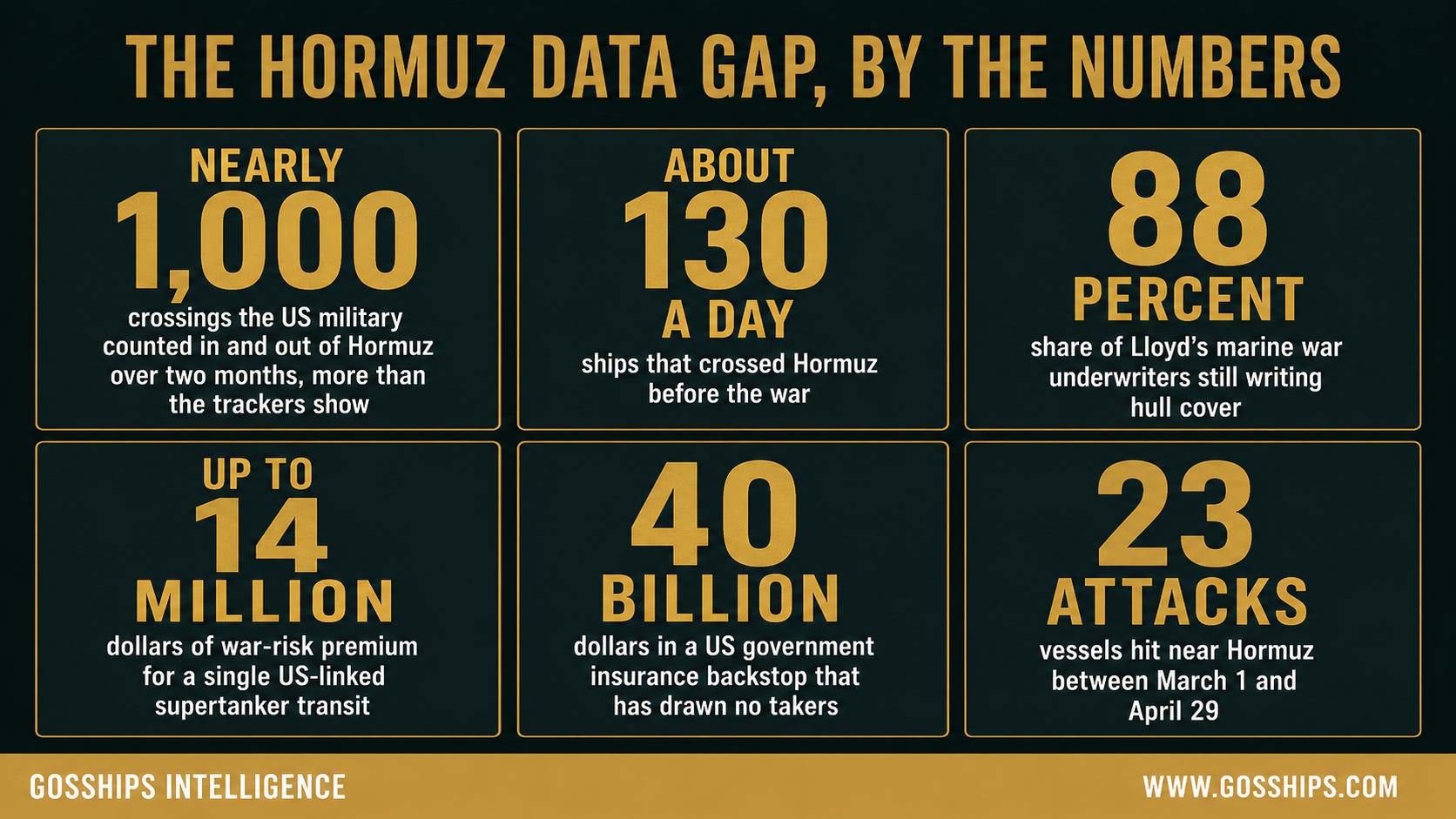
→ Nearly 1,000: Crossings The US Military Counted In And Out Of Hormuz Over Two Months, More Than The Trackers Show (Bloomberg, US Central Command)
→ About 130 A Day: Ships That Crossed Hormuz Before The War (Congressional Research Service)
→ 88 Percent: Share Of Lloyd’s Marine War Underwriters Still Writing Hull Cover (Lloyd’s Market Association)
→ Up To 14 Million Dollars: War-Risk Premium For A Single US-Linked Supertanker Transit (Lloyd’s List)
→ 40 Billion Dollars: The US Government Insurance Backstop That Has Drawn No Takers (DFC, Chubb)
→ 23 Attacks: Vessels Hit Near Hormuz Between March 1 And April 29 (UKMTO)
Related Coverage
The Insurance Market Closed The Strait Of Hormuz Before Iran Did. Here Is What VLCC Rates Reveal.
Sinokor Is Charging $20 Per Barrel to Ship Oil. Last Year It Was $2.50. They Control 40% of Available Tankers. Nobody Can Do Anything About It.
MSC, COSCO, HMM and Other Container Giants Are Quietly Building Crude Tanker Fleets. What’s the Strategy?
The gap between what the trackers see and what the satellites see is easy to state and hard to trade. The harder part is who carries the exposure, what flips the premium, and what it means for the books of the people writing and buying this cover. There is also a quieter reading of the same data that suggests the war premium is closer to its peak than its floor, and that the next move may be down. That analysis, and the signals we are watching to call the turn, is below.
🔍 Why It Matters
The data gap is not a trivia point about ship tracking. It is an underwriting input, and every audience that touches a Gulf voyage is exposed to it differently.
