


⚓ The Gosships Team
Gosships Intelligence Is Published At Gosships.com
For Sponsorship And Partnership Inquiries Contact intelligence@gosships.com
|⚓ About Us | 🛢️ Exclusive Report | 📋 SwiftAction Training |
🏅Black Gold Membership (*53 Slots Left)
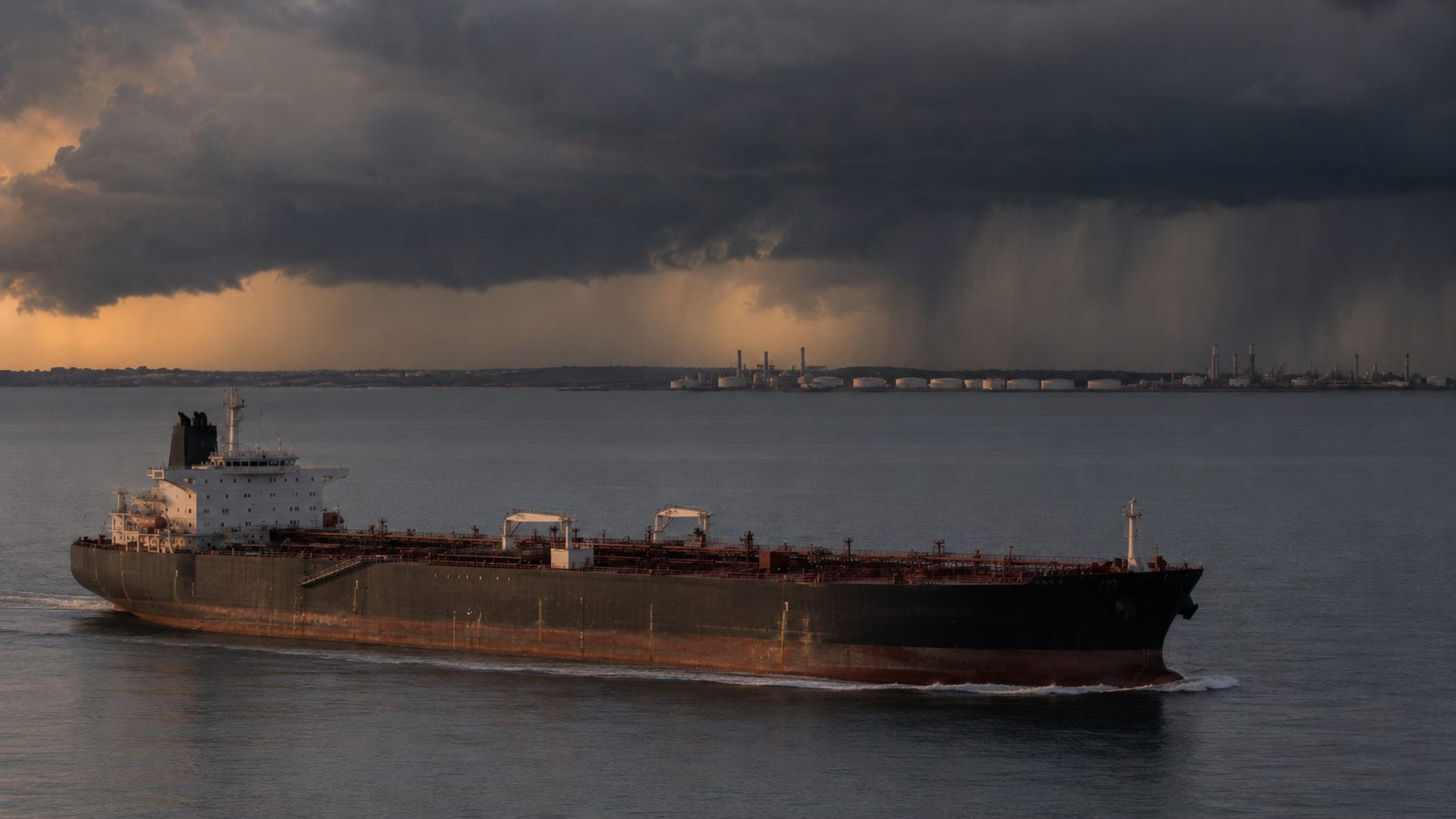
Trafigura earned more in six months than it did in the whole of last year, and its own report says a substantial portion was banked before the first strike on Iran. The half year that produced those numbers closed with just one month of war inside it. The six months now on the clock contain the war’s peak, the peace at Versailles, and a market trying to decide what traders are worth when the shooting stops. That is the half everyone will actually be grading.
📋 In This Issue:
🛢️ The Story
📊 By The Numbers
🔍 Why It Matters
👀 What To Watch
🚨 Gosships Signal
🔔 Not Subscribed? Gosships Intelligence Delivers Oil Shipping Intelligence. Subscribe Here!
📊 Order Our Exclusive Report
→ Global Tanker Market Outlook Q3 2026 Edition
📋 Competency-Based Maritime Training
→ SwiftAction
📌 Gosships Data Card
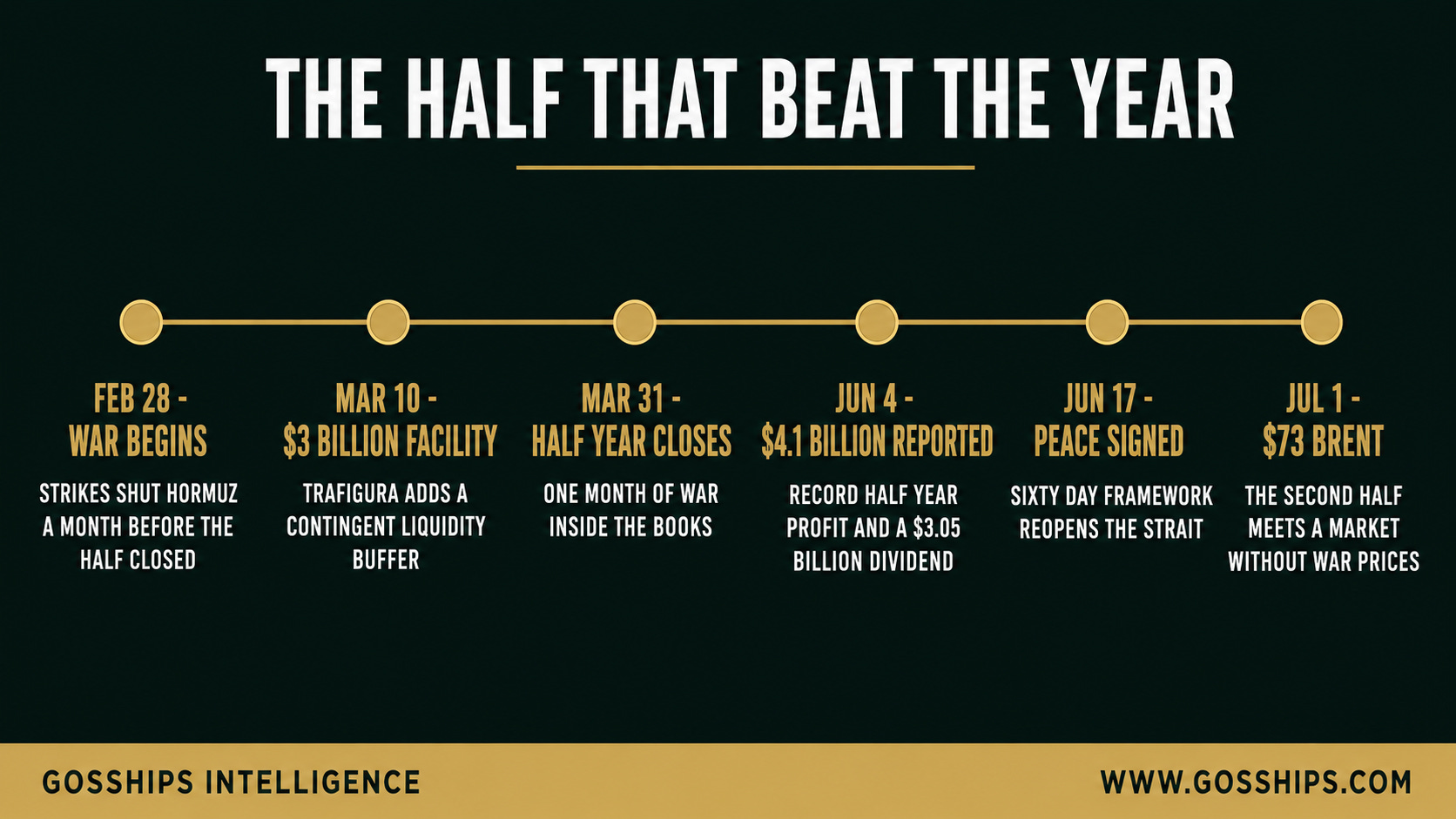
→ Feb 28: US and Israeli strikes on Iran begin, effectively shutting the Strait of Hormuz to normal tanker traffic one month before Trafigura’s half year closed (US Energy Information Administration, Short Term Energy Outlook)
→ March 10: Bloomberg reports the top energy traders lining up around $7 billion in fresh credit, including Trafigura’s $3 billion contingent liquidity facility
→ March 31: Trafigura’s 2026 first half closes with roughly one month of war inside the books (Trafigura 2026 Half Year Report)
→ June 4: Trafigura reports $4.1 billion in half year profit, beating all of fiscal 2025, and allocates a record $3.05 billion dividend (Trafigura press release; Bloomberg, June 4, 2026)
→ June 17: Trump and Pezeshkian sign the 14 point framework reopening Hormuz toll free for 60 days (NBC News)
→ July 1: Brent trades near $73, down almost 40 percent from the April war peak, as the second half runs without war prices (CNBC)
🛢️ The Story
On June 4, Trafigura Group published a set of results that rearranged the league table of the war. Net profit for the first half of its 2026 financial year, the six months from October 2025 through March 2026, came in at $4.1 billion, according to the company’s published results and Bloomberg’s same day coverage. That is more than the $2.7 billion the group earned in the whole of fiscal 2025. Chief executive Richard Holtum kept the language dry. “These results demonstrate the value of the diversified platform we have built, and the importance of disciplined execution,” he said in the company’s announcement.
The board’s language was louder. Trafigura allocated a record $3.05 billion dividend to its employee shareholders for the half, per Bloomberg and Invezz, more than the roughly $2.9 billion distributed for all of fiscal 2025. Trafigura is owned by its own senior staff, so that record payout lands in the accounts of the people who ran the trades. Underlying EBITDA more than doubled to $7,921 million from $3,930 million a year earlier, per the company’s financial review. Traded volumes of oil, petroleum products, natural gas and LNG reached 8.7 million barrels per day, up 21 percent on the first half of 2025. Group equity rose to $17.5 billion and liquidity hit a record $19.4 billion, including a new $3 billion contingent facility.
Then there is the sentence that turns a results release into a story. In its own half year financial review, Trafigura wrote: “A substantial portion of the period’s profits had been secured before the conflict in the Middle East began at the end of February 2026, leaving the Group well positioned to respond when conditions changed.”
Sit with the calendar for a moment. Trafigura’s first half ran from October 1 to March 31. The war began on February 28, when United States and Israeli strikes on Iran triggered retaliatory attacks on Gulf shipping and the effective closure of the Strait of Hormuz, with the US Energy Information Administration recording shipping traffic as extremely limited from that date. That leaves roughly one month of war inside a six month reporting period. The record half was not primarily a war windfall. By the company’s own account, the bulk of it was earned in the quiet, positioning through the winter while the market argued about escalation risk.
That is what makes the question in the headline fair, and worth being precise about. There is no evidence, and no suggestion here, that Trafigura knew what was coming. The honest version of the question is the one every rival trading desk is asking: was the group positioned for generic winter tightness and disruption risk that happened to detonate, or did its analysts simply read the same escalation signals everyone else saw and act earlier? Either answer is legal. Only one of them is repeatable, and the difference is worth billions.
What the war month did test was the machine itself. When Hormuz shut, dramatic price swings hit energy markets, per Bloomberg’s March 10 reporting, and the resulting margin calls sent the industry scrambling for cash. Bloomberg reported on March 10 that the top energy traders lined up around $7 billion in fresh credit, and Trafigura’s contribution to that scramble, a $3 billion facility described at the time as a liquidity buffer for a period of heightened volatility, now sits in the half year report relabeled as prudence: record liquidity of $19.4 billion. The facility raised in the panic became the balance sheet flex in the presentation. That is not an accusation. It is how the strongest houses work: the same dislocation that forces weaker hands to shrink gets refinanced into ammunition.
The freight market Trafigura trades against went vertical in the same window, with the Baltic Exchange’s TD3C VLCC benchmark hitting a record $423,736 per day in early March, per Baltic Exchange data reported by Seatrade Maritime. A house moving 8.7 million barrels per day does not watch that from the sidelines; every voyage, every demurrage clause and every storage decision repriced in real time.
Now look at the half nobody has reported yet. Trafigura’s second half runs from April 1 to September 30. Inside it so far: Brent’s war peak of $118 in April, per CNBC. The blockade that froze Iranian exports for roughly two months. The June 17 framework signed by Donald Trump and Masoud Pezeshkian, one signature at a Versailles dinner and one in Tehran per NBC News, reopening the strait toll free for 60 days. The export sprint that followed, with TankerTrackers.com estimating 50 million barrels of Iranian crude shipped in two weeks, per CNBC’s July 1 reporting. And the unwind: Brent just closed out its worst quarter since 2020, per CNBC, traded near $73 on July 1, and eased further as the first Doha round concluded. The diplomacy is moving just as fast. The round itself convened only after weekend clashes, per CNBC’s June 29 reporting; Qatar cited positive progress in the indirect Doha meetings, per CNN; Trump told reporters the negotiations were going well, per CNBC; and Axios reports a live dispute over whether Iran charges tolls once the free window ends.
Trafigura’s own guidance for that half is one measured line: performance has continued to be good in the second half to date, but the external environment is difficult to forecast given political tensions and market volatility, per the company’s June 4 release as reported by Invezz. Translate the caution: the group just told the market its record half was mostly built before the war, and that the war half now in progress started well. If that holds through September, fiscal 2026 does not just beat fiscal 2025. It rewrites what a normal year is supposed to look like for a house that moves nearly 9 million barrels per day.
The peer set frames the stakes. Vitol told banks it made roughly $2 billion in the first quarter despite nine figure derivatives losses, per Bloomberg. Mercuria earned $1.43 billion and Gunvor just $104 million in 2025, per Reuters figures via Global Banking and Finance Review. Trafigura’s $4.1 billion half is, for now, the largest profit figure any major trading house has put on the record since the war began, and it came with the smallest disclosed war exposure. Which is exactly why the second half report, due after September, is the one the whole market will read line by line.
What the locked in profits actually were, how the second half is positioned for the mid August cliff, what a record dividend to employee owners signals about the cycle, and the six markers that will show whether the war half beats the quiet half: all of it is below.
