


⚓ The Gosships Team
Gosships Intelligence Is Published At Gosships.com
For Sponsorship And Partnership Inquiries Contact intelligence@gosships.com
|⚓ About Us | 🛢️ Exclusive Report | 📋 SwiftAction Training |
🏅Black Gold Membership (*53 Slots Left)
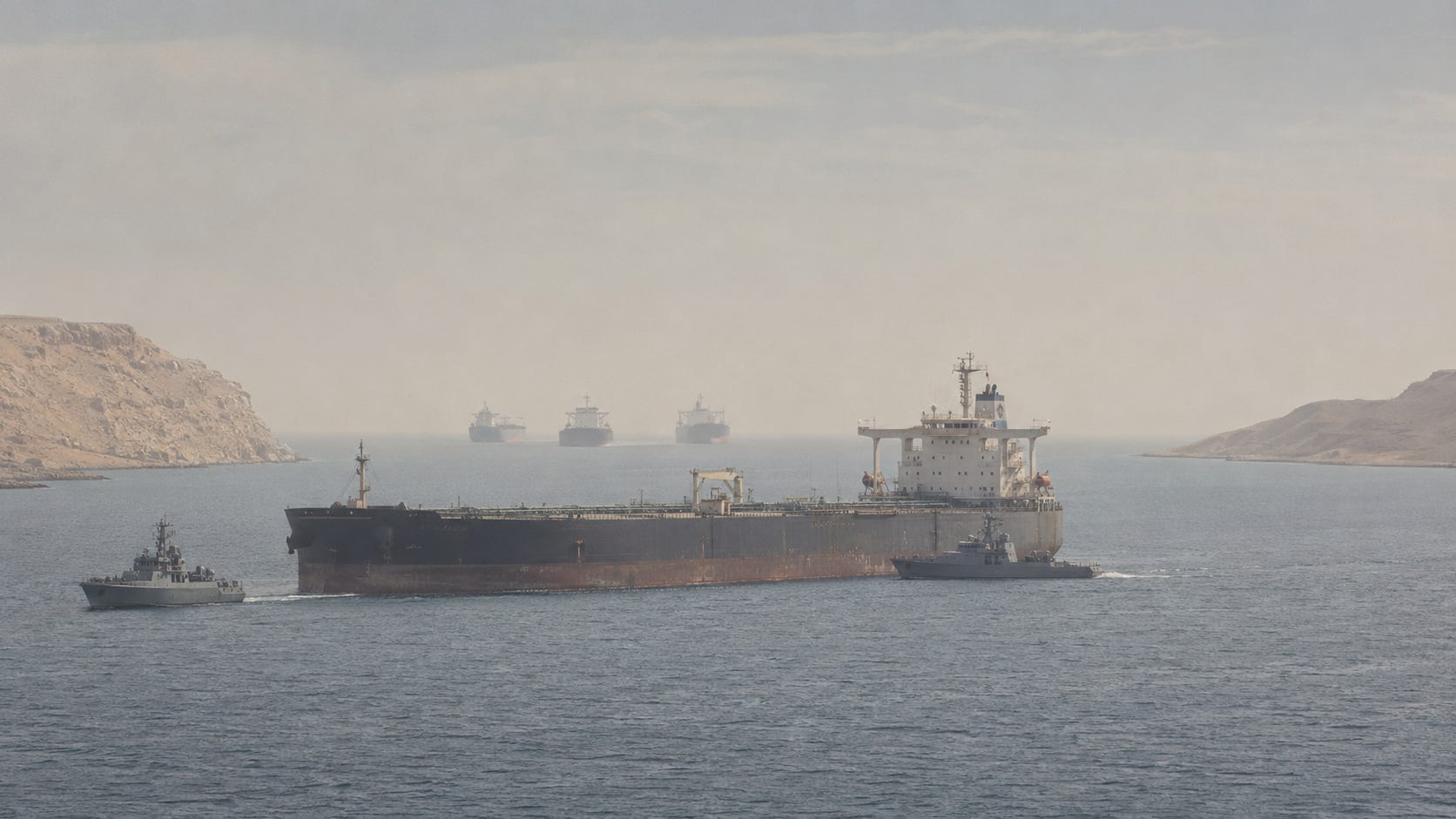
The free ride through the Strait of Hormuz has an expiration date, and Iran is already writing what comes after it. The June 17 framework bought the world 60 days of toll free passage through the artery carrying roughly a fifth of its traded oil. Iran’s parliament is drafting legislation to make transit fees permanent, Tehran is claiming the right to administer the strait and charge for it, and Washington spent this week’s Doha round trying to talk it out of exactly that. Around August 16, one of them runs out of road.
📋 In This Issue:
🛢️ The Story
📊 By The Numbers
🔍 Why It Matters
👀 What To Watch
🚨 Gosships Signal
🔔 Not Subscribed? Gosships Intelligence Delivers Oil Shipping Intelligence. Subscribe Here!
📊 Order Our Exclusive Report
→ Global Tanker Market Outlook Q3 2026 Edition
📋 Competency-Based Maritime Training
→ SwiftAction
📌 Gosships Data Card
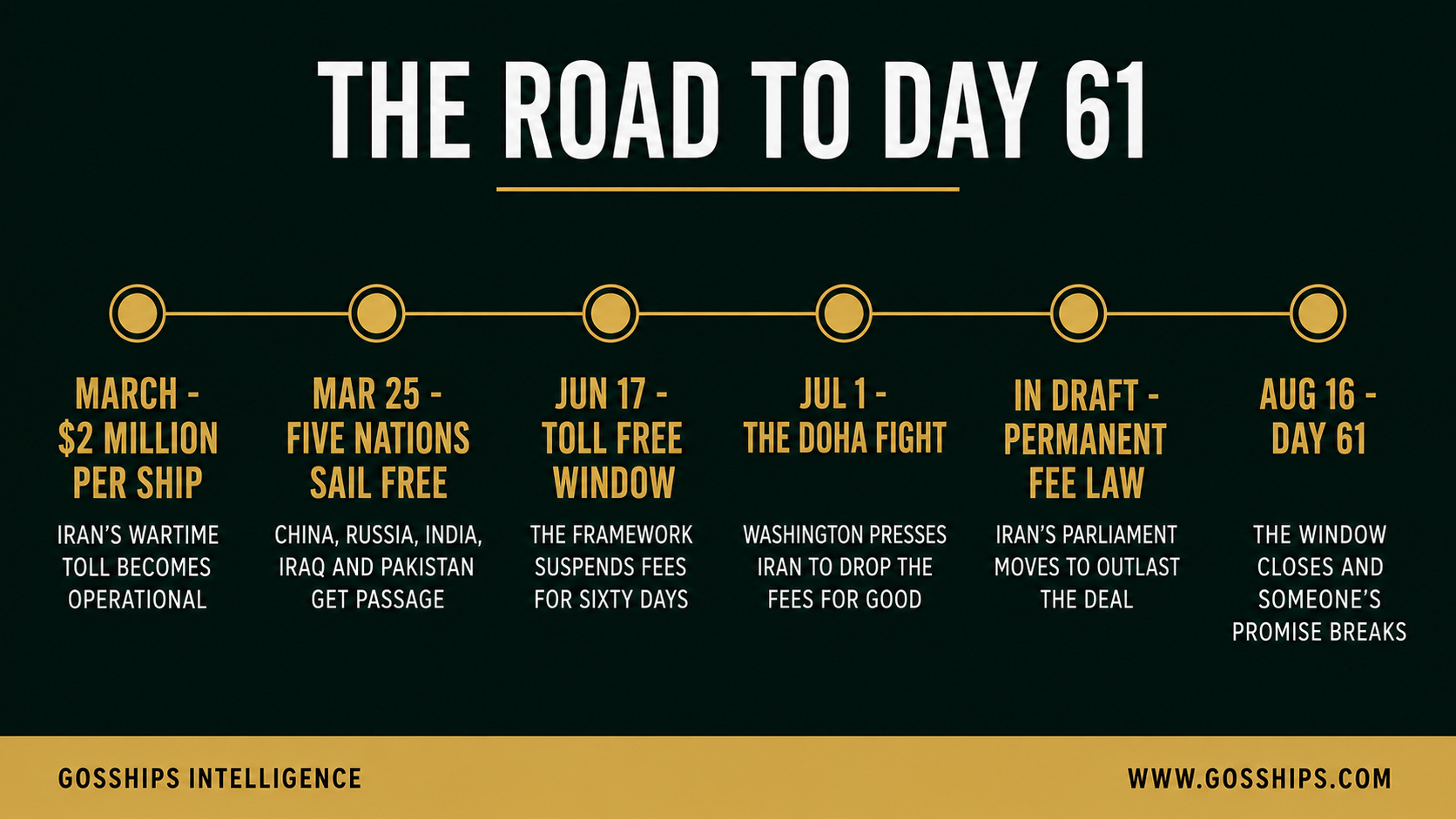
→ March: Iran’s wartime transit toll becomes operational, with charges reported up to $2 million per vessel (Kurdistan 24; Sourcing Journal)
→ March 25: Foreign Minister Abbas Araghchi names China, Russia, India, Iraq and Pakistan as permitted to transit, saying “We are in a state of war” (Akashvani, March 25; Newsweek; Al Jazeera explainer)
→ June 17: The Trump and Pezeshkian framework reopens the strait toll free for 60 days, suspending the fee regime (NBC News)
→ July 1: The US uses the resumed Doha talks to press Iran to drop plans for tolls once the window ends (Axios)
→ In draft: Iran’s parliament works on legislation to impose a $2 million transit fee as a permanent system (The Standard; Sourcing Journal)
→ August 16: The 60 day window expires, by date arithmetic from the June 17 signing (Gosships Intelligence calculation from NBC News terms)
🛢️ The Story
Iran has already answered the question in this headline once. For roughly three months of war, the Strait of Hormuz operated as the world’s most expensive checkpoint: vessels seeking passage through Iranian waters underwent vetting by the Islamic Revolutionary Guard Corps and paid for the privilege, with charges reported as high as $2 million per vessel, per Kurdistan 24 and Sourcing Journal reporting from the period. What is new is what Tehran is building for the day the peace framework’s meter starts running again.
Start with the wartime architecture, because it is the template. On March 25, Foreign Minister Abbas Araghchi named the nations whose ships could transit at all: China, Russia, India, Iraq and Pakistan, per India’s Akashvani news service, with Al Jazeera’s explainer detailing the same list. His justification was unapologetic: “We are in a state of war. The region is a war zone, and there is no reason to allow the ships of our enemies and their allies to pass through,” per Newsweek’s contemporaneous coverage. Malaysia later negotiated its own exemption directly with Tehran, per The Standard. Passage, in other words, became a bilateral diplomatic product, priced by relationship.
The June 17 framework switched the meter off. Donald Trump and Masoud Pezeshkian’s 14 point agreement reopened the strait to commercial traffic without tolls for 60 days, with Iran committing its best efforts for that window only, pending a permanent deal, per NBC News. Trump has publicly staked out the endgame: the strait will be “permanently toll-free,” per Newsweek, with Vice President JD Vance telling CNBC it would remain toll free “for the long term.”
Tehran is staking out the opposite one, in public and in legislation. Iranian officials insist the country holds joint sovereignty over the strait with Oman and intends to administer passage and request fees once the 60 day term ends, per Al Jazeera’s July 1 coverage of the Doha talks. Iran’s parliament is drafting legislation to impose a $2 million transit fee as a formal, permanent system, per The Standard, and Sourcing Journal reports the move toward a formalized toll structure has continued through the peace process. Tehran’s framing is deliberate: these are maritime service fees, covering navigational assistance, escort and environmental services, not tolls, per Gulf News. A maritime strategist quoted by Yahoo Finance called that distinction what it is: code for safe passage.
That word game is not cosmetic. It is the whole fight. Under the law of the sea as most of the world reads it, Hormuz is an international strait subject to transit passage that cannot be suspended or conditioned on payment, a position laid out in legal analyses from the Eno Center and Just Security. Iran, which signed but never ratified the convention, reads its own territorial waters differently. And the fees versus tolls distinction is engineered for the negotiating table: a toll on an international strait is a treaty breach, while a service fee for an escort you accepted is a commercial arrangement. One can be denounced. The other can be invoiced.
This week, the fight moved into a conference room in Doha. The first indirect round since the weekend clashes convened with Qatar and Pakistan mediating, and per Axios, the American case is precisely that Iran stands to gain more from a broader deal than it could ever collect at the checkpoint: Washington is trying to talk Tehran out of charging tolls once the free window ends. Qatar reported positive progress on implementation issues, per CNN, and Trump told reporters the negotiations were going well, per CNBC. Pezeshkian, meanwhile, set his own price for sequence: Iran expects $6 billion of frozen funds released as a first step, per Al Jazeera. Nobody in the room disputes that the window closes. The dispute is what the strait costs on the other side of it.
The traffic numbers explain why both sides care this much. Before the war, roughly 110 vessels a day transited Hormuz; in the past 24 hours, Al Jazeera’s live tracking put it at about 35, with 20 entering the Gulf and 15 leaving. The strait is legally open and commercially two thirds empty. Major carriers and oil companies suspended Hormuz shipments during the war, per Reuters reporting, insurance cover shrank or repriced with them, and the market has not rebuilt what the framework has not guaranteed. Every owner deciding whether to send tonnage back through is pricing the same two dates: the next Doha session, and August 16.
August 16 is not an official deadline published by either government. It is arithmetic: 60 days from the June 17 signing, the day Iran’s best efforts commitment to toll free passage lapses if no permanent deal replaces it. Three scenarios come out of that date, and the market is quietly pricing all of them. A permanent deal that extends free passage, which is Washington’s stated objective. A reversion to the wartime fee regime, now upgraded from IRGC practice to parliamentary law, which is what Tehran’s legislation is built to enable. Or the ugly middle: no deal, no law, and a strait where passage depends, ship by ship, on flag, relationship and nerve, which is roughly what March looked like.
The parliamentary law is the piece the market has not priced properly, because it changes the nature of the thing. A wartime toll collected by the IRGC was an emergency measure that ended with the emergency. A transit fee written into Iranian statute is a permanent revenue claim on the world’s most important oil artery, one that survives this negotiation, this government and this news cycle. Whatever gets signed in Doha, a law on the books in Tehran becomes the default answer to every future crisis: the meter exists, it merely needs switching on.
Who pays if it comes back, why the fees versus tolls wording decides whether Western ships can legally pay at all, what a $2 million charge does to the economics of a two million barrel cargo, and the six markers that will tell you which scenario wins before August 16 announces it: all of it is below.
