


⚓ Gosships Intelligence
Gosships Intelligence Is Published At Gosships.com
For Sponsorship And Partnership Inquiries Contact intelligence@gosships.com
|⚓ About Us | 🛢️ Exclusive Report | 📋 SwiftAction Training |
🏅Black Gold Membership (*53 Slots Left)
Iran’s Persian Gulf Strait Authority published its Non-Compliant Vessels list on X late on Sunday, August 23. It runs to 46 lines and 45 distinct vessels, and every line carries a vessel name and an IMO number. Reuters reproduced the table in full, de-duplicated to 45 rows. There is no owner column on it, so every ownership attribution now in circulation was made by a reporter reading hull names against a register: eight vessels to ADNOC Logistics and Services, five to Sinokor, three to Bahri, two to Nakilat. On September 2, Janggeum Shipping answered for the Korean five and for the vessel that had just been hit. All six are “100% owned by overseas shipowners” [”해외 선주가 100% 소유한 선박”], it said, and the affiliate Janggeum Maritime “does not hold actual ownership rights” [”실소유권을 가지고 있지 않다”].
Take that seriously rather than as a dodge, because nothing in the register contradicts it.
The list is an identification instrument. It works by naming hulls, and Tehran built it to be actionable: it tells charterers, on Maritime Executive’s account, that they must review it before fixing, it threatens fines, detention and confiscation, and it says any vessel that works a transfer alongside a listed hull joins the list. Every one of those consequences attaches to a vessel name and a number.
The fleet it is aimed at is assembled such that a vessel name and a number lead almost nowhere. Riviera Maritime Media examined Equasis records in February across nine hulls and found four VLCCs renamed and listed directly under Sinokor, five more under entities that appeared related, and one name recurring across most of them as owner or manager: Haut Brion, registered mainly in Liberia and in two instances in Panama. The vessels carry a country and the word Prosperity, or a city and the word Energy. Nobody outside the transaction can say how many Haut Brion entities exist, and nobody has named a beneficial owner behind any of them.
So both things hold at once. Sinokor Maritime is the commercial manager the registers record. Janggeum Maritime holds an intermediate charter position, reported in the Korean trade press as taking the vessel on charter and putting it out again to an oil company overseas. And the equity sits somewhere neither the list nor the register reaches.
That is the finding, and it is not a finding about one Korean company. Iran has published an instrument that identifies and penalises hulls, into a market whose hulls now sit in the single-purpose company structure the industry has always used, in which a hull identifies almost nothing.
📋 In This Issue:
⚖️ The Story:
What the list publishes and what it demands, the five vessels attributed to Sinokor and the naming series four of them share, how many of the 45 had already been attacked before they were named, what has happened to crews in this strait since July, the two VLCCs struck on August 31 that are not on it, precisely what was denied on September 2 and what was admitted in the same 24 hours, the case for Sinokor at its strongest, the owning entity nobody can count, and what an instrument that acts on steel can and cannot reach.
📊 By The Numbers:
The 45, the 14, the eight, the five, the three, the 11 nobody has reproduced, the six seafarers killed since July, the $647,000 assessment and the premium behind it.
🔍 Why It Matters:
What changes for the VLCC owner, the charterer, the war risk underwriter and the compliance officer.
👀 What To Watch:
The five markers between now and the next list update, including the two that would prove this reading wrong.
🚨 Gosships Signal:
What a list of hull names can and cannot reach, and what it cost on the night of August 31.
🔔 Not A Member? Unlock The Full Analysis, Data Cards, Archive, & More!
📊 Order Our Exclusive Report
→ Global Tanker Market Outlook Q3 2026 Edition
📋 Competency-Based Maritime Training
→ SwiftAction
🔗 Related Coverage


📌 Gosships Data Card
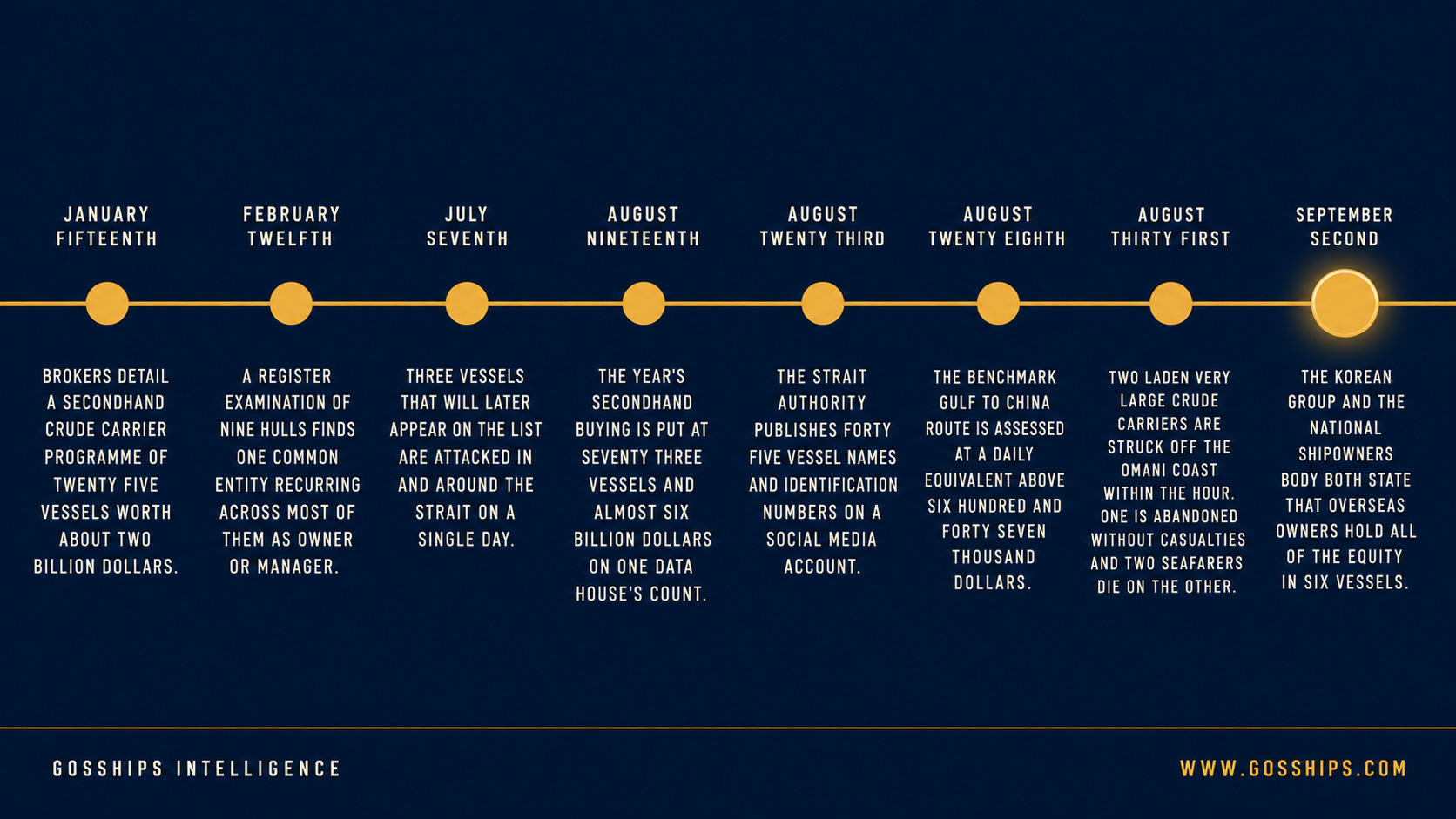
January 15, 2026: Shipbrokers itemise a secondhand VLCC programme bought over the preceding holiday season, “25 vessels built between 2007 and 2016, averaging 12 years of age, in deals valued at around US$2Bn”. One line in it links Chandris (Hellas) to a sale of the 2011-built Oceanis at “around US$68M”.
February 12, 2026: An examination of Equasis records across nine hulls finds four VLCCs renamed and listed directly under Sinokor since January and five more under entities that appear related. One name recurs across most of them as owner or manager: Haut Brion, registered mainly in Liberia and in two instances in Panama. Six of the nine take a city followed by Energy, three a country followed by Prosperity.
July 7, 2026: Three vessels that will appear on Iran’s list just under seven weeks later are attacked near the Strait of Hormuz on a single day: Nakilat’s LNG carrier Al Rekayyat, Bahri’s VLCC Wedyan and the Sinokor-linked Cyprus Prosperity.
August 19, 2026: Splash247, citing VesselsValue, puts Sinokor’s 2026 secondhand tanker buying at 73 vessels for $5.925 billion, a figure it measures against the next eight largest buyers in the market combined, taking Sinokor to around 10 percent of the global VLCC fleet. It dates the accumulation to the previous November.
August 23, 2026: The Persian Gulf Strait Authority posts its Non-Compliant Vessels list on X. It runs to 46 lines carrying 45 distinct vessels, each with a name and an IMO number, and one vessel appears twice under two names. Reporters attribute eight of the vessels to ADNOC Logistics and Services, five to Sinokor, three to Bahri and two to Nakilat.
August 28, 2026: The Baltic Exchange assesses TD3C, Middle East Gulf to China, at WS623, “which corresponds to a daily round-trip TCE of just over $647,000 for the standard Baltic VLCC”. The last assessment before the war, on February 27, was WS216.89 and $209,550.
August 31, 2026: UKMTO Warning 124-26 times an incident at 20:00 UTC, 17 nautical miles east of Khasab: a tanker struck by three projectiles on an outbound transit, later identified as the Sinokor-managed VLCC Senegal Prosperity, which is abandoned, listing to port and dead in the water. Fifty minutes later, at 20:50 UTC on the same advisory service’s timing, Bahri's VLCC Sidr is struck 16.6 nautical miles northeast of Khasab. Two of the Sidr's Filipino seafarers are killed; the Senegal Prosperity's crew are taken off without casualties. Each vessel had loaded two million barrels of Saudi crude at Ju’aymah. Neither is on the August 23 list.
September 2, 2026: Janggeum Shipping and the Korea Shipowners’ Association both state that the abandoned VLCC, together with the five hulls Iran’s list is read as covering, are owned 100 percent by overseas shipowners, and that Janggeum Maritime holds no beneficial ownership. Bahri confirms the deaths of two of its Filipino crew. Within the same 48 hours the Persian Gulf Strait Authority adds 11 vessels to its list on its website, taking the total to 56, and no outlet reproduces the names.
Sources: Reuters via KFGO, August 24, 2026; Seatrade Maritime, August 24, September 1 and September 2, 2026; Maritime Executive, August 24, 2026; Splash247, August 19 and August 25, 2026; Newsweek, August 24, 2026; Riviera Maritime Media, January 15 and February 12, 2026; UKMTO Warning 124-26, August 31, 2026; Joint Maritime Information Center Update 092, September 1, 2026; Baltic Exchange Tanker Report Weeks 9 and 35, 2026; Reuters via MarineLink, September 2, 2026; The Guru, September 2, 2026; MoneyToday, September 2, 2026; Haesa News, August 26 and September 3, 2026; Bloomberg via Insurance Journal, September 1, 2026; Al Jazeera and Asharq Al-Awsat, September 2, 2026; NewsWatch Plus PH, September 2, 2026.
⚖️ The Story
What The List Publishes
Three features of the document matter here.
It is built for identification. The document runs to 46 lines and each line carries a vessel name and an IMO number. One vessel is entered twice, under her current name Vadin and her former name Lila Vadinar, both against IMO 9324100, which is why 46 lines describe 45 hulls. Reuters reproduced the de-duplicated table in full. Newsweek ran a flag analysis across it and found 21 of the entries Liberian and seven Marshall Islands, across 17 flag states in all.
Its consequences all attach to a hull. Listed vessels “shall face restrictions on future passages, including fines, detention, or confiscation”. Removal is possible: “To request removal, vessels must submit a formal application with justifications.” Charterers are told to police it themselves: on Maritime Executive’s account the authority warns companies to check the list before they fix, so as to avoid trouble later. And the clause that made the instrument travel reaches the next hull to work with a listed one: "Effective immediately, any vessel cooperating with listed vessels (via STS, transshipment, etc.) will be added to the list."
And it carries no owner column. There is no company name anywhere on it.
