


⚓ Gosships Intelligence
Gosships Intelligence Is Published At Gosships.com
For Sponsorship And Partnership Inquiries Contact intelligence@gosships.com
|⚓ About Us | 🛢️ Exclusive Report | 📋 SwiftAction Training |
🏅Gold Executive Membership (*53 Slots Left)
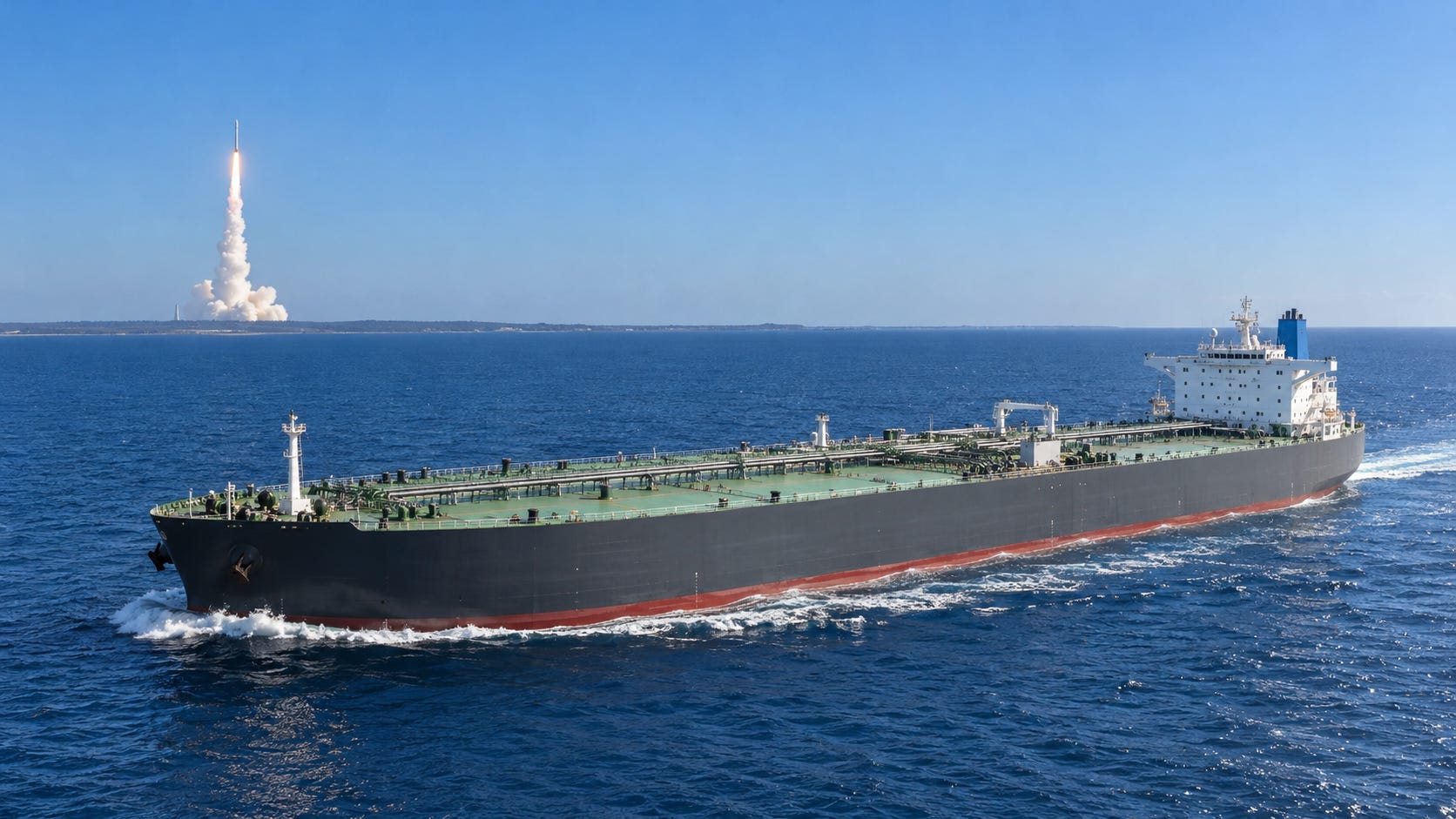
Bloomberg reported on October 9, citing Gibson Shipbrokers, that the cost of hiring a tanker for a US to China voyage had reached about $80 million, more than the $74 million list price of a SpaceX Falcon 9 launch. The Baltic Exchange’s own benchmark backs the broker. Its weekly report for the week to October 9 put TD22, a cargo of 270,000 metric tons from the lightering area off Galveston, Texas, to Ningbo in China, at $79,611,111, and Clarksons Research priced the trip at $37.50 a barrel, against $5 in 2025. TD22 topped the launch price for six business days from October 7, until a fall of $5,122,223 on October 15 took it to $70,583,333, in Baltic data published by the broker Optima Shipbroking. Bloomberg put the fare down to a global tanker shortage, and on our reading the market data show why VLCCs were so scarce. Roughly four-fifths of the crude that crossed Hormuz in the days to October 9 appears to have changed vessels in the Gulf of Oman, by Clarksons Research’s estimate, so each of those cargoes tied up two tankers. A standard VLCC also earned more than twice as much on the Middle East Gulf to China run that week as on the US route, on the Baltic’s figures and our arithmetic. One Asian refiner provisionally agreed to pay anyway. Japan’s Cosmo Oil has a VLCC on provisional charter at $81 million to lift US crude on November 19 to 21, Reuters reported on October 9. On spot arithmetic the trade does not pay. S&P Global reported on October 8 that soaring tanker rates had in effect shut the spot window for sending US crude east, with the WTI arbitrage to Northeast Asia sitting at minus $19.77 a barrel that day by the reckoning of CERA, S&P Global’s energy research arm. “Record freight and crude costs crushed margins in Europe and Asia, while discounted feedstocks propelled US margins to new highs,” the International Energy Agency wrote on October 14. On our reading, the buyers who agreed to rocket prices did so for term supply, diversification or security of supply more than for margin. This brief sets out the rocket comparison, what the fare means per barrel, why a VLCC costs this much, who still pays it, the arbitrage that closed, where the barrels go instead, who profits from the fare and what the record supports.
📋 In This Issue:
⚖️ The Story:
The rocket comparison, what the fare means per barrel, why a VLCC costs this much, who still pays it, the arbitrage that closed, where the barrels go instead, who profits from the fare and what the record supports
📊 By The Numbers:
The $79,611,111 benchmark voyage, the $74 million launch, the $81 million provisional charter, the $37.50 a barrel freight, the minus $19.77 arbitrage into Northeast Asia and the $637,675 a day record on the route
🌍 Why It Matters:
What it changes for the tanker owner and broker, the charterer and crude trader, the underwriter and compliance officer and the ship financier and investor
👀 What To Watch:
Friday’s Baltic report, the Cosmo Oil cargo, November’s export data, Shell’s third-quarter results, Hormuz before the midterms and the falsifier that would change this brief’s reading
🚨 Gosships Signal:
On our reading, the US oil booked to sail east at rocket prices was bought mainly for reasons beyond spot margin


