


⚓ The Gosships Team
Gosships Intelligence Is Published At Gosships.com
For Sponsorship And Partnership Inquiries Contact intelligence@gosships.com
|⚓ About Us | 🛢️ Exclusive Report | 📋 SwiftAction Training |
🏅Black Gold Membership (*53 Slots Left)
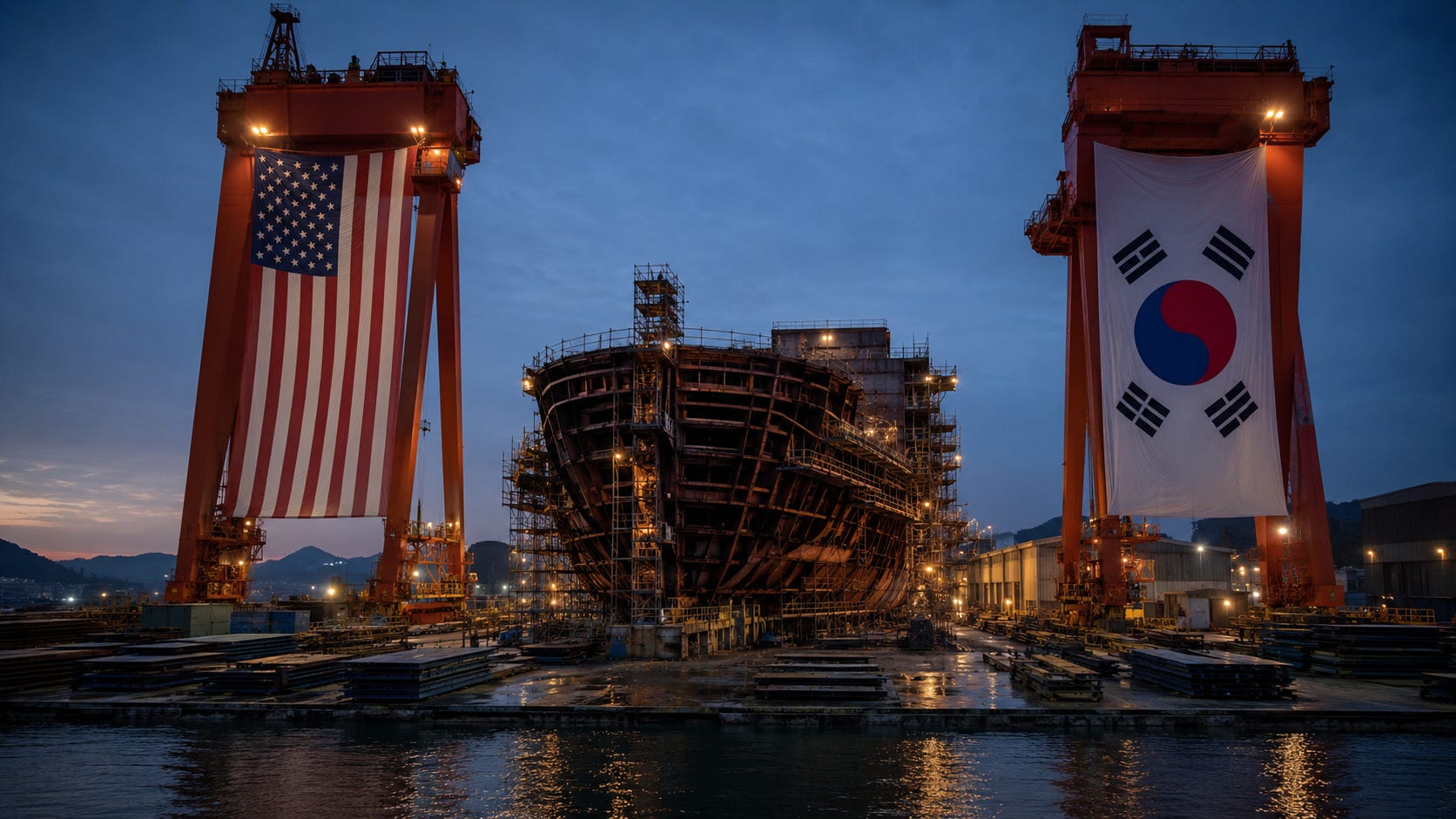
America can no longer build enough of its own ships, and MASGA is the receipt, written in Korean and worth $150 billion.
It is the most consequential shipbuilding story in the world right now, a deal that ties trade, tariffs, warships, tankers and the balance of power in the Pacific into one $150 billion knot. Here are the ten things you need to understand about it, from why it exists to who is building what and the one fight in Washington that could still sink it.
📋 In This Issue:
🛢️ The Story
📊 By The Numbers
🔍 Why It Matters
👀 What To Watch
🚨 Gosships Signal
🔔 Not Subscribed? Gosships Intelligence Delivers Oil Shipping Intelligence. Subscribe Here!
📊 Order Our Exclusive Report
→ Global Tanker Market Outlook Q3 2026 Edition
📋 Competency-Based Maritime Training
→ SwiftAction
📌 Gosships Data Card
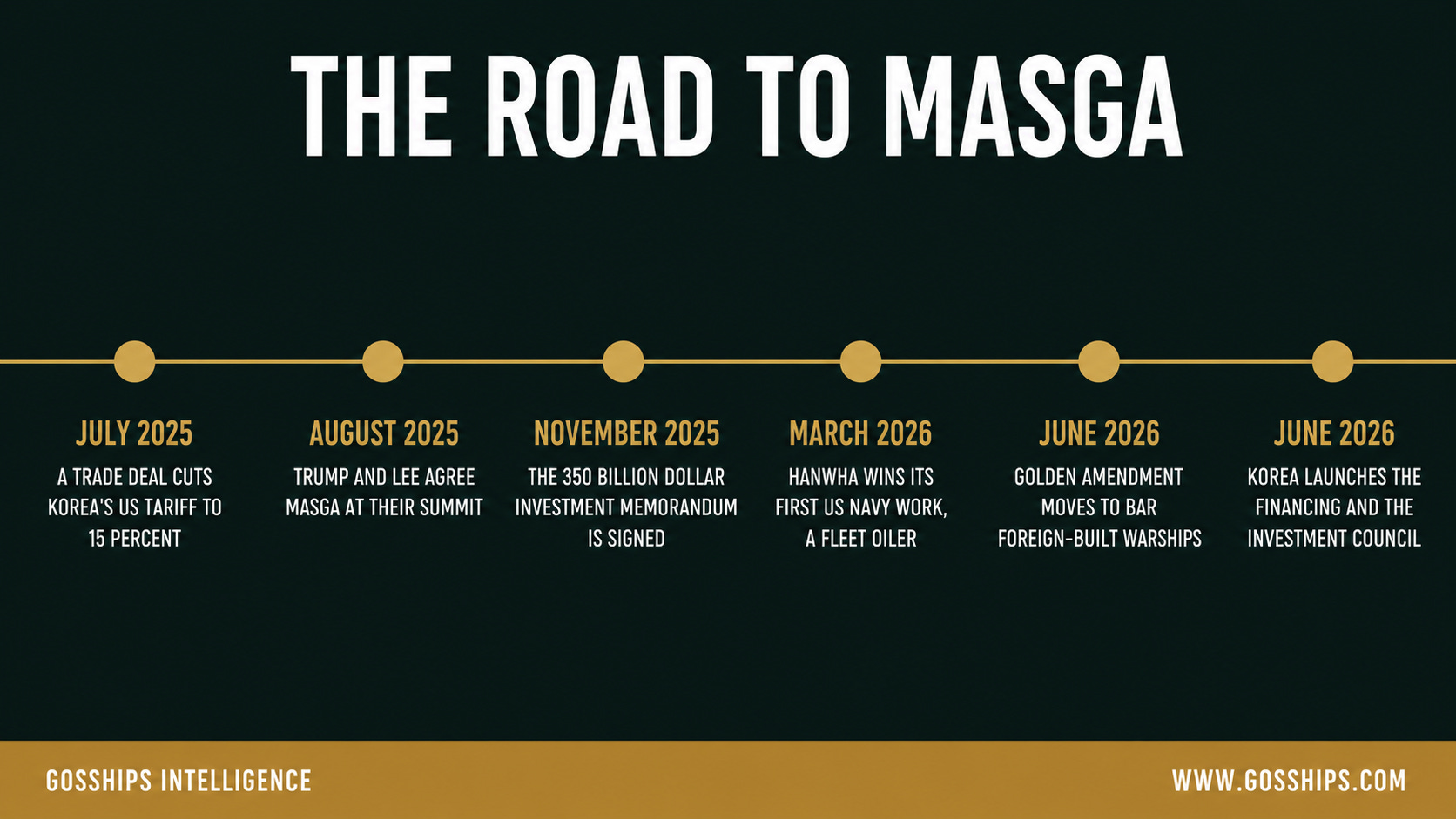
→ July 2025: A US-Korea trade deal cuts Korea’s tariff rate to 15 percent, setting the stage (The Diplomat; NBC News).
→ August 25, 2025: Trump and President Lee Jae-myung agree the MASGA partnership at their summit (NBC News).
→ November 2025: The two governments sign a strategic investment memorandum, $350 billion in total, $150 billion for shipbuilding (UPI; Korea Herald).
→ March 2026: Hanwha wins its first US Navy work, a subcontract on a fleet oiler (Korea Herald; Seoul Economic Daily).
→ June 5, 2026: Rep. Jared Golden’s amendment, barring FY2027 funds for foreign-built battle-force ships, clears the House Armed Services Committee (RealClearDefense).
→ June 25, 2026: Korea launches the policy-finance framework and a Korea-US Shipbuilding Cooperation Investment Council (UPI; Asia Business Daily).
🛢️ The Story
10 Points About MASGA:
1. What MASGA actually is:
MASGA stands for “Make American Shipbuilding Great Again,” a deliberate echo of Donald Trump’s own slogan, and it is the label South Korea itself attached to a $150 billion pledge to rebuild the American shipbuilding base. That $150 billion sits inside a broader $350 billion South Korean investment commitment to the United States. The money is meant to build and upgrade US shipyards, train American workers, rebuild the supply chains that feed a yard, and perform maintenance, repair and overhaul, known as MRO, on US Navy vessels. It sounds like an American program. It is a Korean one, anchored by the three giants of Korean shipbuilding: HD Hyundai, Samsung Heavy Industries and Hanwha Ocean.
2. It was born from a trade war, not goodwill:
In July 2025 the United States and South Korea struck a tariff deal that cut Korea’s US tariff rate to 15 percent. On August 25, 2025, President Trump and South Korean President Lee Jae-myung met and agreed the MASGA partnership, with Lee publicly promising to help “Make American Shipbuilding Great Again,” according to NBC News. The logic was transactional on both sides: Washington wanted Korea’s shipbuilding capacity, and Seoul wanted tariff relief and a deeper alliance. In November 2025 the two governments signed a strategic investment memorandum formalizing the framework, and the companies signed roughly 11 non-binding industrial agreements to begin turning the pledge into projects.
3. The real reason America agreed is a 232-to-1 gap:
America is not doing MASGA out of ambition. It is doing it out of fear, and the fear has a number: 232. A US Office of Naval Intelligence assessment, reported by outlets from Fox News to The War Zone, found that China’s shipyards hold roughly 232 times the shipbuilding capacity of the United States, about 23 million tons of annual capacity against under 100,000. China now accounts for close to half of all global shipbuilding capacity. The Secretary of the Navy put it in one line: a single Chinese shipyard has more capacity than every American shipyard combined.
4. China has already won the naval numbers race:
China’s People’s Liberation Army Navy is the largest on earth by hull count, more than 370 ships and submarines per the Pentagon’s China Military Power Report, and the Office of Naval Intelligence projects it will reach roughly 475 battle-force ships by 2035 against just 305 to 317 for the US. The American fleet has already slipped below 300, short of every target Washington has set, and a Government Accountability Office review found roughly 82 percent of the Navy’s ships under construction running behind schedule. The budget nearly doubled over two decades; the fleet shrank.
5. America cannot even fuel its own fleet:
This is where oil enters the story. The Chief of Naval Operations, Admiral Daryl Caudle, warned in March 2026 that the “fragility” of Military Sealift Command, the oilers, tankers and cargo ships that keep the Navy fed and fueled, could hold the Navy back from world-class status, calling it the center of gravity for any Indo-Pacific fight. The commercial picture is worse: the United States is the world’s largest LNG exporter, yet not one US yard builds an LNG carrier, and America launches only a handful of ocean-going commercial ships a year against China’s output of more than a thousand. The Navy’s own May 2026 Shipbuilding Plan finally cracked open the door to building ships overseas, and MASGA is the policy that walked through it.
6. The money is finally moving:
For most of a year MASGA was a memorandum. On June 25, 2026, Seoul launched the policy-finance framework that funds it: the new Korea-US Strategic Investment Corporation, four state-backed lenders and the three shipbuilders signed an MOU at the Export-Import Bank of Korea to share the early-stage risk, and the partners stood up a Korea-US Shipbuilding Cooperation Investment Council to pick projects and coordinate the financing. This is the machinery that turns a $150 billion headline into steel.
7. The three Korean giants have split the work:
Hanwha Group bought the Philadelphia shipyard, the largest commercial yard in the US, in December 2024, and has committed $5 billion to push it from about two ocean-going ships a year toward twenty, aiming to make it the first American yard to build LNG carriers. HD Hyundai is standing up a $5 billion fund with Cerberus Capital to buy and modernize more US yards. Samsung Heavy Industries has partnered with US firms on maintenance, modernization and construction. Two of the three are buying and rebuilding American industrial capacity outright.
8. Then it hit a wall in Congress:
On June 5, 2026, Representative Jared Golden’s amendment to the FY2027 National Defense Authorization Act cleared the House Armed Services Committee on a bipartisan 44-12 vote and headed to the House floor. It moves to bar any FY2027 Navy funds from being spent to procure a battle-force ship built in a foreign yard, in plain terms a ban on building US warships in Korea. The Senate carved out a narrow exception for up to two fuel and two sealift vessels, so the two chambers must now reconcile in conference. The tension is not abstract: Trump has pushed Seoul on whether Korea could “quickly build 10 naval vessels,” per KED Global, the exact order the amendment is written to block.
9. So the first ships are oilers, not warships:
The amendment does not touch MRO, commercial or logistics work, so that is where MASGA delivers first. Fittingly, the first US Navy work Hanwha won, in March 2026, was a subcontract on a fleet oiler, the Next Generation Logistics Ship, not a destroyer. And to keep hulls American-built while borrowing Korean design, all three giants have paired with US primes: Samsung Heavy and design house DSEC with General Dynamics NASSCO, HD Hyundai with Huntington Ingalls, and Hanwha with Leidos. The FY2027 bill itself is projected to seek about $1.85 billion to integrate and assess allied shipyards, led by South Korea.
10. The catch money cannot fix is people:
The US Navy Secretary said in January 2026 that American shipbuilding must hire roughly 250,000 workers this decade, and the Philadelphia yard has reported turnover near 100 percent. Korea and Japan lean on foreign labor to staff their yards, which collides with the Trump administration’s immigration stance, and skeptics from the Cato Institute onward argue the decline is structural, not something money or protectionism can quickly reverse. Whether MASGA is a genuine revival or an expensive rental of Korean capacity is the question the next year will answer, and the deeper analysis is below.
🔗 Related Coverage
The Three Korean Giants That Dominate Global Shipbuilding Just Made a $150 Billion Bet on America. A Law From 1920 Decides Whether It Pays Off.
MSC, COSCO, HMM and Other Container Giants Are Quietly Building Crude Tanker Fleets. What’s the Strategy?
The IMO Just Cleared the Path for the Autonomous Tanker. Owners Are Ordering 140 New Supertankers to Match.
America did not choose MASGA. The math chose it. But a 232-to-1 capacity gap, an amendment in Congress, and a workforce that no longer exists at scale all stand between the pledge and the ships. What that means for where the world’s tankers and LNG carriers get built, who wins, and the vote in Washington that could gut it, is below.
