


⚓ The Gosships Team
Gosships Intelligence Is Published At Gosships.com
For Sponsorship And Partnership Inquiries Contact intelligence@gosships.com
|⚓ About Us | 🛢️ Exclusive Report | 📋 SwiftAction Training |
🏅Black Gold Membership (*53 Slots Left)
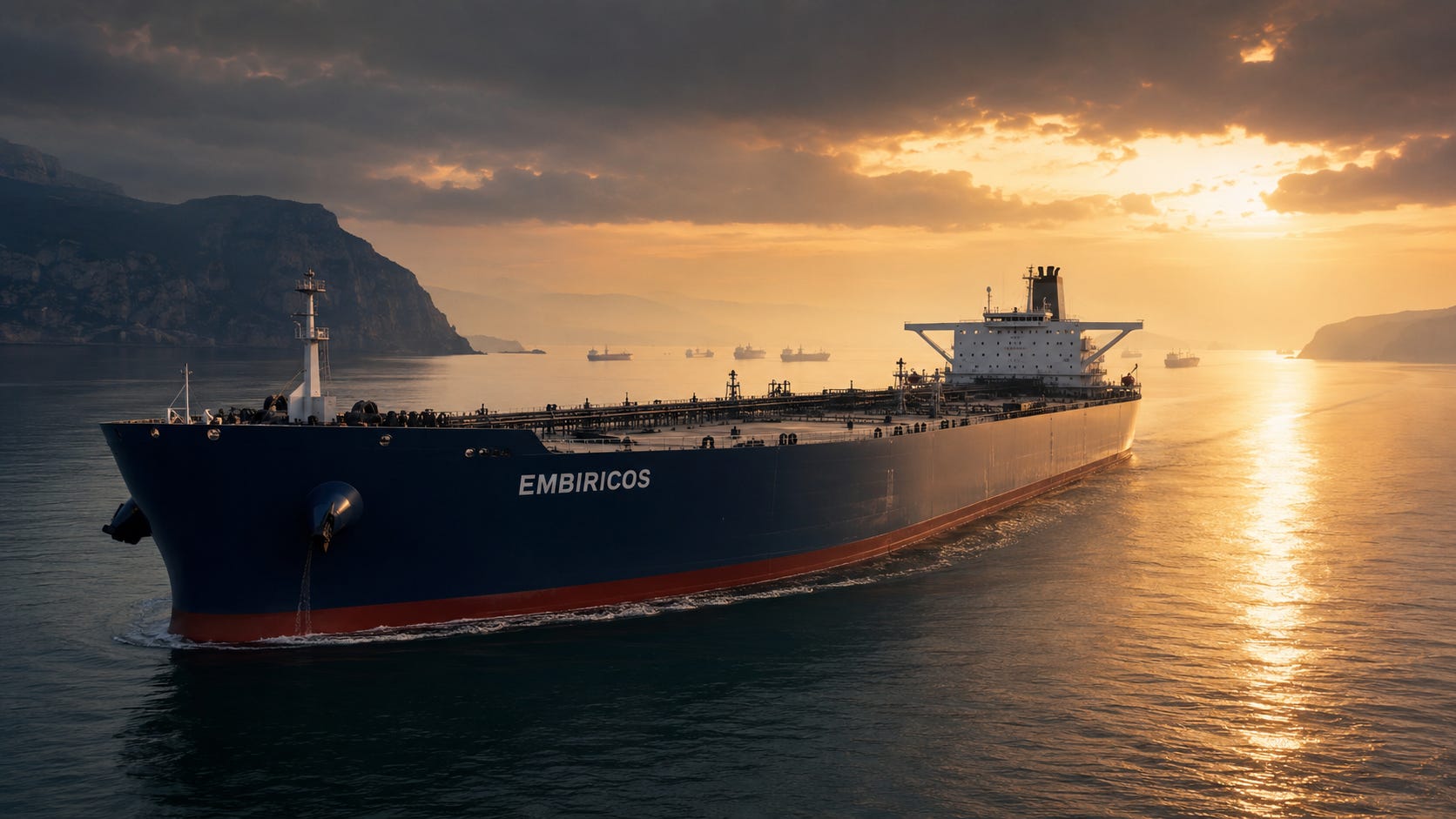
A single Greek-owned supertanker just earned more in a day than most ships earn in a week, and the number is almost hard to say out loud: 468,900 dollars. Embiricos, one of the oldest names in Greek shipping, banked that VLCC fixture as a handful of bold Greek owners began sailing back into the Persian Gulf, the one place most of the market is desperate to avoid. At that rate a supertanker claws back a real slice of its own price in a single voyage, and every dollar of it eventually rides into the price of the fuel that crude becomes. But here is the catch that makes this more than a number: much of the record Gulf rate is, in one analyst’s blunt word, imaginary. So is this the most profitable voyage in tanker history, or a mirage with a minefield under it?
📋 In This Issue:
🛢️ The Story
📊 By The Numbers
🔍 Why It Matters
👀 What To Watch
🚨 Gosships Signal
🔔 Not Yet Subscribed? Gosships Intelligence Delivers Oil Shipping Intelligence. Subscribe Here!
📊 Order Our Exclusive Report
→ Global Tanker Market Outlook Q3 2026 Edition
📋 Competency-Based Maritime Training
→ SwiftAction
📌 Gosships Data Card
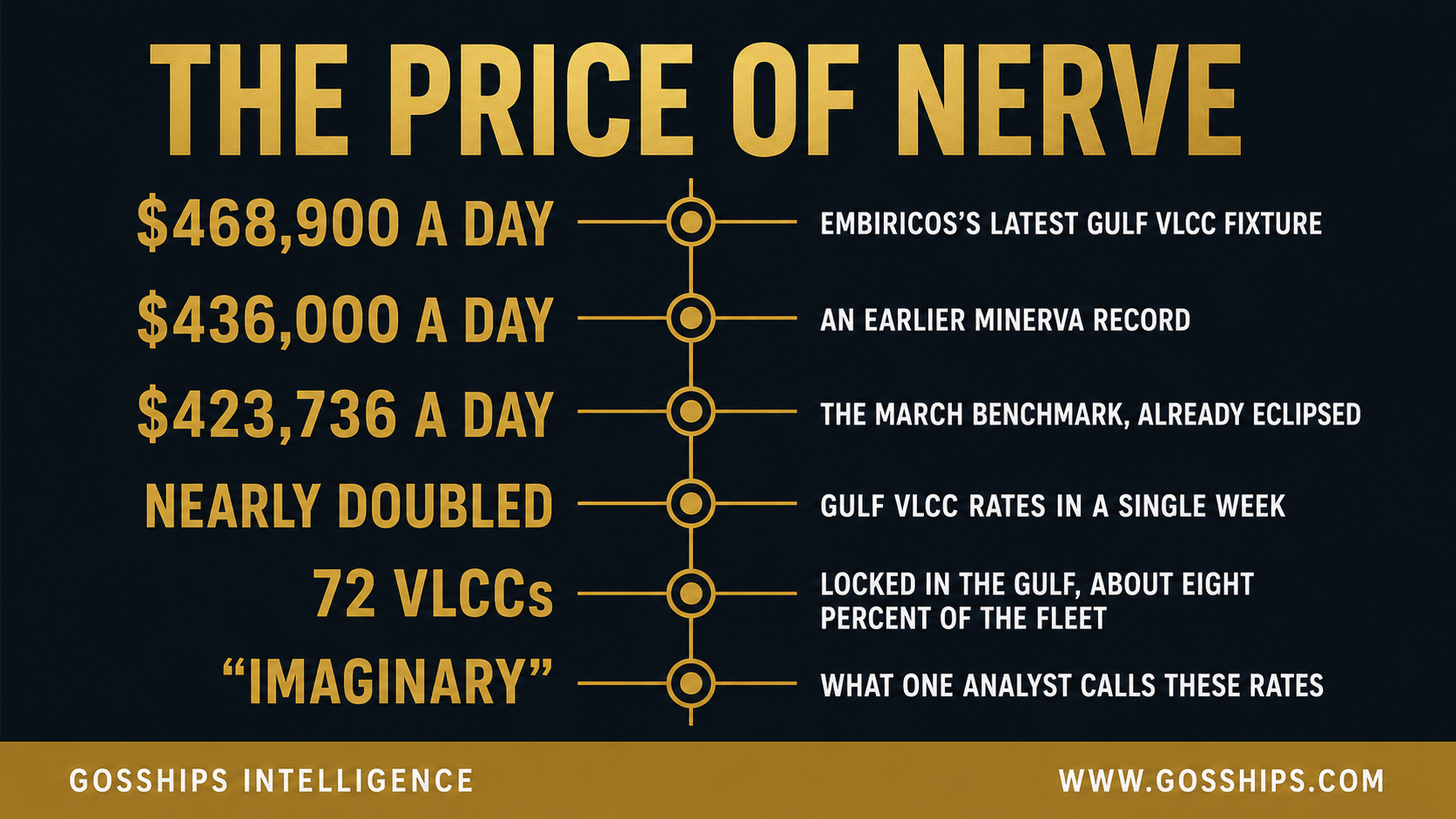
→ $468,900 A DAY - Embiricos’s latest Gulf VLCC fixture (TradeWinds)
→ $436,000 A DAY - An earlier Minerva record, reported at the time as a highest-ever spot rate (TradeWinds)
→ $423,736 A DAY - The March benchmark, already eclipsed
→ NEARLY DOUBLED - Gulf VLCC rates in a single week
→ 72 VLCCs - Locked in the Gulf, about eight percent of the global fleet
→ “IMAGINARY” - What a Signal Ocean analyst calls these rates
Sources: TradeWinds; Lloyd’s List; Seatrade Maritime.
🛢️ The Story
In a normal year a very large crude carrier earns somewhere between 30,000 and 60,000 dollars a day. This month a Greek owner banked nearly half a million. Embiricos, one of the oldest names in Greek shipping, fixed a VLCC at 468,900 dollars a day, a deal that, in TradeWinds’ words, marked “adventurous Greeks” trickling back into the Gulf. At that rate a single supertanker earns more in three weeks than it used to earn in a year and claws back a meaningful slice of its own newbuild price in one voyage. It is among the highest VLCC fixtures the market has ever seen. It is also not the strangest part of the story.
The records have been falling and re-setting almost faster than the market can track them. The benchmark Middle East VLCC rate first stunned brokers at 423,736 dollars a day in March. Then Minerva Marine’s 317,000-dwt Pantanassa was fixed at 436,000 dollars a day, reported by TradeWinds as the highest spot rate a VLCC had ever earned, a record so unstable that the initial charter collapsed and the ship was immediately re-fixed at an even higher rate. Embiricos's 468,900 belongs in that same rarefied band, where the hottest Greek fixtures have already pushed past half a million dollars a day and the wildest Gulf assessments have flirted with 700,000. Seatrade Maritime reports Hormuz VLCC rates fixing near 470,000 dollars a day after Gulf tanker rates nearly doubled in a single week, as charterers raced to lock in ships on a bet that the strait was about to reopen. The cause of the frenzy is brutally simple: scarcity. Lloyd’s List counts 329 crude and product tankers immobilized in the Middle East Gulf, including 72 VLCCs, roughly 8 percent of the world’s entire supertanker fleet, trapped or idled by the war.
The strange part is that the volumes are collapsing even as the rates explode. Lloyd’s List reports the Hormuz crisis has cut VLCC loadings out of the Gulf by roughly 36 percent, while the voyages that do happen run longer and more expensive. Fewer barrels are moving, yet every cargo that does move commands a fortune, because the ships willing to carry it have become the scarcest thing in the market. The split shows up inside the indexes themselves. Lloyd’s List notes that Middle East VLCC assessments are pinned near their all-time peak while Atlantic rates have started to sink, a divergence that tells you the Gulf number is being driven by fear and scarcity rather than by real, repeatable trade. Even the so-called floor is elevated. At one point the Gulf VLCC rate held at 100,000 dollars a day, more than double a healthy market, for the simple reason that almost no one would quote a ship at all.
This is where the story becomes unmistakably Greek. While most of the market fled the Gulf or sat at anchor waiting for the danger to pass, it is Greek owners who are sailing in to collect. Embiricos and Minerva are banking the headline fixtures, and Lloyd’s List reports Dynacom-controlled tonnage, the suezmaxes Pola and Smyrni and the 2018-built Marathi, ballasting west through Hormuz to line up for prompt Arabian Gulf cargoes. It is the oldest move in the Greek playbook. The great Greek fortunes were built by buying ships when everyone else was selling and sailing into danger when everyone else stayed home, through every tanker boom and chokepoint crisis since the 1950s. The Greeks did not come to own the largest share of the world’s tanker fleet by being cautious. They got there by being paid for nerve, and the Gulf in 2026 is the richest dare the market has offered in a generation.
And the freight is only one of the ways the Greeks are cashing this crisis. Splash247 reports Embiricos making a fortune selling VLCCs into the same frenzy, banking record asset prices for older ships even as the spot market runs white-hot. At the same time, Lloyd’s List reports Greek owners leading the global crude-tanker newbuilding order spree, locking in tomorrow’s fleet while shipyard slots are still available. Earn a fortune on today’s voyage, sell the aging hull at a record price, and order its replacement for delivery years out. It is the complete Greek playbook run across every part of the cycle at once, and it is the exact opposite of the caution that has frozen most of the rest of the market in place.
Except there is a catch hiding inside the headline number, and it is the most important thing in this story. Much of the record Gulf rate is, in the blunt words of a Signal Ocean analyst quoted by Lloyd’s List, imaginary. The Middle East VLCC indexes that throw off these jaw-dropping figures are not built on completed voyages. They are estimates of what a fully insured supertanker would charge to run the strait, built for stretches when no such voyage is even possible. The benchmark has posted six separate one-day moves of more than 100,000 dollars, swinging by a supertanker’s annual profit in a single afternoon. As Lloyd’s List explains, the figure persists precisely because the voyage it is pricing is, for the moment, one that almost no ship is actually making. The Atlantic VLCC indexes are anchored in real, completed fixtures. The Gulf indexes are, in large part, a number that panellists estimate. And yet that imagined number has very real effects, because freight derivatives and the tanker funds that track them are priced off it. Lloyd’s List notes that a tanker freight ETF builds most of its position from forward agreements priced off the very Middle East benchmark that, right now, almost no ship is actually transiting.
So which is it: a half-million-dollar payday or a mirage? The answer is both, and the difference is the willingness to sail. A rate is only real if a ship actually completes the voyage, and that is exactly the gap the Greeks are stepping into. By putting real hulls into the real Gulf, Embiricos, Minerva and Dynacom are converting the imaginary index into actual cash, capturing the enormous premium that exists precisely because almost no one else will take the transit. The risk is the mirror image of the reward. That 468,900-dollar day assumes the ship clears a strait that has been mined, declared closed, reopened and contested by turns, on a war-risk insurance bill that can run 6 to 10 million dollars for a single passage. The Greek bet is that the rate is real and the danger is survivable. If they are right, these are the most profitable voyages in the history of the trade. If the strait snaps shut behind them, the number on the fixture note is worth precisely nothing. What the world’s most aggressive owners can see that the rest of the market is missing, and whether a number this big can possibly hold, is below.
